
OET OET-RV OET-LV GHT ULT UST BSB MSB BLB AICNT OEB WEBBE WMBB NET LSV FBV TCNT T4T LEB BBE Moff JPS Wymth ASV DRA YLT Drby RV SLT Wbstr KJB-1769 KJB-1611 Bshps Gnva Cvdl TNT Wycl SR-GNT UHB BrLXX BrTr Related Parallel Simple Interlinear Topics Reference Dictionary Search
ParallelVerse GEN EXO LEV NUM DEU JOB JOS JDG RUTH 1 SAM 2 SAM PSA AMOS HOS 1 KI 2 KI 1 CHR 2 CHR PROV ECC SNG JOEL MIC ISA ZEP HAB JER LAM YNA (JNA) NAH OBA DAN EZE EZRA EST NEH HAG ZEC MAL LAO GES LES ESG DNG 2 PS TOB JDT WIS SIR BAR LJE PAZ SUS BEL MAN 1 MAC 2 MAC 3 MAC 4 MAC YHN (JHN) MARK MAT LUKE ACTs YAC (JAM) GAL 1 TH 2 TH 1 COR 2 COR ROM COL PHM EPH PHP 1 TIM TIT 1 PET 2 PET 2 TIM HEB YUD (JUD) 1 YHN (1 JHN) 2 YHN (2 JHN) 3 YHN (3 JHN) REV
2 Sam Intro C1 C2 C3 C4 C5 C6 C7 C8 C9 C10 C11 C12 C13 C14 C15 C17 C18 C19 C20 C21 C22 C23 C24
2 Sam 16 V1 V2 V3 V4 V5 V6 V7 V8 V10 V11 V12 V13 V14 V15 V16 V17 V18 V19 V20 V21 V22 V23
Note: This view shows ‘verses’ which are not necessarily natural language units and hence sometimes only part of a sentence will be visible—click on any Bible version abbreviation down the left-hand side to see the verse in more of its context. Normally the OET discourages the reading of individual ‘verses’, but this view is only designed as a tool for Bible-translators and others doing comparisons of different translations—the older translations are further down the page (so you can read up from the bottom to trace the English translation history). The OET segments on this page are still early looks into the drafted texts of the Open English Translation of the Bible—please double-check these texts in advance before using in public.
B I ◄ ← 2 Sam 16:9 ↓ → ► ≡ ═ ©
Text critical issues=none Clarity of original=clear Importance to us=normal Speaker(s)=Narrator,Abishai (All still tentative.)
OET (OET-RV) The Tseruyah’s son Abishai asked the king, “Why should this dead dog curse my master the king? Please, let me cross over and lop off his head.”
OET-LV And_ ʼAⱱīshay the_son_of Tsərūyāh/(Zeruiah) _he/it_said to the_king to/for_what the_dog (the)_dead the_this will_he_curse DOM my_master the_king let_me_pass_over please and_let_me_remove DOM his/its_head.
UHB וַיֹּ֨אמֶר אֲבִישַׁ֤י בֶּן־צְרוּיָה֙ אֶל־הַמֶּ֔לֶךְ לָ֣מָּה יְקַלֵּ֞ל הַכֶּ֤לֶב הַמֵּת֙ הַזֶּ֔ה אֶת־אֲדֹנִ֖י הַמֶּ֑לֶךְ אֶעְבְּרָה־נָּ֖א וְאָסִ֥ירָה אֶת־רֹאשֽׁוֹ׃ס ‡
(vayyoʼmer ʼₐⱱīshay ben-ʦərūyāh ʼel-hammelek lāmmāh yəqallēl hakkeleⱱ hammēt hazzeh ʼet-ʼₐdoniy hammelek ʼeˊbərāh-nāʼ vəʼāşirāh ʼet-roʼshō.§)
Key: khaki:verbs.
Note: Automatic aligning of the OET-RV to the LV is done by some temporary software, hence the OET-RV alignments are incomplete (and may occasionally be wrong).
BrLXX Καὶ εἶπεν Ἀβεσσὰ υἱὸς Σαρουίας πρὸς τὸν βασιλέα, ἱνατί καταρᾶται ὁ κύων ὁ τεθνηκὼς οὗτος τὸν κύριόν μου τὸν βασιλέα; διαβήσομαι δὴ καὶ ἀφελῶ τὴν κεφαλὴν αὐτοῦ.
(Kai eipen Abessa huios Sarouias pros ton basilea, hinati kataratai ho kuōn ho tethnaʸkōs houtos ton kurion mou ton basilea; diabaʸsomai daʸ kai afelō taʸn kefalaʸn autou.)
BrTr And Abessa the son of Saruia said to the king, Why does this dead dog curse my lord the king? let me go over now and take off his head.
ULT And Abishai the son of Zeruiah said to the king, “Why should this dead dog curse my lord the king? Please, let me go over and let me remove his head.”
UST Then Abishai said to the king, “Your Majesty, this man is as worthless as a dead dog! You should not allow him to curse you! Permit me to go over there and cut off his head!”
BSB & MSB Then Abishai son of Zeruiah said to the king, “Why should this dead dog curse my lord the king? Let me go over and cut off his head!”
OEB No OEB SA2 16:9 book available
WEBBE & WMBB Then Abishai the son of Zeruiah said to the king, “Why should this dead dog curse my lord the king? Please let me go over and take off his head.”
NET Then Abishai son of Zeruiah said to the king, “Why should this dead dog curse my lord the king? Let me go over and cut off his head!”
LSV And Abishai son of Zeruiah says to the king, “Why does this dead dog revile my lord the king? Please let me pass over and I turn aside his head.”
FBV Abishai, son of Zeruiah, asked the king, “Why should this dead dog curse Your Majesty? Let me go and cut off his head!”
T4T Then Abishai said to the king, “Your Majesty, this man is as worthless as [MET] a dead dog! ◄Why should he be allowed to curse you?/He should not be allowed to curse you.► [RHQ] Allow me to go over there and cut off his head!”
LEB Then Abishai the son of Zeruiah said to the king, “Why should this dead dog curse my lord the king? Please let me go over and take off his head.”
BBE Then Abishai, the son of Zeruiah, said to the king, Is this dead dog to go on cursing my lord the king? let me go over and take off his head.
Moff No Moff SA2 16:9 book available
JPS Then said Abishai the son of Zeruiah unto the king: 'Why should this dead dog curse my lord the king? let me go over, I pray thee, and take off his head.'
ASV Then said Abishai the son of Zeruiah unto the king, Why should this dead dog curse my lord the king? let me go over, I pray thee, and take off his head.
DRA And Abisai the son of Sarvia said to the king: Why should this dead dog curse my lord the king? I will go, and cut off his head.
YLT And Abishai son of Zeruiah saith unto the king, 'Why doth this dead dog revile my lord the king? let me pass over, I pray thee, and I turn aside his head.'
Drby And Abishai the son of Zeruiah said to the king, Why should this dead dog curse my lord the king? let me go over, I pray thee, and take off his head.
RV Then said Abishai the son of Zeruiah unto the king, Why should this dead dog curse my lord the king? let me go over, I pray thee, and take off his head.
(Then said Abishai the son of Zeruiah unto the king, Why should this dead dog curse my lord the king? let me go over, I pray thee/you, and take off his head.)
SLT And Abishai son of Zeruiah will say to the king, Wherefore shall this dead dog curse my lord the king? I will pass over now and take away his head.
Wbstr Then said Abishai the son of Zeruiah to the king, Why should this dead dog curse my lord the king? let me go over, I pray thee, and take off his head.
KJB-1769 ¶ Then said Abishai the son of Zeruiah unto the king, Why should this dead dog curse my lord the king? let me go over, I pray thee, and take off his head.
(¶ Then said Abishai the son of Zeruiah unto the king, Why should this dead dog curse my lord the king? let me go over, I pray thee/you, and take off his head.)
KJB-1611 ¶ Then said Abishai the sonne of Zeruiah vnto the king, Why should this dead dogge curse my lord the king? let mee goe ouer, I pray thee, and take off his head.
(Modernised spelling is same as from KJB-1769 above)
Bshps Then sayde Abisai the sonne of Zaruia vnto the king: Why doth this dead dogge curse my lord the king? let me go nowe, and take of the head of him.
(Then said Abishai the son of Zaruia unto the king: Why doeth/does this dead dog curse my lord the king? let me go now, and take of the head of him.)
Gnva Then saide Abishai the sonne of Zeruiah vnto the King, Why doeth this dead dog curse my lord the King? let me goe, I pray thee, and take away his head.
(Then said Abishai the son of Zeruiah unto the King, Why doeth/does this dead dog curse my lord the King? let me go, I pray thee/you, and take away his head.)
Cvdl But Abisai the sonne of Zeru Ia sayde vnto the kynge: Shall this deed dogg curse my lorde the kynge? I wyl go and take the heade awaye from him.
(But Abishai the son of Zeru Ya said unto the king: Shall this deed dog curse my lord the king? I will go and take the head away from him.)
Wycl Forsothe Abisay, the sone of Saruye, seide to the kyng, Whi cursith this dogge, that schal die, my lord the kyng? Y schal go, and Y schal girde of his heed.
(For_certain/Truly Abishai, the son of Saruye, said to the king, Why curseth/curses this dog, that shall die, my lord the king? I shall go, and I shall gird of his heed.)
Luth Aber Abisai, der Sohn Zerujas, sprach zu dem Könige: Sollte dieser tote Hund meinem Herrn, dem Könige, fluchen? Ich will hingehen und ihm den Kopf abreißen.
(But Abishai, the/of_the son Zeruiah’s, spoke to/for to_him king(s): Should this tote dog my Lord, to_him king(s), curse(v)? I will go_there and him the head(n) tear_down.)
ClVg Dixit autem Abisai filius Sarviæ regi: Quare maledicit canis hic mortuus domino meo regi? vadam, et amputabo caput ejus.[fn]
(He/She_said however Abishai son Zeruiah to_rule: Why curses dog this/here dead master/dominate mine to_rule? I_will_go, and I_will_amputate the_head his/her.)
16.9 Quid mihi? Solus Abisai dixerat: Vadam et amputabo. Et David Abisai et Joab respondit: Quid mihi? Nunquid vultis interficere istum sicut interfecistis Abner? Dimittite. GREG. lib. XXX Moral., cap. 9. Qui verborum contumeliis pressus virtutem patientiæ servare non potest vel sufficit, etc., usque ad quarum interventu, Deo judice, pœna gravior declinatur.
16.9 What to_me? Alone Abishai had_said: I_will_go and I_will_amputate. And David Abishai and Yoab answered: What to_me? It_is_true you_want to_kill that like you(pl)_killed Abner? Forgive_me. GREG. lib. 20X Moral., chapter. 9. Who of_words insults pressed virtue patience to_keep not/no can or enough, etc., until to whose intervention, to_God judge, punishment heavier is_declined.
Note 1 topic: figures-of-speech / rquestion
לָ֣מָּה יְקַלֵּ֞ל הַכֶּ֤לֶב הַמֵּת֙ הַזֶּ֔ה אֶת־אֲדֹנִ֖י הַמֶּ֑לֶךְ
(Some words not found in UHB: and=he/it_said ʼAⱱīshay son_of Tsərūyāh/(Zeruiah) to/towards the=king to/for=what curse the,dog (the),dead the=this DOM my=master the=king go_over please and,let_me_remove DOM his/its=head )
Abishai is using the question form for emphasis to express his outrage that Shimei would curse King David. If a speaker of your language would not use the question form for that purpose, you could translate this as a statement or as an exclamation. Alternate translation: [This dead dog should not be cursing my lord the king!]
Note 2 topic: figures-of-speech / metaphor
הַכֶּ֤לֶב הַמֵּת֙
(Some words not found in UHB: and=he/it_said ʼAⱱīshay son_of Tsərūyāh/(Zeruiah) to/towards the=king to/for=what curse the,dog (the),dead the=this DOM my=master the=king go_over please and,let_me_remove DOM his/its=head )
See how you translated the similar expression in [9:5](../09/05.md). Alternate translation: [contemptible person]
Note 3 topic: figures-of-speech / 123person
אֶת־אֲדֹנִ֖י הַמֶּ֑לֶךְ
DOM my=master DOM (Some words not found in UHB: and=he/it_said ʼAⱱīshay son_of Tsərūyāh/(Zeruiah) to/towards the=king to/for=what curse the,dog (the),dead the=this DOM my=master the=king go_over please and,let_me_remove DOM his/its=head )
Even though Abishai is addressing David directly, he is speaking of him in the third person as my lord the king to show respect. If it would be helpful in your language, you could translate this in a respectful form in the second person. Alternate translation: [you, my lord the king]
2 Samuel 15-16
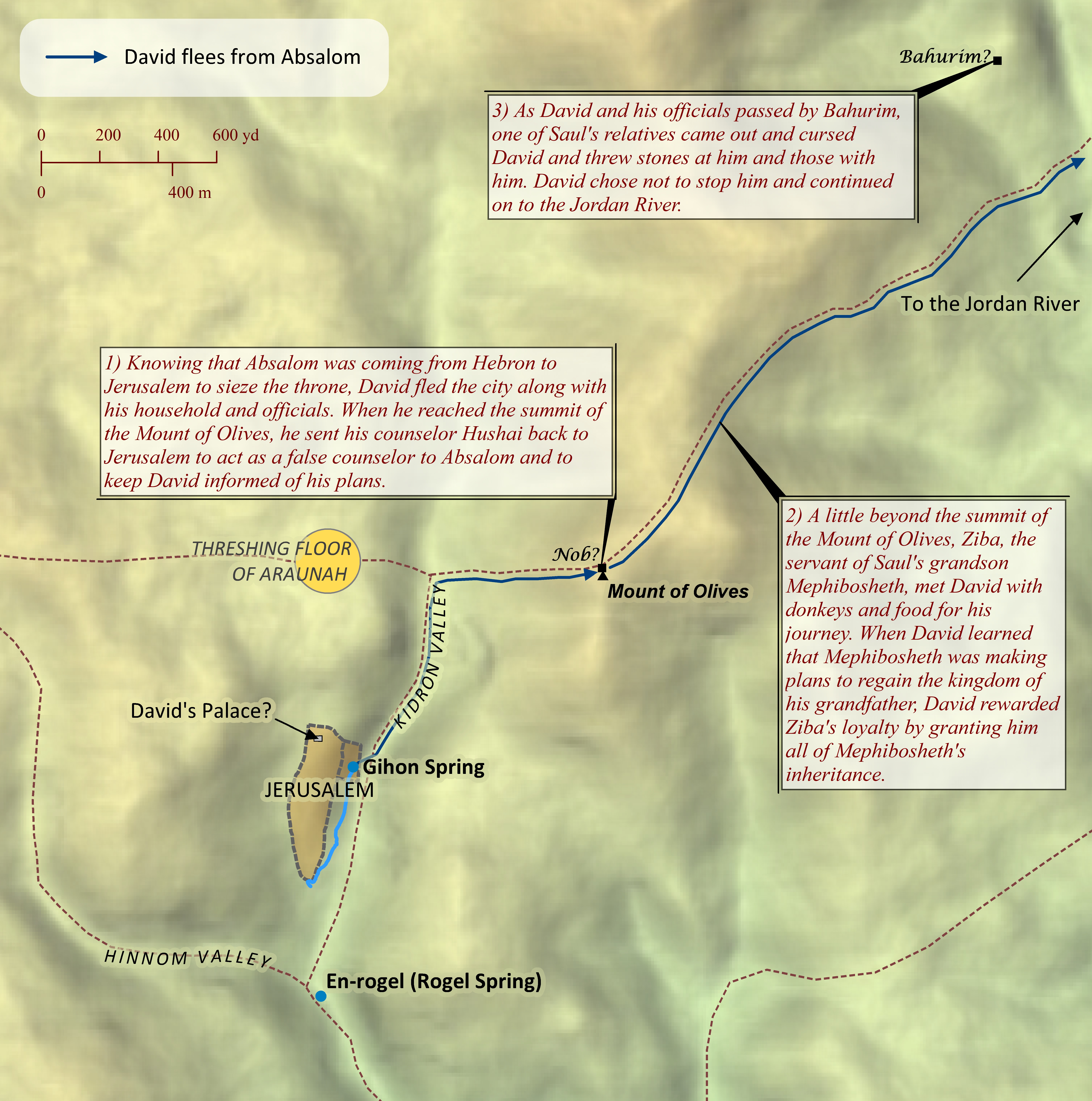
Several years after killing his half brother Amnon and his brothers, Absalom was reconciled to his father David (2 Samuel 13-14). Then Absalom spent the next four years grooming the people of Israel to favor him over his father, all in preparation to eventually rebel against his father’s rule. When it appeared to Absalom that the time had finally come to act on his plan, he staged a coup in the town of Hebron about 19 miles (30 km) south of Jerusalem. A messenger came to David and told him that the people of Israel had declared Absalom king, and David chose to flee Jerusalem with his household and many of his officials. They left the city and crossed the Kidron Valley to take the road that went up the Mount of Olives before heading toward Jericho and the Jordan Valley much further east. When he reached the summit of the Mount of Olives, he sent his counselor Hushai back to Jerusalem to act as a false counselor to Absalom and to keep David informed of his plans. Interestingly, 2 Samuel 15:32 notes that the summit of the Mount of Olives was “where God was worshiped.” Sometime during the ministry of Samuel, the Philistines defeated the Israelites in battle at Ebenezer near Aphek and captured the Ark of the Covenant. They took it to Ashdod, Gath, and Ekron but eventually returned it to Israel, where the Ark was then taken to Kiriath-jearim (1 Samuel 4-5; also see “The Ark of the Covenant Is Captured and Returned” map). After the battle, the worship center of Shiloh appears to have been overrun as well (Psalm 78:60; Jeremiah 7:12-14; 26:6). Many of the priests apparently relocated to the town of Nob near Jerusalem, perhaps on the summit of the Mount of Olives (1 Samuel 22:11; Isaiah 10:32; see “The Ark of the Covenant in the Promised Land” map), while the Tabernacle and altar were relocated to the High Place at Gibeon/Gibeah (1 Chronicles 16:39-40; 21:29; see “David Transports the Ark of the Covenant to Jerusalem” map). A little beyond the summit of the Mount of Olives, Ziba, the servant of Saul’s grandson Mephibosheth, met David with donkeys and food for his journey. When David learned that Mephibosheth was making plans to regain the kingdom of his grandfather, David rewarded Ziba’s loyalty by granting him all of Mephibosheth’s inheritance. As David and his officials passed by Bahurim, one of Saul’s relatives came out and cursed David and threw stones at him and those with him. David chose not to stop him and continued on to the Jordan River (see also “Absalom Rebels against David” map).
Open Bible Data site copyright © 2023–2026 Freely-Given.org.
Python source code for creating these static pages is available on GitHub under an open licence.
For Bible data copyrights, see the details for each displayed Bible version.
The Open English Translation (OET) main site is at OpenEnglishTranslation.Bible or OET.Bible.