
OET OET-RV OET-LV GHT ULT UST BSB MSB BLB AICNT OEB WEBBE WMBB NET LSV FBV TCNT T4T LEB BBE Moff JPS Wymth ASV DRA YLT Drby RV SLT Wbstr KJB-1769 KJB-1611 Bshps Gnva Cvdl TNT Wycl SR-GNT UHB BrLXX BrTr Related Parallel Simple Interlinear Topics Reference Dictionary Search
ParallelVerse GEN EXO LEV NUM DEU JOB JOS JDG RUTH 1 SAM 2 SAM PSA AMOS HOS 1 KI 2 KI 1 CHR 2 CHR PROV ECC SNG JOEL MIC ISA ZEP HAB JER LAM YNA (JNA) NAH OBA DAN EZE EZRA EST NEH HAG ZEC MAL LAO GES LES ESG DNG 2 PS TOB JDT WIS SIR BAR LJE PAZ SUS BEL MAN 1 MAC 2 MAC 3 MAC 4 MAC YHN (JHN) MARK MAT LUKE ACTs YAC (JAM) GAL 1 TH 2 TH 1 COR 2 COR ROM COL PHM EPH PHP 1 TIM TIT 1 PET 2 PET 2 TIM HEB YUD (JUD) 1 YHN (1 JHN) 2 YHN (2 JHN) 3 YHN (3 JHN) REV
2 Sam Intro C1 C2 C3 C4 C5 C6 C7 C8 C9 C10 C11 C12 C13 C14 C16 C17 C18 C19 C20 C21 C22 C23 C24
2 Sam 15 V2 V3 V4 V5 V6 V7 V8 V9 V10 V11 V12 V13 V14 V15 V16 V17 V18 V19 V20 V21 V22 V23 V24 V25 V26 V27 V28 V29 V30 V31 V32 V33 V34 V35 V36 V37
Note: This view shows ‘verses’ which are not necessarily natural language units and hence sometimes only part of a sentence will be visible—click on any Bible version abbreviation down the left-hand side to see the verse in more of its context. Normally the OET discourages the reading of individual ‘verses’, but this view is only designed as a tool for Bible-translators and others doing comparisons of different translations—the older translations are further down the page (so you can read up from the bottom to trace the English translation history). The OET segments on this page are still early looks into the drafted texts of the Open English Translation of the Bible—please double-check these texts in advance before using in public.
B I ◄ ↨ 2 Sam 15:1 ↓ → ► ≡ ═ ©
Text critical issues=none Clarity of original=clear Importance to us=normal Speaker(s)=Narrator (All still tentative.)
OET (OET-RV) Sometime after all that, Abshalom acquired a chariot and horses and hired fifty men to run ahead of him.
OET-LV and_he/it_was from_after thus and_he/it_made to_him/it ʼAⱱīshālōm a_chariot and_horses and_fifty man who_ran before_him.
UHB וַֽיְהִי֙ מֵאַ֣חֲרֵי כֵ֔ן וַיַּ֤עַשׂ לוֹ֙ אַבְשָׁל֔וֹם מֶרְכָּבָ֖ה וְסֻסִ֑ים וַחֲמִשִּׁ֥ים אִ֖ישׁ רָצִ֥ים לְפָנָֽיו׃ ‡
(vayəhī mēʼaḩₐrēy kēn vayyaˊas lō ʼaⱱshālōm merkāⱱāh vəşuşim vaḩₐmishshim ʼiysh rāʦim ləfānāyv.)
Key: khaki:verbs.
Note: Automatic aligning of the OET-RV to the LV is done by some temporary software, hence the OET-RV alignments are incomplete (and may occasionally be wrong).
BrLXX Καὶ ἐγένετο μετὰ ταῦτα καὶ ἐποίησεν ἑαυτῷ Ἀβεσσαλὼμ ἅρματα, καὶ ἵππους, καὶ πεντήκοντα ἄνδρας παρατρέχειν ἔμπροσθεν αὐτοῦ.
(Kai egeneto meta tauta kai epoiaʸsen heautōi Abessalōm harmata, kai hippous, kai pentaʸkonta andras paratreⱪein emprosthen autou.)
BrTr And it came to pass after this that Abessalom [fn]prepared for himself chariots and horses, and fifty men to run before him.
15:1 Gr. made.
ULT And it happened after this that Absalom made for himself a chariot and horses and 50 men running to his face.
UST Soon afterwards, Absalom got a chariot and horses to pull it. He hired 50 men to run in front of him while he was riding around Jerusalem in the chariot.
BSB & MSB Some time later, Absalom provided for himself a chariot with horses and fifty men to run ahead of him.
OEB No OEB SA2 15:1 book available
WEBBE & WMBB After this, Absalom prepared a chariot and horses for himself, and fifty men to run before him.
NET Some time later Absalom managed to acquire a chariot and horses, as well as fifty men to serve as his royal guard.
LSV And it comes to pass afterward that Absalom prepares a chariot and horses for himself, and fifty men are running before him;
FBV Sometime later, Absalom got himself a chariot with horses, and fifty men as bodyguards to run ahead of him.
T4T Some time later, Absalom acquired a chariot and horses to pull it. He hired 50 men to run in front of him to honor him while he was riding around Jerusalem in the chariot.
LEB It happened afterward that Absalom made himself a chariot with horses and fifty men running before him.
BBE Now after this, Absalom got for himself a carriage and horses, and fifty runners to go before him.
Moff No Moff SA2 15:1 book available
JPS And it came to pass after this, that Absalom prepared him a chariot and horses, and fifty men to run before him.
ASV And it came to pass after this, that Absalom prepared him a chariot and horses, and fifty men to run before him.
DRA Now after these things Absalom made himself chariots, and horsemen, and fifty men to run before him.
YLT And it cometh to pass afterwards, that Absalom prepareth for himself a chariot, and horses, and fifty men are running before him;
Drby And it came to pass after this, that Absalom prepared for himself chariots and horses, and fifty men to run before him.
RV And it came to pass after this, that Absalom prepared him a chariot and horses, and fifty men to run before him.
SLT And it will be from after this, and Absalom will make to him chariots and horses, and fifty men running before him.
Wbstr And it came to pass after this, that Absalom prepared him chariots and horses, and fifty men to run before him.
KJB-1769 And it came to pass after this, that Absalom prepared him chariots and horses, and fifty men to run before him.
KJB-1611 ¶ And it came to passe after this, that Absalom prepared him charets and horses, and fiftie men to runne before him.
(Modernised spelling is same as from KJB-1769 above, apart from punctuation)
Bshps After this, Absalo prepared him charettes & horses, and fiftie men to runne before him.
(After this, Absalo prepared him chariots and horses, and fifty men to run before him.)
Gnva After this, Absalom prepared him charets and horses, and fiftie men to runne before him.
(After this, Absalom prepared him chariots and horses, and fifty men to run before him.)
Cvdl And after this it fortuned that Absalom caused to prepare himselfe chearettes and horses, and fyftye men, which were his fote me.
(And after this it fortuned that Absalom caused to prepare himself chariots and horses, and fifty men, which were his footmen.)
Wycl Therfor aftir these thingis Absolon made a chaar to hym, and knyytis, and fifti men, that schulden go bifor hym.
(Therefore after these things Absalom made a chariot to him, and knights/warriors, and fifty men, that should go before him.)
Luth Und es begab sich danach, daß Absalom ließ ihm machen Wagen und Rosse und fünfzig Mann, die seine Trabanten waren.
(And it gifted itself/yourself/themselves after/thereafter/then, that Absalom left/let him make wagon/cart/chariot and horses and fifty man, the his guards were.)
ClVg Igitur post hæc fecit sibi Absalom currus, et equites, et quinquaginta viros qui præcederent eum.[fn]
(Therefore after these_things he_did to_himself Absalom chariot/coach, and horsemen, and fifty men who/which they_would_precede him.)
15.1 Igitur post. Duobus annis mansit in Hierusalem et regem non vidit, tertio introductus est coram rege, quarto fecit sibi currus et equites: quo transacto expulit patrem de regno. Nec pro seductione et interfectione sacerdotum ejectus est de regno, sed pro adulterio et homicidio, Nathan cuncta prædicente.
15.1 Therefore post. For_two years remained in/into/on Yerusalem and the_king not/no he_saw, third introduced it_is before king, quarto he_did to_himself chariot/coach and horsemen: where completed expelled father from/about kingdom. Neither for deception and killing priests cast_out it_is from/about kingdom, but for adultery and murder, Nathan everything preaching.
Note 1 topic: writing-newevent
וַֽיְהִי֙ מֵאַ֣חֲרֵי כֵ֔ן
and=he/it_was from,after so
The author is using this expression to introduce a new development in the story. Use a word, phrase, or other method in your language that is natural for introducing a new development.
Note 2 topic: translate-symaction
וַחֲמִשִּׁ֥ים אִ֖ישׁ רָצִ֥ים לְפָנָֽיו
(Some words not found in UHB: and=he/it_was from,after so and=he/it_made to=him/it ʼAⱱīshālōm chariot and,horses and,fifty (a)_man run before,,him )
Having 50 men run ahead of his chariot to clear the way and announce his coming was a symbolic action by which Absalom asserted his importance. If it would be helpful to your readers, you could explain the significance of this action. Alternate translation: [and he had 50 men run ahead of his chariot to show how important he was]
Note 3 topic: figures-of-speech / metonymy
לְפָנָֽיו
before,,him
Here, to his face represents “ahead of him.” If it would be helpful in your language, you could use an equivalent expression or plain language. Alternate translation: [ahead of him]
2 Samuel 15-16
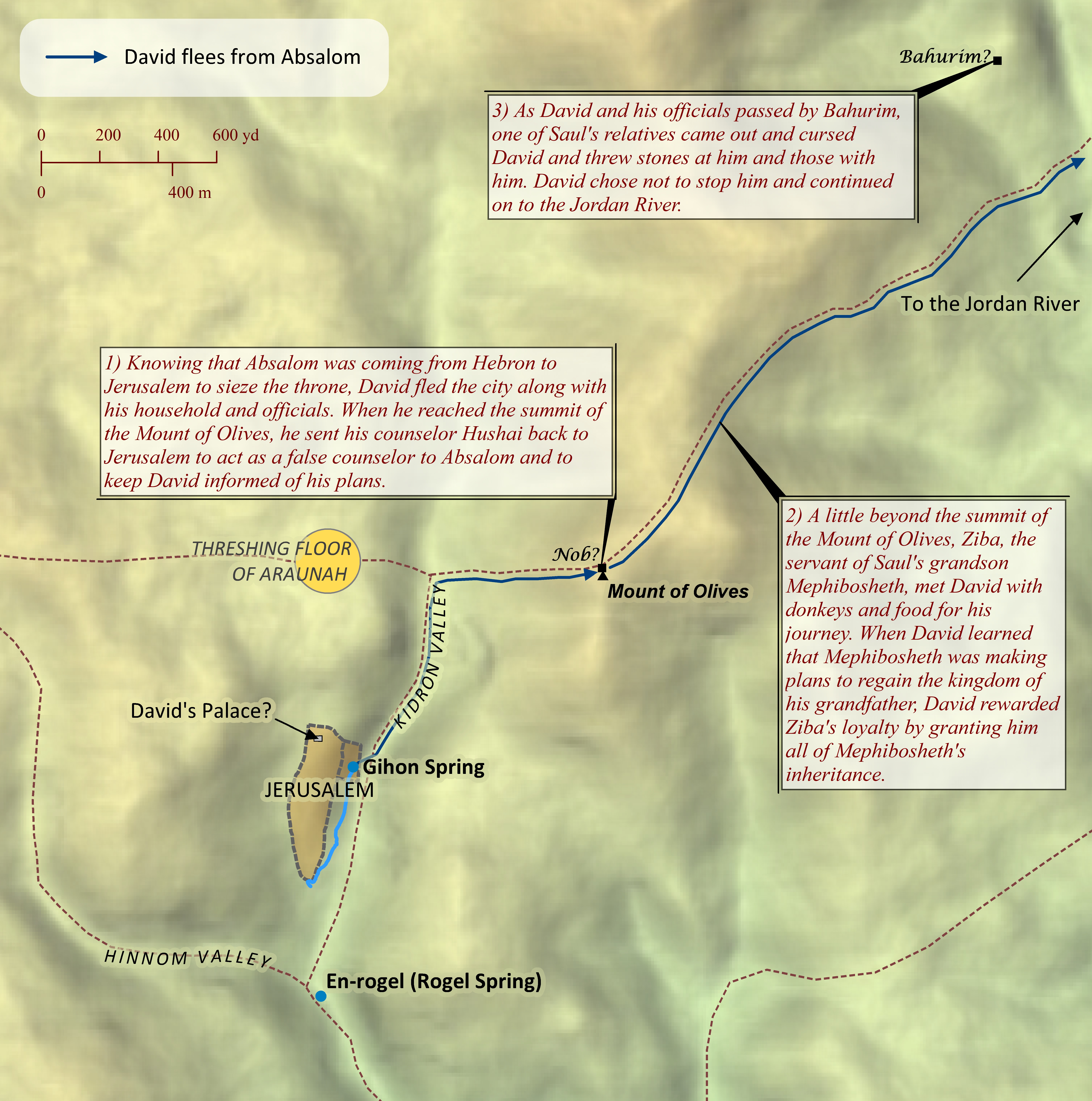
Several years after killing his half brother Amnon and his brothers, Absalom was reconciled to his father David (2 Samuel 13-14). Then Absalom spent the next four years grooming the people of Israel to favor him over his father, all in preparation to eventually rebel against his father’s rule. When it appeared to Absalom that the time had finally come to act on his plan, he staged a coup in the town of Hebron about 19 miles (30 km) south of Jerusalem. A messenger came to David and told him that the people of Israel had declared Absalom king, and David chose to flee Jerusalem with his household and many of his officials. They left the city and crossed the Kidron Valley to take the road that went up the Mount of Olives before heading toward Jericho and the Jordan Valley much further east. When he reached the summit of the Mount of Olives, he sent his counselor Hushai back to Jerusalem to act as a false counselor to Absalom and to keep David informed of his plans. Interestingly, 2 Samuel 15:32 notes that the summit of the Mount of Olives was “where God was worshiped.” Sometime during the ministry of Samuel, the Philistines defeated the Israelites in battle at Ebenezer near Aphek and captured the Ark of the Covenant. They took it to Ashdod, Gath, and Ekron but eventually returned it to Israel, where the Ark was then taken to Kiriath-jearim (1 Samuel 4-5; also see “The Ark of the Covenant Is Captured and Returned” map). After the battle, the worship center of Shiloh appears to have been overrun as well (Psalm 78:60; Jeremiah 7:12-14; 26:6). Many of the priests apparently relocated to the town of Nob near Jerusalem, perhaps on the summit of the Mount of Olives (1 Samuel 22:11; Isaiah 10:32; see “The Ark of the Covenant in the Promised Land” map), while the Tabernacle and altar were relocated to the High Place at Gibeon/Gibeah (1 Chronicles 16:39-40; 21:29; see “David Transports the Ark of the Covenant to Jerusalem” map). A little beyond the summit of the Mount of Olives, Ziba, the servant of Saul’s grandson Mephibosheth, met David with donkeys and food for his journey. When David learned that Mephibosheth was making plans to regain the kingdom of his grandfather, David rewarded Ziba’s loyalty by granting him all of Mephibosheth’s inheritance. As David and his officials passed by Bahurim, one of Saul’s relatives came out and cursed David and threw stones at him and those with him. David chose not to stop him and continued on to the Jordan River (see also “Absalom Rebels against David” map).
Open Bible Data site copyright © 2023–2026 Freely-Given.org.
Python source code for creating these static pages is available on GitHub under an open licence.
For Bible data copyrights, see the details for each displayed Bible version.
The Open English Translation (OET) main site is at OpenEnglishTranslation.Bible or OET.Bible.