
OET OET-RV OET-LV GHT ULT UST BSB MSB BLB AICNT OEB WEBBE WMBB NET LSV FBV TCNT T4T LEB BBE Moff JPS Wymth ASV DRA YLT Drby RV SLT Wbstr KJB-1769 KJB-1611 Bshps Gnva Cvdl TNT Wycl SR-GNT UHB BrLXX BrTr Related Parallel Simple Interlinear Topics Reference Dictionary Search
ParallelVerse GEN EXO LEV NUM DEU JOB JOS JDG RUTH 1 SAM 2 SAM PSA AMOS HOS 1 KI 2 KI 1 CHR 2 CHR PROV ECC SNG JOEL MIC ISA ZEP HAB JER LAM YNA (JNA) NAH OBA DAN EZE EZRA EST NEH HAG ZEC MAL LAO GES LES ESG DNG 2 PS TOB JDT WIS SIR BAR LJE PAZ SUS BEL MAN 1 MAC 2 MAC 3 MAC 4 MAC YHN (JHN) MARK MAT LUKE ACTs YAC (JAM) GAL 1 TH 2 TH 1 COR 2 COR ROM COL PHM EPH PHP 1 TIM TIT 1 PET 2 PET 2 TIM HEB YUD (JUD) 1 YHN (1 JHN) 2 YHN (2 JHN) 3 YHN (3 JHN) REV
Luke Intro C1 C2 C3 C4 C5 C6 C7 C8 C9 C10 C11 C12 C13 C14 C15 C16 C17 C18 C19 C20 C21 C23 C24
Luke 22 V1 V4 V7 V10 V13 V16 V19 V22 V25 V28 V31 V34 V37 V40 V43 V46 V49 V52 V55 V58 V61 V64 V67 V70
Note: This view shows ‘verses’ which are not necessarily natural language units and hence sometimes only part of a sentence will be visible—click on any Bible version abbreviation down the left-hand side to see the verse in more of its context. Normally the OET discourages the reading of individual ‘verses’, but this view is only designed as a tool for Bible-translators and others doing comparisons of different translations—the older translations are further down the page (so you can read up from the bottom to trace the English translation history). The OET segments on this page are still early looks into the drafted texts of the Open English Translation of the Bible—please double-check these texts in advance before using in public.
B I ◄ ← Luke 22:11 ↓ → ► ≡ ═ ©
Text critical issues=small word differences Clarity of original=clear Importance to us=normal Speaker(s)=Yeshua (All still tentative.)
OET (OET-RV) Then tell the home-owner that the teacher wants to know where the guest room is so that he can eat the Passover meal with his apprentices
OET-LV And you_all_will_be_saying to_the home_owner of_the house:
The teacher is_saying to_you:
Where is the guest_room, where I_may_eat the passover_feast with the apprentices/followers of_me?
SR-GNT Καὶ ἐρεῖτε τῷ οἰκοδεσπότῃ τῆς οἰκίας, ‘Λέγει σοι ὁ διδάσκαλος, “Ποῦ ἐστιν τὸ κατάλυμα, ὅπου τὸ Πάσχα μετὰ τῶν μαθητῶν μου φάγω;” ’ ‡
(Kai ereite tōi oikodespotaʸ taʸs oikias, ‘Legei soi ho didaskalos, “Pou estin to kataluma, hopou to Pasⱪa meta tōn mathaʸtōn mou fagō;” ’)
Key: khaki:verbs, light-green:nominative/subject, orange:accusative/object, pink:genitive/possessor, cyan:dative/indirect object.
Note: Automatic aligning of the OET-RV to the LV is done by some temporary software, hence the RV alignments are incomplete (and may occasionally be wrong).
GHT and you-will-say to {the house-ruler} of {the home}, 'The teacher is-saying to {you}, "Where[?] is-being the loose-down-effect/lodging which-where I-may-eat the passover alongside of {the disciples} of {me}[?],"'
ULT And say to the master of the house, ‘The Teacher says to you, “Where is the guest room where I may eat the Passover with my disciples?” ’
UST Say to the owner of the house, ‘Our teacher says to show us the room where he can eat the Passover meal together with us, his disciples.’
BSB & MSB and say to the owner of that house, ‘The Teacher asks: Where is the guest room, where I may eat the Passover with My disciples?’
BLB and you shall say to the master of the house, 'The Teacher says to you, "Where is the guest room, where I may eat the Passover with My disciples?"'
AICNT And you will say to the master of the house, ‘The Teacher says [to you],[fn] “Where is {the}[fn] guest room where I may eat the Passover with my disciples?” ’
22:11, to you: Absent from some manuscripts D(05) Syriac(sys syc syp).
22:11, the: Some manuscripts read “my.” ℵ(01).
OEB and you will say to the owner of the house “The teacher says to you – Where is the room where I am to eat the Passover with my disciples?”
WEBBE Tell the master of the house, ‘The Teacher says to you, “Where is the guest room, where I may eat the Passover with my disciples?” ’
WMBB Tell the master of the house, ‘The Rabbi says to you, “Where is the guest room, where I may eat the Passover with my disciples?” ’
NET and tell the owner of the house, ‘The Teacher says to you, “Where is the guest room where I may eat the Passover with my disciples?” ’
LSV and you will say to the master of the house, The Teacher says to you, Where is the guest-chamber where I may eat the Passover with My disciples?
FBV Tell the owner of the house that the Teacher asks you, ‘Where is the dining room where I can eat the Passover with my disciples?’
TCNT and say to the master of the house, ‘The Teacher asks yoʋ, “Where is the guest room where I can eat the Passover with my disciples?” ’
T4T tell the owner of the house, ‘Our teacher says that we(exc) should ask you(sg) to please show us the room that he arranged with you where he can eat the Passover meal with us, his disciples [RHQ].’
LEB And you will say to the master of the house, ‘The Teacher says to you, “Where is the guest room where I may eat the Passover with my disciples?” ’
BBE And say to the master of the house, The Master says, Where is the guest-room, where I may take the Passover with my disciples?
Moff and tell the owner of the house, "The Teacher asks you, Where is the room in which I can eat the passover with my disciples?"
Wymth and say to the master of the house, "`The Rabbi asks you, Where is the room where I can eat the Passover with my disciples?'
ASV And ye shall say unto the master of the house, The Teacher saith unto thee, Where is the guest-chamber, where I shall eat the passover with my disciples?
DRA And you shall say to the goodman of the house: The master saith to thee, Where is the guest chamber, where I may eat the pasch with my disciples?
YLT and ye shall say to the master of the house, The Teacher saith to thee, Where is the guest-chamber where the passover with my disciples I may eat?
Drby and ye shall say to the master of the house, The Teacher says to thee, Where is the guest-chamber where I may eat the passover with my disciples?
RV And ye shall say unto the goodman of the house, The Master saith unto thee, Where is the guest-chamber, where I shall eat the passover with my disciples?
(And ye/you_all shall say unto the master of the house, The Master saith/says unto thee/you, Where is the guest-chamber/room, where I shall eat the passover with my disciples?)
SLT And ye shall say to the master of the house, The Teacher says to thee, Where is the room where I should eat the pascha with my disciples?
Wbstr And ye shall say to the master of the house, The Master saith to thee, Where is the guest-chamber, where I may eat the passover with my disciples?
KJB-1769 And ye shall say unto the goodman of the house, The Master saith unto thee, Where is the guestchamber, where I shall eat the passover with my disciples?
( And ye/you_all shall say unto the master of the house, The Master saith/says unto thee/you, Where is the guest-chamber/room, where I shall eat the passover with my disciples?)
KJB-1611 And yee shall say vnto the goodman of the house, The Master saith vnto thee, Where is the ghest-chamber where I shall eate the Passeouer with my disciples?
(Modernised spelling is same as from KJB-1769 above, apart from capitalisation and punctuation)
Bshps And ye shall say vnto the good man of the house, the maister saith vnto thee, where is the ghest chamber, where I shall eate ye Passouer with my disciples?
(And ye/you_all shall say unto the master of the house, the master saith/says unto thee/you, where is the guest chamber/room, where I shall eat ye/you_all Passover with my disciples?)
Gnva And say vnto the good man of the house, The Master saith vnto thee, Where is the lodging where I shall eate my Passeouer with my disciples?
(And say unto the master of the house, The Master saith/says unto thee/you, Where is the lodging where I shall eat my Passover with my disciples?)
Cvdl and saye vnto the good man of the house: The master sendeth ye worde: Where is ye gesthouse, wherin I maye eate the Easter labe with my disciples?
(and say unto the master of the house: The master sendeth/sends ye/you_all word: Where is ye/you_all guesthouse, wherein I may eat the Easter/Passover lamb with my disciples?)
TNT and saye vnto the good man of the housse. The master sayeth vnto the: where is the gest chamber where I shall eate myne ester lambe with my disciples?
(and say unto the master of the house. The master saith/says unto them: where is the guest chamber/room where I shall eat mine Easter/Passover lamb with my disciples?)
Wycl And ye schulen seie to the hosebonde man of the hous, The maister seith to thee, Where is a chaumbre, where Y schal ete the pask with my disciplis?
(And ye/you_all should say to the husband man of the house, The master saith/says to thee/you, Where is a chamber/room, where I shall eat the passover with my disciples?)
Luth und saget zu dem Hausherrn: Der Meister läßt dir sagen: Wo ist die Herberge, darinnen ich das Osterlamm essen möge mit meinen Jüngern?
(and says to/for to_him master_of_the_house: The master lets you/to_you(sg) say: Where is the hostel/lodgings, therein I the Easter/Passover_lamb eat may with my disciples?)
ClVg et dicetis patrifamilias domus: Dicit tibi Magister: Ubi est diversorium, ubi pascha cum discipulis meis manducem?
(and you_will_say head_of_household home: He_says to_you Teacher/Master: Where it_is inn, where passover when/with students mine I_will_eat?)
UGNT καὶ ἐρεῖτε τῷ οἰκοδεσπότῃ τῆς οἰκίας, λέγει σοι ὁ διδάσκαλος, ποῦ ἐστιν τὸ κατάλυμα, ὅπου τὸ Πάσχα μετὰ τῶν μαθητῶν μου φάγω?
(kai ereite tōi oikodespotaʸ taʸs oikias, legei soi ho didaskalos, pou estin to kataluma, hopou to Pasⱪa meta tōn mathaʸtōn mou fagō?)
SBL-GNT καὶ ἐρεῖτε τῷ οἰκοδεσπότῃ τῆς οἰκίας· Λέγει σοι ὁ διδάσκαλος· Ποῦ ἐστιν τὸ κατάλυμα ὅπου τὸ πάσχα μετὰ τῶν μαθητῶν μου φάγω;
(kai ereite tōi oikodespotaʸ taʸs oikias; Legei soi ho didaskalos; Pou estin to kataluma hopou to pasⱪa meta tōn mathaʸtōn mou fagō;)
RP-GNT Καὶ ἐρεῖτε τῷ οἰκοδεσπότῃ τῆς οἰκίας, Λέγει σοι ὁ διδάσκαλος, Ποῦ ἐστιν τὸ κατάλυμα, ὅπου τὸ Πάσχα μετὰ τῶν μαθητῶν μου φάγω;
(Kai ereite tōi oikodespotaʸ taʸs oikias, Legei soi ho didaskalos, Pou estin to kataluma, hopou to Pasⱪa meta tōn mathaʸtōn mou fagō;)
TC-GNT καὶ ἐρεῖτε τῷ οἰκοδεσπότῃ τῆς οἰκίας, Λέγει σοι ὁ διδάσκαλος, Ποῦ ἐστι τὸ κατάλυμα, ὅπου τὸ Πάσχα μετὰ τῶν μαθητῶν μου φάγω;
(kai ereite tōi oikodespotaʸ taʸs oikias, Legei soi ho didaskalos, Pou esti to kataluma, hopou to Pasⱪa meta tōn mathaʸtōn mou fagō;)
Key for above GNTs: yellow:punctuation differs, red:words differ (from our SR-GNT base).
This section begins on “the Day of Unleavened Bread.” On that day the Jewish people had to remove from their houses all “leaven” (yeast) and any bread or other food that was made with yeast. Also on that day, each family had to sacrifice a lamb for the Passover meal. In the context of sacrifice, people could refer to any of these lambs as “the Passover” without adding the word “lamb.” For example, see Exodus 12:21 and Deuteronomy 16:2. This is similar to its use in 1 Corinthians 5:7: “Christ our Passover is sacrificed for us.”
Luke, Paul, and other New Testament writers implied that the lamb that was sacrificed on Passover symbolized the fact that Jesus offered himself as a sacrifice to save people from slavery to sin. Jesus knew that during the time of the festival, he himself would become a sacrifice. He would become the “Lamb of God who takes away the sin of the world” (John 1:29).
In this section, Jesus sent two disciples to make preparations for the Passover celebration.
There are parallel passages for this section in Matthew 26:17–25, Mark 14:12–21, and John 13:21–30. Examples of other headings for this section are:
The Preparation of the Passover (NRSV)
Jesus makes arrangements for his last Passover with his disciples (JBP)
In this verse Jesus told Peter and John to ask the owner of the house a question. Jesus told them the words of the question as a direct quote. In some languages it may be more natural to use indirect speech. See the General Comment on 22:11a–d at the end of 22:11c–d for examples.
and say to the owner of that house,
Then say this to the person who owns the house:
Give the owner of the house this message from me:
Speak to the owner of the house and tell him that
say to the owner of that house: Here Jesus told Peter and John to say something to the owner of the house. The owner of that house is a different person from the man whom they would follow.
Some other ways to translate this part of the verse are:
Go/Speak to the person who owns that house. Say to him
and tell the owner of the house (NCV)
and say to the owner (GNT)
‘The Teacher asks:
‘The Teacher says,
‘Our Teacher gave us(dual/excl) a message for you(sing).
I, the Teacher, request
The Teacher asks: The Greek phrase that the BSB translates as The Teacher asks is more literally “The Teacher says.” Jesus was telling Peter and John how to introduce his request to the owner. He implied that the owner already knew him as “the Teacher.” The context also implies that the owner would not be surprised by the request. Introduce the request in a natural way in your language. Some other ways to do this are:
I, the Teacher ask/request you to…
Our teacher gave us this message for you:
The Teacher would like to know
The Teacher: The Greek word that the BSB translates as Teacher was a polite title for a Jewish religious leader. When the two disciples used the title The Teacher here, the owner of the house knew that they were referring to Jesus. For more help in translating this term, see the note on 18:18a.
Where is the guest room,
‘Where is the room
He would like you to show us(dual/excl) your(sing) guest room
that he show you(dual) the room for visitors
where I may eat the Passover with My disciples?’
where my disciples and I may/will eat the Passover feast?’
so that we(dual/excl) can prepare it for him to eat the meal for the Death Passed Us By Feast there with his followers.’
in which you(dual) and I and my other disciples may eat the Passover meal together.
Where is the guest room, where I may eat the Passover with My disciples?: This is a rhetorical question. Jesus used it to make a request. He wanted the owner of the house to show Peter and John the room where he and his disciples would eat the Passover. It was a polite way to ask to see the room so that they could prepare for the Passover meal there. Some ways to translate this request are:
As a rhetorical question. For example:
Would you show us the room where my disciples and I will eat the Passover?
As a request or polite command. For example:
Please show us the guest room where my disciples and I may eat the Passover meal.
Take my messengers to the guest room where I will eat the Passover meal with my disciples.
Use an appropriate way to translate this request in your language.
guest room: The Greek word that the BSB translates as guest room is a general word that can refer to different types of rooms for guests. Jesus may have arranged with this man ahead of time to have the Passover meal with his disciples in this guest room. They were planning to eat in the room but not to sleep there. In 22:12 the room is described in more detail as large and furnished. Here in 22:11 it may be more natural in many languages to use a general term. For example:
room (GNT)
place
eat the Passover: A similar phrase “to eat the Passover” occurred in 22:8. See how you translated it there.
with My disciples: Here the phrase My disciples refers to Jesus’ twelve closest disciples, who were also called apostles. It does not refer only to Peter and John.
In this verse Luke was quoting what Jesus said to his disciples. Jesus quoted the question that he wanted them to ask the house owner in direct speech. This results in a complex embedding of quotes. Consider how you would communicate a message like this in your language. Some other ways to translate it are:
Then say to the man who owns the house, “The Teacher wants to know where he can eat the Passover meal with his disciples.”
Then tell the man who owns the house that I, the Teacher, am asking where I can eat the Passover meal with my disciples.
Use a clear and natural way in your language to repeat the message that Jesus gave Peter and John for the house owner.
Note 1 topic: figures-of-speech / quotesinquotes
ἐρεῖτε τῷ οἰκοδεσπότῃ τῆς οἰκίας, λέγει σοι ὁ διδάσκαλος, ποῦ ἐστιν τὸ κατάλυμα, ὅπου τὸ Πάσχα μετὰ τῶν μαθητῶν μου φάγω
˱you_all˲_˓will_be˒_saying ˱to˲_the home_owner ˱of˲_the house ˓is˒_saying (Some words not found in SR-GNT: Καί ἐρεῖτε τῷ οἰκοδεσπότῃ τῆς οἰκίας λέγει σοί Ὁ διδάσκαλος Ποῦ ἐστίν τό κατάλυμα ὅπου τό Πάσχα μετά τῶν μαθητῶν μού φάγω)
If it would be helpful in your language, you could translate this so that there is not a quotation within a quotation and then another quotation within that one. Alternate translation: [tell the owner of the house that the Teacher wants to know where the guest room is where he can eat the Passover meal with his disciples]
ὁ διδάσκαλος
(Some words not found in SR-GNT: Καί ἐρεῖτε τῷ οἰκοδεσπότῃ τῆς οἰκίας λέγει σοί Ὁ διδάσκαλος Ποῦ ἐστίν τό κατάλυμα ὅπου τό Πάσχα μετά τῶν μαθητῶν μού φάγω)
Teacher is a respectful title for Jesus. You could translate it with an equivalent term that your language and culture would use.
Note 2 topic: figures-of-speech / metonymy
τὸ Πάσχα
(Some words not found in SR-GNT: Καί ἐρεῖτε τῷ οἰκοδεσπότῃ τῆς οἰκίας λέγει σοί Ὁ διδάσκαλος Ποῦ ἐστίν τό κατάλυμα ὅπου τό Πάσχα μετά τῶν μαθητῶν μού φάγω)
Jesus is telling Peter and John to use the name of this part of the festival, Passover, to refer to the meal that people shared on that occasion. Alternate translation: [the Passover meal]
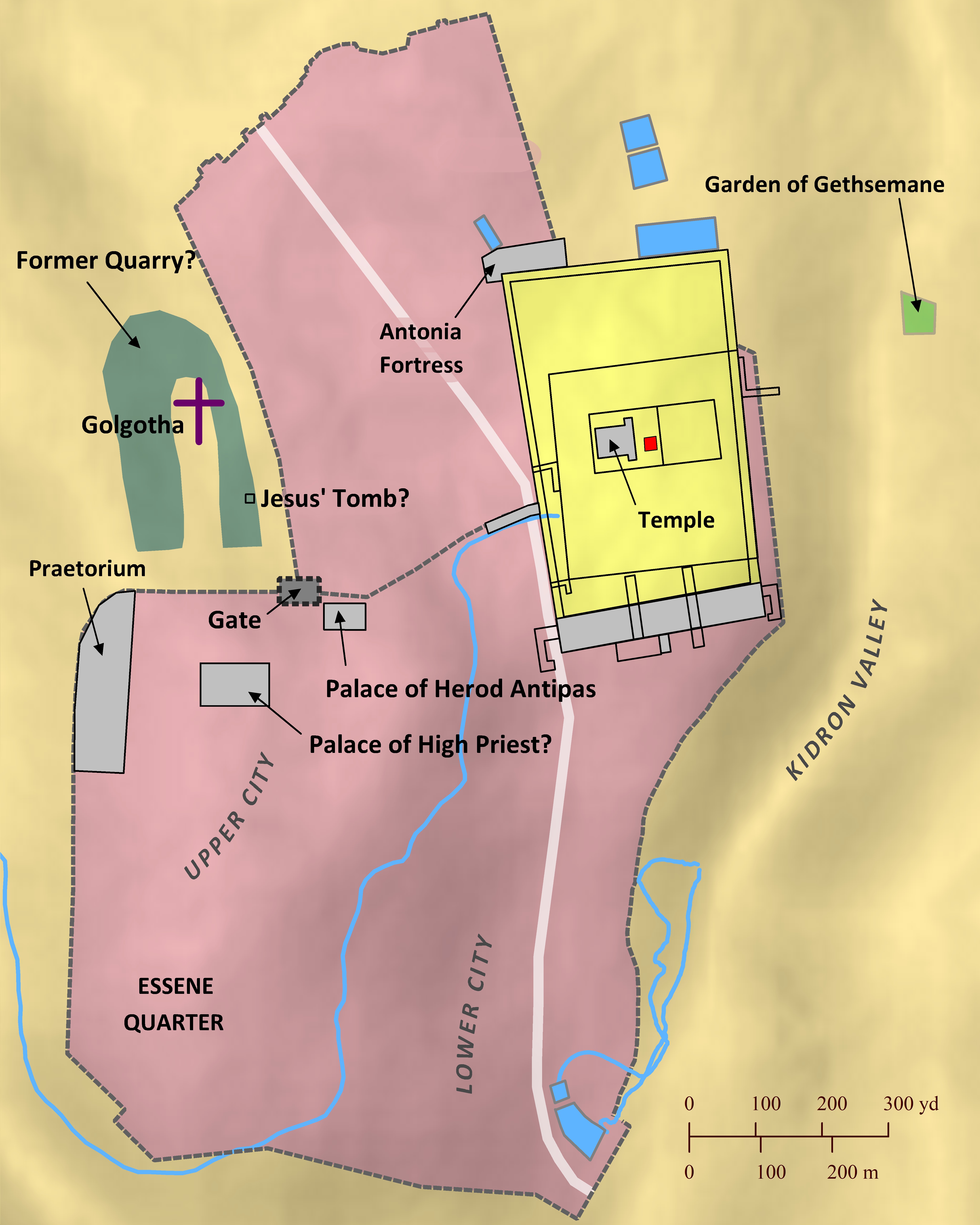
Matthew 26-27; Mark 14-15; Luke 22-23; John 13-19
On the Thursday before he was crucified, Jesus had arranged to share the Passover meal with his disciples in an upper room, traditionally thought to be located in the Essene Quarter of Jerusalem. After they finished the meal, they went to the Garden of Gethsemane, where Jesus often met with his disciples. There Judas Iscariot, one of Jesus’ own disciples, betrayed him to soldiers sent from the High Priest, and they took Jesus to the High Priest’s residence. In the morning the leading priests and teachers of the law put Jesus on trial and found him guilty of blasphemy. The council sent Jesus to stand trial for treason before the Roman governor Pontius Pilate, who resided at the Praetorium while in Jerusalem. The Praetorium was likely located at the former residence of Herod the Great, who had died over 30 years earlier. When Pilate learned that Jesus was from Galilee, he sent him to Herod Antipas, who had jurisdiction over Galilee. But when Jesus gave no answer to Herod’s many questions, Herod and his soldiers sent him back to Pilate, who conceded to the people’s demands that Jesus be crucified. Jesus was forced to carry his cross out of the city gate to Golgotha, meaning Skull Hill, referring to what may have been a small unquarried hill in the middle of an old quarry just outside the gate. After Jesus was unable to carry his cross any further, a man named Simon from Cyrene was forced to carry it for him. There at Golgotha they crucified Jesus. After Jesus died, his body was hurriedly taken down before nightfall and placed in a newly cut, rock tomb owned by Joseph of Arimathea, a member of the Jewish high council. This tomb was likely located at the perimeter of the old quarry.
Open Bible Data site copyright © 2023–2026 Freely-Given.org.
Python source code for creating these static pages is available on GitHub under an open licence.
For Bible data copyrights, see the details for each displayed Bible version.
The Open English Translation (OET) main site is at OpenEnglishTranslation.Bible or OET.Bible.