¶ “Well, you’re all saying that I am,” he said.

OET OET-RV OET-LV GHT ULT UST BSB MSB BLB AICNT OEB WEBBE WMBB NET LSV FBV TCNT T4T LEB BBE Moff JPS Wymth ASV DRA YLT Drby RV SLT Wbstr KJB-1769 KJB-1611 Bshps Gnva Cvdl TNT Wycl SR-GNT UHB BrLXX BrTr Related Parallel Simple Interlinear Topics Reference Dictionary Search
ParallelVerse GEN EXO LEV NUM DEU JOB JOS JDG RUTH 1 SAM 2 SAM PSA AMOS HOS 1 KI 2 KI 1 CHR 2 CHR PROV ECC SNG JOEL MIC ISA ZEP HAB JER LAM YNA (JNA) NAH OBA DAN EZE EZRA EST NEH HAG ZEC MAL LAO GES LES ESG DNG 2 PS TOB JDT WIS SIR BAR LJE PAZ SUS BEL MAN 1 MAC 2 MAC 3 MAC 4 MAC YHN (JHN) MARK MAT LUKE ACTs YAC (JAM) GAL 1 TH 2 TH 1 COR 2 COR ROM COL PHM EPH PHP 1 TIM TIT 1 PET 2 PET 2 TIM HEB YUD (JUD) 1 YHN (1 JHN) 2 YHN (2 JHN) 3 YHN (3 JHN) REV
Luke Intro C1 C2 C3 C4 C5 C6 C7 C8 C9 C10 C11 C12 C13 C14 C15 C16 C17 C18 C19 C20 C21 C23 C24
Luke 22 V1 V4 V7 V10 V13 V16 V19 V22 V25 V28 V31 V34 V37 V40 V43 V46 V49 V52 V55 V58 V61 V64 V67
Note: This view shows ‘verses’ which are not necessarily natural language units and hence sometimes only part of a sentence will be visible—click on any Bible version abbreviation down the left-hand side to see the verse in more of its context. Normally the OET discourages the reading of individual ‘verses’, but this view is only designed as a tool for Bible-translators and others doing comparisons of different translations—the older translations are further down the page (so you can read up from the bottom to trace the English translation history). The OET segments on this page are still early looks into the drafted texts of the Open English Translation of the Bible—please double-check these texts in advance before using in public.
B I ◄ ← Luke 22:70 ↓ → ► ≡ ═ ©
Text critical issues=small word differences Clarity of original=clear Importance to us=normal Speaker(s)=Narrator,Yeshua,Narrator (All still tentative.)
OET (OET-RV) “So then, you are God’s son!” they all reacted.
¶ “Well, you’re all saying that I am,” he said.
OET-LV and said all:
Therefore are you the son of_ the _god?
And he was_saying to them:
You_all are_saying that I am.
SR-GNT Εἶπαν δὲ πάντες, “Σὺ οὖν εἶ ὁ Υἱὸς τοῦ ˚Θεοῦ;” Ὁ δὲ πρὸς αὐτοὺς ἔφη, “Ὑμεῖς λέγετε ὅτι ἐγώ εἰμι.” ‡
(Eipan de pantes, “Su oun ei ho Huios tou ˚Theou;” Ho de pros autous efaʸ, “Humeis legete hoti egō eimi.”)
Key: khaki:verbs, light-green:nominative/subject, orange:accusative/object, pink:genitive/possessor.
Note: Automatic aligning of the OET-RV to the LV is done by some temporary software, hence the RV alignments are incomplete (and may occasionally be wrong).
GHT Moreover, they-say, all, "So, you are-being the Son of {the God}[?]" Moreover, the has-been-asserting toward same, "You are-saying that I am-being."
ULT Then they all said, “Therefore are you the Son of God?” And he said to them, “You are saying that I am.”
UST Then they all asked, “If that is so, are you saying that you are the Son of God?” He answered, “Yes, what you are saying is true.”
BSB So they all asked, “Are You then the Son of God?”
§ He replied, “You say that I am.”
MSB So they all asked, “Are You then the Son of God?”
§ He replied, “You say that I am.”
BLB And they all said, "Are You then the Son of God?" And He was saying to them, "You say that I am."
AICNT And they all said, “Are you then the Son of God?” And he said to them, “You say that I am.”
OEB ‘Are you, then, the Son of God?’ they all asked. ‘It is true,’ answered Jesus, ‘I am.’
WEBBE & WMBB They all said, “Are you then the Son of God?”
¶ He said to them, “You say it, because I am.”
NET So they all said, “Are you the Son of God, then?” He answered them, “You say that I am.”
LSV And they all said, “You, then, are the Son of God?” And He said to them, “You say [it], because I AM”;
FBV They all asked, “So are you the son of God?”
¶ “You say that I am,” Jesus replied.
TCNT So they all said, “Are yoʋ then the Son of God?” He said to them, “You yourselves say that I am.”
T4T Then they all said, “If that is so, are you(sg) saying that you are ◄the Son of God/the Man who is also God►?” He said to them, “Yes, it is just like you say [MTY].”
LEB So they all said, “Are you then the Son of God?” And he said to them, “You say that I am.”
BBE And they all said, Are you then the Son of God? and he said, You say that I am.
Moff "Are you the Son of God then?" they all said. "Certainly," he replied, "I am."
Wymth Thereupon they cried out with one voice, "You, then, are the Son of God?" "It is as you say," He answered; "I am He."
ASV And they all said, Art thou then the Son of God? And he said unto them, Ye say that I am.
DRA Then said they all: Art thou then the Son of God? Who said: You say that I am.
YLT And they all said, 'Thou, then, art the Son of God?' and he said unto them, 'Ye say [it], because I am;'
Drby And they all said, Thou then art the Son of [fn]God? And he said to them, Ye say that I am.
22.70 Elohim
RV And they all said, Art thou then the Son of God? And he said unto them, Ye say that I am.
(And they all said, Art/Are thou/you then the Son of God? And he said unto them, Ye/You_all say that I am.)
SLT And they all said, Art thou therefore the Son of God? And he said to them, Ye say that I am.
Wbstr Then said they all, Art thou then the Son of God? And he said to them, Ye say that I am.
KJB-1769 Then said they all, Art thou then the Son of God? And he said unto them, Ye say that I am.
(Then said they all, Art/Are thou/you then the Son of God? And he said unto them, Ye/You_all say that I am.)
KJB-1611 Then said they all, Art thou then the Sonne of God? And hee said vnto them, Ye say that I am.
(Modernised spelling is same as from KJB-1769 above)
Bshps Then said they all: Art thou then the sonne of God? He sayde: Ye say yt I am.
(Then said they all: Art/Are thou/you then the son of God? He said: Ye/You_all say it I am.)
Gnva Then sayd they all, Art thou then ye Sonne of God? And he sayd to them, Ye say, that I am.
(Then said they all, Art/Are thou/you then ye/you_all Son of God? And he said to them, Ye/You_all say, that I am.)
Cvdl Then sayde they all: Art thou then ye sonne of God? He sayde vnto them: Ye saye it, for I am.
(Then said they all: Art/Are thou/you then ye/you_all son of God? He said unto them: Ye/You_all say it, for I am.)
TNT Then sayde they all: Arte thou then the sonne of God? He sayd to them: ye saye that I am.
(Then said they all: Art/Are thou/you then the son of God? He said to them: ye/you_all say that I am.)
Wycl Therfor alle seiden, Thanne art thou the sone of God? And he seide, Ye seien that Y am.
(Therefore all said, Then art thou/you the son of God? And he said, Ye/You_all said that I am.)
Luth Verse alignment unavailable (unsupported).
ClVg Dixerunt autem omnes: Tu ergo es Filius Dei? Qui ait: Vos dicitis, quia ego sum.[fn]
(They_said however everyone: You(sg) therefore you_are Son of_God? Who he_said: You(pl) you(pl)_say, because I I_am.)
22.70 Vos dicitis. Ita temperat responsionem ut et verum dicat, et sermo calumniæ non pateat. Maluit se Christum Filium Dei probare, quam dicere, ut condemnandi causa tolleretur his qui fatentur quod objiciunt.
22.70 You(pl) you(pl)_say. So/thus tempers answer as and true let_him_say, and speech slander not/no be_open. Preferred himself Christ/Messiah Son of_God to_prove, how to_say, as to_be_condemned cause would_be_removed his who/which they_confess that they_throw_before.
UGNT εἶπαν δὲ πάντες, σὺ οὖν εἶ ὁ Υἱὸς τοῦ Θεοῦ? ὁ δὲ πρὸς αὐτοὺς ἔφη, ὑμεῖς λέγετε ὅτι ἐγώ εἰμι.
(eipan de pantes, su oun ei ho Huios tou Theou? ho de pros autous efaʸ, humeis legete hoti egō eimi.)
SBL-GNT εἶπαν δὲ πάντες· Σὺ οὖν εἶ ὁ υἱὸς τοῦ θεοῦ; ὁ δὲ πρὸς αὐτοὺς ἔφη· Ὑμεῖς λέγετε ὅτι ἐγώ εἰμι.
(eipan de pantes; Su oun ei ho huios tou theou; ho de pros autous efaʸ; Humeis legete hoti egō eimi.)
RP-GNT Εἶπον δὲ πάντες, Σὺ οὖν εἶ ὁ υἱὸς τοῦ θεοῦ; Ὁ δὲ πρὸς αὐτοὺς ἔφη, Ὑμεῖς λέγετε ὅτι ἐγώ εἰμι.
(Eipon de pantes, Su oun ei ho huios tou theou; Ho de pros autous efaʸ, Humeis legete hoti egō eimi.)
TC-GNT [fn]εἶπον δὲ πάντες, Σὺ οὖν εἶ ὁ υἱὸς τοῦ Θεοῦ; ὁ δὲ πρὸς αὐτοὺς ἔφη, Ὑμεῖς λέγετε ὅτι ἐγώ εἰμι.
(eipon de pantes, Su oun ei ho huios tou Theou; ho de pros autous efaʸ, Humeis legete hoti egō eimi.)
22:70 ειπον ¦ ειπαν ᴄᴛ
Key for above GNTs: yellow:punctuation differs, red:words differ (from our SR-GNT base).
Luke indicates that Jesus had several trials. These trials can also be considered to be several parts of the same trial. Luke recorded the details of four of these trials. The chart here lists them according to who was leading at each trial:
22:66–71 | the Jewish council |
23:1–5 | Pilate |
23:6–12 | Herod |
23:13–25 | Pilate again |
In all of Jesus’ trials, there was no one who could prove that Jesus had broken any law of God or man. However, even though he had not done anything wrong, the Roman governor Pilate sentenced him to die on a cross.
The Notes suggest a section heading for each of the trials in the chart. However, you may decide to have one heading for Section Group 22:66–23:25 like the one suggested in the Section Group box above. Another example of a heading for this section group is:
The leaders tried and condemned Jesus
So they all asked, “Are You then the Son of God?”
¶ Then they all asked Jesus, “So are you(sing) yourself the Son of God?”
¶ So they all said to him, “Then are you(sing) the Son of God?”
So they all asked: The phrase So they all asked indicates that all the men in the council asked Jesus this question together.
Are You then the Son of God?: The Greek question that the BSB translates as Are You then the Son of God? expects the answer “Yes.” The people asking the question all hoped that Jesus would say “yes.” Then they could say that he was wrongfully claiming to be divine. To the Jews, this would be blasphemy, and the punishment would be death.
Son of God: The Bible uses the title Son of God to express the fact that Jesus has the same nature as God and that he comes from God. God does not have a physical body, and he did not create/produce Jesus the way a human father produces a son. Jesus existed eternally as the Son with his Father.
He replied, “You say that I am.”
And Jesus said, “You(plur) have rightly said that I am.”
Jesus replied, “It is as you(plur) say.”
Jesus answered them, “What you(plur) have said is true.”
You say that I am: The BSB literally represents the Greek here. The words You and I are both emphatic. Jesus used this emphatic statement to agree that he is the Son of God.Almost all Bible scholars agree that Jesus affirmed here that he is the Son of God. They agree that Jesus’ response is not a denial of that fact. Some Bible scholars question whether he agreed directlyCommentators who follow this view are Arndt, Evans, Godet, Lenski, Green, Hendriksen, Robertson, and Geldenhuys. Evans (p. 335) says, “Israel’s religious leaders have made a proper confession, but they are blind to the significance of it.” Versions that make this view explicit are NIV, NASB, NLT96, GW, and JBP. or indirectly.Commentators who follow this view are Bock, Fitzmyer, Johnson, Marshall, Morris, and Stein. Stein (p. 571) interprets it to mean, “You have worded the question, and I will not deny that I am, but I would have worded it somewhat differently.” However, he also says, “For Luke, Jesus’ answer was an affirmation, for elsewhere he taught that Jesus is the Son of God.” Bock (p. 362) says, “Jesus’ answer is both a positive reply and a type of circumlocution; in effect, he says, ‘I will not deny it, but I would mean it a little differently from the way you mean it.’ No English version makes such a circumlocution explicit. Nolland (p. 1111) suggests, “The words are yours, but I admit the identification” as a possible wording for this viewpoint. The NET has this note: “Jesus’ reply, ‘You say that I am,’ was not a denial, but a way of giving a qualified positive response: ‘You have said it, but I do not quite mean what you think.’ However, there is no evidence here that Jesus was reluctant to answer their question directly because they may not have had the same understanding as he did. The context indicates that Jesus agreed directly.In 22:71 the elders interpreted Jesus’ answer as a direct agreement that he is God’s Son, so they angrily condemned him. The parallel verse in Mark 14:62 is even more direct, literally “I am.” He had just said in 22:69 that he would sit at God’s right side.
Some English versions translate the statement in a literal way that is ambiguous.Versions that are ambiguous are: BSB, GNT, RSV, ESV, CEV, REB, NCV, NET, NLT, and KJV. Reiling and Swellengrebel point out, “A too literal rendering may easily suggest that Jesus has another, or no opinion on the matter. To avoid this some versions give slightly adjusted renderings such as, ‘you say rightly, I am he’ (Jerusalem), ‘as you say: I am He’ (Balinese), ‘as you said to me, I am that’ (Kapauku).” In some languages a literal translation wrongly implies that Jesus denied that he was the Son of God. Be careful to translate Jesus’ statement as agreement, not as a denial.
Some ways to translate this agreement are:
You’re right to say that I am. (GW)
Yes, you yourselves have correctly said that I am the Son of God.
You have understood what I said. Yes, I am.
Note 1 topic: figures-of-speech / explicit
σὺ οὖν εἶ ὁ Υἱὸς τοῦ Θεοῦ
(Some words not found in SR-GNT: εἶπαν δέ πάντες σύ Οὖν εἶ ὁ Υἱός τοῦ Θεοῦ ὁ Δέ πρός αὐτούς ἔφη Ὑμεῖς λέγετε ὅτι ἐγώ εἰμί)
The council asked this question because they wanted Jesus to confirm explicitly their understanding that he was saying he was the Son of God. Alternate translation: [So when you said that, did you mean that you are the Son of God]
Note 2 topic: guidelines-sonofgodprinciples
ὁ Υἱὸς τοῦ Θεοῦ
the he (Some words not found in SR-GNT: εἶπαν δέ πάντες σύ Οὖν εἶ ὁ Υἱός τοῦ Θεοῦ ὁ Δέ πρός αὐτούς ἔφη Ὑμεῖς λέγετε ὅτι ἐγώ εἰμί)
Son of God is an important title that Jesus deserves, even though the elders did not think he deserved it.
Note 3 topic: figures-of-speech / idiom
ὑμεῖς λέγετε ὅτι ἐγώ εἰμι
(Some words not found in SR-GNT: εἶπαν δέ πάντες σύ Οὖν εἶ ὁ Υἱός τοῦ Θεοῦ ὁ Δέ πρός αὐτούς ἔφη Ὑμεῖς λέγετε ὅτι ἐγώ εἰμί)
This is an idiom. Jesus is using it to acknowledge that what the elders are asking about is true. Alternate translation: [Yes, it is just as you say]
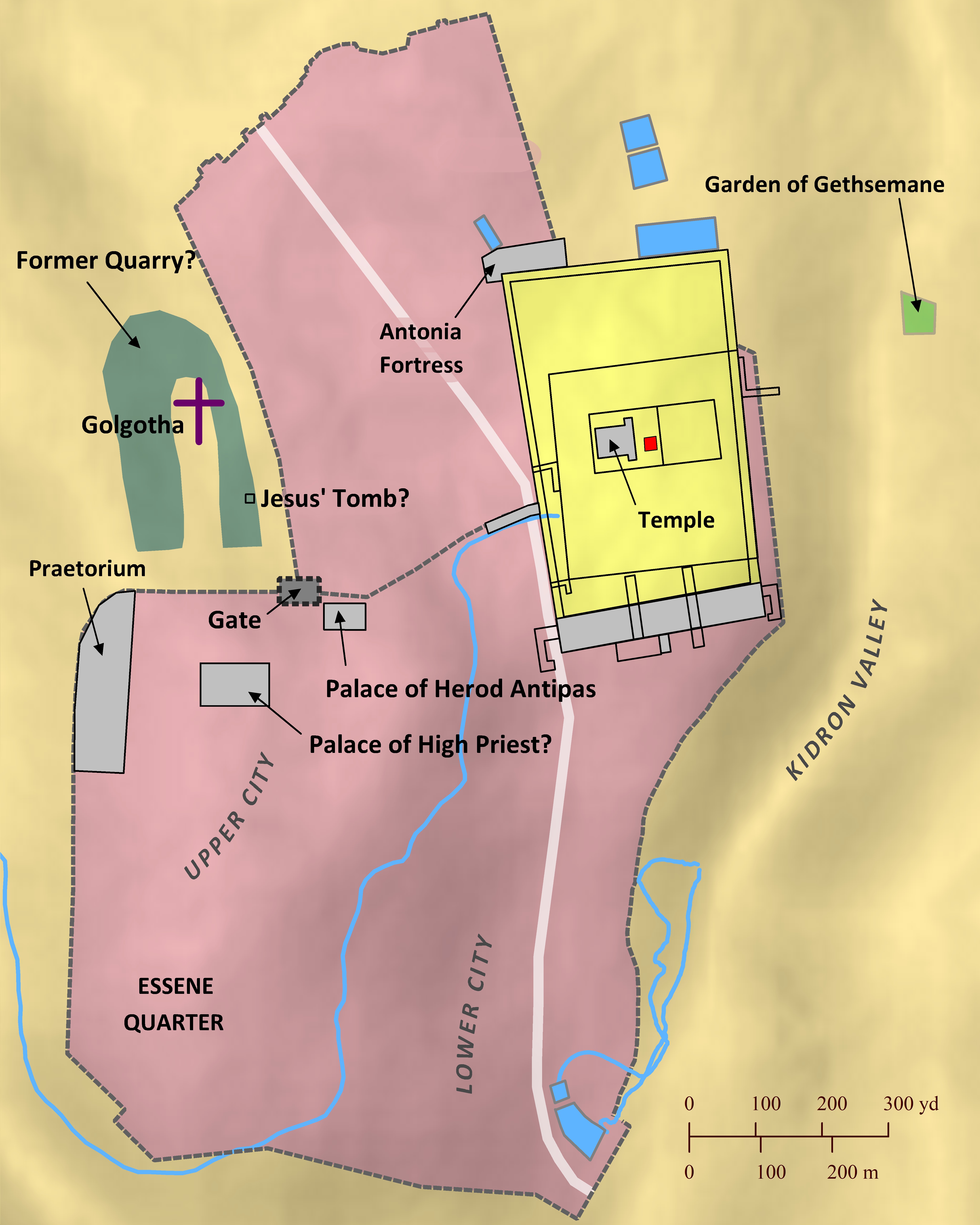
Matthew 26-27; Mark 14-15; Luke 22-23; John 13-19
On the Thursday before he was crucified, Jesus had arranged to share the Passover meal with his disciples in an upper room, traditionally thought to be located in the Essene Quarter of Jerusalem. After they finished the meal, they went to the Garden of Gethsemane, where Jesus often met with his disciples. There Judas Iscariot, one of Jesus’ own disciples, betrayed him to soldiers sent from the High Priest, and they took Jesus to the High Priest’s residence. In the morning the leading priests and teachers of the law put Jesus on trial and found him guilty of blasphemy. The council sent Jesus to stand trial for treason before the Roman governor Pontius Pilate, who resided at the Praetorium while in Jerusalem. The Praetorium was likely located at the former residence of Herod the Great, who had died over 30 years earlier. When Pilate learned that Jesus was from Galilee, he sent him to Herod Antipas, who had jurisdiction over Galilee. But when Jesus gave no answer to Herod’s many questions, Herod and his soldiers sent him back to Pilate, who conceded to the people’s demands that Jesus be crucified. Jesus was forced to carry his cross out of the city gate to Golgotha, meaning Skull Hill, referring to what may have been a small unquarried hill in the middle of an old quarry just outside the gate. After Jesus was unable to carry his cross any further, a man named Simon from Cyrene was forced to carry it for him. There at Golgotha they crucified Jesus. After Jesus died, his body was hurriedly taken down before nightfall and placed in a newly cut, rock tomb owned by Joseph of Arimathea, a member of the Jewish high council. This tomb was likely located at the perimeter of the old quarry.
Open Bible Data site copyright © 2023–2026 Freely-Given.org.
Python source code for creating these static pages is available on GitHub under an open licence.
For Bible data copyrights, see the details for each displayed Bible version.
The Open English Translation (OET) main site is at OpenEnglishTranslation.Bible or OET.Bible.