
OET OET-RV OET-LV GHT ULT UST BSB MSB BLB AICNT OEB WEBBE WMBB NET LSV FBV TCNT T4T LEB BBE Moff JPS Wymth ASV DRA YLT Drby RV SLT Wbstr KJB-1769 KJB-1611 Bshps Gnva Cvdl TNT Wycl SR-GNT UHB BrLXX BrTr Related Parallel Simple Interlinear Topics Reference Dictionary Search
ParallelVerse GEN EXO LEV NUM DEU JOB JOS JDG RUTH 1 SAM 2 SAM PSA AMOS HOS 1 KI 2 KI 1 CHR 2 CHR PROV ECC SNG JOEL MIC ISA ZEP HAB JER LAM YNA (JNA) NAH OBA DAN EZE EZRA EST NEH HAG ZEC MAL LAO GES LES ESG DNG 2 PS TOB JDT ESA WIS SIR BAR LJE PAZ SUS BEL MAN 1 MAC 2 MAC 3 MAC 4 MAC YHN (JHN) MARK MAT LUKE ACTs YAC (JAM) GAL 1 TH 2 TH 1 COR 2 COR ROM COL PHM EPH PHP 1 TIM TIT 1 PET 2 PET 2 TIM HEB YUD (JUD) 1 YHN (1 JHN) 2 YHN (2 JHN) 3 YHN (3 JHN) REV
Luke Intro C1 C2 C3 C4 C5 C6 C7 C8 C9 C10 C11 C12 C13 C14 C15 C16 C17 C18 C19 C20 C21 C23 C24
Luke 22 V1 V4 V7 V10 V13 V16 V19 V22 V25 V28 V31 V34 V37 V40 V43 V46 V49 V52 V58 V61 V64 V67 V70
Note: This view shows ‘verses’ which are not necessarily natural language units and hence sometimes only part of a sentence will be visible—click on any Bible version abbreviation down the left-hand side to see the verse in more of its context. Normally the OET discourages the reading of individual ‘verses’, but this view is only designed as a tool for Bible-translators and others doing comparisons of different translations—the older translations are further down the page (so you can read up from the bottom to trace the English translation history). The OET segments on this page are still early looks into the drafted texts of the Open English Translation of the Bible—please double-check these texts in advance before using in public.
B I ◄ ← Luke 22:55 ↓ → ► ≡ ═ ©
Text critical issues=small word differences Clarity of original=clear Importance to us=normal Speaker(s)=Narrator (All still tentative.)
OET (OET-RV) The staff at the chief priest’s place had lit a fire to sit around in the middle of the courtyard, and Peter slipped in with them.
OET-LV And having_kindled a_fire in the_midst of_the courtyard, and having_sat_together, the Petros was_sitting in_the_midst of_them.
SR-GNT Περιαψάντων δὲ πῦρ ἐν μέσῳ τῆς αὐλῆς, καὶ συγκαθισάντων, ἐκάθητο ὁ Πέτρος μέσος αὐτῶν. ‡
(Periapsantōn de pur en mesōi taʸs aulaʸs, kai sugkathisantōn, ekathaʸto ho Petros mesos autōn.)
Key: khaki:verbs, light-green:nominative/subject, orange:accusative/object, pink:genitive/possessor, cyan:dative/indirect object.
Note: Automatic aligning of the OET-RV to the LV is done by some temporary software, hence the RV alignments are incomplete (and may occasionally be wrong).
GHT Moreover, of {kindle[ing]} [a] fire in to {midst} of {the courtyard} and of {same be[ing]-seated-together}, the Peter has-been-being-seated in to {midst} of {same}.
ULT And they having kindled a fire in the middle of the courtyard and having sat down together, Peter was sitting in the midst of them.
UST Some people lit a fire in the middle of the courtyard and sat down together. Peter came and sat among them.
BSB [When] [those present] had kindled a fire in [the] middle of the courtyard and sat down together, Peter sat down among them.
MSB [When] [those present] had kindled a fire in [the] middle of the courtyard and sat down together, Peter sat down among them.
BLB And they having kindled a fire in the midst of the courtyard, and having sat down together, Peter was sitting among them.
AICNT And when they had kindled a fire in the middle of the courtyard and sat down together, [[and]][fn] Peter was sitting among them [[, warming himself]].[fn]
OEB But, when they had lit a fire in the centre of the courtyard and had all sat down there, Peter seated himself in the middle of them.
WEBBE & WMBB When they had kindled a fire in the middle of the courtyard and had sat down together, Peter sat amongst them.
NET When they had made a fire in the middle of the courtyard and sat down together, Peter sat down among them.
LSV and they having kindled a fire in the midst of the court, and having sat down together, Peter was sitting in the midst of them,
FBV They started a fire in the middle of the courtyard and sat down by it. Peter was there among them.
TCNT Some had kindled a fire there in the middle of the courtyard and sat down together, and Peter sat down among them.
T4T They kindled a fire in the middle of the courtyard and sat down together. Peter sat among them.
LEB And when they[fn] had kindled a fire in the middle of the courtyard and sat down together, Peter sat down among them.
22:55 *Here “when” is supplied as a component of the participle (“had kindled”) which is understood as temporal
BBE And a fire was lighted in the middle of the open square, and they were seated together, and Peter was among them.
Moff and sat down among some people who had lit a fire in the courtyard and were sitting round it.
Wymth And when they had lighted a fire in the middle of the court and had seated themselves in a group round it, Peter was sitting among them,
ASV And when they had kindled a fire in the midst of the court, and had sat down together, Peter sat in the midst of them.
DRA And when they had kindled a fire in the midst of the hall, and were sitting about it, Peter was in the midst of them.
YLT and they having kindled a fire in the midst of the court, and having sat down together, Peter was sitting in the midst of them,
Drby And they having lit a fire in the midst of the court and sat down together, Peter sat among them.
RV And when they had kindled a fire in the midst of the court, and had sat down together, Peter sat in the midst of them.
SLT And having kindled a fire in the midst of the hall, and they having sat down together, Peter sat down in the midst of them.
Wbstr And when they had kindled a fire in the midst of the hall, and were set down together, Peter sat down among them.
KJB-1769 And when they had kindled a fire in the midst of the hall, and were set down together, Peter sat down among them.
KJB-1611 And when they had kindled a fire in the middes of the hall, and were set downe together, Peter sate downe among them.
(Modernised spelling is same as from KJB-1769 above)
Bshps And when they had kyndeled a fire in the myddes of the hall, and were set downe together, Peter also sate downe among them.
(And when they had kyndeled a fire in the midst of the hall, and were set down together, Peter also sat down among them.)
Gnva And when they had kindled a fire in the middes of the hall, and were set downe together, Peter also sate downe among them.
(And when they had kindled a fire in the midst of the hall, and were set down together, Peter also sat down among them.)
Cvdl Then kyndled they a fyre in the myddest of the palace, and sat them downe together. And Peter sat him downe amonge them.
(Then kindled they a fire in the midst of the palace, and sat them down together. And Peter sat him down among them.)
TNT When they had kyndled a fyre in the middes of the palys and were set doune to geder Peter also sate doune amonge them.
(When they had kindled a fire in the midst of the palys and were set down together Peter also sat down among them.)
Wycl And whanne a fier was kyndelid in the myddil of the greet hous, and thei saten aboute, Petir was in the myddil of hem.
(And when a fire was kindled in the middle of the great house, and they sat about, Peter was in the middle of hem.)
Luth Da zündeten sie ein Feuer an mitten im Palast und setzten sich zusammen, und Petrus setzte sich unter sie.
(So ignitedn they/she/them a fire(n) at/to midway/in_the_middle in_the palace and put/set/sat itself/yourself/themselves together, and Peter sat itself/yourself/themselves under they/she/them.)
ClVg Accenso autem igne in medio atrii et circumsedentibus illis, erat Petrus in medio eorum.[fn]
(Accenso however with_fire in/into/on in_the_middle courtyard and circumwhile_sitting to_them, was Peter in/into/on in_the_middle their.)
22.55 Igne in medio. Ignis cupiditatis instinctu maligni spiritus accensus, in atrio Caiphæ ad negandum et blasphemandum Deum linguas perfidorum armabat. Quod enim intus in domo principis sacerdotum maligna synodus gerebat, hoc ignis inter frigora noctis foris accensus typice demonstrabat. Hoc frigore ad horam torpens Petrus, quasi prunis ministrorum calefieri cupiebat, quia temporalis commodi solatium perfidorum societate quærebat. Sed hanc infidelitatem Domino respiciente reliquit et post resurrectionem in captura piscium, cum prunas positas, et piscem superpositum vidisset, cor suum prunis amoris inflammavit.
22.55 Igne in/into/on in_the_middle. Ignis of_desire instinctu maligni spirit accensus, in/into/on court Caiphæ to negandum and blasphemandum God tongue/languages perfidorum weaponsbat. That because inside/within in/into/on at_home to_the_princes priests maligna synodus gerebat, this fire between frigora of_the_night outside accensus typically demonstrabat. This cold to an_hour torpens Peter, as_if black_coal minister/serverum calefieri he_wanted, because temporal commodi relief/comfort(n) perfidorum society was_looking_for. But this infidelity Master looking_back left and after resurrection in/into/on capture/catch(n) fish, when/with prunas placeds, and fish superpositum had_seen, heart his_own black_coal of_love ignited.
UGNT περιαψάντων δὲ πῦρ ἐν μέσῳ τῆς αὐλῆς, καὶ συνκαθισάντων, ἐκάθητο ὁ Πέτρος μέσος αὐτῶν.
(periapsantōn de pur en mesōi taʸs aulaʸs, kai sunkathisantōn, ekathaʸto ho Petros mesos autōn.)
SBL-GNT ⸀περιαψάντων δὲ πῦρ ἐν μέσῳ τῆς αὐλῆς καὶ ⸀συγκαθισάντων ἐκάθητο ὁ Πέτρος ⸀μέσος αὐτῶν.
(⸀periapsantōn de pur en mesōi taʸs aulaʸs kai ⸀sugkathisantōn ekathaʸto ho Petros ⸀mesos autōn.)
RP-GNT Ἁψάντων δὲ πῦρ ἐν μέσῳ τῆς αὐλῆς, καὶ συγκαθισάντων αὐτῶν, ἐκάθητο ὁ Πέτρος ἐν μέσῳ αὐτῶν.
(Hapsantōn de pur en mesōi taʸs aulaʸs, kai sugkathisantōn autōn, ekathaʸto ho Petros en mesōi autōn.)
TC-GNT [fn]ἁψάντων δὲ [fn]πῦρ ἐν μέσῳ τῆς αὐλῆς, καὶ [fn]συγκαθισάντων [fn]αὐτῶν, ἐκάθητο ὁ Πέτρος [fn]ἐν μέσῳ αὐτῶν.
(hapsantōn de pur en mesōi taʸs aulaʸs, kai sugkathisantōn autōn, ekathaʸto ho Petros en mesōi autōn.)
22:55 αψαντων ¦ περιαψαντων ᴄᴛ
22:55 πυρ ¦ πυραν ᴀɴᴛ
22:55 συγκαθισαντων ¦ συνκαθισαντων ᴛʜ ᴡʜ
22:55 αυτων ¦ — ᴄᴛ
22:55 εν μεσω ¦ μεσος ᴄᴛ
Key for above GNTs: yellow:punctuation differs, red:words differ (from our SR-GNT base).
In 22:33 Peter said that he would never leave Jesus or be unfaithful to him. But in 22:34 Jesus predicted that actually Peter would say three times that he did not know Jesus. After Jesus was arrested, Peter followed Jesus to the house of the high priest and waited in the courtyard. Three different people said that Peter had been with Jesus, and three times Peter said he did not know Jesus. But then a rooster crowed, and Peter suddenly remembered what Jesus had said. Peter wept with great sorrow because he had denied that he knew Jesus his Lord.
Some other examples of headings for this section are:
Peter Denies Jesus (NRSV)
Jesus’ Condemnation and Peter’s Denials (NET)
Peter Says He Doesn’t Know Jesus (NCV)
There are parallel passages for this section in Matthew 26:57–58, 26:69–75, Mark 14:53–54, 14:66–72, and John 18:12–18, 18:25–27.
When those present had kindled a fire in the middle of the courtyard
After they arrived, they made a fire in the middle of the compound.
When they brought Jesus to the house, some people lit a fire in the open area/yard to warm themselves,
In Greek, 22:55a begins with a common conjunction that can be translated as “and” or “then.” The NIV translated this word as “But” (the NIV11 says “And”). Many English versions, including the BSB, do not translate it. Connect the verse to 22:54 in a natural way in your language.
This verse indicates that the crowd that arrested Jesus arrived with him at the high priest’s house. In some languages it is necessary to make this information explicit. For example:
But when they arrived
When those present had kindled a fire: The Greek phrase that the BSB translates as those present had kindled a fire is literally “and kindling a fire.” It refers to a small fire that people could sit around and warm themselves. (The parallel passage in Mark 14:54 makes this clear.) Probably some of the people in the crowd who arrested Jesus made the fire. However, in Greek, the text does not make that explicit. Some ways to translate the action are:
A fire had been lit (GNT)
Some men had lit a fire (GW)
The guards lit a fire (NLT)
The reason why they lit a fire was so that people could warm themselves. It was April and the nights were cold. In some languages people may think of a different reason. If this is true in your language, it may be helpful to indicate the implied reason. For example:
they had kindled a fire for warmth
in the middle of the courtyard: A courtyard is an open area that is surrounded by rooms or high walls. In this context the courtyard was part of the high priest’s house. It had walls around it but no roof. The phrase middle of the courtyard refers to the central part of the open area. Other ways to translate this phrase are:
in the center of the courtyard (GNT)
in the middle of the yardKankanaey back translation on TW.
In some languages it may not be necessary to specify that the fire was in the middle part of the courtyard. This information may already be implied. For example:
in the open area of the compound
in the yard of the houseWestern Bukidnon Manobo back translation on TW.
and sat down together,
Then they sat down together near the fire,
and they sat around/near the fire together.
and sat down together: The people who had come from arresting Jesus sat with each other around the fire. Some ways to translate this action are:
As they sat together (GW)
and were sitting around it (CEV)
Peter sat down among them.
and Peter sat with them.
Peter also came and sat there among them.
Peter sat down among them: Peter sat with the other people near the fire so that he too could warm himself. Some other ways to translate this are:
Peter sat there with them (CEV)
Peter sat among them (REB)
Peter joined them there (NLT)
In some languages it may be more natural to change the order of clauses in this verse. For example:
55aA fire had been lit in the center of the courtyard, 55cand Peter joined 55bthose who were sitting around it. (GNT)
Notice that the GNT uses a passive verb in the first clause. This is a good way to put the focus on making the fire, rather than on who made it.
Note 1 topic: writing-pronouns
περιαψάντων & πῦρ
˓having˒_kindled & ˓a˒_fire
Here the pronoun they does not mean the same thing as in the previous verse. Luke is not saying that the leaders and soldiers who had arrested Jesus built this fire. Rather, Luke is using the word they in an indefinite sense. Alternate translation: [some people had started a fire]
Note 2 topic: writing-participants
περιαψάντων & πῦρ
˓having˒_kindled & ˓a˒_fire
Luke is using this phrase to introduce some new characters into the story. Alternate translation: [some of the people who were there at the high priest’s house had started a fire]
Note 3 topic: figures-of-speech / explicit
πῦρ
˓a˒_fire
Implicitly, the purpose of the fire was to keep the people warm during the cool night. If it would be helpful to your readers, you could state that explicitly. Alternate translation: [a fire to keep warm]
Note 4 topic: figures-of-speech / explicit
ἐν μέσῳ τῆς αὐλῆς
in ˓the˒_midst ˱of˲_the courtyard
Luke assumes that his readers will know that in this culture, the courtyard of a house had walls around it, but no roof. You may wish to clarify this for your readers. This was an outdoor fire. Alternate translation: [in the middle of the open courtyard]
μέσος αὐτῶν
˱in˲_˓the˒_midst ˱of˲_them
Alternate translation: [there together with them]
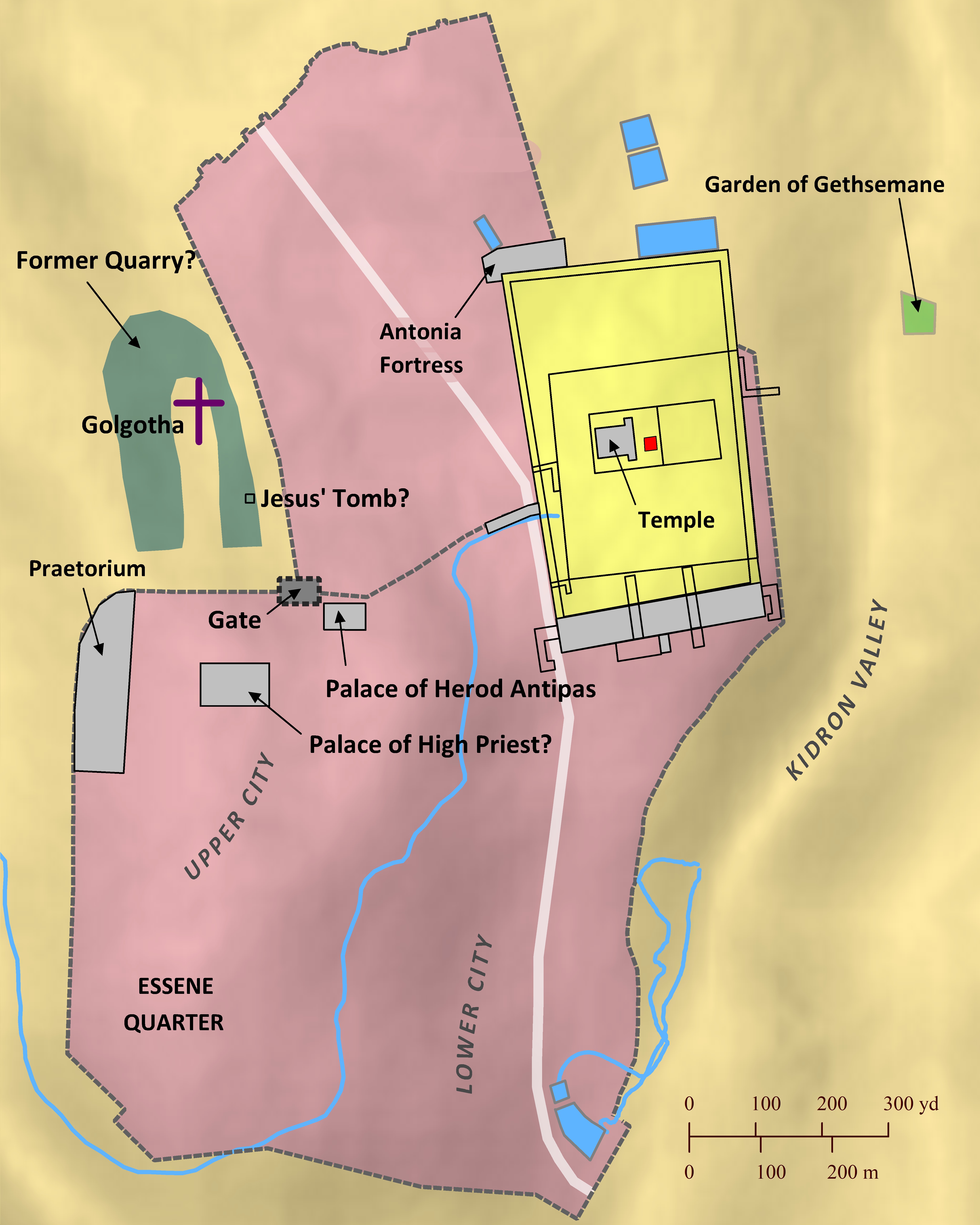
Matthew 26-27; Mark 14-15; Luke 22-23; John 13-19
On the Thursday before he was crucified, Jesus had arranged to share the Passover meal with his disciples in an upper room, traditionally thought to be located in the Essene Quarter of Jerusalem. After they finished the meal, they went to the Garden of Gethsemane, where Jesus often met with his disciples. There Judas Iscariot, one of Jesus’ own disciples, betrayed him to soldiers sent from the High Priest, and they took Jesus to the High Priest’s residence. In the morning the leading priests and teachers of the law put Jesus on trial and found him guilty of blasphemy. The council sent Jesus to stand trial for treason before the Roman governor Pontius Pilate, who resided at the Praetorium while in Jerusalem. The Praetorium was likely located at the former residence of Herod the Great, who had died over 30 years earlier. When Pilate learned that Jesus was from Galilee, he sent him to Herod Antipas, who had jurisdiction over Galilee. But when Jesus gave no answer to Herod’s many questions, Herod and his soldiers sent him back to Pilate, who conceded to the people’s demands that Jesus be crucified. Jesus was forced to carry his cross out of the city gate to Golgotha, meaning Skull Hill, referring to what may have been a small unquarried hill in the middle of an old quarry just outside the gate. After Jesus was unable to carry his cross any further, a man named Simon from Cyrene was forced to carry it for him. There at Golgotha they crucified Jesus. After Jesus died, his body was hurriedly taken down before nightfall and placed in a newly cut, rock tomb owned by Joseph of Arimathea, a member of the Jewish high council. This tomb was likely located at the perimeter of the old quarry.
Open Bible Data site copyright © 2023–2026 Freely-Given.org.
Python source code for creating these static pages is available on GitHub under an open licence.
For Bible data copyrights, see the details for each displayed Bible version.
The Open English Translation (OET) main site is at OpenEnglishTranslation.Bible or OET.Bible.