
OET OET-RV OET-LV GHT ULT UST BSB MSB BLB AICNT OEB WEBBE WMBB NET LSV FBV TCNT T4T LEB BBE Moff JPS Wymth ASV DRA YLT Drby RV SLT Wbstr KJB-1769 KJB-1611 Bshps Gnva Cvdl TNT Wycl SR-GNT UHB BrLXX BrTr Related Parallel Simple Interlinear Topics Reference Dictionary Search
ParallelVerse GEN EXO LEV NUM DEU JOB JOS JDG RUTH 1 SAM 2 SAM PSA AMOS HOS 1 KI 2 KI 1 CHR 2 CHR PROV ECC SNG JOEL MIC ISA ZEP HAB JER LAM YNA (JNA) NAH OBA DAN EZE EZRA EST NEH HAG ZEC MAL LAO GES LES ESG DNG 2 PS TOB JDT WIS SIR BAR LJE PAZ SUS BEL MAN 1 MAC 2 MAC 3 MAC 4 MAC YHN (JHN) MARK MAT LUKE ACTs YAC (JAM) GAL 1 TH 2 TH 1 COR 2 COR ROM COL PHM EPH PHP 1 TIM TIT 1 PET 2 PET 2 TIM HEB YUD (JUD) 1 YHN (1 JHN) 2 YHN (2 JHN) 3 YHN (3 JHN) REV
Luke Intro C1 C2 C3 C4 C5 C6 C7 C8 C9 C10 C11 C12 C13 C14 C15 C16 C17 C18 C19 C20 C21 C23 C24
Luke 22 V1 V4 V7 V10 V13 V19 V22 V25 V28 V31 V34 V37 V40 V43 V46 V49 V52 V55 V58 V61 V64 V67 V70
Note: This view shows ‘verses’ which are not necessarily natural language units and hence sometimes only part of a sentence will be visible—click on any Bible version abbreviation down the left-hand side to see the verse in more of its context. Normally the OET discourages the reading of individual ‘verses’, but this view is only designed as a tool for Bible-translators and others doing comparisons of different translations—the older translations are further down the page (so you can read up from the bottom to trace the English translation history). The OET segments on this page are still early looks into the drafted texts of the Open English Translation of the Bible—please double-check these texts in advance before using in public.
B I ◄ ← Luke 22:16 ↓ → ► ≡ ═ ©
Text critical issues=small word differences Clarity of original=clear Importance to us=normal Speaker(s)=Yeshua (All still tentative.)
OET (OET-RV) because I’m telling you that I certainly won’t eat it again until it’s fulfilled in God’s kingdom.”
OET-LV For/Because I_am_saying to_you_all that by_no_means I_may_ not _eat it, until of_which it_may_be_fulfilled in the kingdom of_ the _god.
SR-GNT Λέγω γὰρ ὑμῖν ὅτι οὐ μὴ φάγω αὐτὸ, ἕως ὅτου πληρωθῇ ἐν τῇ Βασιλείᾳ τοῦ ˚Θεοῦ.” ‡
(Legō gar humin hoti ou maʸ fagō auto, heōs hotou plaʸrōthaʸ en taʸ Basileia tou ˚Theou.”)
Key: khaki:verbs, orange:accusative/object, pink:genitive/possessor, cyan:dative/indirect object, red:negative.
Note: Automatic aligning of the OET-RV to the LV is done by some temporary software, hence the RV alignments are incomplete (and may occasionally be wrong).
GHT for I-am-saying to {you} that not-still, no, I-should_not_eat out of {same} until of {when} it-may-be-fulfilled in to {the kingdom} of {the God},"
ULT For I say to you that I will certainly not eat it until when it is fulfilled in the kingdom of God.”
UST I tell you, the next time I eat it will be when God gives it its deepest meaning when he rules everywhere as king.”
BSB & MSB For I tell you that I will not eat it again until it is fulfilled in the kingdom of God.”
BLB For I say to you that never again will I eat thereof, until it is fulfilled in the kingdom of God."
AICNT for I say to you [that][fn] I will not eat of it [[again]][fn] until it is fulfilled in the kingdom of God.”
OEB For I tell you that I will not eat it again, until it has had its fulfilment in the kingdom of God.’
WEBBE & WMBB for I tell you, I will no longer by any means eat of it until it is fulfilled in God’s Kingdom.”
MSG (14-16)When it was time, he sat down, all the apostles with him, and said, “You’ve no idea how much I have looked forward to eating this Passover meal with you before I enter my time of suffering. It’s the last one I’ll eat until we all eat it together in the kingdom of God.”
NET For I tell you, I will not eat it again until it is fulfilled in the kingdom of God.”
LSV for I say to you that I may eat of it no longer until it may be fulfilled in the Kingdom of God.”
FBV I tell you I shall not eat it again until the time is fulfilled in the kingdom of God.”
TCNT For I tell you that I will certainly not eat it [fn]again until it is fulfilled in the kingdom of God.”
22:16 again ¦ — CT
T4T I want you to know that I will not eat the Passover meal again until all those whose lives God rules completely realize what it represents.”
LEB For I tell you that I will not eat it until it is fulfilled in the kingdom of God.”
BBE For I say to you, I will not take it till it is made complete in the kingdom of God.
Moff for I tell you I will never eat the passover again till the fulfilment of it in the Reign of God."
Wymth for I tell you that I certainly shall not eat one again till its full meaning has been brought out in the Kingdom of God."
ASV for I say unto you, I shall not eat it, until it be fulfilled in the kingdom of God.
DRA For I say to you, that from this time I will not eat it, till it be fulfilled in the kingdom of God.
YLT for I say to you, that no more may I eat of it till it may be fulfilled in the reign of God.'
Drby For I say unto you, that I will not eat any more at all of it until it be fulfilled in the kingdom of [fn]God.
22.16 Elohim
RV for I say unto you, I will not eat it, until it be fulfilled in the kingdom of God.
SLT For I say to you, no more should I eat of it, till when it should be completed in the kingdom of God.
Wbstr For I say to you, I will not any more eat of it until it shall be fulfilled in the kingdom of God.
KJB-1769 For I say unto you, I will not any more eat thereof, until it be fulfilled in the kingdom of God.
( For I say unto you, I will not anymore eat thereof, until it be fulfilled in the kingdom of God.)
KJB-1611 For I say vnto you, I will not any more eate thereof, vntill it be fulfilled in the kingdome of God.
(Modernised spelling is same as from KJB-1769 above)
Bshps For I saye vnto you, hencefoorth I wyll not eate of it any more, vntyll it be fulfylled in the kyngdome of God.
(For I say unto you, henceforth I will not eat of it anymore, until it be fulfilled in the kingdom of God.)
Gnva For I say vnto you, Hencefoorth I will not eate of it any more, vntill it bee fulfilled in the kingdome of God.
(For I say unto you, Henceforth I will not eat of it anymore, until it be fulfilled in the kingdom of God.)
Cvdl For I saye vnto you: that hence forth I wil eate nomore therof, tyll it be fulfilled in the kyngdome of God.
(For I say unto you: that henceforth I will eat no more thereof, till it be fulfilled in the kingdom of God.)
TNT For I saye vnto you: hence forthe I will not eate of it eny moore vntill it be fulfilled in the kingdome of God.
(For I say unto you: henceforth I will not eat of it any more until it be fulfilled in the kingdom of God.)
Wycl for Y seie to you, that fro this tyme Y schal not ete it, til it be fulfillid in the rewme of God.
(for I say to you, that from this time I shall not eat it, till it be fulfilled in the realm of God.)
Luth Denn ich sage euch, daß ich hinfort nicht mehr davon essen werde, bis daß es erfüllet werde im Reich Gottes.
(Because I said you, that I henceforth not more of_that eat become, until that it fulfilled become in_the kingdom God’s.)
ClVg Dico enim vobis, quia ex hoc non manducabo illud, donec impleatur in regno Dei.[fn]
(I_say because to_you(pl), because from this not/no I_will_eat it/this/that, until be_fulfilled in/into/on kingdom of_God.)
22.16 Non manducabo. Non ultra Mosaicum Pascha celebrabo, donec in Ecclesia quod est regnum Dei spiritualiter intellectum compleatur. In hoc regno usque hodie manducat Christus, cum ea quæ Moyses rudi populo carnaliter observanda præcepit, in membris suis spiritualiter exercet.
22.16 Not/No I_will_eat. Not/No beyond/besides Mosaicum Passover I_will_celebrate, until in/into/on Assembly/Church that it_is kingdom of_God spiritually understanding be_completed. In this kingdom until today/at_this_time eats Christ/Messiah, when/with them which Moses stick to_the_people carnally/sensually to_be_observed ordered, in/into/on members to_his_own spiritually exercises.
UGNT λέγω γὰρ ὑμῖν, ὅτι οὐ μὴ φάγω αὐτὸ, ἕως ὅτου πληρωθῇ ἐν τῇ Βασιλείᾳ τοῦ Θεοῦ.
(legō gar humin, hoti ou maʸ fagō auto, heōs hotou plaʸrōthaʸ en taʸ Basileia tou Theou.)
SBL-GNT λέγω γὰρ ὑμῖν ⸀ὅτι οὐ μὴ φάγω ⸀αὐτὸ ἕως ὅτου πληρωθῇ ἐν τῇ βασιλείᾳ τοῦ θεοῦ.
(legō gar humin ⸀hoti ou maʸ fagō ⸀auto heōs hotou plaʸrōthaʸ en taʸ basileia tou theou.)
RP-GNT λέγω γὰρ ὑμῖν ὅτι οὐκέτι οὐ μὴ φάγω ἐξ αὐτοῦ, ἕως ὅτου πληρωθῇ ἐν τῇ βασιλείᾳ τοῦ θεοῦ.
(legō gar humin hoti ouketi ou maʸ fagō ex autou, heōs hotou plaʸrōthaʸ en taʸ basileia tou theou.)
TC-GNT λέγω γὰρ ὑμῖν ὅτι [fn]οὐκέτι οὐ μὴ φάγω [fn]ἐξ αὐτοῦ, ἕως ὅτου πληρωθῇ ἐν τῇ βασιλείᾳ τοῦ Θεοῦ.
(legō gar humin hoti ouketi ou maʸ fagō ex autou, heōs hotou plaʸrōthaʸ en taʸ basileia tou Theou.)
Key for above GNTs: yellow:punctuation differs, red:words differ (from our SR-GNT base).
In this section Jesus ate his last meal with his twelve disciples before he died. During this Passover meal, Jesus told them about the new covenant that he was making with them. He took bread and gave thanks to God. Then he divided the bread into pieces and gave it to his disciples to share. He said to them, “This is my body, given for you.” After the main meal, he gave his disciples a cup of wine to drink from. He said, “This cup is the new covenant in my blood, which is poured out for you.” When Jesus said these things, he indicated that he would sacrifice himself by dying as a substitute for his disciples to save them from slavery to sin. By doing this, he would fulfill the real meaning of Passover. As God saved the people of Israel who put the blood of the Passover lamb on their doors, he will save the people who trust in Jesus’ sacrifice for them.
Jesus told his disciples to continue to remember him by taking bread and wine as his body and blood given for them. This thanksgiving service is now called the Eucharist, from the Greek word that means “thanksgiving.” It is also called the Lord’s Supper and Holy Communion.
Some other examples of headings for this section are:
The Lord’s Supper (NET)
Jesus established the Thanksgiving/Eucharist celebration
Jesus sacrifices his body and blood to save his disciples
Jesus makes a new covenant with his disciples
There are parallel passages for this section in Matthew 26:26–30, Mark 14:22–26, and 1 Corinthians 11:23–25.
For I tell you that
for I tell you this:
I assure you that
For: The Greek conjunction that the BSB translates as For often introduces a reason or an explanation. In this verse Jesus explained more about his eagerness to eat that Passover meal with his apostles. This explanation begins in 22:16b. Jesus says that he will not eat the Passover meal again until its meaning is fulfilled in the kingdom of God.When Jesus instituted the Eucharist at this Passover, he showed his apostles that he was about to suffer for them, redeem them, and open the kingdom of God for them and other believers. Jesus was eager for this redemption to be accomplished. Lenski (p. 1040) says, “The last phrase ‘before I suffer” explains this strong desire….The nearer the hour of suffering and death came for Jesus the more he longed for it to come in order that the great work might be done and redemption be actually wrought.” Johnson (p. 337) says, “For Jesus’ ‘eagerness’ for everything to be accomplished, compare the saying in 12:50.”
Introduce his explanation in a natural way in your language. In some languages a conjunction may not be needed, as in several English versions.
I tell you: Jesus often used the phrase I tell you to introduce a statement that he wanted to emphasize. See the note on 17:34a for more information and translation suggestions.
you: The pronoun you is plural here. It refers to Jesus’ apostles.
I will not eat it again
I will not eat a Passover meal again
I will not eat another “Death Passed Us By” meal
until it is fulfilled in the kingdom of God.”
until its true meaning is fulfilled in God’s kingdom.”
before the time when God reigns/rules and makes all that it represents happen.”
I will not eat it again until it is fulfilled: There are two ways to interpret the statement I will not eat it again until it is fulfilled:
It indicates that after Jesus ate that Passover meal with his disciples, he would not eat another Passover meal until its meaning was fulfilled. For example:
I will not eat another Passover meal until it is given its true meaning (NCV) (BSB, NCV, NIV, KJV, NASB, REB, GW, NLT, CEV, NET, JBP)
It indicates that Jesus would not eat another Passover meal, including the one that night with his disciples, until its meaning was fulfilled. Here is another way to translate this:
I shall not eat it until it is fulfilled (RSV) (RSV, NJB, GNT, ESV)
It is recommended that you follow interpretation (1).There is a textual issue concerning the word “again.” It is not included in some of the best Greek manuscripts. Metzger (1971, p. 173) gives the decision not to include it a C rating, indicating uncertainty about the decision. The Notes consider this issue more of a translation decision than a strictly textual matter. Along with most Bible scholars, it favors translating in a way that refers to future Passover meals, not this final one that he ate with his disciples. Scholars who follow interpretation (1) include Bock, Bratcher, Creed, Godet, Green, Fitzmyer, Hendriksen, Lenski, Marshall, Morris, Nolland, Plummer, Reiling and Swellengrebel, Stein, and Summers. The whole context, especially 22:15, strongly implies that Jesus did eat the Passover meal with his disciples. (See also 22:21.) Although the word again is not included in some Greek manuscripts, it is necessary in English to express the right meaning.
until it is fulfilled: The Greek phrase that the BSB literally translates as until it is fulfilled refers to the time when the meaning that the Passover meal symbolizes will be completely fulfilled.
The Passover symbolizes God redeeming his people. He redeemed the Jewish people when he saved them from death and slavery in Egypt at the time of the first Passover. God redeemed his people from eternal death and slavery to sin through Jesus’ death as a substitute for them. The Passover lamb symbolizes Jesus.
Some other ways to translate this phrase are:
until its meaning is fulfilled (NLT)
until it is given its full meaning (GNT)
until what it symbolizes is accomplished
The verb is fulfilled is passive. In some languages it may be necessary to translate it as active. If that is true in your language, you may supply “God” as the subject.Marshall (p. 796) says, “The passive is probably a circumlocution for an active verb with God as subject.” For example:
until God fulfills the purpose/meaning of the Passover meal
until God causes what the Passover meal represents to happen
in the kingdom of God: In this context the phrase in the kingdom of God refers to the time when God will reign over everyone as king. At that time Jesus will reign with God, and God will give his people the complete freedom that Passover symbolizes. Because Jesus atoned for his people’s sin by his death for them, God will free them completely from sin and death. At that time there will be a great feast, and God’s people will celebrate with Jesus forever.
Some ways to translate in the kingdom of God here are:
when God rules his people as king
when God becomes King in the worldUma back translation on TW.
in God’s glorious reign/chieftaincy
kingdom of God: The phrase kingdom of God refers to God’s activity of ruling and caring for his people as their king. It does not refer here to a land or country that he rules over. For more information and translation suggestions, see the note on kingdom of God at 17:20a–b. See also kingdom of God in the Glossary.
Note 1 topic: translate-versebridge
γὰρ
(Some words not found in SR-GNT: λέγω Γάρ ὑμῖν ὅτι οὒ μή φάγω αὐτό ἕως ὅτου πληρωθῇ ἐν τῇ Βασιλείᾳ τοῦ Θεοῦ)
Jesus is giving the reason why he has been so eager to share this Passover meal with his disciples, as he said in the previous verse. If it would be helpful in your language, you could put this reason before the result by creating a verse bridge. You could combine [22:15](../22/15.md) and [22:16](../22/16.md), putting all of [22:16](../22/16.md) first, followed by all of [22:15](../22/15.md). This would require saying “this Passover meal” in [22:16](../22/16.md) and it in [22:15](../22/15.md). You could have no introductory word for [22:16](../22/16.md) and begin [22:15](../22/15.md) with “And so.”
λέγω & ὑμῖν
˱I˲_˓am˒_saying & ˱to˲_you_all
Jesus says this to emphasize the importance of what he is about to say. Alternate translation: [I can assure you]
Note 2 topic: figures-of-speech / explicit
οὐ μὴ φάγω αὐτὸ
(Some words not found in SR-GNT: λέγω Γάρ ὑμῖν ὅτι οὒ μή φάγω αὐτό ἕως ὅτου πληρωθῇ ἐν τῇ Βασιλείᾳ τοῦ Θεοῦ)
Since Jesus is just about to eat a Passover meal, he means implicitly that he will not eat such a meal again until the later time he describes. Alternate translation: [I will certainly not eat it again]
Note 3 topic: figures-of-speech / activepassive
ἕως ὅτου πληρωθῇ ἐν τῇ Βασιλείᾳ τοῦ Θεοῦ
until ˱of˲_which ˱it˲_˓may_be˒_fulfilled in the Kingdom ¬the ˱of˲_God
If it would be helpful in your language, you could express this with an active form, and you could state who will do the action. See the discussion in the introduction to this chapter. This could mean: (1) “until people celebrate this feast in the kingdom of God.” (2) “until God gives this feast its full meaning when he establishes his kingdom.” (3) “until I die as the true Passover sacrifice and establish the kingdom of God.”
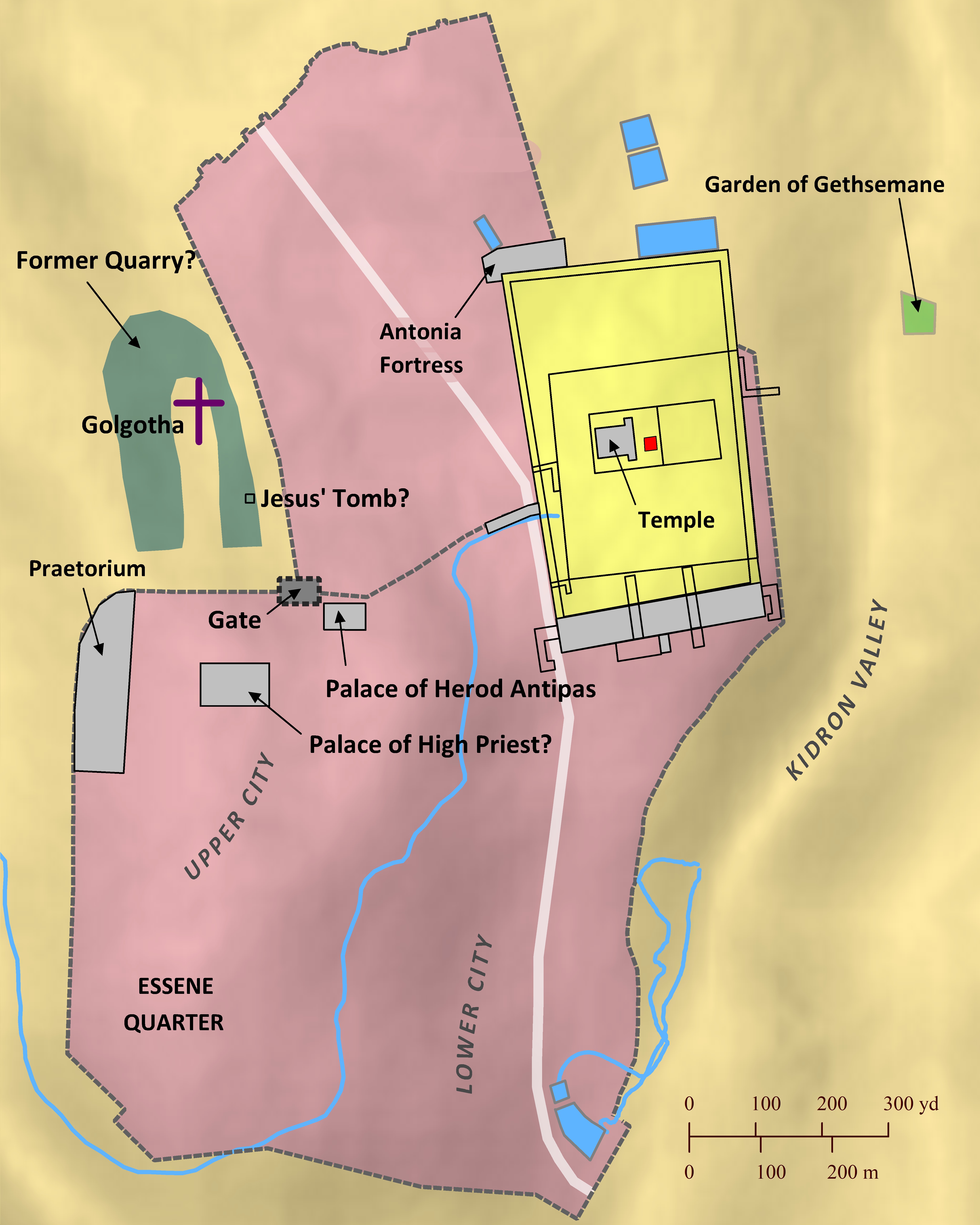
Matthew 26-27; Mark 14-15; Luke 22-23; John 13-19
On the Thursday before he was crucified, Jesus had arranged to share the Passover meal with his disciples in an upper room, traditionally thought to be located in the Essene Quarter of Jerusalem. After they finished the meal, they went to the Garden of Gethsemane, where Jesus often met with his disciples. There Judas Iscariot, one of Jesus’ own disciples, betrayed him to soldiers sent from the High Priest, and they took Jesus to the High Priest’s residence. In the morning the leading priests and teachers of the law put Jesus on trial and found him guilty of blasphemy. The council sent Jesus to stand trial for treason before the Roman governor Pontius Pilate, who resided at the Praetorium while in Jerusalem. The Praetorium was likely located at the former residence of Herod the Great, who had died over 30 years earlier. When Pilate learned that Jesus was from Galilee, he sent him to Herod Antipas, who had jurisdiction over Galilee. But when Jesus gave no answer to Herod’s many questions, Herod and his soldiers sent him back to Pilate, who conceded to the people’s demands that Jesus be crucified. Jesus was forced to carry his cross out of the city gate to Golgotha, meaning Skull Hill, referring to what may have been a small unquarried hill in the middle of an old quarry just outside the gate. After Jesus was unable to carry his cross any further, a man named Simon from Cyrene was forced to carry it for him. There at Golgotha they crucified Jesus. After Jesus died, his body was hurriedly taken down before nightfall and placed in a newly cut, rock tomb owned by Joseph of Arimathea, a member of the Jewish high council. This tomb was likely located at the perimeter of the old quarry.
Open Bible Data site copyright © 2023–2026 Freely-Given.org.
Python source code for creating these static pages is available on GitHub under an open licence.
For Bible data copyrights, see the details for each displayed Bible version.
The Open English Translation (OET) main site is at OpenEnglishTranslation.Bible or OET.Bible.