OET OET-RV OET-LV GHT ULT UST BSB MSB BLB AICNT OEB WEBBE WMBB NET LSV FBV TCNT T4T LEB BBE Moff JPS Wymth ASV DRA YLT Drby RV SLT Wbstr KJB-1769 KJB-1611 Bshps Gnva Cvdl TNT Wycl SR-GNT UHB BrLXX BrTr Related Parallel Simple Interlinear Topics Reference Dictionary Search
ParallelVerse GEN EXO LEV NUM DEU JOB JOS JDG RUTH 1 SAM 2 SAM PSA AMOS HOS 1 KI 2 KI 1 CHR 2 CHR PROV ECC SNG JOEL MIC ISA ZEP HAB JER LAM YNA (JNA) NAH OBA DAN EZE EZRA EST NEH HAG ZEC MAL LAO GES LES ESG DNG 2 PS TOB JDT WIS SIR BAR LJE PAZ SUS BEL MAN 1 MAC 2 MAC 3 MAC 4 MAC YHN (JHN) MARK MAT LUKE ACTs YAC (JAM) GAL 1 TH 2 TH 1 COR 2 COR ROM COL PHM EPH PHP 1 TIM TIT 1 PET 2 PET 2 TIM HEB YUD (JUD) 1 YHN (1 JHN) 2 YHN (2 JHN) 3 YHN (3 JHN) REV
Mark Intro C1 C2 C3 C4 C5 C6 C7 C8 C9 C10 C11 C12 C13 C15 C16
Mark 14 V1 V4 V7 V10 V13 V16 V19 V22 V25 V28 V31 V34 V37 V40 V43 V46 V49 V52 V55 V58 V61 V64 V67 V70
Note: This view shows ‘verses’ which are not necessarily natural language units and hence sometimes only part of a sentence will be visible—click on any Bible version abbreviation down the left-hand side to see the verse in more of its context. Normally the OET discourages the reading of individual ‘verses’, but this view is only designed as a tool for Bible-translators and others doing comparisons of different translations—the older translations are further down the page (so you can read up from the bottom to trace the English translation history). The OET segments on this page are still early looks into the drafted texts of the Open English Translation of the Bible—please double-check these texts in advance before using in public.
Text critical issues=small word differences Clarity of original=clear Importance to us=normal Speaker(s)=Narrator (All still tentative.)
OET (OET-RV) Meanwhile, Yeshua was in Beyt-Ania (Bethany) at the home of Simon who had previously had leprosy. Yeshua was sitting there when a woman came in with a hand-crafted container of very expensive fragrant lotion. Breaking open the sealed flask, she poured the fragrant oil over Yeshua’s head.[ref]
OET-LV And him being in Baʸthania, in the house of_Simōn the leprous, reclining of_him, a_woman came having an_alabaster_flask of_ointment, of_ genuine expensive _nard, having_broken the alabaster_flask, she_poured_down it on_the head of_him.
SR-GNT Καὶ ὄντος αὐτοῦ ἐν Βηθανίᾳ, ἐν τῇ οἰκίᾳ Σίμωνος τοῦ λεπροῦ, κατακειμένου αὐτοῦ, ἦλθεν γυνὴ ἔχουσα ἀλάβαστρον μύρου, νάρδου πιστικῆς πολυτελοῦς· συντρίψασα τὴν ἀλάβαστρον, κατέχεεν αὐτοῦ τῆς κεφαλῆς. ‡
(Kai ontos autou en Baʸthania, en taʸ oikia Simōnos tou leprou, katakeimenou autou, aʸlthen gunaʸ eⱪousa alabastron murou, nardou pistikaʸs polutelous; suntripsasa taʸn alabastron, kateⱪeʼen autou taʸs kefalaʸs.)
Key: khaki:verbs, light-green:nominative/subject, orange:accusative/object, pink:genitive/possessor, cyan:dative/indirect object.
Note: Automatic aligning of the OET-RV to the LV is done by some temporary software, hence the RV alignments are incomplete (and may occasionally be wrong).
GHT and of {same being} in to {Bethany}, in to {the home} of {Simon the leprous}, of {same being-lain-down}, [a] woman comes, having [an] alabaster-vessel of {ointment}, of {faithful/trustworthy much-completed/precious/costly spikenard} and, crush[ing] the alabaster-vessel, she-pours-down of {same} down/against of {the head}.
ULT And he being in Bethany in the house of Simon the leper, he reclining to eat, a woman came, having an alabaster jar of very precious perfumed oil of pure nard. Having broken the jar, she poured it on his head.
UST Now Jesus was in the village of Bethany. He was in the home of Simon, who used to have a skin disease. While Jesus was feasting there, a woman arrived. She brought with her a stone jar that contained nard, a very valuable, fragrant ointment. She shattered the jar and poured the ointment on Jesus’ head.
BSB & MSB While [Jesus] was in Bethany reclining at the table in the home of Simon the Leper,[fn] a woman came [with] an alabaster jar of expensive perfume, made of pure nard. She broke open the jar [and] poured [it] on [Jesus’] head.
14:3 Aramaic Simon the Potter or Simon the Jar Maker
BLB And of Him being in Bethany in the house of Simon the leper, of Him having reclined, a woman came having an alabaster flask of fragrant oil of pure nard, of great price. Having broken the alabaster flask, she poured it on His head.
AICNT And while {he}[fn] was in Bethany, in the house of Simon the leper, as he reclined, a woman {came}[fn] with an alabaster jar of ointment [of pure nard, very costly],[fn] [[and]][fn] breaking the [alabaster][fn] jar, she poured it on his head.
14:3, he: Some manuscripts read “Jesus.” D(05) Latin(ff2 i).
14:3, came: W(032) reads “approached.”
14:3, of pure nard, very costly: Absent from D(05).
14:3, and: Included in A(02) C(04) D(05) W(032) Latin(a ff2 i k) BYZ TR ‖ Absent from ℵ(01) B(03) NA28 SBLGNT THGNT.
14:3, alabaster: Absent from Latin(k).
OEB When Jesus was still at Bethany, in the house of Simon the leper, while he was sitting at the table, a woman came with an alabaster jar of choice spikenard perfume of great value. She broke the jar, and poured the perfume on his head.
WEBBE & WMBB While he was at Bethany, in the house of Simon the leper, as he sat at the table, a woman came having an alabaster jar of ointment of pure nard—very costly. She broke the jar and poured it over his head.
NET Now while Jesus was in Bethany at the house of Simon the leper, reclining at the table, a woman came with an alabaster jar of costly aromatic oil from pure nard. After breaking open the jar, she poured it on his head.
LSV And He, being in Bethany, in the house of Simon the leper, at His reclining, there came a woman having an alabaster box of ointment, of spikenard, very precious, and having broken the alabaster box, poured [it] on His head;
FBV Meanwhile Jesus was in Bethany, eating a meal at Simon the leper's home. A woman came in with an alabaster jar of very expensive pure nard perfume.[fn] She broke the jar open and poured the perfume on Jesus' head.
14:3 Nard: an essential oil derived from the roots of the spikenard plant native to China and India.
TCNT Meanwhile Jesus was in Bethany, reclining at the table in the house of Simon the leper, and a woman came with an alabaster jar of very expensive ointment made of pure nard. She broke the alabaster jar and poured the ointment on his head.
T4T Jesus was at Bethany town in the house of Simon, whom Jesus had healed from leprosy. While they were eating, a woman came to him. She was carrying a stone jar that contained expensive fragrant perfume called nard. She opened the jar and then she poured the perfume on Jesus’ head.
LEB ¶ And while[fn] he was at Bethany in the house of Simon the leper, as[fn] he was reclining for a meal, a woman came holding an alabaster flask of very costly perfumed oil of genuine nard. After[fn] breaking the alabaster flask, she poured it[fn] out on his head.
14:3 *Here “while” is supplied as a component of the temporal genitive absolute participle (“was”)
14:3 *Here “as” is supplied as a component of the temporal genitive absolute participle (“was reclining for a meal”)
14:3 *Here “after” is supplied as a component of the participle (“breaking”) which is understood as temporal
14:3 *Here the direct object is supplied from context in the English translation
BBE And while he was in Bethany in the house of Simon the leper, seated at table, there came a woman with a bottle of perfumed oil of great price; and when the bottle was broken she put the perfume on his head.
Moff When he was at Bethany in the house of Simon the leper, lying at table, a woman came up with an alabaster flask of pure nard perfume, which had cost a great sum; the flask she broke and poured the perfume over his head.
Wymth Now when He was at Bethany, in the house of Simon the Leper, while He was at table, there came a woman with a jar of pure, sweet-scented ointment very costly: she broke the jar and poured the ointment over His head.
ASV And while he was in Bethany in the house of Simon the leper, as he sat at meat, there came a woman having an alabaster cruse of ointment of pure nard very costly; and she brake the cruse, and poured it over his head.
DRA And when he was in Bethania, in the house of Simon the leper, and was at meat, there came a woman having an alabaster box of ointment of precious spikenard: and breaking the alabaster box, she poured it out upon his head.
YLT And he, being in Bethany, in the house of Simon the leper, at his reclining (at meat), there came a woman having an alabaster box of ointment, of spikenard, very precious, and having broken the alabaster box, did pour on his head;
Drby And when he was in Bethany, in the house of Simon the leper, as he lay at table, there came a woman having an alabaster flask of ointment of pure nard, very costly; and having broken the alabaster flask, she poured it out upon his head.
RV And while he was in Bethany in the house of Simon the leper, as he sat at meat, there came a woman having an alabaster cruse of ointment of spikenard very costly; and she brake the cruse, and poured it over his head.
(And while he was in Bethany in the house of Simon the leper, as he sat at meat, there came a woman having an alabaster cruse of ointment of spikenard/nard very costly; and she brake the cruse, and poured it over his head.)
SLT And he being in Bethany in the house of Simon the leprous, he reclining at table, a woman came having an alabaster box of perfumed oil of persuasive, costly, spikenard; and having broken the alabaster box, she poured upon his head.
Wbstr And being in Bethany, in the house of Simon the leper, as he sat at table, there came a woman having an alabaster box of ointment of spikenard, very precious; and she broke the box, and poured it on his head.
KJB-1769 ¶ And being in Bethany in the house of Simon the leper, as he sat at meat, there came a woman having an alabaster box of ointment of spikenard very precious; and she brake the box, and poured it on his head.
(¶ And being in Bethany in the house of Simon the leper, as he sat at meat, there came a woman having an alabaster box of ointment of spikenard/nard very precious; and she brake the box, and poured it on his head.)
KJB-1611 ¶ And being in Bethanie, in the house of Simon the leper, as he sate at meat, there came a woman, hauing an Alabaster boxe of oyntment of [fn]spikenard very precious, and shee brake the boxe, and powred it on his head.
(Modernised spelling is same as from KJB-1769 above, apart from capitalisation and punctuation and footnotes)
14:3 Or, pure nard: or liquid nard.
Bshps And when he was at Bethanie, in the house of Simon the leper, euen as he sate at meate, there came a woman hauyng an alabaster boxe of very precious oyntment, called Narde pisrike, and she brake the boxe, and powred it on his head.
(And when he was at Bethany, in the house of Simon the leper, even as he sat at meat, there came a woman having an alabaster box of very precious ointment, called Spikenard/Nard, and she brake the box, and poured it on his head.)
Gnva And when hee was in Bethania in the house of Simon the leper, as he sate at table, there came a woman hauing a boxe of oyntment of spikenarde, very costly, and shee brake the boxe, and powred it on his head.
(And when he was in Bethany in the house of Simon the leper, as he sat at table, there came a woman having a box of ointment of spikenard/nard, very costly, and she brake the box, and poured it on his head.)
Cvdl And when he was at Bethanye in the house of Symon the leper, and sat at the table, there came a woman, which had a boxe of pure and costly Nardus oyntment. And she brake ye boxe, & poured it vpo his heade.
(And when he was at Bethany in the house of Simon the leper, and sat at the table, there came a woman, which had a box of pure and costly Nard ointment. And she brake ye/you_all box, and poured it upon his head.)
TNT When he was in Bethania in the housse of Simon the leper even as he sate at meate ther came a woman hauynge an alablaster boxe of oyntment called narde that was pure and costly: and she brake the boxe and powred it on is heed.
(When he was in Bethany in the house of Simon the leper even as he sat at meat there came a woman having an alabaster box of ointment called nard that was pure and costly: and she brake the box and poured it on is heed.)
Wycl And whanne he was at Betanye, in the hous of Symount leprous, and restide, a womman cam, that hadde a boxe of alabastre of precious oynement spikenard; and whanne the boxe of alabastre was brokun, sche helde it on his heed.
(And when he was at Bethany, in the house of Simon leprous, and rested, a woman came, that had a box of alabaster of precious ointment spikenard; and when the box of alabaster was broken, she held it on his heed.)
Luth Und da er zu Bethanien war in Simons, des Aussätzigen, Hause und saß zu Tisch, da kam ein Weib, die hatte ein Glas mit ungefälschtem und köstlichem Nardenwasser; und sie zerbrach das Glas und goß es auf sein Haupt.
(And there he to/for Bethany what/which in Simons, the lepers, house(n) and sat to/for table, there came a woman, the had a glass/jar with genuine and delicious spikenard_water; and they/she/them broke the glass/jar and poured/cast it on/in/to be head.)
ClVg Et cum esset Bethaniæ in domo Simonis leprosi, et recumberet, venit mulier habens alabastrum unguenti nardi spicati pretiosi: et fracto alabastro, effudit super caput ejus.[fn]
(And when/with was Bethany in/into/on at_home Simon’s lepers, and would_sit_down, he_came woman having alabaster ointments spikenard/nard spiked most_precious: and broken alabaster, poured_out over the_head his/her.)
14.3 Et cum esset Bethaniæ. ID. Hinnulus cervorum semper ad lectulum suum redit, id est, Filius obediens Patri usque ad mortem: obedientiam a nobis petit. Simon enim obediens dicitur. Simonis leprosi. Simon leprosus mundum infidelem primo, postea fidelem significat. Et recumberet, venit, etc. Recumbente seipso, id est, humiliante se, ut eum tangeret fides peccatricis: quæ de pedibus ascendit ad caput, a capite descendit per fidem, id est, a Christo ad membra ejus. Mulier. BEDA. Maria Magdalena soror Lazari quem suscitavit Dominus, etc., usque ad ut Matthæus et Marcus perhibent, oleo sancto perfudit. Alabastrum. Alabastrum marmor candidum variis guttis distinctum unguenta incorrupta servat. Nardi spicati. Pistica nardus dicitur mista, quia non solum de radice, sed de spicis et de foliis compositum erat: quod est pretiosius. Et fracto. HIER. Domus impleta odore, cœlum et terra est. Fractum alabastrum carnale est desiderium, quod frangitur ad caput: ex quo omne corpus compaginatum est. BED. Devotio Mariæ, fidem et pietatem designat Ecclesiæ, etc., usque ad pia prædicatione et devotis veneratur obsequiis.
14.3 And when/with was Bethany. ID. Fawn deer(sg) always to bed his_own returns, that it_is, Son obedient To_the_father until to death: obedience from us asks. Simon because obedient it_is_said. Simon’s lepers. Simon leper the_world infidel/unfaithful_(one) at_first, afterwards faithful means. And would_sit_down, he_came, etc. Lying_down to_himself, that it_is, humiliating himself, as him would_touch faith sinner: which from/about feet went_up to the_head, from head came_down through faith, that it_is, from to_Christ/Messiah to members his/her. Woman. BEDA. Maria Magdalena sister Of_Lazarus which raised Master, etc., until to as Matthew and Marcus they_give, with_oil holy poured_over. Alabaster. Alabaster marble white various drops distinct ointments intact keeps. Nard spiked. Pistachio nard-oil it_is_said mixed, because not/no only from/about root, but from/about ears_of_grain and from/about leaves(n) composed was: that it_is more_precious. And broken. HIER. House filled by_smell, sky and earth/land it_is. Broken alabaster carnal it_is desire/wish, that breaks to the_head: from where everything body joined_together it_is. BED. Devotion Mary, faith and piety designates Assemblies/Churches, etc., until to pious preaching and devoted venerates/worships compliances.
UGNT καὶ ὄντος αὐτοῦ ἐν Βηθανίᾳ, ἐν τῇ οἰκίᾳ Σίμωνος τοῦ λεπροῦ, κατακειμένου αὐτοῦ, ἦλθεν γυνὴ ἔχουσα ἀλάβαστρον μύρου, νάρδου πιστικῆς πολυτελοῦς; συντρίψασα τὴν ἀλάβαστρον, κατέχεεν αὐτοῦ τῆς κεφαλῆς.
(kai ontos autou en Baʸthania, en taʸ oikia Simōnos tou leprou, katakeimenou autou, aʸlthen gunaʸ eⱪousa alabastron murou, nardou pistikaʸs polutelous; suntripsasa taʸn alabastron, kateⱪeʼen autou taʸs kefalaʸs.)
SBL-GNT Καὶ ὄντος αὐτοῦ ἐν Βηθανίᾳ ἐν τῇ οἰκίᾳ Σίμωνος τοῦ λεπροῦ κατακειμένου αὐτοῦ ἦλθεν γυνὴ ἔχουσα ἀλάβαστρον μύρου νάρδου πιστικῆς πολυτελοῦς· ⸀συντρίψασα ⸀τὴν ἀλάβαστρον κατέχεεν ⸀αὐτοῦ τῆς κεφαλῆς.
(Kai ontos autou en Baʸthania en taʸ oikia Simōnos tou leprou katakeimenou autou aʸlthen gunaʸ eⱪousa alabastron murou nardou pistikaʸs polutelous; ⸀suntripsasa ⸀taʸn alabastron kateⱪeʼen ⸀autou taʸs kefalaʸs.)
RP-GNT Καὶ ὄντος αὐτοῦ ἐν Βηθανίᾳ, ἐν τῇ οἰκίᾳ Σίμωνος τοῦ λεπροῦ, κατακειμένου αὐτοῦ, ἦλθεν γυνὴ ἔχουσα ἀλάβαστρον μύρου νάρδου πιστικῆς πολυτελοῦς· καὶ συντρίψασα τὸ ἀλάβαστρον, κατέχεεν αὐτοῦ κατὰ τῆς κεφαλῆς.
(Kai ontos autou en Baʸthania, en taʸ oikia Simōnos tou leprou, katakeimenou autou, aʸlthen gunaʸ eⱪousa alabastron murou nardou pistikaʸs polutelous; kai suntripsasa to alabastron, kateⱪeʼen autou kata taʸs kefalaʸs.)
TC-GNT Καὶ ὄντος αὐτοῦ ἐν Βηθανίᾳ ἐν τῇ οἰκίᾳ Σίμωνος τοῦ λεπροῦ, κατακειμένου αὐτοῦ ἦλθε γυνὴ ἔχουσα ἀλάβαστρον μύρου νάρδου πιστικῆς πολυτελοῦς, [fn]καὶ συντρίψασα [fn]τὸ ἀλάβαστρον κατέχεεν αὐτοῦ [fn]κατὰ τῆς κεφαλῆς.
(Kai ontos autou en Baʸthania en taʸ oikia Simōnos tou leprou, katakeimenou autou aʸlthe gunaʸ eⱪousa alabastron murou nardou pistikaʸs polutelous, kai suntripsasa to alabastron kateⱪeʼen autou kata taʸs kefalaʸs.)
Key for above GNTs: yellow:punctuation differs, red:words differ (from our SR-GNT base).
In this section, Mark told how a woman honored Jesus. She did this by pouring very expensive perfume on his head while he was eating with some friends. Jesus said that what the woman did prepared his body for burial. Her action contrasted sharply with the way the Jewish leaders were plotting to arrest and kill Jesus in the previous section (14:1–2). It also contrasted with Judas’ offer to betray Jesus in the next section (14:10–11).
The events in this section happened in Bethany, which was near Jerusalem on the slope of the Mount of Olives. Before 14:3, the last reference to Jesus’ location was in 13:3, which tells us that “Jesus was sitting on the Mount of Olives.” Mark 11:11–12 indicates that Jesus stayed in Bethany at night and went to Jerusalem during the day.
It is good to translate this section before you decide on a heading for it.
Here are some other possible headings for this section:
A woman pours perfume on Jesus’ head
A woman honors Jesus at Bethany
There are parallel passages for this section in Matthew 26:6–13 and John 12:1–8.
While Jesus was in Bethany
¶ Jesus was in Bethany (GNT)
¶ Meanwhile, Jesus was in the village of Bethany.
reclining at the table in the home of Simon the Leper,
eating in the house of a man who was called Simon the Leper.
He and others went to eat at the house of that Simon whose leprosy had been cured. While they were eating,
While Jesus was in Bethany reclining at the table in the home of Simon the Leper: The clause While Jesus was in Bethany introduces a new story that contrasts with the story in 14:1–2. While the chief priests and elders were plotting against him in 14:1–2, Jesus was in Bethany in the home of a friend. Begin this story in a natural way in your language.
Here are some other ways to translate this:
Meanwhile, Jesus was in Bethany at the home of Simon, a man who had leprosy. (NLT96)
Jesus was eating in Bethany at the house of Simon (CEV)
From 14:4a we know that Jesus was not eating alone. In some languages it may be more natural to indicate that here. For example:
Jesus and others
Bethany: Bethany was a village on the eastern slope of the Mount of Olives. It was about four kilometers from Jerusalem.
reclining at the table: The Greek phrase that the BSB translates as reclining at the table is literally just “reclining” or “lying.” In this context it probably means that Jesus was lying on his side, on a low couch or cushion. His head was propped on one elbow. This was one of the positions that people of Jesus’ time used when they ate, especially if it was a special meal. However, the position is not in focus here.According to Louw & Nida people in Bible times ate in different positions. (1) They reclined on a couch or cushions facing a low table; (2) they sat on chairs around a table; and (3) they sat on cushions around a table.
Here are some other ways to translate this phrase:
Keep the position and add an explanatory phrase. For example:
reclining at the table (NIV)
lying on his side eating
Use a position that people normally use for eating in your culture. For example, the RSV says:
as he sat at the table
Omit the position and just say what Jesus was doing. For example, the GNT says:
While Jesus was eating
See also the notes on 2:15a, where the BSB translates a similar Greek word as “dining.”
In some languages it may be natural to first mention that Jesus was eating, and then introduce what happened while he was eating. For example:
Jesus was in Bethany, eating at the home of Simon the Leper. While he was eating…
Simon the Leper: The phrase Simon the Leper refers to a man named Simon who had been sick with the disease called “leprosy.” The name Simon was a common name, so people probably added the phrase the Leper to identify him.
According to Jewish law, lepers were not allowed to visit with healthy people or to eat with them. For this reason, most scholars believe that Simon was already healed from his leprosy. In some languages it may be best to indicate this explicitly. For example:
Simon, whose leprosy was healed
a man called Simon, who once had been a leper
Simon, a man who had suffered from a dreaded skin disease (GNT)
Leper: A Leper is a person who has a skin disease called “leprosy.” The Greek word that many English versions translate as “leprosy” refers to a variety of dreaded skin diseases. This same word occurs in 1:40a.
a woman came with an alabaster jar
A woman arrived carrying a beautiful jar made of alabaster stone
a certain woman entered the house. She brought/carried a bottle made from a kind of stone called alabaster.
a woman came with an alabaster jar: This clause indicates that a woman came to the place where Jesus was. She was carrying a beautiful jar.
Here are some other ways to translate this:
a woman came in carrying a bottle made of alabaster
a certain woman brought a lovely/expensive stone vial
a woman: Mark does not indicate who this woman was. Introduce her into the story in a natural way in your language.
alabaster jar: An alabaster jar was a small, expensive container like a vial or bottle. It was made from a beautiful white and yellow stone called alabaster that came from Egypt.
Here are some other ways to translate the word alabaster:
Borrow the word from a major language version and add a descriptive phrase. For example:
a flask/bottle made of alabaster
a jar/bottle made of a beautiful stone called alabaster If you use this option, be careful that the descriptive phrase fits smoothly into the story and does not distract the reader with unnecessary details. Interesting but unnecessary details can be put in a footnote if desired.
Use a descriptive phrase that describes the significance of “alabaster” in the context. For example:
a beautiful bottle/vial
Use a general term. For example:
a bottle (REB, GW)
You should not substitute a different locally-known material for “alabaster,” because this verse is describing a historical incident.
of expensive perfume, made of pure nard.
that was filled with perfume. The perfume was very expensive because it was pure/genuine nard.
This jar was filled with perfume. The perfume was made from pure nard oil, so its price was very high.
of expensive perfume, made of pure nard: The Greek word that the BSB translates as perfume refers here to a sweet-smelling oil. This particular perfume cost a lot of money.
Here are some other ways to translate the phrase of very expensive perfume, made of pure nard:
filled with a very expensive sweet-smelling oil made from pure nard
…filled with perfume. The price of this perfume was very high because it was made from pure/undiluted nard oil.
made of pure nard: The Greek word that most English versions translate as pure probably indicates that the nard was not diluted or mixed with anything else. It was one hundred percent nard. The nard would be very expensive because it was pure.
nard: The word nard is the name of the oil from a plant called spikenard or nard.
Here are some other ways to translate this:
Borrow the term and spell it according to the sounds of your language. For example:
nardi
narade
Borrow the term and add a descriptive phrase. For example:
an oil called nard
a good-smelling oil called nard
She broke open the jar
The woman broke the jar
She broke/snapped the mouth/neck of the bottle
She broke open the jar: The woman intentionally broke or snapped the narrow neck of the jar in order to open it and easily pour out the perfume. Opening the jar in this way may also have indicated that she intended to pour out all the perfume.A number of commentaries say that breaking the bottle also indicated that it could not be used again. None of the commentaries used in preparing these notes clarified whether there were alternate ways of opening sealed alabaster perfume flasks or whether such flasks could be resealed, so it is difficult to know whether the woman’s intention was to keep the flask from being reused. It may be necessary to make some of the implied information explicit so that your readers understand why the woman broke the jar. For example:
She broke open the jar (NLT)
She opened the flask/bottle by breaking off its neck
She snapped/broke off the neck/lip of the bottle
Your translation should not imply that the woman smashed the entire jar or that she broke it over Jesus’ head. It should also not imply that she broke it accidentally. In some languages it may be too awkward to clearly explain how the woman broke the jar. If that is true in your language, consider translating in a general way. For example:
She opened the bottle (GW)
and poured it on Jesus’ head.
and poured the perfume on Jesus’ head. (GNT)
so that she could pour out all the perfume onto Jesus’ head to honor him.
and poured it on Jesus’ head: In Jewish culture people often poured oil on the head of an important guest. This showed courtesy and hospitality toward him. When the woman poured perfume on Jesus’ head, she honored him in a greater way than guests were normally honored.In that culture women did not interrupt men who were eating except to serve them more food. So the woman showed special courage in pouring this expensive perfume on Jesus’ head during the meal. The woman did not use ordinary anointing oil. She poured all the expensive perfume on Jesus.
In some cultures people may be confused by the action of pouring perfume on the head of a guest. It may express a wrong meaning. If this is true in your language, it may be necessary to indicate the purpose of the action. For example:
poured the perfume on his head to honor him
Note 1 topic: writing-newevent
καὶ
(Some words not found in SR-GNT: Καί ὄντος αὐτοῦ ἐν Βηθανίᾳ ἐν τῇ οἰκίᾳ Σίμωνος τοῦ λεπροῦ κατακειμένου αὐτοῦ ἦλθεν γυνή ἔχουσα ἀλάβαστρον μύρου νάρδου πιστικῆς πολυτελοῦς συντρίψασα τήν ἀλάβαστρον κατέχεεν αὐτοῦ τῆς κεφαλῆς)
Here, the word And introduces the next major event in the story. This event most likely happened about the same time as the chief priests and scribes were planning how to kill Jesus. If it would be helpful in your language, you could use a word or phrase that introduces the next event, or you could leave And untranslated. Alternate translation: [Meanwhile,]
Note 2 topic: writing-pronouns
καὶ ὄντος αὐτοῦ ἐν Βηθανίᾳ, ἐν τῇ οἰκίᾳ Σίμωνος τοῦ λεπροῦ, κατακειμένου αὐτοῦ
(Some words not found in SR-GNT: Καί ὄντος αὐτοῦ ἐν Βηθανίᾳ ἐν τῇ οἰκίᾳ Σίμωνος τοῦ λεπροῦ κατακειμένου αὐτοῦ ἦλθεν γυνή ἔχουσα ἀλάβαστρον μύρου νάρδου πιστικῆς πολυτελοῦς συντρίψασα τήν ἀλάβαστρον κατέχεεν αὐτοῦ τῆς κεφαλῆς)
Both uses of the pronoun he refer to Jesus. If it would be helpful in your language, you could say the meaning explicitly. Alternate translation: [And Jesus being in Bethany in the house of Simon the leper, Jesus reclining to eat]
Note 3 topic: figures-of-speech / explicit
Σίμωνος τοῦ λεπροῦ
˱of˲_Simon the leprous
Here Mark could be implying that: (1) Simon had once been a leper but had been healed. Alternate translation: [of Simon, who had been healed of leprosy]; (2) the house was owned by Simon, who was a leper, but he did not live there. Alternate translation: [owned by Simon the leper]; (3) the leper was a nickname for Simon, who did not actually have leprosy. Alternate translation: [of Simon, who was nicknamed “the leper”]
Note 4 topic: translate-names
Σίμωνος
˱of˲_Simon
The word Simon is the name of a man. This is a different man than Simon Peter and Simon the Zealot.
Note 5 topic: translate-unknown
κατακειμένου αὐτοῦ
reclining ˱of˲_him
In Jesus’ culture, people would usually recline, or lay on one side, when they were eating. If it would be helpful in your language, you could refer to the position in which people eat in your culture, or you could just refer to eating. Alternate translation: [he sitting down to eat] or [he eating]
Note 6 topic: writing-participants
ἦλθεν γυνὴ ἔχουσα ἀλάβαστρον μύρου, νάρδου πιστικῆς πολυτελοῦς
came (Some words not found in SR-GNT: Καί ὄντος αὐτοῦ ἐν Βηθανίᾳ ἐν τῇ οἰκίᾳ Σίμωνος τοῦ λεπροῦ κατακειμένου αὐτοῦ ἦλθεν γυνή ἔχουσα ἀλάβαστρον μύρου νάρδου πιστικῆς πολυτελοῦς συντρίψασα τήν ἀλάβαστρον κατέχεεν αὐτοῦ τῆς κεφαλῆς)
Here Mark introduces a woman into the story. If your language has its own way of introducing new participants, you could use it here in your translation. Alternate translation: [there was a woman who had an alabaster jar of very precious perfumed oil of pure nard. She came to Jesus]
Note 7 topic: figures-of-speech / possession
ἀλάβαστρον μύρου, νάρδου πιστικῆς πολυτελοῦς
˓an˒_alabaster_flask ˱of˲_ointment ˱of˲_nard genuine expensive
Mark is using the possessive form to describe an alabaster jar that is filled with very precious perfumed oil, which he identifies as pure nard. If it would be helpful in your language, you could express the ideas in another way. Alternate translation: [an alabaster jar full of very precious perfumed oil, specifically nard]
Note 8 topic: translate-unknown
ἀλάβαστρον
˓an˒_alabaster_flask
The word alabaster is the name of a soft, white stone. People stored precious and valuable items in jars made from alabaster. If your readers would not be familiar with this type of stone, you could use the name of something similar in your area or you could use a more general term. Alternate translation: [a white stone jar]
Note 9 topic: translate-unknown
μύρου & πολυτελοῦς
˱of˲_ointment & expensive
This oil had fragrant additives. To make themselves have a nice smell, people would rub the oil on themselves or sprinkle their clothing with it. Mark indicates that this was particularly precious oil. If your readers would not be familiar with this type of oil, you could use the name of something similar in your area or you could use a more general term. Alternate translation: [of very precious oil with perfume in it]
πολυτελοῦς
expensive
Alternate translation: [very expensive]
Note 10 topic: translate-unknown
νάρδου πιστικῆς
˱of˲_nard genuine
Here Mark indicates that the oil was made from the roots of a nard plant, which is sometimes called “spikenard.” If your readers would not be familiar with nard plants, you could use a descriptive phrase or a more general expression. Alternate translation: [of pure extract from spikenard roots] or [made only from plant roots]
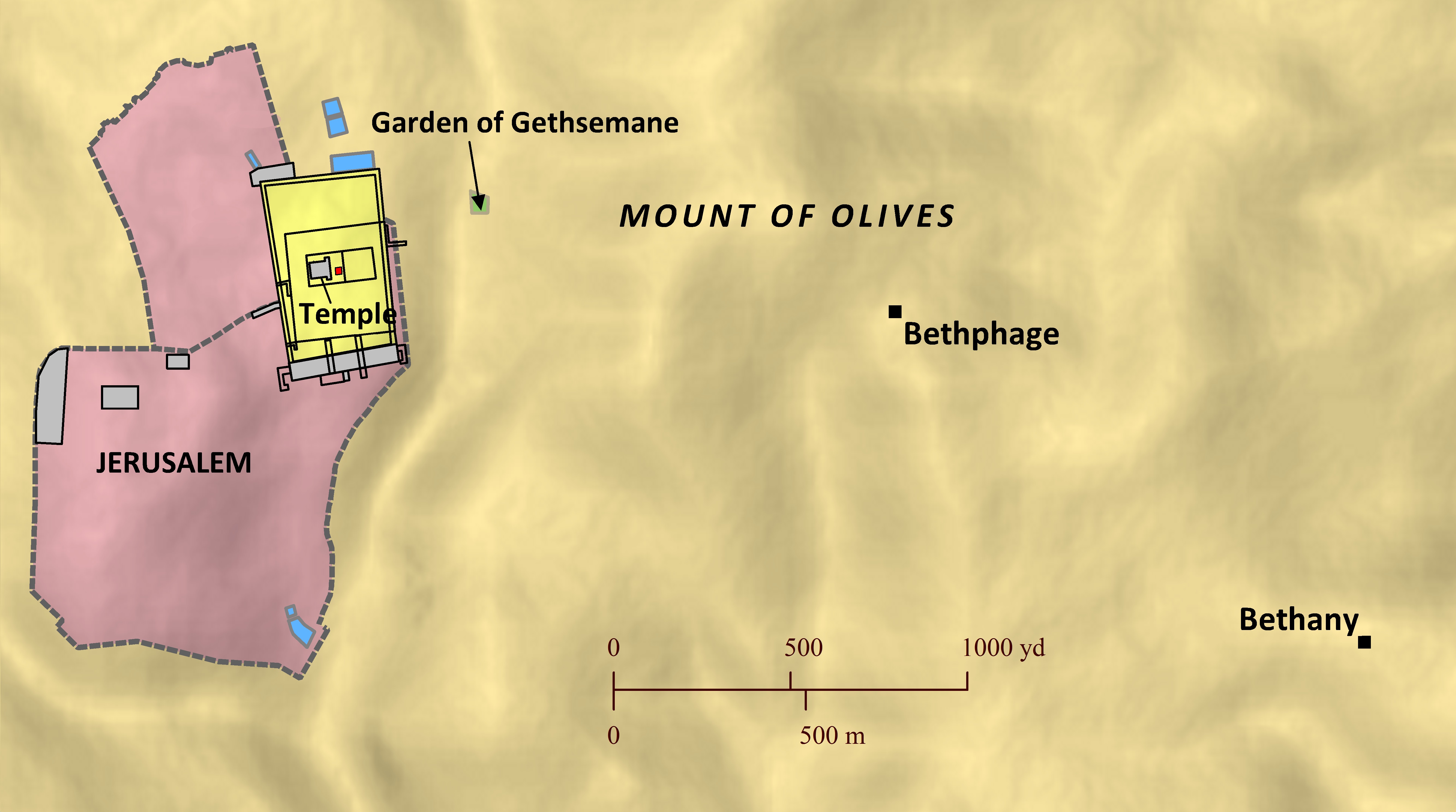
Matthew 21:1-17; Mark 11:1-11; Luke 19:28-48; John 12:1-19; see also Matthew 26:6-13; Mark 14:3-9
At the start of Passover one week before he was crucified, Jesus and his disciples traveled to Jerusalem, approaching the city from the east. When they arrived at the village of Bethphage, Jesus mounted a donkey and rode down the Mount of Olives as a humble king entering his capital city. Along the way, many people laid branches and cloaks in his path to welcome him. After Jesus entered the city, he immediately went up to the Temple and drove out the moneychangers and merchants there, and he healed the blind and the lame. Then he traveled nearly two miles outside the city to the village of Bethany to spend the night, which appears to have been where he typically lodged each night while visiting Jerusalem during the crowded Passover festival. Bethany is also where Jesus’ close friends Mary, Martha, and Lazarus lived. One evening while Jesus was there at a large dinner party given in his honor, Martha served the food, and Mary poured expensive perfume on Jesus’ feet and wiped his feet with her hair.
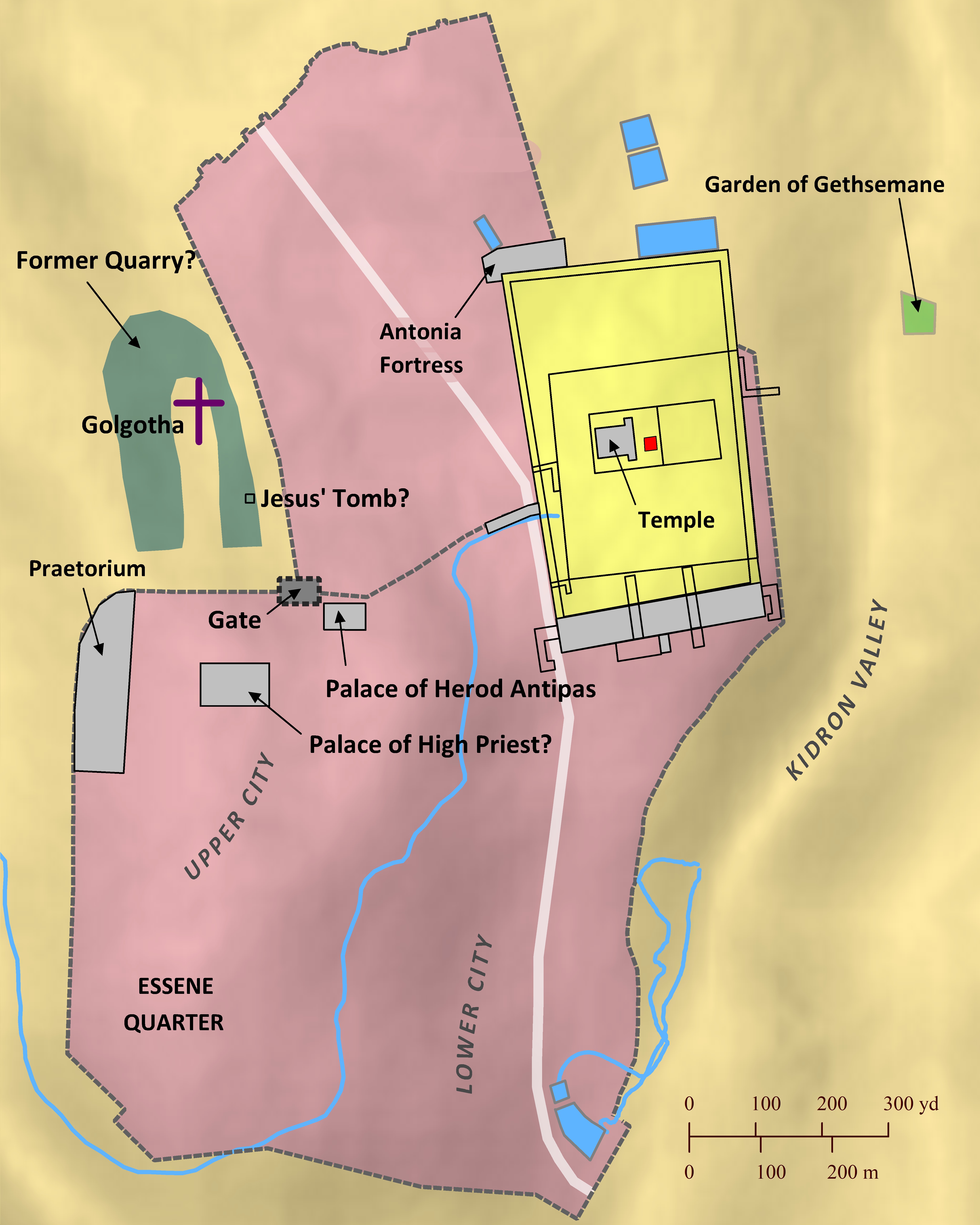
Matthew 26-27; Mark 14-15; Luke 22-23; John 13-19
On the Thursday before he was crucified, Jesus had arranged to share the Passover meal with his disciples in an upper room, traditionally thought to be located in the Essene Quarter of Jerusalem. After they finished the meal, they went to the Garden of Gethsemane, where Jesus often met with his disciples. There Judas Iscariot, one of Jesus’ own disciples, betrayed him to soldiers sent from the High Priest, and they took Jesus to the High Priest’s residence. In the morning the leading priests and teachers of the law put Jesus on trial and found him guilty of blasphemy. The council sent Jesus to stand trial for treason before the Roman governor Pontius Pilate, who resided at the Praetorium while in Jerusalem. The Praetorium was likely located at the former residence of Herod the Great, who had died over 30 years earlier. When Pilate learned that Jesus was from Galilee, he sent him to Herod Antipas, who had jurisdiction over Galilee. But when Jesus gave no answer to Herod’s many questions, Herod and his soldiers sent him back to Pilate, who conceded to the people’s demands that Jesus be crucified. Jesus was forced to carry his cross out of the city gate to Golgotha, meaning Skull Hill, referring to what may have been a small unquarried hill in the middle of an old quarry just outside the gate. After Jesus was unable to carry his cross any further, a man named Simon from Cyrene was forced to carry it for him. There at Golgotha they crucified Jesus. After Jesus died, his body was hurriedly taken down before nightfall and placed in a newly cut, rock tomb owned by Joseph of Arimathea, a member of the Jewish high council. This tomb was likely located at the perimeter of the old quarry.
Open Bible Data site copyright © 2023–2026 Freely-Given.org.
Python source code for creating these static pages is available on GitHub under an open licence.
For Bible data copyrights, see the details for each displayed Bible version.
The Open English Translation (OET) main site is at OpenEnglishTranslation.Bible or OET.Bible.