
OET INT FRT GEN EXO LEV NUM DEUT JOB YEHO (JOS) HERO (JDG) RUTH 1 SAM 2 SAM PSA AMOS HOS 1 KI 2 KI 1 CHR 2 CHR PROV ECC SNG YOEL (JOEL) MIC ISA ZEP HAB YIR (JER) LAM YNA (JNA) NAH OBAD DAN EZEK EZRA EST NEH HAG ZEC MAL 2 PS WIS TOB MAN BAR G DAN G ESD L ESD ESG JDT 3 MAC SIR 1 MAC 2 MAC 4 MAC YHN (JHN) MARK MAT LUKE ACTs YAC (JAM) GAL 1 TH 2 TH 1 COR 2 COR ROM COL LAOD PHM EPH PHP 1 TIM TIT 1 PET 2 PET 2 TIM HEB YUD (JUD) 1 YHN (1 JHN) 2 YHN (2 JHN) 3 YHN (3 JHN) REV
OET MARK Intro C2 C3 C4 C5 C6 C7 C8 C9 C10 C11 C12 C13 C14 C15 C16
OET MRK 1 V1 V3 V5 V7 V9 V11 V13 V15 V17 V19 V21 V23 V25 V27 V29 V31 V33 V35 V37 V39 V41 V43 V45
This is still an early look into the drafted text of the Open English Translation of the Bible. Please double-check the text in advance before using in public.
2 The prophet Yeshayah (Isaiah) wrote:
“Look, I’m sending my messenger ahead of you,
the one who’ll be preparing your path.[ref]
3 The voice out in the wilderness shouting,
‘Get the path ready for Yahweh—
≈ make it smooth for him to walk on.’ ”[ref]
4 Yohan (John; Grk. Yoannes) turned up in the wilderness announcing that people should get immersed in water in order to show that their sins have been forgiven, 5 and many from the Yehudah (Judea) region and from Yerushalem (Jerusalem) city went out to hear him, and asked Yohan to immerse them in the Yarden (Jordan) river as they confessed their sins.
6 Yohan was dressed in simple clothes made from camel hair with a leather belt around his waist,[ref] and he lived on locusts and wild honey. 7 He also announced, “There’s a greater man coming soon—in fact I’m not even good enough to bend down and untie his sandal straps. 8 I immersed you all in water, but he’ll immerse you in God’s holy spirit.”
1:9 Yeshua gets immersed and then tempted
(Mat. 3:13–4:11; Luke 3:21-22; 4:1-13)
9 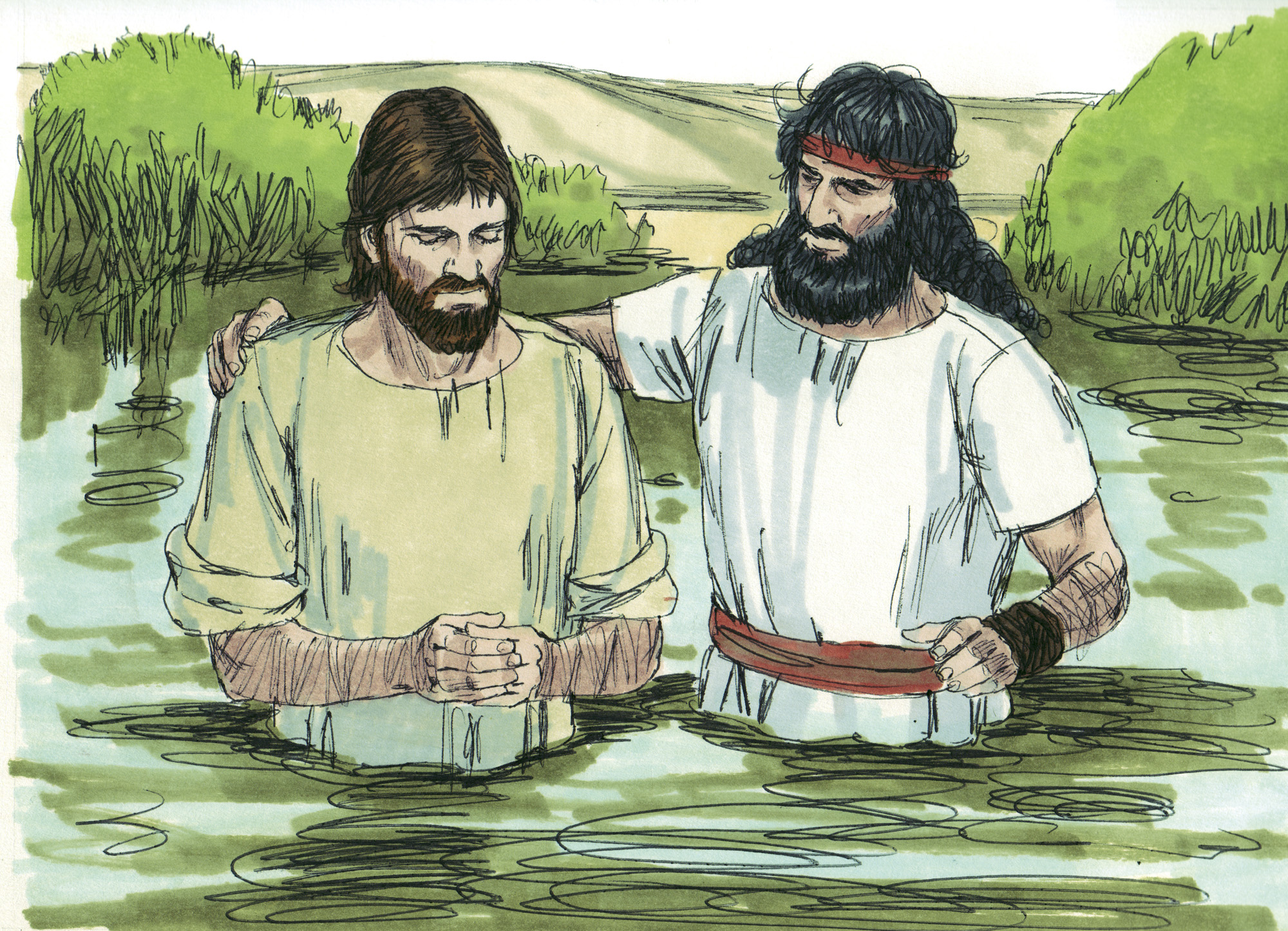 Then one day Yeshua (Jesus; Grk. Yesus) came from Nazaret (Nazareth) in the Galil region, and he got immersed in the Yarden (Jordan) river by Yohan (John; Grk. Yoannes). 10 As Yeshua came up out of the water, he saw the sky being opened up, and God’s spirit coming down on him like a dove. 11 And a voice came from the sky saying, “You’re my son who I love and am pleased with.”[ref]
12 After that, the spirit sent him out into the wilderness 13 where he was tested by Satan for forty days. He was out there with the wild animals, but God’s messengers[fn] looked after him there.
1:13 The Greek doesn’t actually distinguish between human messengers and heavenly messengers (so-called ‘angels’—the Greek word just transliterated letter-by-letter instead of being actually translated).
1:14 The selection of the first followers/apprentices
(Mat. 4:12-22; Luke 4:14-15; 5:1-11)
14 After Yohan (John; Grk. Yoannes) had been arrested, Yeshua (Jesus; Grk. Yesus) went back up north to Galil, announcing the good news from God 15 saying, “The promised time is here, and God’s kingdom is now near. Turn from your sins and believe this good news.”[ref]
16 As he went around Lake Galil, Yeshua saw two fishermen, Shim’on (Simon) and his brother Andreas, throwing a net into the lake 17 and he said to them, “Come with me and I’ll make you into fishers of people.” 18 So they left their fishing work and went off with Yeshua.
19 Then a bit further on he saw two of Zavday’s (Grk. Zebedaios’) sons, Ya’akov (James; Grk. Yakobos) and his brother Yohan, in a boat getting the nets ready. 20 Yeshua called them and they too went off with him, leaving their father Zavday in the boat with the hired workers.
21 They went on into Kafarnaoum (Capernaum) where as soon as a rest day started, he would go into the Jewish meeting hall (Grk. synagogue) and teach there. 22 The congregation was amazed at his teaching, because he taught like someone with authority, not like the regular teachers there.[ref]
23 Then a demon-possessed man in the meeting hall suddenly yelled out, 24 “What are we to you, Yeshua (Jesus; Grk. Yesus) of Nazaret (Nazareth)? You’ve come to destroy us. I know that you’re God’s holy one.”
25 But Yeshua scolded it,[fn] saying, “Keep quiet!”, and, “Come out of him!”
26 Then the demon threw the man into a convulsion, cried out loudly, and left him. 27 Everyone was astounded and asked each other, “What just happened? We haven’t heard anything like this before—he has authority to command demons, and they obey him!” 28 So then the news about Yeshua spread all over that entire Galil region.
1:25 The Greek pronoun is masculine, implying that the man was the one being scolded, yet “Come out of him!” implies that the spirit is being spoken to.
29 After leaving the meeting hall, Yeshua (Jesus; Grk. Yesus) went with Ya’akov (James; Grk. Yakobos) and Yohan (John; Grk. Yoannes) into the home of Shim’on (Simon) and Andreas. 30 Inside, Shim’on’s mother-in-law was lying down with a fever, and the others spoke to Yeshua about her. 31 When he went up to her, and took hold of her hand and helped her up, the fever left her and she prepared something for them to eat.
32 That evening when the sun set, the people brought all those who were sick or demon-possessed to Yeshua. 33 It seemed like the entire town had gathered there outside the front door. 34 Yeshua healed many who were sick from a range of diseases, and he commanded many demons to leave—not allowing them to speak because they knew that he was the messiah.
35 In the small hours of the morning, Yeshua (Jesus; Grk. Yesus) got up and went out to a quiet place and prayed there. 36 But Shim’on (Simon) and the others came looking for him, 37 and when they found him they said, “Everyone’s looking for you!”
38 “Well,” Yeshua answered, “we’ll be going into the other villages around here, so that I can also tell them. That’s what I came here for.” 39 Then he went preaching in all their meeting halls in Galil, and driving out demons.[ref]
40 One day, a man with leprosy came to Yeshua (Jesus; Grk. Yesus) asking him, “I know that you could heal me if you wanted to.”
41 Yeshua felt compassion for him, reached out his hand and touched him, and said, “Yes, I will. Get well.” 42 Then immediately the leprosy disappeared and he was well again. 43 So Yeshua sent him away, but warned him: 44 “Don’t talk to anyone—just go to the priest and show him that you’re well, and as a testimony of that, make the offering that Mosheh (Moses) commanded so as to be declared clean again.”[ref]
45 But after the man left, he started telling lots of people and spreading the news—so much so that Yeshua could no longer come into the town but had to stay out in quieter places, and people kept coming to him.

At the time of Jesus’ birth, the land of Israel (now called Palestine by the Romans) was ruled by the Romans, who had granted Herod the Great the title of “king” over the region (see “Palestine under Roman Rule” map). His domain included most of the land that once belonged to Israel. After his death, the Romans granted Herod’s wishes that his kingdom be divided among his sons Archelaus, Antipas, and Philip. The region of the Decapolis (“Ten Cities”) was never included in Herod’s kingdom and had a distinctly Gentile population and character. The cities of this region enjoyed semi-autonomous status under the Romans.
OET MARK Intro C2 C3 C4 C5 C6 C7 C8 C9 C10 C11 C12 C13 C14 C15 C16