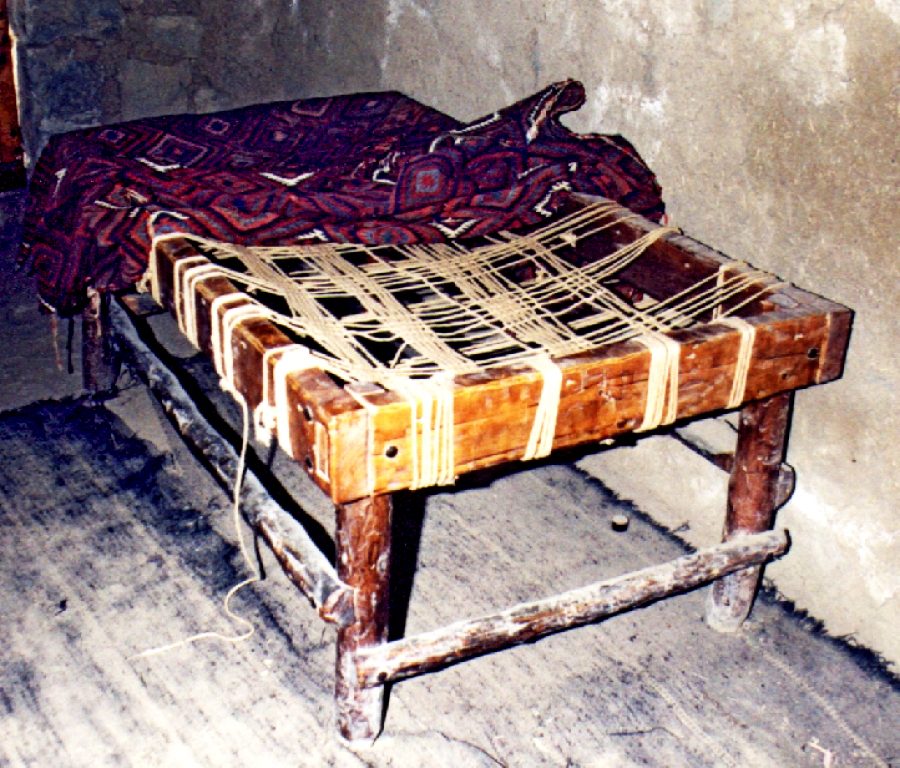
Replica of a wooden bed (© Ray Pritz by United Bible Societies)
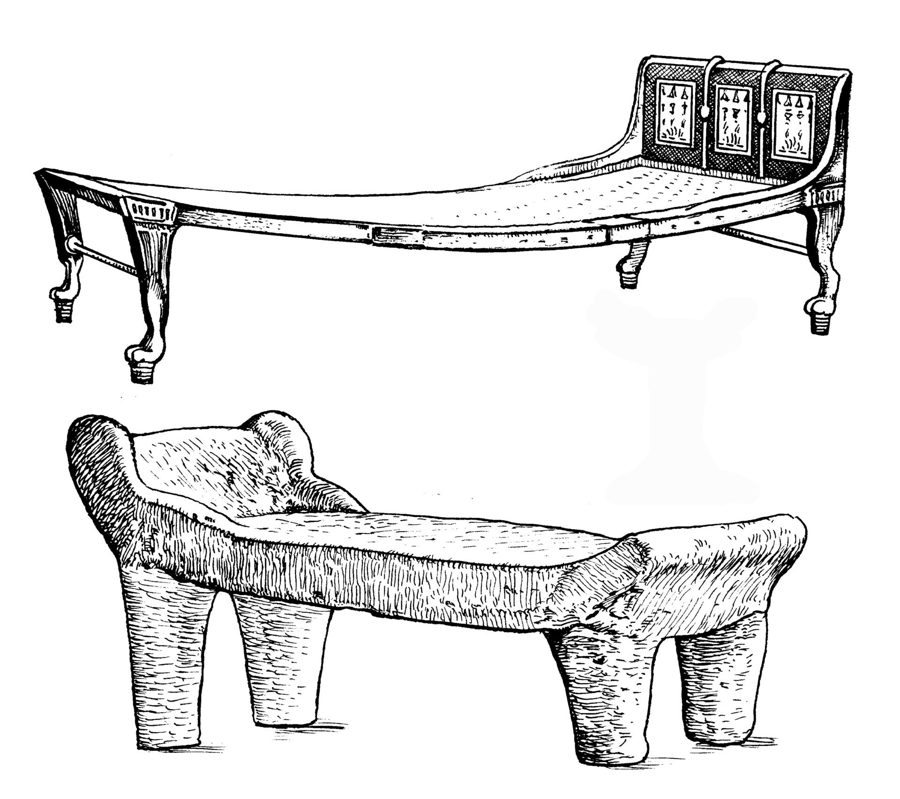
Drawing of beds made of different materials (© Deutsche Bibelgesellschaft, Stuttgart by United Bible Societies)
References
- Hebrew יָצוּעַ yatsu‘a: GEN 49:4, 1 CHR 5:1, JOB 17:13, PSA 63:6, PSA 132:3
- Hebrew מִטָּה mitah: GEN 47:31, GEN 48:2, GEN 49:33, EXO 8:3, 1 SAM 19:13, 1 SAM 19:15, 1 SAM 19:16, 1 SAM 28:23
20 more references
2 SAM 4:7, 1 KI 17:19, 1 KI 21:4, 2 KI 1:4, 2 KI 1:6, 2 KI 1:16, 2 KI 4:10, 2 KI 4:21, 2 KI 4:32, 2 KI 11:2, 2 CHR 22:11, 2 CHR 24:25, EST 1:6, EST 7:8, PSA 6:6, PROV 26:14, SNG 3:7, EZEK 23:41, AMOS 3:12, AMOS 6:4 - Hebrew מֵסַב mesav: SNG 1:12
- Hebrew מַצָּע matsa‘: ISA 28:20
- Hebrew מִשְׁכָּב mishkav: GEN 49:4, EXO 8:3, EXO 21:18, LEV 15:4, LEV 15:5, LEV 15:21, LEV 15:23, LEV 15:24
36 more references
LEV 15:26, LEV 18:22, LEV 20:13, NUM 31:17, NUM 31:18, NUM 31:35, HERO 21:11, HERO 21:12, 2 SAM 4:5, 2 SAM 4:7, 2 SAM 4:11, 2 SAM 11:2, 2 SAM 11:13, 2 SAM 13:5, 2 SAM 17:28, 1 KI 1:47, 2 KI 6:12, 2 CHR 16:14, JOB 7:13, JOB 33:15, JOB 33:19, PSA 4:4, PSA 36:4, PSA 41:3, PSA 149:5, PROV 7:17, PROV 22:27, ECC 10:20, SNG 3:1, ISA 57:2, ISA 57:7, ISA 57:8, EZEK 23:17, EZEK 32:25, HOS 7:14, MIC 2:1 - Hebrew עֶרֶשׂ ‘eres: DEUT 3:11, JOB 7:13, PSA 6:6, PSA 41:3, PSA 132:3, PROV 7:16, SNG 1:16, AMOS 3:12
1 more references
AMOS 6:4 - Greek κλινάριον klinarion: ACTs 5:15
- Greek κλίνη klinē: MAT 9:2, MAT 9:6, MARK 4:21, MARK 7:4, MARK 7:30, LUKE 5:18, LUKE 8:16, LUKE 17:34
- Greek κλινίδιον klinidion: LUKE 5:19, LUKE 5:24
- Greek κοίτη koitē: LUKE 11:7, ROM 9:10, ROM 13:13, HEB 13:4, JDT 13:1, ESG 4:17, WIS 3:13, WIS 3:16
- Greek κράβαττος krabattos: MARK 2:4, MARK 2:9, MARK 2:11, MARK 2:12, MARK 6:55, YHN 5:8, YHN 5:9, YHN 5:10
- Greek στρωμνή strōmnē: JDT 9:3, JDT 13:9
- Greek φορεῖον foreion: 2 MAC 3:27, 2 MAC 9:8
- Latin cubile: L ESD 3:1
- Latin lectus: L ESD 12:26
Description and usage
The bed was an object on which a person slept. In some cases it could be a raised piece of furniture. However, the Semites from Kena’an (Canaan) did not usually sleep on raised beds, but rather on skins spread on the floor. When the bed was a piece of raised furniture, it took a form similar to beds used in most cultures today: a low platform standing on four legs, a bit longer than the length of a man, and about 70-80 centimeters (27-31 inches) wide.
———
Translation
GEN 47:31: The beds used from ancient times in Mitsrayim (Egypt), especially by richer people, were similar to beds known in most cultures today. Specimens of them have been found in a number of Mitsri (Egyptian) tombs. Sometimes in place of pillows, the Mitsrim (Egyptians) made use of headrests. These were made of wood, concave in form, with a base or pedestal 20 centimeters (8 inches) or more in height. It is probable that it was this kind of headrest upon which Ya’akov (Jacob) bowed himself (compare NJB “pillow”). Another possibility may be considered when translating this verse. The Hebrew word mitah translated “bed” by RSV can also mean “staff,” and this indeed is how it was understood by the Septuagint (followed by HEB 11:21 and NIV). However, the great majority of translations say “bed.” Translators should not attempt to harmonize the translations of this verse and HEB 11:21.
PSA 6:6: “My couch” (RSV) in the third line of this verse is synonymous with “my bed” in the second line. GNT (also NJB, REB) uses “bed” and “pillow” as more natural contemporary equivalents.
SNG 1:12: The Hebrew word mesav referring to a piece of furniture occurs only here. While most modern translations understand it to be a kind of “couch” (RSV, GNT), some understand it to refer to the low “table” (KJV, NASB, SPCL) at which people reclined for meals. Some translations avoid having to make the choice by rendering the first line of this verse as “As long as my king is near me” (GECL) or “While my king is at his banquet” (FRCL). TOB renders mesav as “enclosure” and adds a footnote explaining that the word, which may designate the bed that surrounded the dining table or the courtiers surrounding the couple, here speaks of a garden whose perfume attracts the king. ITCL has adopted this interpretation by rendering the first line as “Now that my king is here in his garden.”
In a number of New Testament contexts, the Greek terms klinarion, klinidion and krabattos refer to cots or stretchers on which sick or convalescent persons might be resting or on which they could be transported. It could be made of reeds or cloth. It was thin and light and could be rolled or folded and carried easily by one person. There is no New Testament context in which these terms refer to couches on which people reclined while eating.
The Greek word klinē refers generally to any piece of furniture employed for reclining or lying on. In MAT 9:2 a rendering such as “stretcher” or “cot” (in American English) is certainly more advisable than the traditional rendering “bed” (RSV), which might imply a large piece of furniture. In each passage translators must employ a term for klinē that is most likely to identify the type of object which fits the context.
LUKE 11:7: It is not necessary to understand the statement “my children are with me in bed” (RSV) to mean that the children were in the same bed with the man, but it is, of course, possible that the reference here is to a relatively humble house in which all the members of the family would sleep on the floor in the same corner of the room or on a single raised platform. This passage may be rendered simply as “I have gone to bed and so have my children” or “I am already in bed and so are my children.”
The bed is sometimes used figuratively. In several places it refers to sexual intercourse (ROM 13:13, WIS 3:13, WIS 3:16, SIR 23:18), whether in marriage or in an unlawful union. When the Greek word koitē is used together with the verb echō in ROM 9:10, it means “to be pregnant.” In 1 MAC 1:5 the text says literally that Alexandros (Alexander) “fell into bed,” that is, he got sick or “fell sick” (RSV).
 Open English Translation (OET)