
OET OET-RV OET-LV GHT ULT UST BSB MSB BLB AICNT OEB WEBBE WMBB NET LSV FBV TCNT T4T LEB BBE Moff JPS Wymth ASV DRA YLT Drby RV SLT Wbstr KJB-1769 KJB-1611 Bshps Gnva Cvdl TNT Wycl SR-GNT UHB BrLXX BrTr Related Parallel Simple Interlinear Topics Reference Dictionary Search
ParallelVerse GEN EXO LEV NUM DEU JOB JOS JDG RUTH 1 SAM 2 SAM PSA AMOS HOS 1 KI 2 KI 1 CHR 2 CHR PROV ECC SNG JOEL MIC ISA ZEP HAB JER LAM YNA (JNA) NAH OBA DAN EZE EZRA EST NEH HAG ZEC MAL LAO GES LES ESG DNG 2 PS TOB JDT WIS SIR BAR LJE PAZ SUS BEL MAN 1 MAC 2 MAC 3 MAC 4 MAC YHN (JHN) MARK MAT LUKE ACTs YAC (JAM) GAL 1 TH 2 TH 1 COR 2 COR ROM COL PHM EPH PHP 1 TIM TIT 1 PET 2 PET 2 TIM HEB YUD (JUD) 1 YHN (1 JHN) 2 YHN (2 JHN) 3 YHN (3 JHN) REV
Acts Intro C1 C2 C3 C4 C5 C6 C7 C8 C9 C10 C11 C12 C13 C14 C16 C17 C18 C19 C20 C21 C22 C23 C24 C25 C26 C27 C28
Acts 15 V1 V3 V5 V7 V9 V11 V13 V15 V17 V19 V21 V23 V25 V27 V29 V31 V33 V35 V39 V41
Note: This view shows ‘verses’ which are not necessarily natural language units and hence sometimes only part of a sentence will be visible—click on any Bible version abbreviation down the left-hand side to see the verse in more of its context. Normally the OET discourages the reading of individual ‘verses’, but this view is only designed as a tool for Bible-translators and others doing comparisons of different translations—the older translations are further down the page (so you can read up from the bottom to trace the English translation history). The OET segments on this page are still early looks into the drafted texts of the Open English Translation of the Bible—please double-check these texts in advance before using in public.
B I ◄ ← Acts 15:37 ↓ → ► ≡ ═ ©
Text critical issues=small word differences Clarity of original=clear Importance to us=normal Speaker(s)=Narrator (All still tentative.)
OET (OET-RV) Barnabas agreed and wanted to take Yohan Markos (John Mark) along with them as well,
OET-LV And Barnabas was_wishing to_take_along_with them also the Yōannaʸs, which being_called Markos.
SR-GNT Βαρναβᾶς δὲ ἐβούλετο συμπαραλαβεῖν καὶ τὸν Ἰωάννην, τὸν καλούμενον Μᾶρκον. ‡
(Barnabas de ebouleto sumparalabein kai ton Yōannaʸn, ton kaloumenon Markon.)
Key: khaki:verbs, light-green:nominative/subject, orange:accusative/object.
Note: Automatic aligning of the OET-RV to the LV is done by some temporary software, hence the RV alignments are incomplete (and may occasionally be wrong).
GHT Moreover, Barnabas has-been-intending to-take-beside-together also John, the being-upon-called "Mark."
ULT But Barnabas was wanting also to take with them John called Mark.
UST Barnabas agreed that it would be good to go back and visit these believers. But Barnabas said that he wanted to take John, whose other name was Mark, along with them again.
BSB Barnabas wanted to take John, [also] called Mark.
MSB Barnabas wanted to take John called[fn] Mark.
15:37 CT and F35 John, also called
BLB Now Barnabas purposed also to take along John, called Mark.
AICNT Barnabas {wanted}[fn] to take with them [also][fn] John, called Mark.
15:37, wanted: Some manuscripts read “planned.” D(05) BYZ TR.
15:37, also: Absent from D(05) BYZ TR.
OEB Barnabas wished to take with them John, whose other name was Mark;
WEBBE Barnabas planned to take John, who was called Mark, with them also.
WMBB Barnabas planned to take Yochanan, who was called Mark, with them also.
NET Barnabas wanted to bring John called Mark along with them too,
LSV And Barnabas resolved to take with [them] John called Mark,
FBV Barnabas planned to take along John Mark too.
TCNT Now Barnabas wanted to bring John (who was also called Mark).
T4T Barnabas agreed with Paul, and said that he wanted to take John, whose other name was Mark, along with them again.
LEB Now Barnabas wanted to take John who was called Mark along also,
BBE And Barnabas had a desire to take with them John, named Mark.
Moff But while Barnabas wanted to take John (who was called Mark) along with them,
Wymth Barnabas, however, was bent on taking with them John, whose other name was Mark,
ASV And Barnabas was minded to take with them John also, who was called Mark.
DRA And Barnabas would have taken with them John also, that was surnamed Mark;
YLT And Barnabas counselled to take with [them] John called Mark,
Drby And Barnabas proposed to take with [them] John also, called Mark;
RV And Barnabas was minded to take with them John also, who was called Mark.
SLT And Barnabas purposed to take with them John, called Mark.
Wbstr And Barnabas determined to take with them John, whose surname was Mark.
KJB-1769 And Barnabas determined to take with them John, whose surname was Mark.
KJB-1611 And Barnabas determined to take with them Iohn, whose surname was Marke.
(Modernised spelling is same as from KJB-1769 above)
Bshps And Barnabas gaue counsell to take with them Iohn, whose sirname was Marke.
(And Barnabas gave council/counsel to take with them Yohn, whose surname was Mark.)
Gnva And Barnabas counselled to take with them Iohn, called Marke.
(And Barnabas counselled to take with them Yohn, called Mark.)
Cvdl But Barnabas gaue councell, that they shulde take with the Ihon, whose syrname was Marke.
(But Barnabas gave council/counsel, that they should take with the Yohn, whose surname was Mark.)
TNT And Barnabas gave counsell to take with them Iohn called also Marke.
(And Barnabas gave council/counsel to take with them Yohn called also Mark.)
Wycl And Barnabas wolde take with hym Joon, that was named Marcus.
(And Barnabas would take with him Yohn, that was named Marcus.)
Luth Barnabas aber gab Rat, daß sie mit sich nähmen Johannes, mit dem Zunamen Markus.
(Barnabass but gave council/advice, that they/she/them with itself/yourself/themselves taken John, with to_him surname(s) Markus.)
ClVg Barnabas autem volebat secum assumere et Joannem, qui cognominabatur Marcus.
(Barnabas however wanted with_him to_take_up and Yohan, who/which was_surnamed Marcus.)
UGNT Βαρναβᾶς δὲ ἐβούλετο συνπαραλαβεῖν καὶ τὸν Ἰωάννην, τὸν καλούμενον Μᾶρκον;
(Barnabas de ebouleto sunparalabein kai ton Yōannaʸn, ton kaloumenon Markon;)
SBL-GNT Βαρναβᾶς δὲ ⸀ἐβούλετο συμπαραλαβεῖν ⸀καὶ τὸν Ἰωάννην τὸν καλούμενον Μᾶρκον·
(Barnabas de ⸀ebouleto sumparalabein ⸀kai ton Yōannaʸn ton kaloumenon Markon;)
RP-GNT Βαρνάβας δὲ ἐβουλεύσατο συμπαραλαβεῖν τὸν Ἰωάννην, τὸν καλούμενον Μάρκον.
(Barnabas de ebouleusato sumparalabein ton Yōannaʸn, ton kaloumenon Markon.)
TC-GNT Βαρνάβας δὲ [fn]ἐβουλεύσατο [fn]συμπαραλαβεῖν [fn]τὸν [fn]Ἰωάννην τὸν [fn]καλούμενον Μάρκον,
(Barnabas de ebouleusato sumparalabein ton Yōannaʸn ton kaloumenon Markon,)
15:37 εβουλευσατο ¦ εβουλετο ᴄᴛ
15:37 συμπαραλαβειν ¦ συνπαραλαβειν ᴛʜ ᴡʜ
15:37 τον ¦ και ɴᴀ ᴘᴄᴋ ¦ και τον ꜱʙʟ ᴛʜ ᴡʜ
15:37 ιωαννην ¦ ιωανην ᴡʜ
15:37 καλουμενον ¦ επικαλουμενον ᴀɴᴛ
Key for above GNTs: yellow:punctuation differs, red:words differ (from our SR-GNT base).
Acts 15
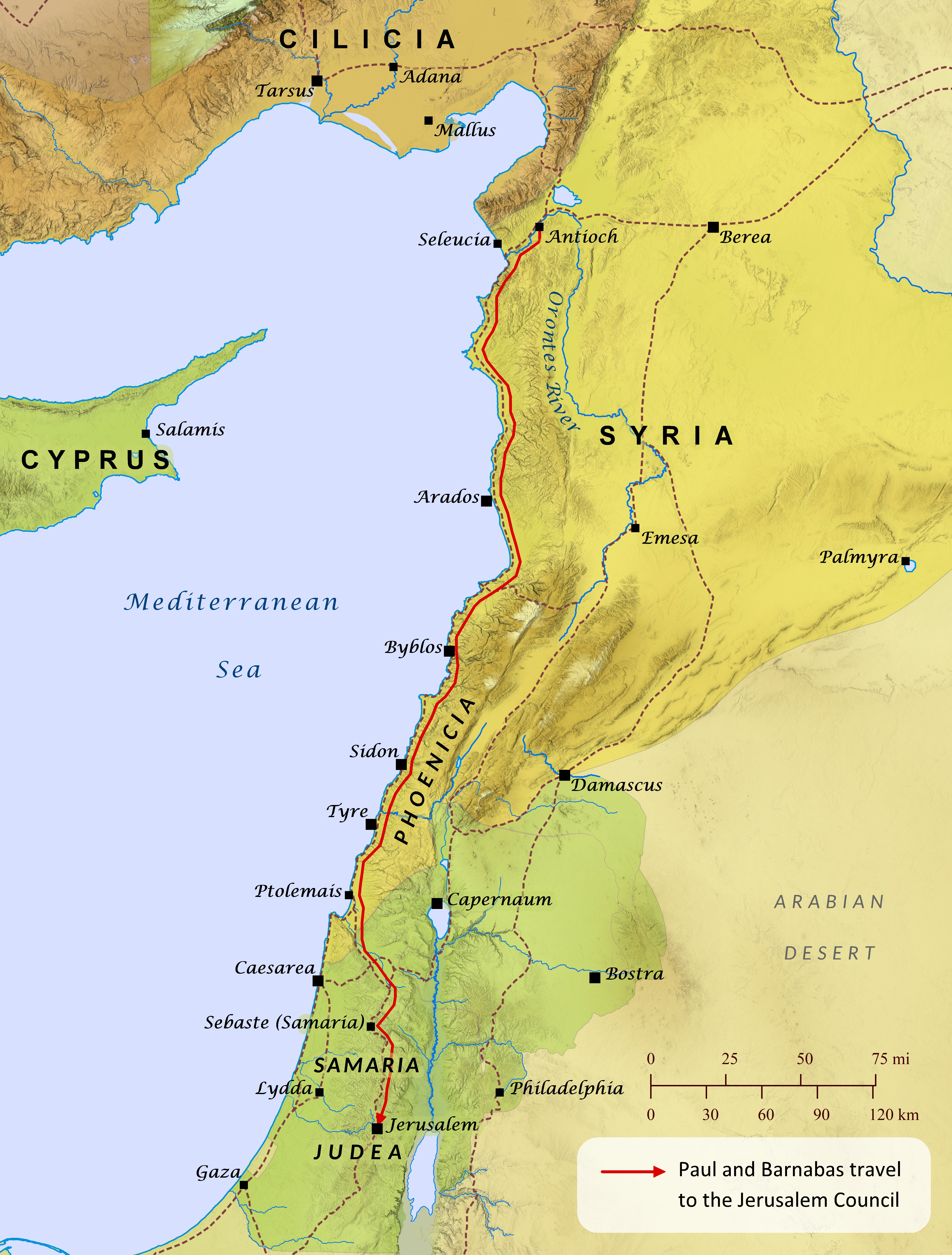
Paul’s first three missionary journeys originated from Antioch, one of the largest cities in the Roman Empire by Paul’s time. Founded by Seleucus I Nicator, it first served as the capital of the Seleucid Empire, and by the time of Paul it boasted a significant Jewish population. Decades earlier King Herod the Great of Judea had funded the building of a marble colonnaded street there that was nearly two miles (3.2 km) long. As persecuted followers of Jesus fled Judea, some of them traveled as far as Antioch. There they led many Jews and even Gentiles to become believers, and it was in Antioch that the followers of Jesus were first called “Christians” (Acts 11:19-26). Antioch was also the starting point for Paul’s first three missionary journeys (Acts 13:1-3; 15:36-41; 18:22-23). After Paul’s first missionary journey, some people came to Antioch from Judea and began to teach that all believers–Jews and Gentiles–must be circumcised and follow the laws of Moses (Acts 15:1). But Paul and Barnabas argued against them. So the church in Antioch sent Paul and Barnabas and other leaders to Jerusalem to discuss this issue with the apostles and elders there. As they passed through Phoenicia and Samaria on their way to Jerusalem, they told others (presumably Jewish believers) about the conversion of many Gentiles to the faith, and all the believers rejoiced with them. After Paul and the other leaders arrived in Jerusalem and were warmly received by the church there, their reports about the conversion of Gentiles led some believers from the sect of the Pharisees to insist that these new believers be circumcised and follow the laws of Moses. After much debate about the matter, the apostles and elders in Jerusalem decided that Gentile believers did not need to follow the laws of Moses except for a few critical requirements: that they abstain from sacrifices made to idols, from blood, from what has been strangled, and from sexual immorality. Then the Jerusalem church sent Paul and the other leaders back to Antioch with a letter stating this decision. After Paul and the others arrived in Antioch and delivered the letter, the church in Antioch rejoiced. Paul and Barnabas remained in Antioch and continued to teach the believers there. Sometime after this Paul and a believer named Silas embarked on a second missionary journey to visit the churches that Paul had helped to found during his first missionary journey, and Barnabas took his relative John Mark to minister in his home region of Cyprus.
Open Bible Data site copyright © 2023–2026 Freely-Given.org.
Python source code for creating these static pages is available on GitHub under an open licence.
For Bible data copyrights, see the details for each displayed Bible version.
The Open English Translation (OET) main site is at OpenEnglishTranslation.Bible or OET.Bible.