Open Bible Data Home About News OET Key
OET OET-RV OET-LV ULT UST BSB MSB BLB AICNT OEB WEBBE WMBB NET LSV FBV TCNT T4T LEB BBE Moff JPS Wymth ASV DRA YLT Drby RV SLT Wbstr KJB-1769 KJB-1611 Bshps Gnva Cvdl TNT Wycl SR-GNT UHB BrLXX BrTr Related Topics Parallel Interlinear Reference Dictionary Search
ParallelVerse GEN EXO LEV NUM DEU JOB JOS JDG RUTH 1 SAM 2 SAM PSA AMOS HOS 1 KI 2 KI 1 CHR 2 CHR PROV ECC SNG JOEL MIC ISA ZEP HAB JER LAM YNA (JNA) NAH OBA DAN EZE EZRA EST NEH HAG ZEC MAL LAO GES LES ESG DNG 2 PS TOB JDT WIS SIR BAR LJE PAZ SUS BEL MAN 1 MAC 2 MAC 3 MAC 4 MAC YHN (JHN) MARK MAT LUKE ACTs YAC (JAM) GAL 1 TH 2 TH 1 COR 2 COR ROM COL PHM EPH PHP 1 TIM TIT 1 PET 2 PET 2 TIM HEB YUD (JUD) 1 YHN (1 JHN) 2 YHN (2 JHN) 3 YHN (3 JHN) REV
Mark Intro C1 C2 C3 C4 C5 C6 C7 C8 C9 C10 C11 C12 C13 C14 C15 C16
Mark 15 V1 V3 V5 V7 V9 V11 V13 V15 V17 V19 V21 V23 V25 V27 V29 V31 V33 V35 V37 V39 V41 V43 V45 V47
Note: This view shows ‘verses’ which are not natural language units and hence sometimes only part of a sentence will be visible—click on any Bible version abbreviation down the left-hand side to see the verse in more of its context. Normally the OET discourages the reading of individual ‘verses’, but this view is only designed as a tool for doing comparisons of different translations—the older translations are further down the page (so you can read up from the bottom to trace the English translation history). The OET segments on this page are still very early looks into the unfinished texts of the Open English Translation of the Bible—please double-check these texts in advance before using in public.
Text critical issues=small word differences Clarity of original=clear Importance to us=normal (All still tentative.)
OET (OET-RV) [ref](Back in the temple, the curtain tore down the middle from the top to the bottom.)
OET-LV And the curtain of_the temple was_torn into two, from top to bottom.

SR-GNT Καὶ τὸ καταπέτασμα τοῦ ναοῦ ἐσχίσθη εἰς δύο, ἀπʼ ἄνωθεν ἕως κάτω. ‡
(Kai to katapetasma tou naou esⱪisthaʸ eis duo, apʼ anōthen heōs katō.)
Key: khaki:verbs, light-green:nominative/subject, orange:accusative/object, pink:genitive/possessor.
Note: Automatic aligning of the OET-RV to the LV is done by some temporary software, hence the RV alignments are incomplete (and may occasionally be wrong).
ULT And the curtain of the temple was split in two from top to bottom.
UST And then the drape hanging in front of the Most Holy Place in the temple ripped in half; it tore from the top to the bottom.
BSB And the veil of the temple was torn in two from top to bottom.
MSB (Same as BSB above)
BLB And the veil of the temple was torn into two from top to bottom.
AICNT And the curtain of the temple was torn in two from top to bottom.
OEB The Temple curtain was torn in two from top to bottom.
WEBBE The veil of the temple was torn in two from the top to the bottom.
WMBB (Same as above)
NET And the temple curtain was torn in two, from top to bottom.
LSV and the veil of the temple was torn in two from top to bottom,
FBV The Temple veil was ripped in two from top to bottom.
TCNT Then the veil of the temple was torn in two from top to bottom.
T4T At that moment the heavy thick curtain that closed off the most holy place in the Temple split into two pieces from top to bottom. That showed that ordinary people could now go into the presence of God.
LEB And the curtain of the temple was torn in two from top to bottom.
BBE And the curtain of the Temple was parted in two from end to end.
Moff And the curtain of the temple was torn in two, from top to bottom.
Wymth And the curtain in the Sanctuary was torn in two, from top to bottom.
ASV And the veil of the temple was rent in two from the top to the bottom.
DRA And the veil of the temple was rent in two, from the top to the bottom.
YLT and the veil of the sanctuary was rent in two, from top to bottom,
Drby And the veil of the temple was rent in two from the top to the bottom.
RV And the veil of the temple was rent in twain from the top to the bottom.
SLT And the veil of the temple was split in two from above to below.
Wbstr And the vail of the temple was rent in two, from the top to the bottom.
KJB-1769 And the veil of the temple was rent in twain from the top to the bottom.
KJB-1611 And the vaile of the Temple was rent in twaine, from the top to the bottome.
(And the veil of the Temple was rent in twain/two_or_both, from the top to the bottom.)
Bshps And the vayle of the temple dyd rent in two peeces, from the toppe to the bottome.
(And the veil of the temple did rent in two pieces, from the top to the bottom.)
Gnva And the vaile of the Temple was rent in twaine, from the toppe to the bottome.
(And the veil of the Temple was rent in twain/two_or_both, from the top to the bottom. )
Cvdl And the vale of the teple rent in two peces, from aboue tyll beneth.
(And the vale of the teple rent in two pieces, from above till beneath.)
TNT And the vayle of the temple dyd rent in two peces, from the toppe to the boottome.
(And the veil of the temple did rent in two pieces, from the top to the boottome. )
Wycl And the veil of the temple was rent atwo fro the hiyeste to bynethe.
(And the veil of the temple was rent atwo from the highest to beneath.)
Luth Und der Vorhang im Tempel zerriß in zwei Stücke, von oben an bis unten aus.
(And the/of_the Vorhang in_the temple tore in two pieces, from above at/to until below out.)
ClVg Et velum templi scissum est in duo, a summo usque deorsum.[fn]
(And velum temple split it_is in/into/on two, from top until down. )
15.38 Et velum templi. Ut arcam testamenti, et omnia legis sacramenta quæ tegebantur appareant, et ad gentes transeant. Ante dicebatur: Notus in Judæa Deus, in Isræl magnum nomen ejus Psal. 75.; nunc autem: Exaltare super cœlos Deus Ibid. 56., et in omni, etc.; et in Evangelio prius: In viam gentium ne abieritis Matth. 10..; et post passionem: Ite, et docete omnes gentes Ibid. 28..
15.38 And velum temple. As the_box testament, and everything law sacraments which tegebantur appareant, and to people/nations let_them_pass. Ante it_was_said: Notus in/into/on Yudea God, in/into/on Israel magnum name his Psal. 75.; now however: Exalt/Speak_highly_of over heavens God Ibid. 56., and in/into/on omni, etc.; and in/into/on Evangelio first/before: In way/road nations not you_will_open Matth. 10..; and after passion: Ite, and teach everyone people/nations Ibid. 28..
UGNT καὶ τὸ καταπέτασμα τοῦ ναοῦ ἐσχίσθη εἰς δύο, ἀπ’ ἄνωθεν ἕως κάτω.
(kai to katapetasma tou naou esⱪisthaʸ eis duo, ap’ anōthen heōs katō.)
SBL-GNT καὶ τὸ καταπέτασμα τοῦ ναοῦ ἐσχίσθη εἰς δύο ἀπʼ ἄνωθεν ἕως κάτω.
(kai to katapetasma tou naou esⱪisthaʸ eis duo apʼ anōthen heōs katō.)
RP-GNT Καὶ τὸ καταπέτασμα τοῦ ναοῦ ἐσχίσθη εἰς δύο ἀπὸ ἄνωθεν ἕως κάτω.
(Kai to katapetasma tou naou esⱪisthaʸ eis duo apo anōthen heōs katō.)
TC-GNT Καὶ τὸ καταπέτασμα τοῦ ναοῦ ἐσχίσθη εἰς δύο [fn]ἀπὸ ἄνωθεν ἕως κάτω.
(Kai to katapetasma tou naou esⱪisthaʸ eis duo apo anōthen heōs katō. )
15:38 απο ¦ απ CT
Key for above GNTs: yellow:punctuation differs, red:words differ (from our SR-GNT base).
15:38 The curtain that was torn in two might have been the one that separated the sanctuary from the courtyard (a magnificent tapestry eighty feet tall) or the one that separated the Most Holy Place from the rest of the sanctuary. If it was the former, the tearing (like the darkness, 15:33) was visible to people; it would indicate that Jesus’ prediction of the sanctuary’s destruction (14:58; 15:29) was being fulfilled spiritually (see Rom 9–11) but awaited physical fulfillment in AD 70. If it was the interior curtain that tore, it was probably a sign that, just as the heavens were split for Jesus to reveal his direct access to God (see study note on Mark 1:10), his death now extended this access to his followers (see Heb 6:19-20; 9:3-14; 10:19-20).
Mark told the story of Jesus’ death and indicated the time certain important events happened. Jesus was nailed to the cross at the third hour of the day (9:00 a.m.). Then at the sixth hour (12:00 noon) it became as dark as nighttime. It probably remained dark until Jesus died sometime during the ninth hour (3:00 p.m.).
Three important events happened in this section. First, Jesus shouted, “My God, my God, why have you abandoned me?” These are the only words that Mark recorded that Jesus spoke while on the cross. They show that God the Father rejected Jesus while he took upon himself the sins of mankind. Second, when Jesus died, the curtain in the temple was torn in two. This curtain represented the barrier between mankind and the presence of God. Third, the Roman centurion in charge of the crucifixion confessed that Jesus was the Son of God. (He was the first man in the book of Mark to say this.)
It is good to translate this section before you decide on a heading for it.
Here are some other possible headings for this section:
The death of Jesus
Jesus dies on the cross
There are parallel passages for this section in Matthew 27:45–56, Luke 23:44–49, and John 19:28–30.
And the veil of the temple was torn in two
¶ The curtain that was in the temple tore/ripped into two pieces,
¶ Just then, the heavy cloth divider that hung/was in the temple split/divided in two.
from top to bottom.
starting at the top and going to the bottom.
The tear went from the top of the cloth divider to the bottom.
And: The Greek word that the BSB translates as And introduces what happened immediately after Jesus died. In some languages, it may be natural to use a time word or phrase here. For example:
At once (CEV)
Just then
the veil of the temple: The phrase the veil of the temple refers to the large, thick cloth that hung in the temple. It either hung at the entrance to the temple building or between two rooms in the temple building. (These two rooms are known as “The Holy Place” and “The Holy of Holies.”In the commentaries there is much discussion of which of these two curtains is intended and with divided opinion. The outer curtain is favored by some because of its public aspect. The inner curtain is favored by others because of references to it in Hebrews (6:19, 9:3; 10:19–20) and because the Greek word used here is more consistently used of the inner curtain. In the end, the choice of curtain does not greatly effect the sense. The tearing of either curtain would speak of the destruction of the temple and Old Testament system and symbolically show that a new way has been opened for man to approach God.) This curtain was possibly as much as twenty-five meters tall.
Here are some other ways to translate this phrase:
cloth door of the temple
cloth divider of the temple
heavy cloth that separated two rooms in the temple
temple: The Greek word that the BSB translates as temple here refers to the main temple building. This is the same word as in 14:58b and 15:29c–d. See temple, Meaning 2, in the Glossary for more information.
was torn in two from top to bottom: The Greek phrase that the BSB translates as was torn in two means that the curtain was ripped/split into two pieces.The same Greek verb is used in a figurative sense in 1:10b (“He saw the heavens breaking open”). If possible, use the same word you used there.
If possible, use an expression that does not identify who (or what) caused the curtain to tear. For example:
the curtain tore/ripped in two
the curtain was torn/divided in two
If it is necessary in your language to identify who caused this to happen, you should say “God.” For example:
God tore the curtain in two.
Note 1 topic: translate-symaction
τὸ καταπέτασμα τοῦ ναοῦ ἐσχίσθη
(Some words not found in SR-GNT: Καί τό καταπέτασμα τοῦ ναοῦ ἐσχίσθη εἰς δύο ἀπʼ ἄνωθεν ἕως κάτω)
If your language does not use this passive form, you could express the idea in active form or in another way that is natural in your language. If you need to say who did the action, it is clear from the context that it was God. Alternate translation: [God split the curtain of the temple]
Note 2 topic: figures-of-speech / explicit
τὸ καταπέτασμα τοῦ ναοῦ
(Some words not found in SR-GNT: Καί τό καταπέτασμα τοῦ ναοῦ ἐσχίσθη εἰς δύο ἀπʼ ἄνωθεν ἕως κάτω)
Here Mark could be referring to the curtain: (1) that separated the Most Holy Place from the rest of the temple. Alternate translation: [the curtain that marked off the Most Holy Place in the temple] (2) that separated the Holy Place from the rest of the temple area. Alternate translation: [the curtain that marked off the temple building]
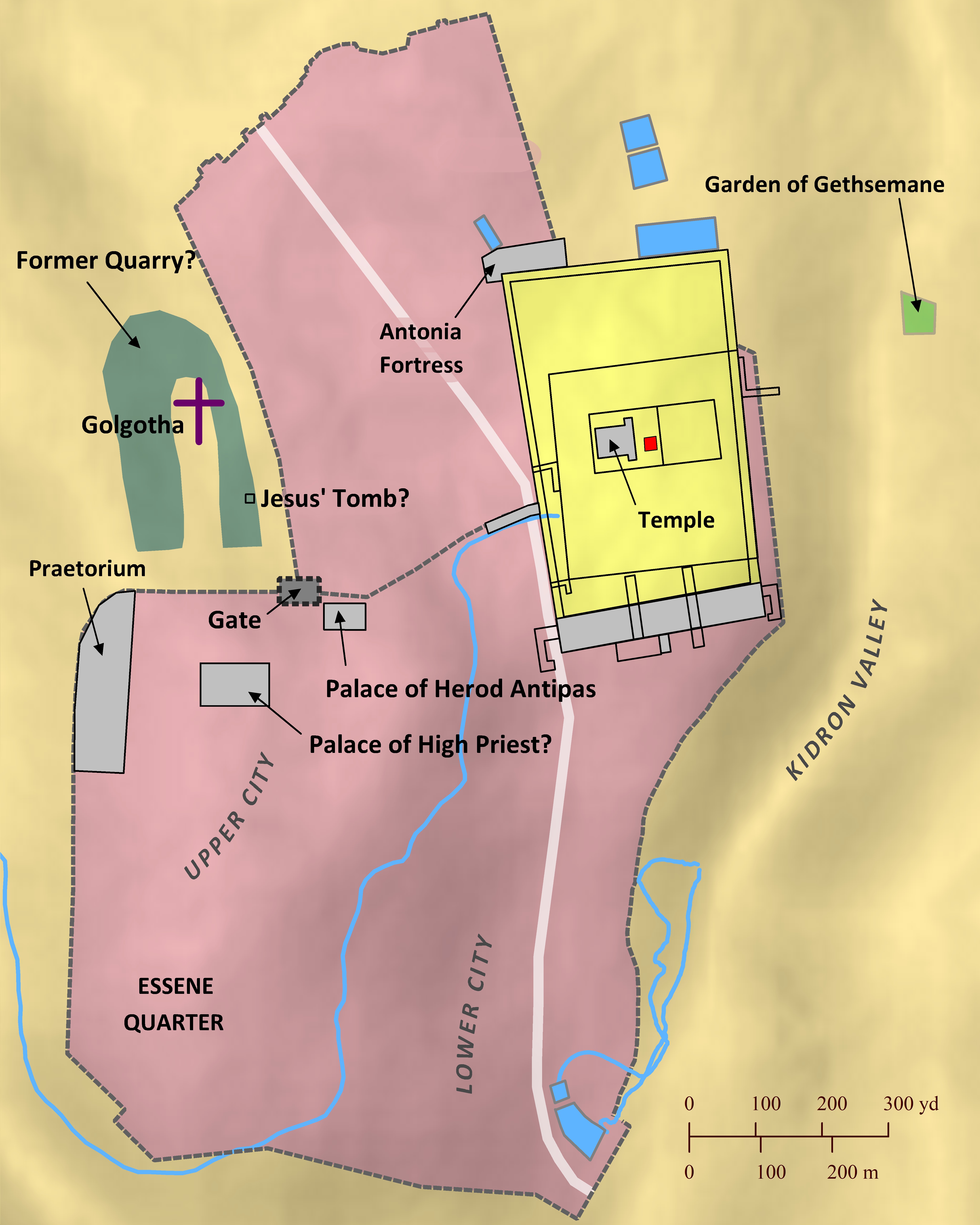
Matthew 26-27; Mark 14-15; Luke 22-23; John 13-19
On the Thursday before he was crucified, Jesus had arranged to share the Passover meal with his disciples in an upper room, traditionally thought to be located in the Essene Quarter of Jerusalem. After they finished the meal, they went to the Garden of Gethsemane, where Jesus often met with his disciples. There Judas Iscariot, one of Jesus’ own disciples, betrayed him to soldiers sent from the High Priest, and they took Jesus to the High Priest’s residence. In the morning the leading priests and teachers of the law put Jesus on trial and found him guilty of blasphemy. The council sent Jesus to stand trial for treason before the Roman governor Pontius Pilate, who resided at the Praetorium while in Jerusalem. The Praetorium was likely located at the former residence of Herod the Great, who had died over 30 years earlier. When Pilate learned that Jesus was from Galilee, he sent him to Herod Antipas, who had jurisdiction over Galilee. But when Jesus gave no answer to Herod’s many questions, Herod and his soldiers sent him back to Pilate, who conceded to the people’s demands that Jesus be crucified. Jesus was forced to carry his cross out of the city gate to Golgotha, meaning Skull Hill, referring to what may have been a small unquarried hill in the middle of an old quarry just outside the gate. After Jesus was unable to carry his cross any further, a man named Simon from Cyrene was forced to carry it for him. There at Golgotha they crucified Jesus. After Jesus died, his body was hurriedly taken down before nightfall and placed in a newly cut, rock tomb owned by Joseph of Arimathea, a member of the Jewish high council. This tomb was likely located at the perimeter of the old quarry.
Open Bible Data site copyright © 2023–2026 Freely-Given.org.
Python source code for creating these static pages is available on GitHub under an open licence.
For Bible data copyrights, see the details for each displayed Bible version.
The Open English Translation (OET) main site is at OpenEnglishTranslation.Bible or OET.Bible.