
OET INT FRT GEN EXO LEV NUM DEUT JOB YEHO (JOS) HERO (JDG) RUTH 1 SAM 2 SAM PSA AMOS HOS 1 KI 2 KI 1 CHR 2 CHR PROV ECC SNG YOEL (JOEL) MIC ISA ZEP HAB YIR (JER) LAM YNA (JNA) NAH OBAD DAN EZEK EZRA EST NEH HAG ZEC MAL 2 PS WIS TOB MAN BAR G DAN G ESD L ESD ESG JDT 3 MAC SIR 1 MAC 2 MAC 4 MAC YHN (JHN) MARK MAT LUKE ACTs YAC (JAM) GAL 1 TH 2 TH 1 COR 2 COR ROM COL LAOD PHM EPH PHP 1 TIM TIT 1 PET 2 PET 2 TIM HEB YUD (JUD) 1 YHN (1 JHN) 2 YHN (2 JHN) 3 YHN (3 JHN) REV
OET MARK Intro C1 C2 C3 C4 C5 C6 C7 C8 C9 C10 C11 C12 C13 C14 C16
OET MRK 15 V1 V3 V5 V7 V9 V11 V13 V15 V17 V19 V21 V23 V25 V27 V29 V31 V33 V35 V37 V39 V41 V43 V45 V47
This is still an early look into the drafted text of the Open English Translation of the Bible. Please double-check the text in advance before using in public.
15:1 Pilatos tries to interrogate Yeshua
(Yhn 18:28-38; Mat. 27:1-2; 11-14; Luke 23:1-5)
15 First thing in the morning, the chief priests called a meeting with the elders and the religious teachers and all the council, and they ordered that Yeshua (Jesus; Grk. Yesus) be tied up and taken over to Governor Pilatos (Pilate). 2 There Pilatos asked him, “Are you the king of the Yehudim (Jews)?”
“You said it,” replied Yeshua.
3 Then the chief priests started hurling accusations against Yeshua, 4 so Pilatos asked him again, “Don’t you have anything to say? Listen to all those accusations they’re making against you.”
5 ⇔But Pilatos was astounded that Yeshua didn’t answer any further.
6 Now at time of the Jewish Passover, at their request, Pilatos (Pilate) would normally pardon one prisoner for them. 7 There was another prisoner at that time named Bar-Aba (Grk. Barabbas), who was an activist arrested for murder. 8 By now the crowd had arrived, and asked Pilatos to release a prisoner as usual at Passover, 9 so he asked them, “Do you all want me to release the King of the Yehudim (Jews) for you?” 10 (That was because Pilatos was well aware that the chief priests had brought Yeshua (Jesus; Grk. Yesus) because they were jealous of his popularity.) 11 But the chief priests stirred up the crowd to start saying that it was Bar-Aba that they wanted released, 12 so Pilatos asked again, “Then what should I do with this man that you call the King of the Yehudim?”
13 The crowd yelled back, “Execute him on a post.”
14 “What has he even done wrong?” Pilatos demanded.
But they just yelled louder, “Execute him on a post!”
15 Now Pilatos wanted to placate the crowd, so he had Bar-Aba released while he had Yeshua flogged and then handed over to the execution squad.
16 So the soldiers led Yeshua (Jesus; Grk. Yesus) inside the palace that was the governor’s residence, and called in the rest of the battalion. 17 They mocked Yeshua by dressing him in a kingly robe, and after someone twisted some thorns together into a mock crown, they pressed it onto his head, 18 and began saluting him, “Greetings, king of the Yehudim (Jews).” 19 They took turns whacking his head with a stick and spitting on him, while others knelt down in front of him and pretended to be bowing to him. 20 After they’d finished having fun mocking him, they took the purple robe off him, and put his own robe back on him. Then they led him outside towards the execution area.
21 As they walked out of the city, they came across a man coming in from the country. He was Shim’on (Simon) from Kurainai (Cyrene) (Kurainai—the father of Alexandros (Alexander) and Rufos),[ref] and the soldiers forced him to carry the execution post, 22 and so they all arrived at Golgotha (which means ‘Place of the skull’). 23 There the soldiers went to give some spiced wine to Yeshua (Jesus; Grk. Yesus), but he declined it. 24 So they carried out the execution, taking Yeshua’s clothes and drawing straws to see who would get what.[ref] 25 By now it was around 9am, and they affixed Yeshua to the post. 26 The charge had been written out and attached at the top: “The king of the Yehudim (Jews).” 27 That morning, two thieves were also executed there—one on each side of Yeshua.
28 ◘ 29 As people passed by on that path, they insulted Yeshua, shaking their heads[ref] and shouting, “Hoy there! You who reckoned you could demolish the temple and rebuild it in three days,[ref] 30 come down from that post and save yourself.”
31 Similarly the chief priests and the religious teachers laughed together and mocked, “He did miracles for others, but he can’t even save himself. 32 Now if that so-called ‘chosen one’ or ‘king of Yisrael’ (Israel) would just come down from there, then we’d be able to believe him.”
Even the other two being executed with him were deriding him.
33 At noon, it got dark everywhere, until around 3pm, 34 when Yeshua (Jesus; Grk. Yesus) shouted loudly, “My god, my god, why have you abandoned me?”[ref]
35 Some of the people standing nearby thought he was calling the prophet Eliyah (Elijah). 36 One of them ran, and soaked a sponge in some sour wine, then put it on a stick and held it up for Yeshua to drink,[ref] saying, “Hang on. Let’s see if Eliyah does come to get him down.”
37 But just then, Yeshua uttered a loud cry and exhaled his last breath.
38 (Back in the temple, the curtain tore down the middle from the top to the bottom.)[ref] 39 When Yeshua died, the Romaios commander who had been standing back watching everything said, “That man was definitely God’s son.”
40 Further back, there was also a group of women observing everything. They included Miryam (Grk. Maria/Mariam) from Magdala, Miryam the mother of young Ya’akov (James; Grk. Yakobos) and Yoseh, and Salome,[ref] 41 and others who had followed Yeshua around Galil and helped look after him, along with many others who had come down to Yerushalem (Jerusalem) with him.
42 As evening came, it was now the Preparation Day, i.e., the day before the Rest Day. 43 Yosef (Joseph) (who’d come from Arimathaia city and one who was waiting for the coming of God’s kingdom), a prominent council member, steeled himself up and went in to see the governor to get permission to transfer Yeshua’s (Jesus’; Grk. Yesus’) body. 44 Governor Pilatos (Pilate) didn’t think he’d be dead yet, so he called an army commander to find out if Yeshua had indeed died. 45 As soon as he found out, he gave Yosef permission, 46 so Yosef and his companions went and bought some linen burial cloth and then, removing Yeshua’s body from the post, wrapped it in the cloth and placed it in a burial chamber that had been chiselled into a rockface. Then they rolled a rock across the opening. 47 Others were watching and noted where the body had been laid, including Miryam (Grk. Maria/Mariam) from Magdala and Miryam who was Yoseh’ mother.

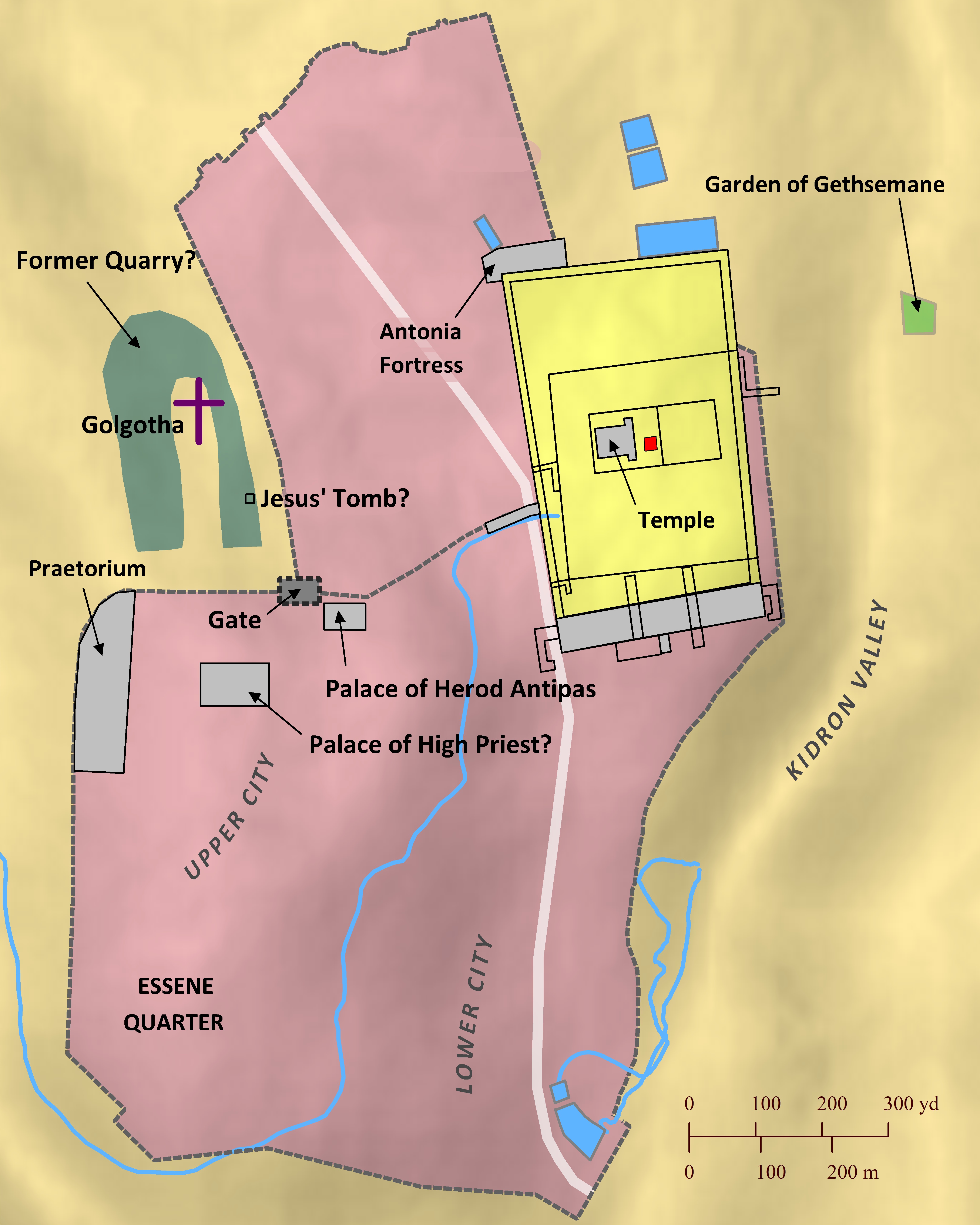
Matthew 26-27; Mark 14-15; Luke 22-23; John 13-19
On the Thursday before he was crucified, Jesus had arranged to share the Passover meal with his disciples in an upper room, traditionally thought to be located in the Essene Quarter of Jerusalem. After they finished the meal, they went to the Garden of Gethsemane, where Jesus often met with his disciples. There Judas Iscariot, one of Jesus’ own disciples, betrayed him to soldiers sent from the High Priest, and they took Jesus to the High Priest’s residence. In the morning the leading priests and teachers of the law put Jesus on trial and found him guilty of blasphemy. The council sent Jesus to stand trial for treason before the Roman governor Pontius Pilate, who resided at the Praetorium while in Jerusalem. The Praetorium was likely located at the former residence of Herod the Great, who had died over 30 years earlier. When Pilate learned that Jesus was from Galilee, he sent him to Herod Antipas, who had jurisdiction over Galilee. But when Jesus gave no answer to Herod’s many questions, Herod and his soldiers sent him back to Pilate, who conceded to the people’s demands that Jesus be crucified. Jesus was forced to carry his cross out of the city gate to Golgotha, meaning Skull Hill, referring to what may have been a small unquarried hill in the middle of an old quarry just outside the gate. After Jesus was unable to carry his cross any further, a man named Simon from Cyrene was forced to carry it for him. There at Golgotha they crucified Jesus. After Jesus died, his body was hurriedly taken down before nightfall and placed in a newly cut, rock tomb owned by Joseph of Arimathea, a member of the Jewish high council. This tomb was likely located at the perimeter of the old quarry.
OET MARK Intro C1 C2 C3 C4 C5 C6 C7 C8 C9 C10 C11 C12 C13 C14 C16