
OET OET-RV OET-LV GHT ULT UST BSB MSB BLB AICNT OEB WEBBE WMBB NET LSV FBV TCNT T4T LEB BBE Moff JPS Wymth ASV DRA YLT Drby RV SLT Wbstr KJB-1769 KJB-1611 Bshps Gnva Cvdl TNT Wycl SR-GNT UHB BrLXX BrTr Related Parallel Simple Interlinear Topics Reference Dictionary Search
ParallelVerse GEN EXO LEV NUM DEU JOB JOS JDG RUTH 1 SAM 2 SAM PSA AMOS HOS 1 KI 2 KI 1 CHR 2 CHR PROV ECC SNG JOEL MIC ISA ZEP HAB JER LAM YNA (JNA) NAH OBA DAN EZE EZRA EST NEH HAG ZEC MAL LAO GES LES ESG DNG 2 PS TOB JDT WIS SIR BAR LJE PAZ SUS BEL MAN 1 MAC 2 MAC 3 MAC 4 MAC YHN (JHN) MARK MAT LUKE ACTs YAC (JAM) GAL 1 TH 2 TH 1 COR 2 COR ROM COL PHM EPH PHP 1 TIM TIT 1 PET 2 PET 2 TIM HEB YUD (JUD) 1 YHN (1 JHN) 2 YHN (2 JHN) 3 YHN (3 JHN) REV
Yhn Intro C1 C2 C3 C4 C5 C6 C7 C8 C9 C10 C11 C12 C13 C14 C15 C16 C18 C19 C20 C21
Yhn 17 V1 V2 V4 V5 V6 V7 V8 V9 V10 V11 V12 V13 V14 V15 V16 V17 V18 V19 V20 V21 V22 V23 V24 V25 V26
Note: This view shows ‘verses’ which are not necessarily natural language units and hence sometimes only part of a sentence will be visible—click on any Bible version abbreviation down the left-hand side to see the verse in more of its context. Normally the OET discourages the reading of individual ‘verses’, but this view is only designed as a tool for Bible-translators and others doing comparisons of different translations—the older translations are further down the page (so you can read up from the bottom to trace the English translation history). The OET segments on this page are still early looks into the drafted texts of the Open English Translation of the Bible—please double-check these texts in advance before using in public.
Text critical issues=small word differences Clarity of original=clear Importance to us=normal Speaker(s)=Yeshua (All still tentative.)
OET (OET-RV) And eternal life means knowing you, the only true God, and knowing me—Yeshua the messiah that you sent.
OET-LV And this is the eternal life, that they_may_be_knowing you, the only true god, and Yaʸsous chosen_one/messiah whom you_sent_out.
SR-GNT Αὕτη δέ ἐστιν ἡ αἰώνιος ζωὴ, ἵνα γινώσκωσι σὲ, τὸν μόνον ἀληθινὸν ˚Θεὸν, καὶ ὃν ἀπέστειλας, ˚Ἰησοῦν ˚Χριστόν. ‡
(Hautaʸ de estin haʸ aiōnios zōaʸ, hina ginōskōsi se, ton monon alaʸthinon ˚Theon, kai hon apesteilas, ˚Yaʸsoun ˚Ⱪriston.)
Key: khaki:verbs, light-green:nominative/subject, orange:accusative/object.
Note: Automatic aligning of the OET-RV to the LV is done by some temporary software, hence the RV alignments are incomplete (and may occasionally be wrong).
GHT Moreover, same is-being the eternal being-alive[noun] in-which-place they-may-be-knowing you, the only genuine God, and whom you-send-off/away, Jesus Anointed.
ULT Now this is eternal life, that they would know you, the only true God, and the one you sent, Jesus Christ.
UST This is what it means to live forever: to know you, who are the only real God, and to know me, Jesus the Messiah, the one whom you have sent into the world.
BSB & MSB Now this is eternal life, that they may know You, the only true God, and Jesus Christ, whom You have sent.
BLB Now this is eternal life, that they may know You, the only true God, and Jesus Christ, whom You have sent.
AICNT “And this is eternal life, that they may know [you,][fn] the only true God, and the one whom you have sent, Jesus Christ [[into this world]].[fn]
OEB And the eternal life is this – to know you the one true God, and Jesus Christ whom you have sent as your messenger.
WEBBE This is eternal life, that they should know you, the only true God, and him whom you sent, Jesus Christ.
WMBB This is eternal life, that they should know you, the only true God, and him whom you sent, Yeshua the Messiah.
NET Now this is eternal life – that they know you, the only true God, and Jesus Christ, whom you sent.
LSV and this is the continuous life, that they may know You, the only true God, and Him whom You sent—Jesus Christ;
FBV Eternal life is this: to know you, the only true God, and Jesus Christ whom you sent.
TCNT This is eternal life, that they may know yoʋ, the only true God, and Jesus Christ whom yoʋ have sent.
T4T The way for people to live eternally is for them to know that you are the only true God, and to know that I, Jesus, am the Messiah, the one you have sent.
LEB Now this is eternal life: that they know you, the only true God, and Jesus Christ, whom you have sent.
BBE And this is eternal life: to have knowledge of you, the only true God, and of him whom you have sent, even Jesus Christ.
Moff And this is eternal life, that they know thee, the only real God, and him whom thou hast sent, even Jesus Christ.
Wymth And in this consists the Life of the Ages—in knowing Thee the only true God and Jesus Christ whom Thou hast sent.
ASV And this is life eternal, that they should know thee the only true God, and him whom thou didst send, even Jesus Christ.
DRA Now this is eternal life: That they may know thee, the only true God, and Jesus Christ, whom thou hast sent.
YLT and this is the life age-during, that they may know Thee, the only true God, and him whom Thou didst send — Jesus Christ;
Drby And this is the eternal life, that they should know thee, the only true [fn]God, and Jesus Christ whom thou hast sent.
17.3 Elohim
RV And this is life eternal, that they should know thee the only true God, and him whom thou didst send, even Jesus Christ.
(And this is life eternal, that they should know thee/you the only true God, and him whom thou/you didst/did send, even Jesus Christ.)
SLT And this is eternal life, that they might know thee the only true God, and whom thou hast sent, Jesus Christ.
Wbstr And this is life eternal, that they may know thee the only true God, and Jesus Christ whom thou hast sent.
KJB-1769 And this is life eternal, that they might know thee the only true God, and Jesus Christ, whom thou hast sent.
( And this is life eternal, that they might know thee/you the only true God, and Jesus Christ, whom thou/you hast sent.)
KJB-1611 And this is life eternall, that they might know thee the onely true God, and Iesus Christ whom thou hast sent.
(Modernised spelling is same as from KJB-1769 above, apart from punctuation)
Bshps This is lyfe eternall, that they myght knowe thee, the only true God, & Iesus Christe whom thou hast sent.
(This is life eternal, that they might know thee/you, the only true God, and Yesus/Yeshua Christ whom thou/you hast sent.)
Gnva And this is life eternall, that they knowe thee to be the onely very God, and whom thou hast sent, Iesus Christ.
(And this is life eternal, that they know thee/you to be the only very God, and whom thou/you hast sent, Yesus/Yeshua Christ.)
Cvdl But this is the life euerlastinge, that they knowe the (that thou onely art the true God) and whom thou hast sent, Iesus Christ.
(But this is the life everlasting, that they know the (that thou/you only art the true God) and whom thou/you hast sent, Yesus/Yeshua Christ.)
TNT This is lyfe eternall that they myght knowe the that only very God and whom thou hast sent Iesus Christ.
(This is life eternal that they might know the that only very God and whom thou/you hast sent Yesus/Yeshua Christ.)
Wycl And this is euerlastynge lijf, that thei knowe thee very God aloone, and whom thou hast sent, Jhesu Crist.
(And this is everlasting life, that they know thee/you very God alone, and whom thou/you hast sent, Yesus/Yeshua Christ.)
Luth Das ist aber das ewige Leben, daß sie dich, daß du allein wahrer GOtt bist, und den du gesandt hast, JEsum Christum, erkennen.
(The is but the eternal life, that they/she/them you/yourself, that you(sg) alone/only true God are, and the you(sg) sent have, Yesus Christ, recognise/realise.)
ClVg Hæc est autem vita æterna: ut cognoscant te, solum Deum verum, et quem misisti Jesum Christum.[fn]
(These it_is however life eternal: as let_them_know you(sg), only God true, and which you_sent Yesus Christ/Messiah.)
17.3 Hæc est autem, etc. Ordo, Ut cognoscant te, et quem misisti, id est Christum cum Spiritu, qui est amborum, esse unum et solum verum Deum. Si ergo eo modo te clarificat Filius sicut dedisti ei potestatem omnis creaturæ, et sic dedisti, ut omne quod dedisti ei det eis vitam æternam: Et hæc est vita æterna, ut cognoscant te. Sic te ergo Filius clarificat, ut omnibus quos dedisti ei te cognitum faciat. Ut cognoscant te. Quod hic est ex Patre, in futuro erit plene. Qui ergo proficit in cognitione, magis vivere tendit. Quando autem erit plena cognitio, erit sine fine laudatio. Et hæc est illa clarificatio, sed prius hic clarificatur dum innotescit fidelibus; unde: Ego te clarificavi super terram.
17.3 These it_is however, etc. Order(n), As let_them_know you(sg), and which you_sent, that it_is Christ/Messiah when/with By_Spirit, who/which it_is both, to_be one and only true God. When/But_if therefore by_him just/only you(sg) glorifies Son like you_gave to_him power everyone creatures, and so you_gave, as everything that you_gave to_him give to_them life eternal: And these_things it_is life eternal, as let_them_know you(sg). So you(sg) therefore Son glorifies, as to_all which you_gave to_him you(sg) known let_him_do. As let_them_know you(sg). That this/here it_is from Father, in/into/on future will_be fully/completely. Who therefore is_progressing in/into/on knowledge, more to_live tends. When however will_be full knowledge, will_be without fine praise(n). And these_things it_is that glorification, but first/before this/here is_glorified while becomes_known to_the_faithful; from_where/who: I you(sg) I_glorified over the_earth/land.
UGNT αὕτη δέ ἐστιν ἡ αἰώνιος ζωὴ, ἵνα γινώσκωσι σὲ, τὸν μόνον ἀληθινὸν Θεὸν, καὶ ὃν ἀπέστειλας, Ἰησοῦν Χριστόν.
(hautaʸ de estin haʸ aiōnios zōaʸ, hina ginōskōsi se, ton monon alaʸthinon Theon, kai hon apesteilas, Yaʸsoun Ⱪriston.)
SBL-GNT αὕτη δέ ἐστιν ἡ αἰώνιος ζωὴ ἵνα γινώσκωσι σὲ τὸν μόνον ἀληθινὸν θεὸν καὶ ὃν ἀπέστειλας Ἰησοῦν Χριστόν.
(hautaʸ de estin haʸ aiōnios zōaʸ hina ginōskōsi se ton monon alaʸthinon theon kai hon apesteilas Yaʸsoun Ⱪriston.)
RP-GNT Αὕτη δέ ἐστιν ἡ αἰώνιος ζωή, ἵνα γινώσκωσίν σε τὸν μόνον ἀληθινὸν θεόν, καὶ ὃν ἀπέστειλας Ἰησοῦν χριστόν.
(Hautaʸ de estin haʸ aiōnios zōaʸ, hina ginōskōsin se ton monon alaʸthinon theon, kai hon apesteilas Yaʸsoun ⱪriston.)
TC-GNT αὕτη δέ ἐστιν ἡ αἰώνιος ζωή, ἵνα γινώσκωσί σε τὸν μόνον ἀληθινὸν Θεόν, καὶ ὃν ἀπέστειλας Ἰησοῦν Χριστόν.
(hautaʸ de estin haʸ aiōnios zōaʸ, hina ginōskōsi se ton monon alaʸthinon Theon, kai hon apesteilas Yaʸsoun Ⱪriston.)
Key for above GNTs: yellow:punctuation differs, orange:accents differ, red:words differ (from our SR-GNT base).
In this section, chapter 17, Jesus prayed to God his Father. He asked his Father to restore the glory that he had before he came to earth. He also asked his Father to protect his disciples from evil. He prayed for people in the future who would believe in him. He also told his Father that he wanted his disciples to always be with him.
Sometimes it is difficult to know to whom the pronouns “they” and “them” refer. Most of the time, Jesus was praying for the 11 disciples with him. However, he also prayed for all Christians, including those who would believe in him in the future. And even some of the prayers for the 11 disciples could also be thought to be prayers for future believers.
Here are some other possible Section Headings:
Jesus Prays for Himself, His Disciples, and His Church (GW)
Jesus’ prayer for his disciples
In this paragraph Jesus asked his Father to restore the glory that he had before he came to earth.
Now this is eternal life, that they may know You, the only true God,
And this is what unending life is/means: knowing you(sing). You are the only true God.
To live forever is to know you(sing). You are the one true God.
Now this is eternal life, that they may know You: These clauses explain what the eternal life that Jesus will give is like and what it means. Having eternal life means knowing God. Here are other ways to translate these clauses:
this is the meaning of eternal life–knowing you
this is what it means to have eternal life: they will know you
And eternal life means to know you (GNT)
Now this: The pronoun this here refers forward, to the idea of knowing God and Jesus Christ. And so knowing God and Jesus Christ is what eternal life really is. That is what eternal life is like—knowing and worshiping God and enjoying his presence forever.
eternal life: This phrase here is defined as a quality of life, not just as a life that does not end. See how you translated the phrase in 17:2. For example:
Really living is…
The really important thing about eternal life is…
good life forever
that they may know You: The phrase know You here means “have a close relationship with God.” This type of knowledge here implies love for God, and faith and trust in God.
the only true God: This phrase indicates that there is only one God. The many idols and other things that people believe are gods and worship are not truly gods at all. They do not have divine power and do not have the divine nature of the true God. In some languages it is more natural to translate this phrase with an additional clause or sentence. For example:
the only one who is really God (TH)
that they may know you. You are true and you are the only true God there is.
true: The Greek word that the BSB translates as true in this context means “real” or “genuine,” the opposite of “false.” See how you translated this word in 1 John 5:20 and 1 Thessalonians 1:9.
and Jesus Christ, whom You have sent.
And it is/means knowing me, Jesus Christ, the one you(sing) sent into the world.
And to live forever is to know me, Jesus the Messiah. I am the one you(sing) chose to send into the world.
and Jesus Christ: This phrase here means that eternal life also includes knowing Jesus Christ. Because Jesus was speaking, in some languages it is more natural to include a first-person pronoun. See the General Comment on 17:1–3. For example:
and knowing me, Jesus Christ,
Jesus Christ: The word Christ is a title. The Jews used it to refer to the person whom God had appointed and promised to send as king and savior. But here the title Christ is used as one of Jesus’ names. See how you translated the phrase Jesus Christ in 1:17.
The title Christ is the Greek translation of the Hebrew word “Messiah,” which means “the anointed one.” In Old Testament times, kings and priests were anointed with oil (oil was put on their head). That was done to show that God had chosen and appointed them as leaders.
Here are some ways to translate Christ:
Use a title or a descriptive phrase in your language that has the same meaning as Christ. For example:
Messiah
Promised Deliverer
the Rescuer-King whom God appointed
Transliterate Christ and include a phrase that explains the meaning. For example:
Christ, the appointed one
Cristo, the Savior whom God promised to send
the Christ who comes from God
Transliterate Christ and indicate in some way that it is a title. For example:
the Christ
the Kirisita
If you do not indicate the meaning of Christ in the text, you may want to include a footnote to explain it. Or you may want to explain the meaning in a glossary. For example:
The word/title “Christ” refers to the king and savior whom God had promised to send. The word means “anointed,” which means to pour oil on someone to show that God chose him for a special purpose.
See also Christ Messiah, in KBT.
whom You have sent: This clause gives more information about Jesus Christ. In some languages it is more natural to make this clause a separate sentence. For example.
And you sent him/me into the world.
In these verses Jesus referred to himself in the third person, as “your Son,” “the Son,” “him,” and “Jesus Christ.” In some languages a literal translation may cause readers to think that Jesus was talking about someone else. In those languages it may be necessary to include first person pronouns. For example:
me, your Son
me
so that I might glorify you
αὕτη δέ ἐστιν ἡ αἰώνιος ζωὴ
this (Some words not found in SR-GNT: αὕτη Δέ ἐστίν ἡ αἰώνιος ζωή ἵνα γινώσκωσι σέ τόν μόνον ἀληθινόν Θεόν καί ὅν ἀπέστειλας Ἰησοῦν Χριστόν)
The clause could mean: (1) the rest of the verse describes what eternal life is. Alternate translation: [Now this is what it means to have eternal life]; (2) the rest of the verse describes the means by which one receives eternal life. Alternate translation: [Now this is how people live forever]
Note 1 topic: figures-of-speech / 123person
ὃν ἀπέστειλας, Ἰησοῦν Χριστόν
(Some words not found in SR-GNT: αὕτη Δέ ἐστίν ἡ αἰώνιος ζωή ἵνα γινώσκωσι σέ τόν μόνον ἀληθινόν Θεόν καί ὅν ἀπέστειλας Ἰησοῦν Χριστόν)
Jesus uses the one you sent and Jesus Christ to refer to himself in the third person. If it would be helpful in your language, you could translate this in the first person, as in the UST.
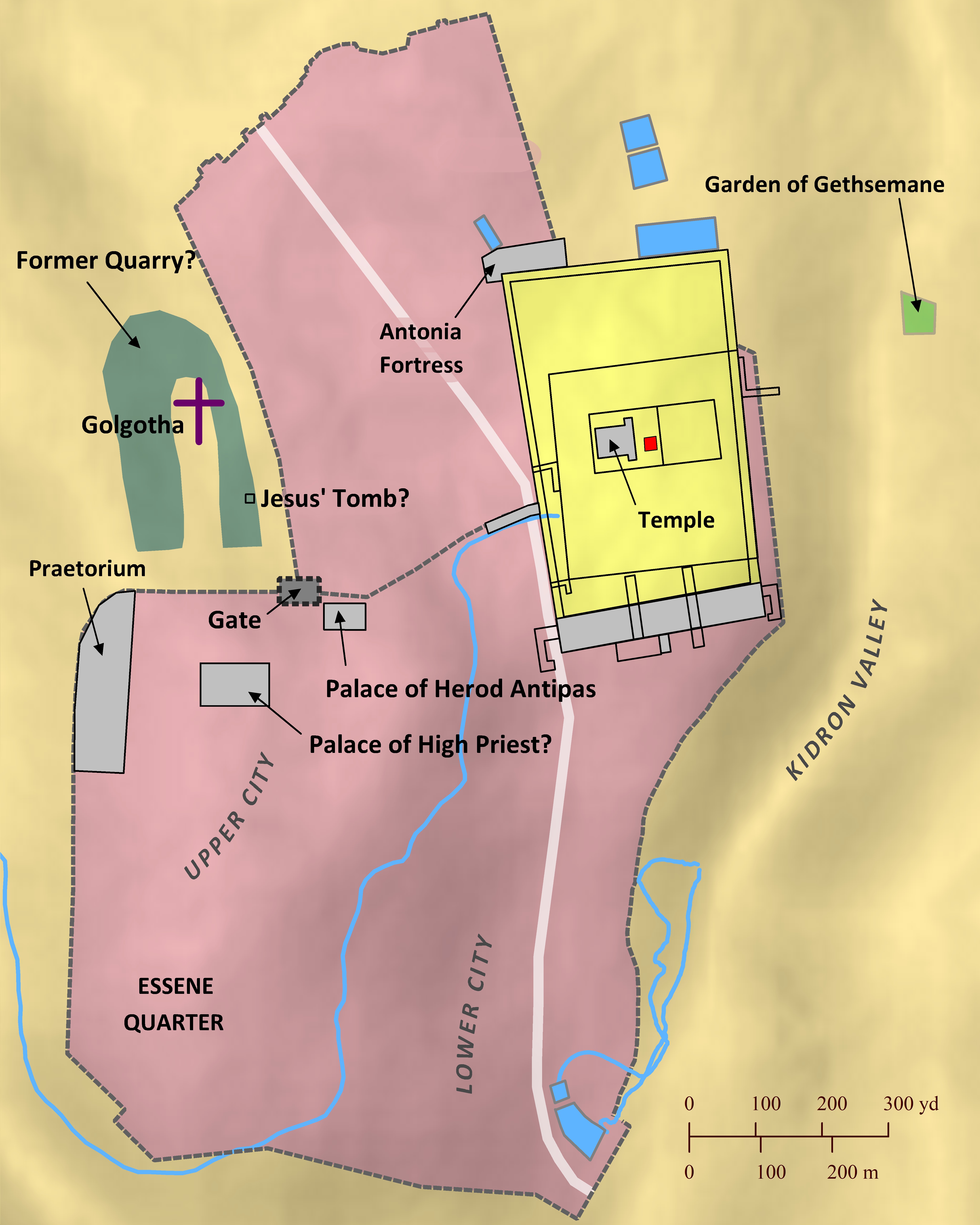
Matthew 26-27; Mark 14-15; Luke 22-23; John 13-19
On the Thursday before he was crucified, Jesus had arranged to share the Passover meal with his disciples in an upper room, traditionally thought to be located in the Essene Quarter of Jerusalem. After they finished the meal, they went to the Garden of Gethsemane, where Jesus often met with his disciples. There Judas Iscariot, one of Jesus’ own disciples, betrayed him to soldiers sent from the High Priest, and they took Jesus to the High Priest’s residence. In the morning the leading priests and teachers of the law put Jesus on trial and found him guilty of blasphemy. The council sent Jesus to stand trial for treason before the Roman governor Pontius Pilate, who resided at the Praetorium while in Jerusalem. The Praetorium was likely located at the former residence of Herod the Great, who had died over 30 years earlier. When Pilate learned that Jesus was from Galilee, he sent him to Herod Antipas, who had jurisdiction over Galilee. But when Jesus gave no answer to Herod’s many questions, Herod and his soldiers sent him back to Pilate, who conceded to the people’s demands that Jesus be crucified. Jesus was forced to carry his cross out of the city gate to Golgotha, meaning Skull Hill, referring to what may have been a small unquarried hill in the middle of an old quarry just outside the gate. After Jesus was unable to carry his cross any further, a man named Simon from Cyrene was forced to carry it for him. There at Golgotha they crucified Jesus. After Jesus died, his body was hurriedly taken down before nightfall and placed in a newly cut, rock tomb owned by Joseph of Arimathea, a member of the Jewish high council. This tomb was likely located at the perimeter of the old quarry.
Open Bible Data site copyright © 2023–2026 Freely-Given.org.
Python source code for creating these static pages is available on GitHub under an open licence.
For Bible data copyrights, see the details for each displayed Bible version.
The Open English Translation (OET) main site is at OpenEnglishTranslation.Bible or OET.Bible.