
OET OET-RV OET-LV GHT ULT UST BSB MSB BLB AICNT OEB WEBBE WMBB NET LSV FBV TCNT T4T LEB BBE Moff JPS Wymth ASV DRA YLT Drby RV SLT Wbstr KJB-1769 KJB-1611 Bshps Gnva Cvdl TNT Wycl SR-GNT UHB BrLXX BrTr Related Parallel Simple Interlinear Topics Reference Dictionary Search
ParallelVerse GEN EXO LEV NUM DEU JOB JOS JDG RUTH 1 SAM 2 SAM PSA AMOS HOS 1 KI 2 KI 1 CHR 2 CHR PROV ECC SNG JOEL MIC ISA ZEP HAB JER LAM YNA (JNA) NAH OBA DAN EZE EZRA EST NEH HAG ZEC MAL LAO GES LES ESG DNG 2 PS TOB JDT WIS SIR BAR LJE PAZ SUS BEL MAN 1 MAC 2 MAC 3 MAC 4 MAC YHN (JHN) MARK MAT LUKE ACTs YAC (JAM) GAL 1 TH 2 TH 1 COR 2 COR ROM COL PHM EPH PHP 1 TIM TIT 1 PET 2 PET 2 TIM HEB YUD (JUD) 1 YHN (1 JHN) 2 YHN (2 JHN) 3 YHN (3 JHN) REV
Jos Intro C1 C2 C3 C4 C5 C6 C7 C8 C9 C10 C11 C12 C14 C15 C16 C17 C18 C19 C20 C21 C22 C23 C24
Jos 13 V1 V2 V3 V4 V5 V6 V7 V8 V9 V10 V11 V12 V13 V14 V15 V16 V17 V18 V19 V20 V22 V23 V24 V25 V26 V27 V28 V29 V30 V31 V32 V33
Note: This view shows ‘verses’ which are not necessarily natural language units and hence sometimes only part of a sentence will be visible—click on any Bible version abbreviation down the left-hand side to see the verse in more of its context. Normally the OET discourages the reading of individual ‘verses’, but this view is only designed as a tool for Bible-translators and others doing comparisons of different translations—the older translations are further down the page (so you can read up from the bottom to trace the English translation history). The OET segments on this page are still early looks into the drafted texts of the Open English Translation of the Bible—please double-check these texts in advance before using in public.
Text critical issues=none Clarity of original=clear Importance to us=normal Speaker(s)=Narrator (All still tentative.)
OET (OET-RV) and all the cities on the plateau, and all the kingdom of Sihon (the king of the Amorites who had reigned in Heshbon) who Mosheh had defeated, he and the leaders of Midian: Evi and Rekem and Zur and Hur and Reba (the princes of Sihon who had lived in the land).
OET-LV And_all/each/any/every the_cities_of the_plain and_all the_kingdom_of Şīḩōn the_king_of the_ʼAmorī who he_reigned in_Ḩeshbōn whom Mosheh he_had_defeated DOM_him/it and_DOM the_leaders_of Midyān DOM ʼEvī and_DOM Reqem and_DOM Tsūr/(Tsūr) and_DOM Ḩūr and_DOM Reⱱaˊ the_princes_of Şīḩōn who_were_dwelling_of the_earth/land.
UHB וְכֹל֙ עָרֵ֣י הַמִּישֹׁ֔ר וְכָֽל־מַמְלְכ֗וּת סִיחוֹן֙ מֶ֣לֶךְ הָאֱמֹרִ֔י אֲשֶׁ֥ר מָלַ֖ךְ בְּחֶשְׁבּ֑וֹן אֲשֶׁר֩ הִכָּ֨ה מֹשֶׁ֜ה אֹת֣וֹ ׀ וְאֶת־נְשִׂיאֵ֣י מִדְיָ֗ן אֶת־אֱוִ֤י וְאֶת־רֶ֨קֶם֙ וְאֶת־צ֤וּר וְאֶת־חוּר֙ וְאֶת־רֶ֔בַע נְסִיכֵ֣י סִיח֔וֹן יֹשְׁבֵ֖י הָאָֽרֶץ׃ ‡
(vəkol ˊārēy hammīshor vəkāl-mamləkūt şīḩōn melek hāʼₑmoriy ʼₐsher mālak bəḩeshbōn ʼₐsher hikkāh mosheh ʼotō vəʼet-nəsīʼēy midyān ʼet-ʼₑviy vəʼet-reqem vəʼet-ʦūr vəʼet-ḩūr vəʼet-reⱱaˊ nəşīkēy şīḩōn yoshⱱēy hāʼāreʦ.)
Key: khaki:verbs.
Note: Automatic aligning of the OET-RV to the LV is done by some temporary software, hence the OET-RV alignments are incomplete (and may occasionally be wrong).
BrLXX καὶ πάσας τὰς πόλεις τοῦ Μισὼρ, καὶ πᾶσαν τὴν βασιλείαν τοῦ Σηὼν βασιλέως τῶν Ἀμοῤῥαίων, ὃν ἐπάταξε Μωυσῆς αὐτὸν καὶ τοὺς ἡγουμένους Μαδιὰμ, καὶ τὸν Εὐὶ, καὶ τὸν Ῥοβὸκ, καὶ τὸν Σοὺρ, καὶ τὸν Οὒρ, καὶ τὸν Ῥοβὲ ἄρχοντα ἔναρα Σιὼν, καὶ τοὺς κατοικοῦντας Σιών.
(kai pasas tas poleis tou Misōr, kai pasan taʸn basileian tou Saʸōn basileōs tōn Amoɽɽaiōn, hon epataxe Mōusaʸs auton kai tous haʸgoumenous Madiam, kai ton Eui, kai ton Ɽobok, kai ton Sour, kai ton Our, kai ton Ɽobe arⱪonta enara Siōn, kai tous katoikountas Siōn.)
BrTr and all the cities of Misor, and all the kingdom of Seon king of the Amorites, whom Moses smote, even him and the princes of Madian, and Evi, and Roboc, and Sur, and Ur, and Robe prince of the spoils of Sion, and the inhabitants of Sion.
ULT and all of the cities of the plateau, and all of the kingdom of Sihon, the king of the Amorite, who had reigned in Heshbon, whom Moses struck, him and the leaders of Midian: Evi and Rekem and Zur and Hur and Reba, the princes of Sihon, the dwellers of the land.
UST and all the cities situated along the plateau, and the whole kingdom of Sihon, king of the Amorites. He formerly reigned in the city of Heshbon. Moses defeated Sihon, and he also defeated the leaders of Midian. Their names were Evi, Rekem, Zur, Hur and Reba. The Midianites lived within Sihon’s kingdom, and these leaders served him as vassals.
BSB & MSB all the cities of the plateau and all the kingdom of Sihon king of the Amorites, who reigned in Heshbon [until] Moses killed him and the chiefs of Midian ( Evi, Rekem, Zur, Hur, and Reba), the princes of Sihon who lived in the land.
OEB that is, all the towns on the tableland, all the realm of Sihon, the Amorite king who reigned in Heshbon and was defeated by Moses along with the Midianite leaders Evi, Rekem, Zur, Hur, and Reba, Sihon”s princes throughout the land.
WEBBE & WMBB all the cities of the plain, and all the kingdom of Sihon king of the Amorites, who reigned in Heshbon, whom Moses struck with the chiefs of Midian, Evi, Rekem, Zur, Hur, and Reba, the princes of Sihon, who lived in the land.
NET It encompassed all the cities of the plain and the whole realm of King Sihon of the Amorites who ruled in Heshbon. Moses defeated him and the Midianite leaders Evi, Rekem, Zur, Hur, and Reba (they were subjects of Sihon and lived in his territory).
LSV and all the cities of the plain, and all the kingdom of Sihon king of the Amorite, who reigned in Heshbon, whom Moses struck, with the princes of Midian, Evi, and Rekem, and Zur, and Hur, and Reba, princes of Sihon, inhabitants of the land.
FBV all the towns of the plateau and all the kingdom of Sihon, the Amorite king, who ruled in Heshbon. He was defeated by Moses, as well as the Midianite leaders Evi, Rekem, Zur, Hur, and Reba, princes who lived in the kingdom and who were allied to Sihon.
T4T That land included all the towns on the plain and all the area that King Sihon had previously ruled. But the army of Moses had defeated him and the rulers of the Midian people-group: Evi, Rekem, Zur, Hur, and Reba. The armies of all those rulers fought battles along with the army of Sihon, and they lived in that country.
LEB all of the cities of the plateau, and all the kingdom of Sihon king of the Amorites,[fn] who reigned in Heshbon and whom Moses defeated with the leaders of Midian, Evi, Rekem, Zur, Hur, and Reba, the princes of Sihon who dwelled in the land.
13:21 Hebrew “Amorite”
BBE And all the towns of the table-land, and all the kingdom of Sihon, king of the Amorites, who was ruling in Heshbon, whom Moses overcame, together with the chiefs of Midian, Evi, and Rekem, and Zur, and Hur, and Reba, the chiefs of Sihon, who were living in the land.
Moff all the towns on the tableland, all the realm of Sihon the Amorite king who reigned in Heshbon and was defeated by Moses along with the Midianite chiefs Evi, Rekem, Zur, Hur, and Reba, Sihon’s princes throughout the land.
JPS and all the cities of the table-land, and all the kingdom of Sihon king of the Amorites, who reigned in Heshbon, whom Moses smote with the chiefs of Midian, Evi, and Rekem, and Zur, and Hur, and Reba, the princes of Sihon, that dwelt in the land.
ASV and all the cities of the plain, and all the kingdom of Sihon king of the Amorites, who reigned in Heshbon, whom Moses smote with the chiefs of Midian, Evi, and Rekem, and Zur, and Hur, and Reba, the princes of Sihon, that dwelt in the land.
DRA And all the cities of the plain, and all the kingdoms of Sehon king of the Amorrhites, that reigned in Hesebon, whom Moses slew with the princes of Madian: Hevi, and Recem, and Sur and Hur, and Rebe, dukes of Sehon inhabitants of the land.
YLT and all the cities of the plain, and all the kingdom of Sihon king of the Amorite, who reigned in Heshbon, whom Moses smote, with the princes of Midian, Evi, and Rekem, and Zur, and Hur, and Reba, princes of Sihon, inhabitants of the land.
Drby all the cities of the plateau, and the whole kingdom of Sihon the king of the Amorites, who reigned at Heshbon, whom Moses smote, him and the princes of Midian, Evi, and Rekem, and Zur, and Hur, and Reba, the chiefs of Sihon dwelling in the land.
RV and all the cities of the plain, and all the kingdom of Sihon king of the Amorites, which reigned in Heshbon, whom Moses smote with the chiefs of Midian, Evi, and Rekem, and Zur, and Hur, and Reba, the princes of Sihon, that dwelt in the land.
SLT And all the cities of the plain, and all the kingdom of Sihon, king of the Amorites who reigned in Heshbon, whom Moses smote him with the chiefs of Midian, Evi, and Rekem, and Zur, and Hur and Reba, princes of Sihon, dwelling in the land.
Wbstr And all the cities of the plain, and all the kingdom of Sihon king of the Amorites, who reigned in Heshbon, whom Moses smote with the princes of Midian, Evi, and Rekem, and Zur, and Hur, and Reba, dukes of Sihon, dwelling in the country.
KJB-1769 And all the cities of the plain, and all the kingdom of Sihon king of the Amorites, which reigned in Heshbon, whom Moses smote with the princes of Midian, Evi, and Rekem, and Zur, and Hur, and Reba, which were dukes of Sihon, dwelling in the country.
KJB-1611 And all the cities of the plaine, and all the kingdome of Sihon king of the Amorites, which reigned in Heshbon, whom Moses smote with the princes of Midian, Eui, and Rekem, and Zur, and Hur, and Reba, which were dukes of Sihon, dwelling in the countrey.
(And all the cities of the plain, and all the kingdom of Sihon king of the Amorites, which reigned in Heshbon, whom Moses smote with the princes of Midian, Eui, and Rekem, and Zur, and Hur, and Reba, which were dukes of Sihon, dwelling in the country.)
Bshps And al the cities of the plaine, and all the kingdome of Sehon king of the Amorites, which raigned in Hesbon, which Moyses smote, with the lordes of Madian, Eui, Bekem, Zur, and Hur, & Keba, the whiche were dukes of Sehon, dwelling in the countrey.
(And all the cities of the plain, and all the kingdom of Sehon king of the Amorites, which reigned in Hesbon, which Moses smote, with the lords of Madian, Eui, Bekem, Zur, and Hur, and Keba, the which were dukes of Sehon, dwelling in the country.)
Gnva And all the cities of the plaine: and all the kingdome of Sihon King of the Amorites, which reigned in Heshbon, whome Moses smote with the Princes of Midian, Eui, and Rekem, and Zur, and Hur, and Reba, the dukes of Sihon, dwelling in the countrey.
(And all the cities of the plain: and all the kingdom of Sihon King of the Amorites, which reigned in Heshbon, whom Moses smote with the Princes of Midian, Eui, and Rekem, and Zur, and Hur, and Reba, the dukes of Sihon, dwelling in the country.)
Cvdl and all the cities vpon the playne, and all the realme of Sihon kynge of the Amorites, which dwelt at Hesbon, whom Moses smote with the prynces of Madian, Eui, Rekem, Zur, Hur, & Reba, the mightie men of kynge Sihon, which were inhabiters of the londe.
(and all the cities upon the plain, and all the realm of Sihon king of the Amorites, which dwelt at Hesbon, whom Moses smote with the princes of Madian, Eui, Rekem, Zur, Hur, and Reba, the mighty men of king Sihon, which were inhabitants of the land.)
Wycl alle the feeldi citees, and alle the rewmes of Seon, kyng of Amorrey, that regnede in Esebon, whom Moyses smoot, with hise princes, Madian, Euey and Recten, and Sur, and Hur, and Rebee, duykis of Seon, enhabiters of the lond.
(all the plain cities, and all the realms of Sihon, king of Amorrey, that reigned in Heshbon, whom Moses smote, with his princes, Madian, Hivites and Recten, and Sur, and Hur, and Rebee, dukes of Sihon, inhabitants of the land.)
Luth und alle Städte auf der Ebene und das ganze Reich Sihons, des Königs der Amoriter, der zu Hesbon saß, den Mose schlug, samt den Fürsten Midians, Evi, Rekem, Zur, Hur und Reba, die Gewaltigen des Königs Sihon, die im Lande wohneten.
(and all cities on/in/to the/of_the Level/flat and the whole/all kingdom Sihon’s, the kings the/of_the Amorites, the/of_the to/for Heshbon sat, the Moses hit/beat(v), together_with the prince(s)/ruler(s) Midian’s, Evi, Rekem, Zur, Hur and Reba, the mighty_(ones) the kings Sihon, the in_the land lived/resided.)
ClVg et omnes urbes campestres, universaque regna Sehon regis Amorrhæi, qui regnavit in Hesebon, quem percussit Moyses cum principibus Madian: Hevæum, et Recem, et Sur, et Hur, et Rebe duces Sehon habitatores terræ.
(and everyone cities plain, and_everywhere kingdoms Sihon king Amorite, who/which reigned in/into/on Heshbon, which he_struck Moses when/with princes/leaders Midian: Hivites, and Rekem, and Sur, and Hur, and Rebe leaders Sihon the_inhabitants of_the_earth/land(pl).)
Before Moses died he had given land to the tribes of Reuben, Gad and the half-tribe of Manasseh. In this section Yahweh reminded Joshua of the land that they still had not conquered. Then there is a detailed listing of the boundaries of the lands on the east side of the Jordan River.
Here is another possible section heading:
The land east of the Jordan River
all the cities of the plateau
Reuben inherited all these cities on the plain
The clan of Reuben inherited all these cities on the Medeba Plateau
all the cities of the plateau: The clause all the cities of the plateau summarizes the list of towns that appear in verses 17–21. This clause is almost identical to the clause in verse 13:17b and you should translate it the same way. In verse 17 this phrase was at the beginning of the list, and here it comes at the end of the list.
and all the kingdom of Sihon king of the Amorites,
and the whole kingdom of King Sihon of the Amorites,
and all the area that King Sihon of the Amorites ruled
and all the kingdom of Sihon king of the Amorites: The phrase the kingdom of Sihon king of the Amorites indicates that Moses gave the land that King Sihon ruled on the plateau to the tribe of Reuben.
who reigned in Heshbon until Moses killed him and the chiefs of Midian
who ruled in Heshbon. Moses defeated him and Midian’s leaders
from Heshbon City. Moses defeated him along with the leaders of the Midianites,
who reigned in Heshbon: The clause who reigned in Heshbon indicates that Heshbon was the capital city of King Sihon. Heshbon was mentioned in 13:10 and 13:17, and you should translate it the same way every time.
until Moses killed him and the chiefs of Midian: Moses defeated King Sihon along with all the other leaders of Midian. It may be helpful to begin a new sentence here. For example:
Moses had defeated him along with the Midianites including Evi, Rekem, Zur, Hur and Reba (NCV)
chiefs of Midian: Midian was one of the sons of Abraham and Keturah (Genesis 25:1–2). Midian’s descendants became a group called Midian. They were a nomadic people who lived in northwest Arabia, east of the Gulf of Aqaba.13:21 Rasmussen p. 245.
(Evi, Rekem, Zur, Hur, and Reba), the princes of Sihon who lived in the land.
Evi, Rekem, Zur, Hur, and Reba. They were rulers under King Sihon who lived in that country.
including Evi, Rekem, Zur, Hur, and Reba. These leaders lived in that land and ruled with King Sihon.
(Evi, Rekem, Zur, Hur, and Reba), the princes of Sihon: These five names are the leaders of the Midian people. The story of how Moses and the Israelites fought and killed these leaders is found in Numbers 31:7–8.
princes of Sihon: The phrase princes of Sihon indicates that these leaders of Midian were under the authority of King Sihon.
Here is another way to translate this phrase:
all of them had ruled the land for King Sihon (GNT)
who lived in the land: The clause who lived in the land indicates that these five Midianite leaders and their people lived in the land that King Sihon ruled.
Note 1 topic: translate-names
אֶת־אֱוִ֤י וְאֶת־רֶ֨קֶם֙ וְאֶת־צ֤וּר וְאֶת־חוּר֙ וְאֶת־רֶ֔בַע
DOM ʼEvī and=DOM Reqem and=DOM Tsūr/(Tsūr) and=DOM Ḩūr and=DOM Reⱱaˊ
The words Evi, Rekem, Zur, Hur, and Reba are the names of men.
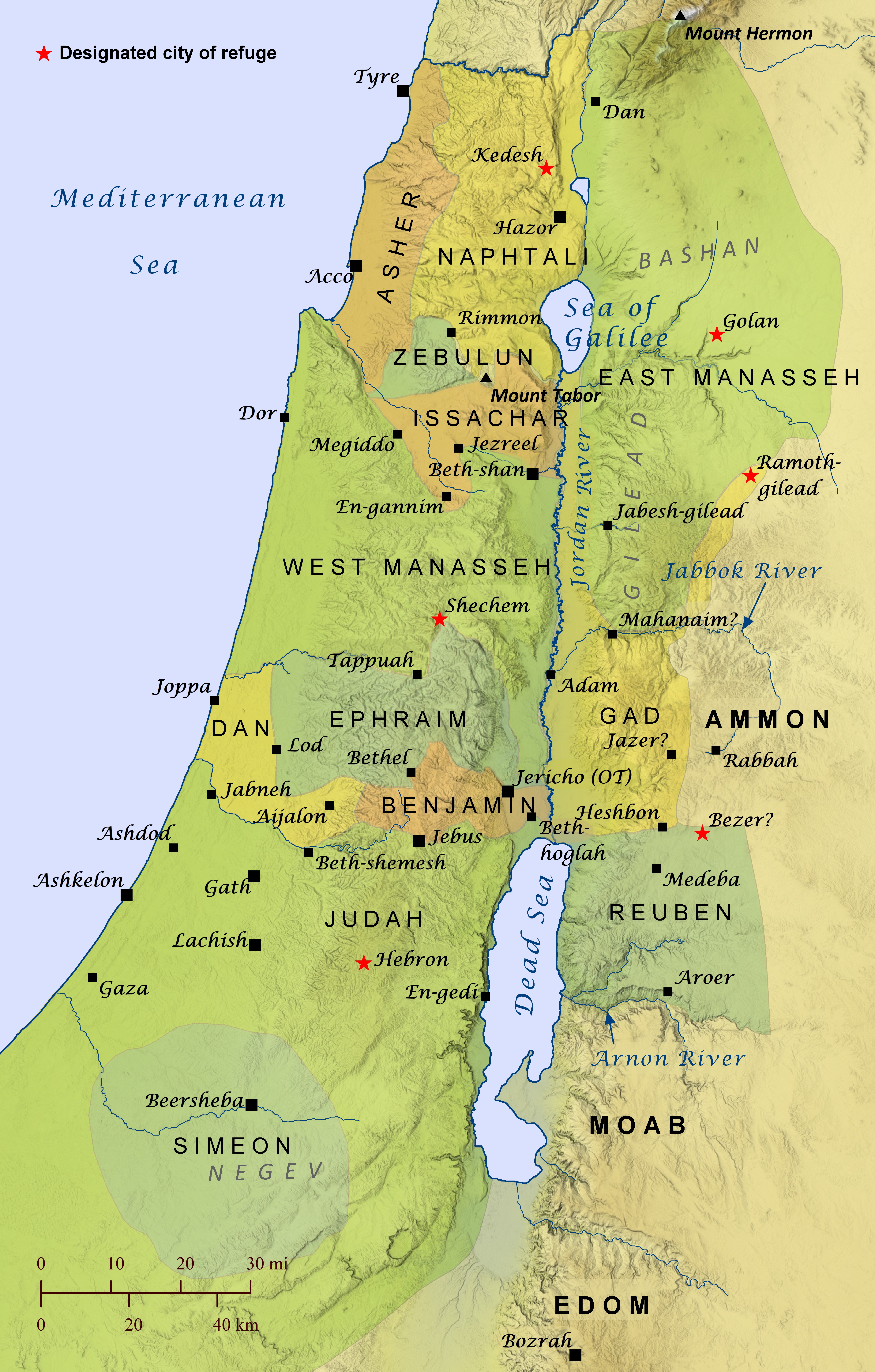
After the Israelites had conquered portions of the Promised Land and Joshua had grown old, the Lord directed him to divide the rest of the land among the tribes of Israel as their inheritance (Joshua 13-20). The eastern tribes had already been allotted their land under Moses’ leadership (Numbers 32), but they continued to help the other tribes drive out the Canaanites from land west of the Jordan River. The Lord also instructed the Israelites to designate several cities of refuge, where someone could flee for protection from an avenger if they accidentally killed someone (Numbers 35; Joshua 20).
Open Bible Data site copyright © 2023–2026 Freely-Given.org.
Python source code for creating these static pages is available on GitHub under an open licence.
For Bible data copyrights, see the details for each displayed Bible version.
The Open English Translation (OET) main site is at OpenEnglishTranslation.Bible or OET.Bible.