
OET OET-RV OET-LV GHT ULT UST BSB MSB BLB AICNT OEB WEBBE WMBB NET LSV FBV TCNT T4T LEB BBE Moff JPS Wymth ASV DRA YLT Drby RV SLT Wbstr KJB-1769 KJB-1611 Bshps Gnva Cvdl TNT Wycl SR-GNT UHB BrLXX BrTr Related Parallel Simple Interlinear Topics Reference Dictionary Search
ParallelVerse GEN EXO LEV NUM DEU JOB JOS JDG RUTH 1 SAM 2 SAM PSA AMOS HOS 1 KI 2 KI 1 CHR 2 CHR PROV ECC SNG JOEL MIC ISA ZEP HAB JER LAM YNA (JNA) NAH OBA DAN EZE EZRA EST NEH HAG ZEC MAL LAO GES LES ESG DNG 2 PS TOB JDT WIS SIR BAR LJE PAZ SUS BEL MAN 1 MAC 2 MAC 3 MAC 4 MAC YHN (JHN) MARK MAT LUKE ACTs YAC (JAM) GAL 1 TH 2 TH 1 COR 2 COR ROM COL PHM EPH PHP 1 TIM TIT 1 PET 2 PET 2 TIM HEB YUD (JUD) 1 YHN (1 JHN) 2 YHN (2 JHN) 3 YHN (3 JHN) REV
Jos Intro C1 C2 C3 C4 C5 C6 C7 C8 C9 C10 C11 C12 C14 C15 C16 C17 C18 C19 C20 C21 C22 C23 C24
Jos 13 V1 V2 V3 V4 V5 V6 V7 V8 V9 V10 V11 V12 V13 V14 V15 V16 V18 V19 V20 V21 V22 V23 V24 V25 V26 V27 V28 V29 V30 V31 V32 V33
Note: This view shows ‘verses’ which are not necessarily natural language units and hence sometimes only part of a sentence will be visible—click on any Bible version abbreviation down the left-hand side to see the verse in more of its context. Normally the OET discourages the reading of individual ‘verses’, but this view is only designed as a tool for Bible-translators and others doing comparisons of different translations—the older translations are further down the page (so you can read up from the bottom to trace the English translation history). The OET segments on this page are still early looks into the drafted texts of the Open English Translation of the Bible—please double-check these texts in advance before using in public.
Text critical issues=none Clarity of original=clear Importance to us=normal Speaker(s)=Narrator (All still tentative.)
OET (OET-RV) Heshbon and all it’s cities on the plateau, including Dibon, Bamot-Baal, Beyt-Baal-Meon,
OET-LV Ḩeshbōn and_all cities_of_its which are_in_plain Diyⱱvōn and_Bāmōt- baˊal and_Bēyt- baˊal- məˊōn.
UHB חֶשְׁבּ֥וֹן וְכָל־עָרֶ֖יהָ אֲשֶׁ֣ר בַּמִּישֹׁ֑ר דִּיבוֹן֙ וּבָמ֣וֹת בַּ֔עַל וּבֵ֖ית בַּ֥עַל מְעֽוֹן׃ ‡
(ḩeshbōn vəkāl-ˊāreyhā ʼₐsher bammīshor dīⱱōn ūⱱāmōt baˊal ūⱱēyt baˊal məˊōn.)
BrLXX ἕως Ἐσεβὼν, καὶ πάσας τὰς πόλεις τὰς οὔσας ἐν τῇ Μισὼρ, καὶ Δαιβὼν, καὶ Βαιμὼν Βαὰλ, καὶ οἴκου Μεελβὼθ,
(heōs Esebōn, kai pasas tas poleis tas ousas en taʸ Misōr, kai Daibōn, kai Baimōn Baʼal, kai oikou Meʼelbōth,)
BrTr to Esebon, and all the cities in Misor, and Dæbon, and Bæmon-Baal, and the house of Meelboth;
ULT Heshbon and all of its cities that, are in the plateau, Dibon and Bamoth Baal and Beth Baal Meon
UST It also included Heshbon and all the cities that were in the plateau. These cities were Dibon, Bamoth Baal, Beth Baal Meon,
BSB & MSB to Heshbon and all its cities on the plateau, including Dibon, Bamoth-baal, Beth-baal-meon,
OEB Heshbon, and all its townships on the tableland, Dibon, Bamoth-baal, Beth-baal-meon,
WEBBE & WMBB Heshbon, and all its cities that are in the plain; Dibon, Bamoth Baal, Beth Baal Meon,
NET Heshbon and all its surrounding cities on the plain, including Dibon, Bamoth Baal, Beth Baal Meon,
LSV Heshbon, and all its cities which [are] in the plain, Dibon, and Bamoth-Ba‘al, and Beth-Ba‘al-Meon,
FBV Heshbon and all associated towns on the plateau—Dibon, Bamoth Baal, Beth Baal Meon,
T4T It also included Heshbon city and all the nearby towns on the plain—Dibon, Bamioth-Baal, Beth-Baal-Meon,
LEB Heshbon and its cities that are on the plateau; Dibon, Bamoth Baal, Beth Baal Meon,
BBE Heshbon and all her towns in the table-land; Dibon, and Bamoth-baal, and Beth-baal-meon;
Moff Heshbon, and all its townships on the table-land, Dibon, Bamoth-baal, Beth-baalméon,
JPS Heshbon, and all her cities that are in the table-land; Dibon, and Bamoth-baal, and Beth-baal-meon;
ASV Heshbon, and all its cities that are in the plain; Dibon, and Bamoth-baal, and Beth-baal-meon,
DRA And Hesebon, and all their villages, which are in the plains. Dibon also, and Bamothbaal, and the town of Baalmaon,
YLT Heshbon, and all its cities which [are] in the plain, Dibon, and Bamoth-Baal, and Beth-Baal-Meon,
Drby Heshbon, and all her cities that are in the plateau, Dibon, and Bamoth-Baal, and Beth-Baal-meon,
RV Heshbon, and all her cities that are in the plain; Dibon, and Bamoth-baal, and Beth-baal-meon;
SLT Heshbon and all her cities which are in the plain; Dibon and Bamoth-Baal, and the house of the lord of the fortress,
Wbstr Heshbon, and all her cities that are in the plain; Dibon, and Bamoth-baal, and Beth-baal-meon,
KJB-1769 Heshbon, and all her cities that are in the plain; Dibon, and Bamoth-baal, and Beth-baal-meon,[fn]
13.17 Bamoth-baal…: or, the high places of Baal, and house of Baal-meon
KJB-1611 Heshbon and all her cities that are in the plaine: Dibon, and [fn]Bamoth-Baal, and Beth-Baalmeon,
(Heshbon and all her cities that are in the plain: Dibon, and Bamoth-Baal, and Beth-Baalmeon,)
13:17 Or, the high places of Baal, and house of Baalmeon.
Bshps Hesbon, with all their townes that lye in the playne: Dibon and the hill places of Baal, and the house of Baalmeon,
(Hesbon, with all their towns that lie in the plain: Dibon and the hill places of Baal, and the house of Baalmeon,)
Gnva Heshbon with all the cities thereof, that are in the plaine: Dibon and Bamoth-baal, and Bethbaal-meon:
(Heshbon with all the cities thereof, that are in the plain: Dibon and Bamoth-baal, and Bethbaal-meon:)
Cvdl Hesbon, and all the cities therof which lye in the playne felde: Dibon, Bamoth Baal, & Beth Baal Meon,
(Hesbon, and all the cities thereof which lie in the plain field: Dibon, Bamoth Baal, and Beth Baal Meon,)
Wycl and Esebon, and alle the townes of tho, that ben in the feeldi places; and Dibon, and Baal Bamoth, and the citee of Baal Meon,
(and Heshbon, and all the towns of those, that been in the plain places; and Dibon, and Baal Bamoth, and the city of Baal Meon,)
Luth Hesbon und alle ihre Städte, die im ebenen Felde liegen; Dibon, Bamoth-Baal und Beth-Baal-Meon,
(Heshbon and all their/her cities, the in_the even/just field lie/lay; Dibon, Bamoth-baal and Beth-baal-meon,)
ClVg et Hesebon, cunctosque viculos earum, qui sunt in campestribus: Dibon quoque et Bamothbaal, et oppidum Baalmaon,
(and Heshbon, and_all villages of_them, who/which are in/into/on plains: Dibon too and Bamothbaal, and town Baalmaon,)
Before Moses died he had given land to the tribes of Reuben, Gad and the half-tribe of Manasseh. In this section Yahweh reminded Joshua of the land that they still had not conquered. Then there is a detailed listing of the boundaries of the lands on the east side of the Jordan River.
Here is another possible section heading:
The land east of the Jordan River
to Heshbon
It included Heshbon
It included Heshbon City
to Heshbon: In some languages it may be more natural to begin a new sentence. For example:
It included Heshbon
Heshbon: Heshbon was the capital city of King Sihon. You should translate the name of this town the same way you did in 13:10a.
and all its cities on the plateau,
and all the cities on the plain near Heshbon:
and the other cities in the Medeba Plateau.
and all its cities on the plateau: The phrase and all its cities on the plateau indicates all the towns that Sihon king of the Amorites ruled. They were in the plateau or tableland that was near Medeba. These towns are listed in the following verses.
including Dibon, Bamoth-baal, Beth-baal-meon,
Dibon, and Bamoth-baal, and Beth-baal-meon,
These are Dibon City, Bamoth-baal Region, Beth-baal-meon City,
including Dibon: Dibon was a large town that was captured by Israel (Numbers 21:30). Its name today is Dhiban and it is thirteen miles east of the Dead Sea and three and a half miles north of the Arnon Gorge.13:17 Bratcher and Newman, p. 232.
Bamoth-baal: The term Bamoth-baal indicates the area northeast of the Dead Sea to which Balak took Balaam to curse Israel (Numbers 22:41). Bamoth-baal is not a town, but an area or a region.13:17 Rasmussen p. 228.
Here is another way to spell this name:
Bamoth Baal (NIV, NET)
Beth-baal-meon: The term Beth-baal-meon indicates a town that was twenty-three miles southwest of Amman, Jordan, and ten miles east of the Dead Sea. Its name today is Ma’in.13:17 Rasmussen, p. 228, 229.
Here is another way to spell the name of this town:
Beth Baal Meon (NIV, NET)
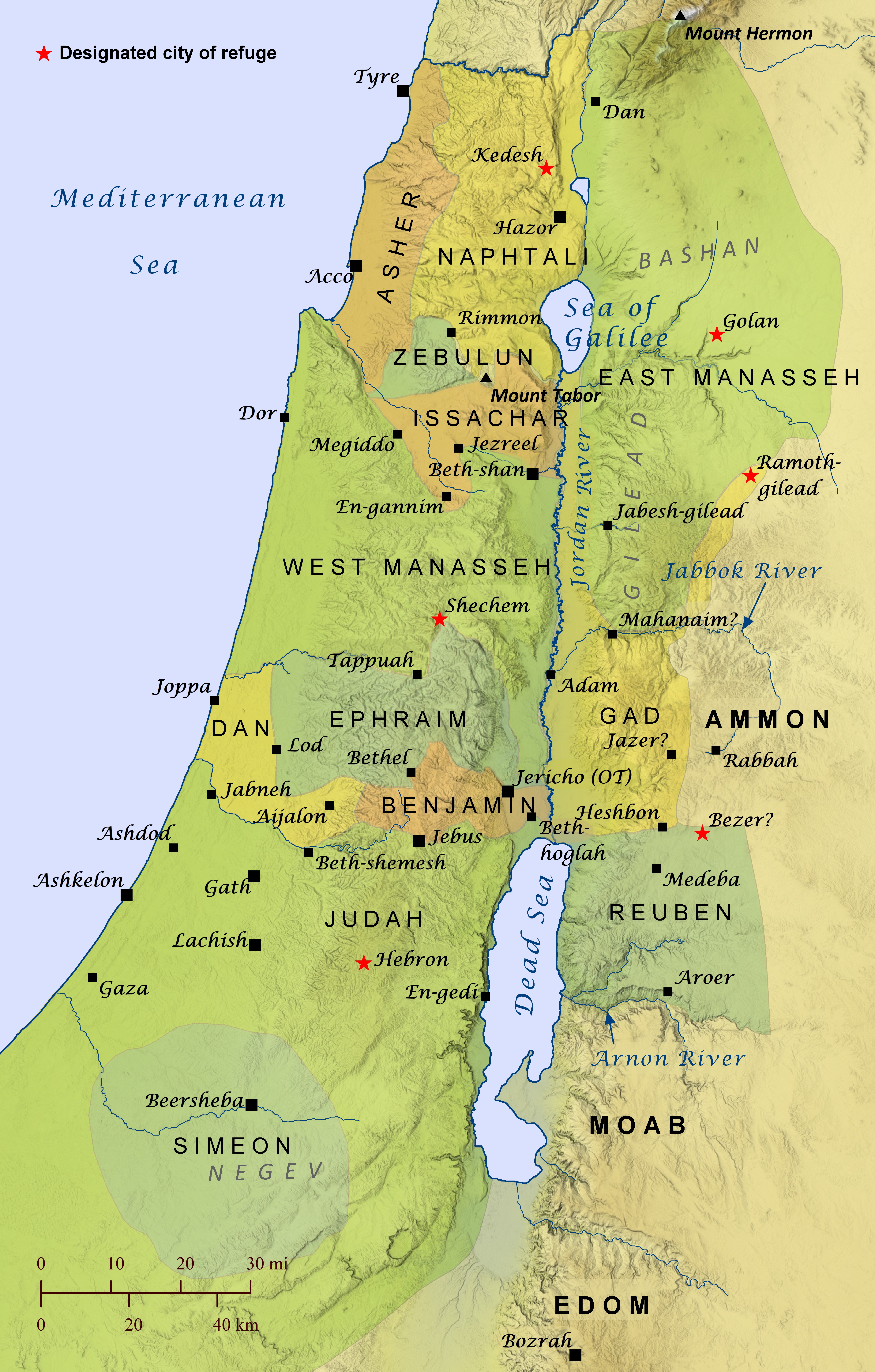
After the Israelites had conquered portions of the Promised Land and Joshua had grown old, the Lord directed him to divide the rest of the land among the tribes of Israel as their inheritance (Joshua 13-20). The eastern tribes had already been allotted their land under Moses’ leadership (Numbers 32), but they continued to help the other tribes drive out the Canaanites from land west of the Jordan River. The Lord also instructed the Israelites to designate several cities of refuge, where someone could flee for protection from an avenger if they accidentally killed someone (Numbers 35; Joshua 20).
Open Bible Data site copyright © 2023–2026 Freely-Given.org.
Python source code for creating these static pages is available on GitHub under an open licence.
For Bible data copyrights, see the details for each displayed Bible version.
The Open English Translation (OET) main site is at OpenEnglishTranslation.Bible or OET.Bible.