
OET OET-RV OET-LV GHT ULT UST BSB MSB BLB AICNT OEB WEBBE WMBB NET LSV FBV TCNT T4T LEB BBE Moff JPS Wymth ASV DRA YLT Drby RV SLT Wbstr KJB-1769 KJB-1611 Bshps Gnva Cvdl TNT Wycl SR-GNT UHB BrLXX BrTr Related Parallel Simple Interlinear Topics Reference Dictionary Search
ParallelVerse GEN EXO LEV NUM DEU JOB JOS JDG RUTH 1 SAM 2 SAM PSA AMOS HOS 1 KI 2 KI 1 CHR 2 CHR PROV ECC SNG JOEL MIC ISA ZEP HAB JER LAM YNA (JNA) NAH OBA DAN EZE EZRA EST NEH HAG ZEC MAL LAO GES LES ESG DNG 2 PS TOB JDT WIS SIR BAR LJE PAZ SUS BEL MAN 1 MAC 2 MAC 3 MAC 4 MAC YHN (JHN) MARK MAT LUKE ACTs YAC (JAM) GAL 1 TH 2 TH 1 COR 2 COR ROM COL PHM EPH PHP 1 TIM TIT 1 PET 2 PET 2 TIM HEB YUD (JUD) 1 YHN (1 JHN) 2 YHN (2 JHN) 3 YHN (3 JHN) REV
Jos Intro C1 C2 C3 C4 C5 C6 C7 C8 C9 C10 C11 C12 C14 C15 C16 C17 C18 C19 C20 C21 C22 C23 C24
Jos 13 V1 V2 V3 V4 V6 V7 V8 V9 V10 V11 V12 V13 V14 V15 V16 V17 V18 V19 V20 V21 V22 V23 V24 V25 V26 V27 V28 V29 V30 V31 V32 V33
Note: This view shows ‘verses’ which are not necessarily natural language units and hence sometimes only part of a sentence will be visible—click on any Bible version abbreviation down the left-hand side to see the verse in more of its context. Normally the OET discourages the reading of individual ‘verses’, but this view is only designed as a tool for Bible-translators and others doing comparisons of different translations—the older translations are further down the page (so you can read up from the bottom to trace the English translation history). The OET segments on this page are still early looks into the drafted texts of the Open English Translation of the Bible—please double-check these texts in advance before using in public.
Text critical issues=none Clarity of original=clear Importance to us=normal Speaker(s)=Narrator (All still tentative.)
OET (OET-RV) plus the land of the Gebalites, all Lebanon towards the east, from Baal-Gad below Mt. Hermon as far as Lebo-Hamath.
OET-LV And_the_earth of_the_Giⱱlī[s] and_all (the)_Ləⱱānōn the_rising_of the_sun from_Baˊal- Gād under the_mountain_of Ḩermōn to Ləⱱōʼ Ḩₐmāt.
UHB וְהָאָ֣רֶץ הַגִּבְלִ֗י וְכָל־הַלְּבָנוֹן֙ מִזְרַ֣ח הַשֶּׁ֔מֶשׁ מִבַּ֣עַל גָּ֔ד תַּ֖חַת הַר־חֶרְמ֑וֹן עַ֖ד לְב֥וֹא חֲמָֽת׃ ‡
(vəhāʼāreʦ haggiⱱliy vəkāl-halləⱱānōn mizraḩ hashshemesh mibaˊal gād taḩat har-ḩermōn ˊad ləⱱōʼ ḩₐmāt.)
BrLXX καὶ πᾶσαν τὴν γῆν Γαλιὰθ Φυλιστιεὶμ, καὶ πάντα τὸν Λίβανον ἀπὸ ἀνατολῶν ἡλίου ἀπὸ Γαλγὰλ ὑπὸ τὸ ὄρος τὸ Ἀερμὼν ἕως τῆς εἰσόδου Ἐμὰθ,
(kai pasan taʸn gaʸn Galiath Fulistieim, kai panta ton Libanon apo anatolōn haʸliou apo Galgal hupo to oros to Aermōn heōs taʸs eisodou Emath,)
BrTr And all the land of Galiath of the Phylistines, and all Libanus eastward from Galgal, under the mountain Aermon as far as the entering in of Emath;
ULT and the land of the Gebalite; and all of Lebanon from the rising of the sun, from Baal Gad below Mount Hermon unto Lebo Hamath.
UST Also conquer the land where the Gebalites live and all of Lebanon east of there, from the city of Baal Gad near Mount Hermon to Lebo Hamath.
BSB & MSB •
the land of the Gebalites;[fn]
•
and all Lebanon to the east, from Baal-gad below Mount Hermon to Lebo-hamath.
13:5 Or the area of Byblos
OEB the land of the Gebalites and all that borders on the eastern Lebanon, from Baal-gad at the foot of Mount Hermon to Lebo-hamath,
WEBBE & WMBB and the land of the Gebalites, and all Lebanon, towards the sunrise, from Baal Gad under Mount Hermon to the entrance of Hamath;
NET the territory of Byblos and all Lebanon to the east, from Baal Gad below Mount Hermon to Lebo Hamath.
LSV and the land of the Giblite, and all Lebanon, at the sun-rising, from Ba‘al-Gad under Mount Hermon, to the going in to Hamath:
FBV as well as the land of the Gebalites and the Lebanon area from the town of Baalgad to the slopes of Mount Hermon to Lebo-hamath,
T4T the area where the Gebal people-group live; and all the Lebanon area east of Baal-Gad city at the bottom of Hermon Mountain, as far as Lebo-Hamath.
LEB and the land of the Gebalites, and all the Lebanon,[fn] ⌊toward the east⌋,[fn] from Baal Gad ⌊at the foot of⌋[fn] Mount Hermon up to Lebo-Hamath;
BBE And the land of the Gebalites, and all Lebanon, looking east, from Baal-gad under Mount Hermon as far as Hamath:
Moff all that borders on the eastern Lebanon, from Baal-gad at the foot of mount Hermon to the pass of Hamath,
JPS and the land of the Gebalites, and all Lebanon, toward the sunrising, from Baal-gad under mount Hermon unto the entrance of Hamath;
ASV and the land of the Gebalites, and all Lebanon, toward the sunrising, from Baal-gad under mount Hermon unto the entrance of Hamath;
DRA And his confines. The country also of Libanus towards the east from Baalgad under mount Hermon to the entering into Emath.
YLT and the land of the Giblite, and all Lebanon, at the sun-rising, from Baal-Gad under mount Hermon, unto the going in to Hamath:
Drby and the land of the Giblites, and all Lebanon, toward the sun-rising, from Baal-Gad at the foot of mount Hermon to the entrance into Hamath;
RV and the land of the Gebalites, and all Lebanon, toward the sunrising, from Baal-gad under mount Hermon unto the entering in of Hamath:
SLT And the land of the Giblites and all Lebanon from the sunrising from lord Gad under mount Hermon, even to the entrance of Hamath.
Wbstr And the land of the Giblites, and all Lebanon towards the sun-rising, from Baal-gad under mount Hermon to the entering into Hamath.
KJB-1769 And the land of the Giblites, and all Lebanon, toward the sunrising, from Baal-gad under mount Hermon unto the entering into Hamath.
KJB-1611 And the land of the Giblites, and al Lebanon toward the Sunne rising, from Baal-Gad vnder mount Hermon, vnto the entring into Hamath.
(And the land of the Giblites, and all Lebanon toward the Sun rising, from Baal-Gad under mount Hermon, unto the entering into Hamath.)
Bshps And the lande of the Giblites, and all Libanon towarde the sunne rising, from the plaine of Gad vnder mount Hermo, vntil a man come to Hamath:
(And the land of the Giblites, and all Libanon toward the sun rising, from the plain of Gad under mount Hermo, until a man come to Hamath:)
Gnva And the land of the Giblites, and all Lebanon, toward the sunne rising from Bahal-gad vnder mount Hermon, vntil one come to Hamath.
(And the land of the Giblites, and all Lebanon, toward the sun rising from Bahal-gad under mount Hermon, until one come to Hamath.)
Cvdl Morouer the londe of the Giblites eastwarde, from Baalgad vnder mount Hermon, tyll a ma come vnto Hamath.
(Moreover/What’s_more the land of the Giblites eastward, from Baalgad under mount Hermon, till a man come unto Hamath.)
Wycl and the cuntrei of Liban ayens the eest, fro Baalgath, vndur the hil of Hermon, til thou entrist into Emath,
(and the country of Lebanon against the east, from Baalgath, under the hill of Hermon, till thou/you enterest/enter into Hamath,)
Luth dazu das Land der Gibliter und der ganze Libanon gegen der Sonnen Aufgang, von Baal-Gad an unter dem Berge Hermon, bis man kommt gen Hamath:
(to_that/in_addition the country the/of_the Gebalites and the/of_the whole/all Lebanon to/against the/of_the suns rise(n), from Baal-gad at/to under to_him mountains/hills Hermon, until man comes to/toward Hamath:)
ClVg ejusque confinia. Libani quoque regio contra orientem, a Baalgad sub monte Hermon, donec ingrediaris Emath;
(and_he borders. Of_Lebanon too region on_the_contrary east, from Baalgad under mountain Hermon, until you_enter Hamath;)
Before Moses died he had given land to the tribes of Reuben, Gad and the half-tribe of Manasseh. In this section Yahweh reminded Joshua of the land that they still had not conquered. Then there is a detailed listing of the boundaries of the lands on the east side of the Jordan River.
Here is another possible section heading:
The land east of the Jordan River
the land of the Gebalites;
There is also the land of the Gebalites,
There are also the districts of the Gebal people,
the land of the Gebalites: It may be more natural to begin a new sentence at the beginning of verse 5, for example:
It also includes the land of the Gebal people
the Gebalites: The term Gebalites indicates the people who lived in Gebal, a town on the coast of the Mediterranean Sea, eighteen miles northeast of modern Beirut.13:5 Rasmussen, p. 235. The ancient Greek name of this town was Byblos, and some English versions (NIV11, NET) refer to it by this name. The modern Arabic name for this town is Jubayl.
and all Lebanon to the east,
and all of Lebanon eastward
all of Lebanon to the east,
and all Lebanon to the east: The phrase all Lebanon to the east indicates that the rest of Lebanon east of Gebal must still be conquered.
The places named in 13:5c describe the southern and northern limits of all Lebanon.
from Baal-gad below Mount Hermon to Lebo-hamath.
from Baal-gad at the foot of Mount Hermon to the entrance into Hamath City,
from Baal-gad at the base of Mount Hermon in the south, to Hamath Mountain Pass in the north.
from Baal-gad below Mount Hermon: The town of Baal-gad was mentioned in Joshua 11:17. It was in the Lebanon Valley at the western foot of Hermon Mountain. Baal-gad was at the southern point Lebanon Valley.
Here is another way to spell the word Baal-gad:
Baal Gad (NIV, NET)
below Mount Hermon: The phrase below Mount Hermon indicates that the town of Baal-gad was at the base of Hermon Mountain.
to Lebo-hamath: There are two ways to interpret the phrase Lebo-hamath.
The Hebrew text reads lebo hamath. The Hebrew word lebo means “entrance.” Some English versions translate this as the entrance of Hamath or the Hamath Mountain Pass. For example:
the border of Hamath (GW) (GW, RSV, NJB, GNT, CEV, KJV)
Some English versions translate this as a proper name, Lebo Hamath. For example:
Lebo Hamath (NIV) (BSB, NIV, ESV, NCV, NLT, NET, NJPS, REB)
It is difficult to know which is the proper interpretation. It is recommended that you follow interpretation (1) unless the national version used in your area uses interpretation (2).
Lebo-hamath: The town of Lebo-hamath and its mountain pass occurs several times in the Bible in boundary lists. See, for example, Numbers 13:21 and Judges 3:3. Hamath town was the northern point of the Lebanon Valley.
Note 1 topic: translate-names
הַגִּבְלִ֗י
(Some words not found in UHB: and=the=earth of,the_Gebalite[s] and=all (the),Lebanon rise_of of,the_sun from,Baal- Gād below/instead_of mount_of Ḩermōn until entrance Ḩₐmāt )
The word Gebalite was the name for someone who lived in the city of Gebal, which was also known as Byblos.
Note 2 topic: figures-of-speech / metonymy
מִזְרַ֣ח הַשֶּׁ֔מֶשׁ
rise_of (Some words not found in UHB: and=the=earth of,the_Gebalite[s] and=all (the),Lebanon rise_of of,the_sun from,Baal- Gād below/instead_of mount_of Ḩermōn until entrance Ḩₐmāt )
The author is using the expression the rising of the sun by association to mean the east. If it would be helpful in your language, you could use an equivalent expression or plain language. Alternate translation: [to the east]
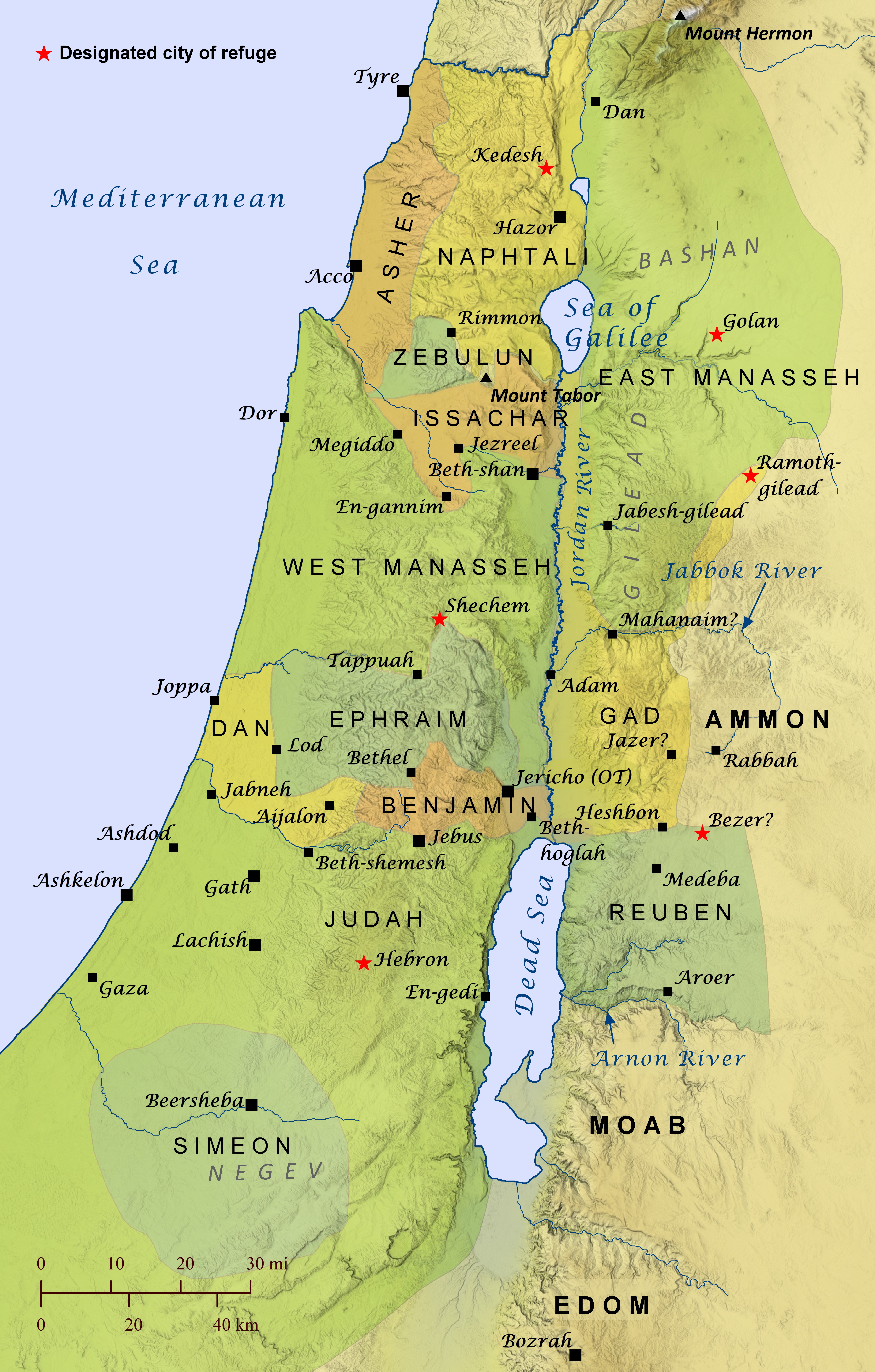
After the Israelites had conquered portions of the Promised Land and Joshua had grown old, the Lord directed him to divide the rest of the land among the tribes of Israel as their inheritance (Joshua 13-20). The eastern tribes had already been allotted their land under Moses’ leadership (Numbers 32), but they continued to help the other tribes drive out the Canaanites from land west of the Jordan River. The Lord also instructed the Israelites to designate several cities of refuge, where someone could flee for protection from an avenger if they accidentally killed someone (Numbers 35; Joshua 20).
Open Bible Data site copyright © 2023–2026 Freely-Given.org.
Python source code for creating these static pages is available on GitHub under an open licence.
For Bible data copyrights, see the details for each displayed Bible version.
The Open English Translation (OET) main site is at OpenEnglishTranslation.Bible or OET.Bible.