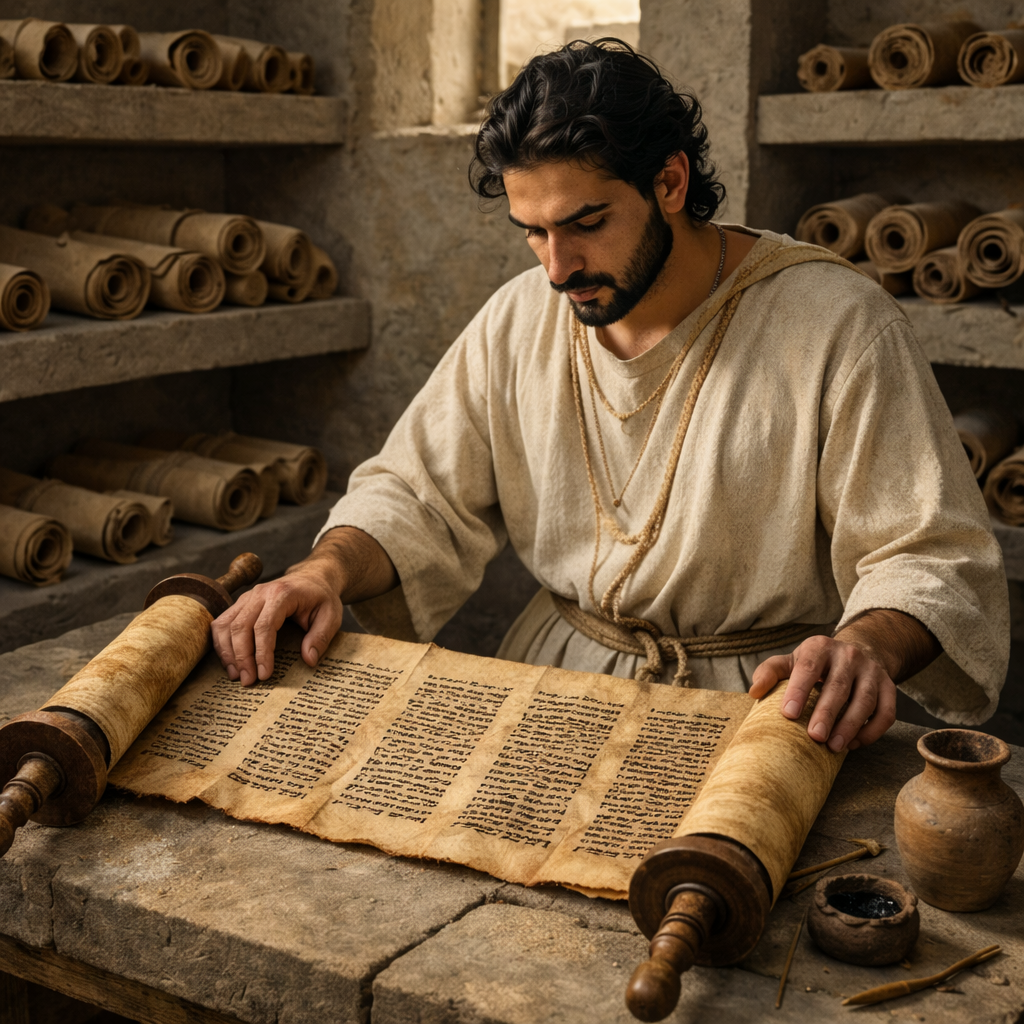
 When he got to Nazaret where he grew up, he went into the Jewish meeting hall as usual on the Rest Day and stood up to do the reading.
OET OET-RV OET-LV GHT ULT UST BSB MSB BLB AICNT OEB WEBBE WMBB NET LSV FBV TCNT T4T LEB BBE Moff JPS Wymth ASV DRA YLT Drby RV SLT Wbstr KJB-1769 KJB-1611 Bshps Gnva Cvdl TNT Wycl SR-GNT UHB BrLXX BrTr Related Parallel Simple Interlinear Topics Reference Dictionary Search
ParallelVerse GEN EXO LEV NUM DEU JOB JOS JDG RUTH 1 SAM 2 SAM PSA AMOS HOS 1 KI 2 KI 1 CHR 2 CHR PROV ECC SNG JOEL MIC ISA ZEP HAB JER LAM YNA (JNA) NAH OBA DAN EZE EZRA EST NEH HAG ZEC MAL LAO GES LES ESG DNG 2 PS TOB JDT WIS SIR BAR LJE PAZ SUS BEL MAN 1 MAC 2 MAC 3 MAC 4 MAC YHN (JHN) MARK MAT LUKE ACTs YAC (JAM) GAL 1 TH 2 TH 1 COR 2 COR ROM COL PHM EPH PHP 1 TIM TIT 1 PET 2 PET 2 TIM HEB YUD (JUD) 1 YHN (1 JHN) 2 YHN (2 JHN) 3 YHN (3 JHN) REV
Luke Intro C1 C2 C3 C5 C6 C7 C8 C9 C10 C11 C12 C13 C14 C15 C16 C17 C18 C19 C20 C21 C22 C23 C24
Luke 4 V1 V3 V5 V7 V9 V11 V13 V15 V17 V19 V21 V23 V25 V27 V29 V31 V33 V35 V37 V39 V41 V43
Note: This view shows ‘verses’ which are not necessarily natural language units and hence sometimes only part of a sentence will be visible—click on any Bible version abbreviation down the left-hand side to see the verse in more of its context. Normally the OET discourages the reading of individual ‘verses’, but this view is only designed as a tool for Bible-translators and others doing comparisons of different translations—the older translations are further down the page (so you can read up from the bottom to trace the English translation history). The OET segments on this page are still early looks into the drafted texts of the Open English Translation of the Bible—please double-check these texts in advance before using in public.
Text critical issues=small word differences Clarity of original=clear Importance to us=normal Speaker(s)=Narrator (All still tentative.)
OET (OET-RV)
When he got to Nazaret where he grew up, he went into the Jewish meeting hall as usual on the Rest Day and stood up to do the reading.
OET-LV And he_came to Nazaret, where he_was having_been_brought_up, and he_came_in according_to that having_been_accustomed to_him, on the day of_the days_of_rest into the synagogue, and he_stood_up to_read.
SR-GNT Καὶ ἦλθεν εἰς Ναζαρά, οὗ ἦν τεθραμμένος, καὶ εἰσῆλθεν κατὰ τὸ εἰωθὸς αὐτῷ, ἐν τῇ ἡμέρᾳ τῶν Σαββάτων εἰς τὴν συναγωγήν, καὶ ἀνέστη ἀναγνῶναι. ‡
(Kai aʸlthen eis Nazara, hou aʸn tethrammenos, kai eisaʸlthen kata to eiōthos autōi, en taʸ haʸmera tōn Sabbatōn eis taʸn sunagōgaʸn, kai anestaʸ anagnōnai.)
Key: khaki:verbs, orange:accusative/object, pink:genitive/possessor, cyan:dative/indirect object.
Note: Automatic aligning of the OET-RV to the LV is done by some temporary software, hence the RV alignments are incomplete (and may occasionally be wrong).
GHT and he-comes into the Nazareth, where he-has-been-being having-been-nourished, and comes-into according-to the having-been-accustomed to {same} in to {the day} of {the sabbaths} into the gathering[translit. "synagogue"] and stands-up/anew to-know-anew[i.e. read/review],
ULT And he came to Nazareth, where he had been raised, and according to his custom, he entered into the synagogue on the Sabbath day, and he stood up to read aloud.
UST Then Jesus went to Nazareth, the town where he had grown up. As he usually did on the Jewish day of rest, he went to the Jewish meeting place. At the appropriate time, he stood up to read something aloud from the Scriptures.
BSB & MSB Then [Jesus] came to Nazareth, where He had been brought up. As was His custom, He entered the synagogue on the Sabbath. And [when] He stood up to read,
BLB And He came to Nazareth, where He had been brought up; and according to His custom, He entered into the synagogue on the day of the Sabbaths, and stood up to read.
AICNT And he came to Nazareth, where he {had been brought up},[fn] and he entered, as was {his}[fn] custom, on the Sabbath day into the synagogue and stood up to read.
OEB ¶ Coming to Nazareth, where he had been brought up, Jesus, as was his custom, went on the Sabbath into the synagogue, and stood up to read the scriptures.
WEBBE & WMBB He came to Nazareth, where he had been brought up. He entered, as was his custom, into the synagogue on the Sabbath day, and stood up to read.
NET Now Jesus came to Nazareth, where he had been brought up, and went into the synagogue on the Sabbath day, as was his custom. He stood up to read,
LSV And He came to Nazareth, where He has been brought up, and He went in, according to His custom, on the day of the Sabbaths, into the synagogue, and stood up to read;
FBV When he arrived in Nazareth, where he had grown up, he went to the synagogue on the Sabbath day as usual.
TCNT When he came to Nazareth, where he had been brought up, he went into the synagogue on the Sabbath day, as was his custom, and stood up to read.
T4T Then Jesus went to Nazareth, the town where he grew up. ◄On the Sabbath/On the Jewish rest day► he went ◄to the synagogue/to the Jewish meeting place►, as he usually did. He stood up to indicate that he wanted to read Scriptures to them.
LEB ¶ And he came to Nazareth, where ⌊he had been brought up⌋,[fn] and according to ⌊his custom⌋[fn] he entered into the synagogue on the day of the Sabbath and stood up to read.
BBE And he came to Nazareth, where he had been as a child, and he went, as his way was, into the Synagogue on the Sabbath, and got up to give a reading.
Moff Then he came to Nazaret, where he had been brought up, and on the sabbath he entered the synagogue as was his custom. He stood up to read the lesson
Wymth He came to Nazareth also, where He had been brought up; and, as was His custom, He went to the synagogue on the Sabbath, and stood up to read.
ASV And he came to Nazareth, where he had been brought up: and he entered, as his custom was, into the synagogue on the sabbath day, and stood up to read.
DRA And he came to Nazareth, where he was brought up: and he went into the synagogue, according to his custom, on the sabbath day; and he rose up to read.
YLT And he came to Nazareth, where he hath been brought up, and he went in, according to his custom, on the sabbath-day, to the synagogue, and stood up to read;
Drby And he came to Nazareth, where he was brought up; and he entered, according to his custom, into the synagogue on the sabbath day, and stood up to read.
RV And he came to Nazareth, where he had been brought up: and he entered, as his custom was, into the synagogue on the sabbath day, and stood up to read.
SLT And he came to Nazareth where he was brought up, and he went in, as was the custom to him in the day of the sabbaths, into the assembly, and stood up to read.
Wbstr And he came to Nazareth, where he had been brought up: and, as his custom was, he went into the synagogue on the sabbath, and stood up to read.
KJB-1769 ¶ And he came to Nazareth, where he had been brought up: and, as his custom was, he went into the synagogue on the sabbath day, and stood up for to read.
KJB-1611 ¶ And hee came to Nazareth, where he had bene brought vp, and as his custome was, he went into the Synagogue on the Sabbath day, and stood vp for to reade.
(Modernised spelling is same as from KJB-1769 above, apart from capitalisation and punctuation)
Bshps And he came to Nazareth, where he was nursed: and, as his custome was, he wet into the synagogue on the Sabboth day, and stoode vp for to reade.
(And he came to Nazareth, where he was nursed: and, as his custom was, he wet into the synagogue on the Sabbath day, and stood up for to read.)
Gnva And hee came to Nazareth where hee had bene brought vp, and (as his custome was) went into the Synagogue on the Sabbath day, and stoode vp to reade.
(And he came to Nazareth where he had been brought up, and (as his custom was) went into the Synagogue on the Sabbath day, and stood up to read.)
Cvdl And he came vnto Nazareth where he was noursed, and as his custome was, he wete in to the synagoge vpon ye Sabbath, and stode vp for to rede.
(And he came unto Nazareth where he was nourished, and as his custom was, he went in to the synagogue upon ye/you_all Sabbath, and stood up for to rede.)
TNT And he came to Nazareth where he was noursed and as hys custome was went in to the synagoge on the Saboth dayes and stode vp for to rede.
(And he came to Nazareth where he was nourished and as his custom was went in to the synagogue on the Sabbath days and stood up for to rede.)
Wycl And he cam to Nazareth, where he was norisschid, and entride aftir his custom in the sabat dai in to a synagoge, and roos to reed.
(And he came to Nazareth, where he was nourished, and entered after his custom in the sabbath day in to a synagogue, and rose to reed.)
Luth Und er kam gen Nazareth, da er erzogen war, und ging in die Schule nach seiner Gewohnheit am Sabbattage und stund auf und wollte lesen.
(And he came to/toward Nazareth, there he trained/educated was, and went in the school after his habit/practice in/at/on_the sabbath_days and stood on/in/to and wanted read.)
ClVg Et venit Nazareth, ubi erat nutritus, et intravit secundum consuetudinem suam die sabbati in synagogam, et surrexit legere.[fn]
(And he_came Nazareth, where was nurtured, and he_entered after/second custom his_own day sabbath in/into/on synagogue, and rose/got_up to_read.)
4.16 Et surrexit legere. BEDA. Qui non venerat ministrari, sed ministrare, etc., usque ad vel prophetiæ lectionis attestatione corrigeret.
4.16 And rose/got_up to_read. BEDA. Who not/no had_come to_be_served, but to_serve, etc., until to or prophecies reading testimony would_correct.
UGNT καὶ ἦλθεν εἰς Ναζαρά, οὗ ἦν τεθραμμένος; καὶ εἰσῆλθεν κατὰ τὸ εἰωθὸς αὐτῷ, ἐν τῇ ἡμέρᾳ τῶν Σαββάτων εἰς τὴν συναγωγήν, καὶ ἀνέστη ἀναγνῶναι.
(kai aʸlthen eis Nazara, hou aʸn tethrammenos; kai eisaʸlthen kata to eiōthos autōi, en taʸ haʸmera tōn Sabbatōn eis taʸn sunagōgaʸn, kai anestaʸ anagnōnai.)
SBL-GNT Καὶ ἦλθεν ⸀εἰς Ναζαρά, οὗ ἦν τεθραμμένος, καὶ εἰσῆλθεν κατὰ τὸ εἰωθὸς αὐτῷ ἐν τῇ ἡμέρᾳ τῶν σαββάτων εἰς τὴν συναγωγήν, καὶ ἀνέστη ἀναγνῶναι.
(Kai aʸlthen ⸀eis Nazara, hou aʸn tethrammenos, kai eisaʸlthen kata to eiōthos autōi en taʸ haʸmera tōn sabbatōn eis taʸn sunagōgaʸn, kai anestaʸ anagnōnai.)
RP-GNT Καὶ ἦλθεν εἰς τὴν Ναζαρέτ, οὗ ἦν τεθραμμένος· καὶ εἰσῆλθεν, κατὰ τὸ εἰωθὸς αὐτῷ, ἐν τῇ ἡμέρᾳ τῶν σαββάτων εἰς τὴν συναγωγήν, καὶ ἀνέστη ἀναγνῶναι.
(Kai aʸlthen eis taʸn Nazaret, hou aʸn tethrammenos; kai eisaʸlthen, kata to eiōthos autōi, en taʸ haʸmera tōn sabbatōn eis taʸn sunagōgaʸn, kai anestaʸ anagnōnai.)
TC-GNT Καὶ ἦλθεν εἰς [fn]τὴν [fn]Ναζαρέτ, οὗ ἦν τεθραμμένος· καὶ εἰσῆλθε, κατὰ τὸ εἰωθὸς αὐτῷ, ἐν τῇ ἡμέρᾳ τῶν σαββάτων εἰς τὴν συναγωγήν, καὶ ἀνέστη ἀναγνῶναι.
(Kai aʸlthen eis taʸn Nazaret, hou aʸn tethrammenos; kai eisaʸlthe, kata to eiōthos autōi, en taʸ haʸmera tōn sabbatōn eis taʸn sunagōgaʸn, kai anestaʸ anagnōnai.)
Key for above GNTs: yellow:punctuation differs, red:words differ (from our SR-GNT base).
In the synagogue in Nazareth, Jesus read a text from Isaiah that refers to the Messiah. Jesus said that what this scripture talked about was happening as he read it. By saying this, Jesus was claiming to be the Messiah. He used examples from the history of Israel to show that the Israelites did not believe and obey God well. He implied that people from other countries were ready to believe and obey God more than the people of Israel were. So the people of Nazareth tried to kill Jesus, but they could not.
Some other possible headings for this section are:
The People of Nazareth Turn against Jesus (CEV)
Jesus Rejected at Nazareth (ESV)
There is a parallel passage for this section in Mark 6:1–6.
Then Jesus came to Nazareth, where He had been brought up.
¶ He went to Nazareth, where he had been raised/reared.
¶ Then Jesus went to the town of Nazareth, where he had grown up.
Then: This verse begins with a Greek conjunction that is often translated as “and.” Some English versions, such as the ESV and NASB, translate it that way. Other versions, such as the NIV and GW, do not translate this conjunction here.
However, since the events in this paragraph occurred after the events in 4:14–15, in some languages, it may be natural to begin this paragraph with a time word or phrase. That is why the BSB says Then, as do several other English versions (NET, GNT). Connect 4:16a to 4:15b in a way that is natural in your language.
Jesus: The Greek literally says “he came,” but if you are beginning a new paragraph here, it may be helpful to translate “he” as Jesus.
Nazareth: Nazareth was the name of the town in Galilee where Jesus had lived when he was a child.
where He had been brought up: The Greek verb that the BSB translates with the English idiom brought up means “reared” or “raised.” It means to take care of a child until he reaches adulthood.
This verb is passive. In some languages it may be more natural to translate without using a passive verb here. For example:
where his parents had raised him
where he had grown up (NCV)
his boyhood home (NLT)
As was His custom, He entered the synagogue on the Sabbath.
On the Sabbath day, he went into the synagogue, as he usually did.
As was his habit on the rest day, he went into the meeting place of the Jews,
As was His custom: The phrase As was His custom means “as he generally did.” Jesus regularly went to a synagogue to worship God on the Sabbath day. This was his habit. Some other ways to translate this are:
as usual (GNT)
as he regularly did (REB)
the synagogue: The synagogue refers to the building in Nazareth where Jews gathered to pray, read Scripture, teach their beliefs, and worship God. For more information, see the note on “synagogues” at 4:15a and synagogue in the Glossary.
the Sabbath: The word Sabbath is the name of the seventh and last day of the week for the Jews. The Sabbath was the special day of the week when the Jews rested and worshiped God. The Law of Moses said that the Jews must not do any work on that day (Deuteronomy 5:12–15).
Some ways to translate Sabbath are:
the Jewish rest day
the day for resting
the day to rest and worship God
If the word Sabbath is already known in your area, you may write it according to the sounds of your language. You may also want to include a phrase to explain the meaning. For example:
the Sabat, the Jews’ day for resting
The term you choose should not make people think the Sabbath is on Sunday, the day when Christians worship. The Sabbath for the Jews began at sundown on Friday and ended at sundown on Saturday. You may want to include a footnote to give more information. For example:
“Sabbath” is the name for the seventh day of the Jews’ week. God told them to rest from work and worship him every week on that day.
And when He stood up to read,
He/Jesus stood up to read.
and he stood up to read from the Scriptures.
He stood up to read: The clause He stood up to read implies that Jesus had been sitting. Then he stood up and came forward. This indicated that he was ready to read. In synagogue worship services, the man who read the Scriptures to the people stood at the front of the congregation.
Note 1 topic: grammar-connect-time-background
καὶ
(Some words not found in SR-GNT: Καί ἦλθεν εἰς Ναζαρέτ οὗ ἦν τεθραμμένος καί εἰσῆλθεν κατά τό εἰωθός αὐτῷ ἐν τῇ ἡμέρᾳ τῶν Σαββάτων εἰς τήν συναγωγήν καί ἀνέστη ἀναγνῶναι)
Luke uses the word And to introduce background information that will help readers understand what happens next. Alternate translation: [Now]
Note 2 topic: figures-of-speech / activepassive
οὗ ἦν τεθραμμένος
where ˱he˲_was ˓having_been˒_brought_up
If it would be helpful in your language, you could express this with an active form, and you could state who did the action. Alternate translation: [where his parents had raised him]
κατὰ τὸ εἰωθὸς αὐτῷ
(Some words not found in SR-GNT: Καί ἦλθεν εἰς Ναζαρέτ οὗ ἦν τεθραμμένος καί εἰσῆλθεν κατά τό εἰωθός αὐτῷ ἐν τῇ ἡμέρᾳ τῶν Σαββάτων εἰς τήν συναγωγήν καί ἀνέστη ἀναγνῶναι)
Alternate translation: [as was his usual practice]
Open Bible Data site copyright © 2023–2026 Freely-Given.org.
Python source code for creating these static pages is available on GitHub under an open licence.
For Bible data copyrights, see the details for each displayed Bible version.
The Open English Translation (OET) main site is at OpenEnglishTranslation.Bible or OET.Bible.