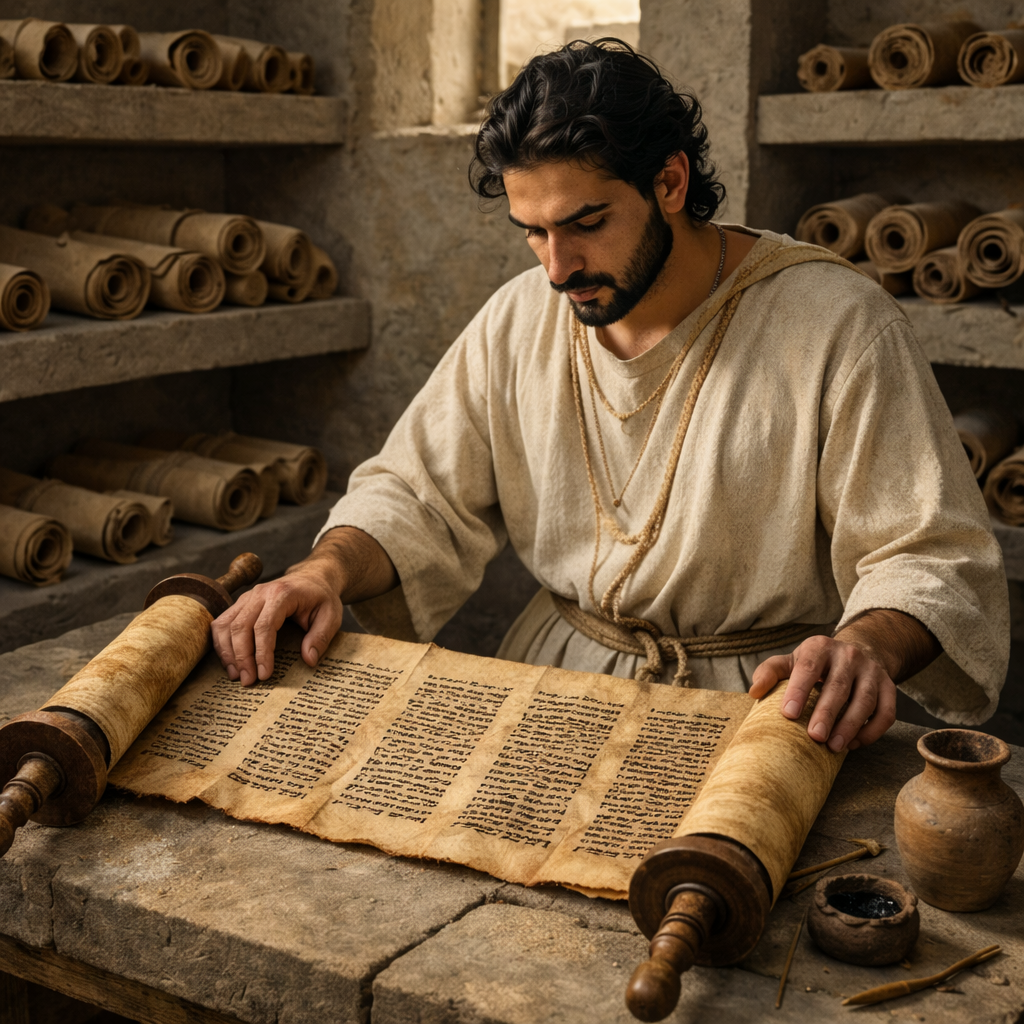
 The scroll of the prophet Yeshayah was handed to him, and opening up the scroll, he found the place where it was written,
OET OET-RV OET-LV GHT ULT UST BSB MSB BLB AICNT OEB WEBBE WMBB NET LSV FBV TCNT T4T LEB BBE Moff JPS Wymth ASV DRA YLT Drby RV SLT Wbstr KJB-1769 KJB-1611 Bshps Gnva Cvdl TNT Wycl SR-GNT UHB BrLXX BrTr Related Parallel Simple Interlinear Topics Reference Dictionary Search
ParallelVerse GEN EXO LEV NUM DEU JOB JOS JDG RUTH 1 SAM 2 SAM PSA AMOS HOS 1 KI 2 KI 1 CHR 2 CHR PROV ECC SNG JOEL MIC ISA ZEP HAB JER LAM YNA (JNA) NAH OBA DAN EZE EZRA EST NEH HAG ZEC MAL LAO GES LES ESG DNG 2 PS TOB JDT WIS SIR BAR LJE PAZ SUS BEL MAN 1 MAC 2 MAC 3 MAC 4 MAC YHN (JHN) MARK MAT LUKE ACTs YAC (JAM) GAL 1 TH 2 TH 1 COR 2 COR ROM COL PHM EPH PHP 1 TIM TIT 1 PET 2 PET 2 TIM HEB YUD (JUD) 1 YHN (1 JHN) 2 YHN (2 JHN) 3 YHN (3 JHN) REV
Luke Intro C1 C2 C3 C5 C6 C7 C8 C9 C10 C11 C12 C13 C14 C15 C16 C17 C18 C19 C20 C21 C22 C23 C24
Luke 4 V1 V3 V5 V7 V9 V11 V13 V15 V19 V21 V23 V25 V27 V29 V31 V33 V35 V37 V39 V41 V43
Note: This view shows ‘verses’ which are not necessarily natural language units and hence sometimes only part of a sentence will be visible—click on any Bible version abbreviation down the left-hand side to see the verse in more of its context. Normally the OET discourages the reading of individual ‘verses’, but this view is only designed as a tool for Bible-translators and others doing comparisons of different translations—the older translations are further down the page (so you can read up from the bottom to trace the English translation history). The OET segments on this page are still early looks into the drafted texts of the Open English Translation of the Bible—please double-check these texts in advance before using in public.
Text critical issues=small word differences Clarity of original=clear Importance to us=normal Speaker(s)=Narrator (All still tentative.)
OET (OET-RV)
The scroll of the prophet Yeshayah was handed to him, and opening up the scroll, he found the place where it was written,
OET-LV And the_scroll of_the prophet Aʸsaias/(Yəshaˊyāh) was_handed_out to_him, and having_opened_up the scroll, he_found the place where it_was having_been_written,
SR-GNT Καὶ ἐπεδόθη αὐτῷ βιβλίον τοῦ προφήτου Ἠσαΐου, καὶ ἀνοίξας τὸ βιβλίον, εὗρεν τὸν τόπον οὗ ἦν γεγραμμένον, ‡
(Kai epedothaʸ autōi biblion tou profaʸtou Aʸsaiou, kai anoixas to biblion, heuren ton topon hou aʸn gegrammenon,)
Key: khaki:verbs, light-green:nominative/subject, orange:accusative/object, pink:genitive/possessor, cyan:dative/indirect object.
Note: Automatic aligning of the OET-RV to the LV is done by some temporary software, hence the RV alignments are incomplete (and may occasionally be wrong).
GHT and [the] scrollet of {Isaiah the prophet} is-given-upon to {same} and, furl[ing]-up/anew the scrollet, he-finds the place of {which} has-been-being having-been-written,
ULT And the scroll of the prophet Isaiah was handed to him and, opening the scroll, he found the place where it was written,
UST Jesus wanted to read some of the words that the prophet Isaiah had spoken long ago. So he asked for the scroll that contained these words, and a synagogue attendant handed it to him. Jesus unrolled the scroll and found the place from which he wanted to read. He read these words:
BSB [the] scroll of the prophet Isaiah was handed to Him. Unrolling [it], He found the place where it was written:
MSB [the] scroll of Isaiah the prophet[fn] was handed to Him. Unrolling [it], He found the place where it was written:
4:17 CT the prophet Isaiah
BLB And the scroll of the prophet Isaiah was given to Him, and having unrolled the scroll, He found the place where it was written:
AICNT And [the scroll of][fn] the prophet Isaiah was given to him, and unrolling the scroll, he found [the place][fn] where it was written,
OEB He was given the book of the prophet Isaiah; and Jesus opened the book and found the place where it says –
WEBBE The book of the prophet Isaiah was handed to him. He opened the book, and found the place where it was written,
WMBB The scroll of the prophet Isaiah was handed to him. He opened the scroll, and found the place where it was written,
NET and the scroll of the prophet Isaiah was given to him. He unrolled the scroll and found the place where it was written,
LSV and there was given over to Him a scroll of Isaiah the prophet, and having unfolded the scroll, He found the place where it has been written:
FBV The scroll of the prophet Isaiah was handed to him. Jesus unrolled the scroll and found the place where it's written:
TCNT The scroll of the prophet Isaiah was handed to him, so he [fn]unrolled the scroll and found the place where it is written,
4:17 unrolled ¦ opened WH
T4T A scroll containing the words that the prophet Isaiah had written was given to him {Someone gave to him a scroll containing the words that the prophet Isaiah had written}. He opened the scroll and found the place from which he wanted to read. He read these words:
LEB And the scroll of the prophet Isaiah was given to him, and unrolling the scroll he found the place where it was written,
BBE And the book of the prophet Isaiah was given to him and, opening the book, he came on the place where it is said,
Moff and was handed the book of the prophet Isaiah; on opening the book he came upon the place where it was written,
Wymth And there was handed to Him the book of the Prophet Isaiah, and, opening the book, He found the place where it was written,
ASV And there was delivered unto him the book of the prophet Isaiah. And he opened the book, and found the place where it was written,
DRA And the book of Isaias the prophet was delivered unto him. And as he unfolded the book, he found the place where it was written:
YLT and there was given over to him a roll of Isaiah the prophet, and having unfolded the roll, he found the place where it hath been written:
Drby And [the] book of the prophet Esaias was given to him; and having unrolled the book he found the place where it was written,
RV And there was delivered unto him the book of the prophet Isaiah. And he opened the book, and found the place where it was written,
SLT And the book of Esaias the prophet was given to him. And having unfolded the book, he found the place where it was written,
Wbstr And there was delivered to him the book of the prophet Isaiah. And when he had opened the book, he found the place where it was written,
KJB-1769 And there was delivered unto him the book of the prophet Esaias. And when he had opened the book, he found the place where it was written,
KJB-1611 And there was deliuered vnto him the booke of the Prophet Esaias, and when he had opened the Booke, he found the place where it was written,
(Modernised spelling is same as from KJB-1769 above, apart from capitalisation and punctuation)
Bshps And there was deliuered vnto hym the booke of the prophete Esaias: And whe he had opened the booke, he founde the place where it was written,
(Modernised spelling is same as from KJB-1769 above, apart from punctuation)
Gnva And there was deliuered vnto him the booke of the Prophet Esaias: and when hee had opened the booke, hee founde the place, where it was written,
(Modernised spelling is same as from KJB-1769 above, apart from capitalisation and punctuation)
Cvdl Then was there delyuered him the boke of ye prophet Esay. And whan he had turned ouer the boke, he founde the place where it is wrytten:
(Then was there delivered him the book of ye/you_all prophet Isaiah. And when he had turned over the book, he found the place where it is written:)
TNT And ther was delyvered vnto him the boke of the Prophete Esaias. And when he had opened the boke he founde the place where it was written.
(Modernised spelling is same as from KJB-1769 above, apart from capitalisation and punctuation)
Wycl And the book of Ysaye, the prophete, was takun to hym; and as he turnede the book, he foond a place, where it was wrytun,
(And the book of Ysaye, the prophet, was taken to him; and as he turned the book, he found a place, where it was written,)
Luth Da ward ihm das Buch des Propheten Jesaja gereicht. Und da er das Buch herumwarf, fand er den Ort, da geschrieben stehet:
(So what/which him the book the prophet(s) Isaiah offered. And there he the book threw_around, found he the place/location, there written stands:)
ClVg Et traditus est illi liber Isaiæ prophetæ. Et ut revolvit librum, invenit locum ubi scriptum erat:
(And handed_over it_is them book/volume Isaiah prophets. And as rolled_back book, he_found place where written was:)
UGNT καὶ ἐπεδόθη αὐτῷ βιβλίον τοῦ προφήτου Ἠσαΐου, καὶ ἀναπτύξας τὸ βιβλίον, εὗρεν τὸν τόπον οὗ ἦν γεγραμμένον,
(kai epedothaʸ autōi biblion tou profaʸtou Aʸsaiou, kai anaptuxas to biblion, heuren ton topon hou aʸn gegrammenon,)
SBL-GNT καὶ ἐπεδόθη αὐτῷ βιβλίον ⸂τοῦ προφήτου Ἠσαΐου⸃ καὶ ⸀ἀναπτύξας τὸ βιβλίον εὗρεν τὸν τόπον οὗ ἦν γεγραμμένον·
(kai epedothaʸ autōi biblion ⸂tou profaʸtou Aʸsaiou⸃ kai ⸀anaptuxas to biblion heuren ton topon hou aʸn gegrammenon;)
RP-GNT Καὶ ἐπεδόθη αὐτῷ βιβλίον Ἠσαΐου τοῦ προφήτου. Καὶ ἀναπτύξας τὸ βιβλίον, εὗρεν τὸν τόπον οὗ ἦν γεγραμμένον,
(Kai epedothaʸ autōi biblion Aʸsaiou tou profaʸtou. Kai anaptuxas to biblion, heuren ton topon hou aʸn gegrammenon,)
TC-GNT καὶ ἐπεδόθη αὐτῷ βιβλίον [fn]Ἡσαΐου τοῦ προφήτου. καὶ [fn]ἀναπτύξας τὸ βιβλίον, εὗρε τὸν τόπον οὗ ἦν γεγραμμένον,
(kai epedothaʸ autōi biblion Haʸsaiou tou profaʸtou. kai anaptuxas to biblion, heure ton topon hou aʸn gegrammenon,)
Key for above GNTs: red:words differ (from our SR-GNT base).
In the synagogue in Nazareth, Jesus read a text from Isaiah that refers to the Messiah. Jesus said that what this scripture talked about was happening as he read it. By saying this, Jesus was claiming to be the Messiah. He used examples from the history of Israel to show that the Israelites did not believe and obey God well. He implied that people from other countries were ready to believe and obey God more than the people of Israel were. So the people of Nazareth tried to kill Jesus, but they could not.
Some other possible headings for this section are:
The People of Nazareth Turn against Jesus (CEV)
Jesus Rejected at Nazareth (ESV)
There is a parallel passage for this section in Mark 6:1–6.
the scroll of the prophet Isaiah was handed to Him.
He was handed/given the scroll of the prophet Isaiah.
Someone gave him the book of the words of the prophet Isaiah.
the scroll of the prophet Isaiah: The phrase the scroll of the prophet Isaiah means “the scroll containing the words of the prophet Isaiah.” Isaiah himself had not personally written this particular scroll. This was a copy of the prophecies that he received from God. Isaiah had prophesied about six hundred years earlier.
scroll: In Jesus’ time people used scrolls, not books like the ones people use today. A scroll was a roll of specially prepared animal skins (called parchment) or papyrus paperParchment was a kind of paper made from animal skins. Papyrus was a kind of paper made from reeds. The scroll in Luke 4:17a was probably sheets of parchment or papyrus that people had sewn together into a long sheet and then rolled up. with writing on it. People wrapped the two ends of the scroll around wooden handles. In order to read from it, a person used these handles to unroll the scroll. People rolled up the scroll and kept it that way when no one was using it. Another way to translate scroll is:
book (GNT)
the prophet Isaiah: The phrase the prophet Isaiah means the same thing as “Isaiah the prophet” in 3:4a. You should translate it the same way in both places.
prophet: A prophet was a person who spoke on behalf of God. He told people what God revealed to him. God gave some prophets power to work miracles. These miracles helped people realize that God sent the prophet. Some ways to translate prophet are:
a spokesman for God
a person who speaks God’s words
God’s message-speaker
It is good to use a general term that does not focus only on foretelling the future. Although prophets did foretell the future, they also gave people other messages from God. They especially told them to stop sinning and to obey God.
Be sure that your term for prophet is different from other words which are similar in meaning such as “angel,” “apostle,” and “preacher.”
This word also occurs in 3:4a. See also prophet in the Glossary.
was handed to Him: The Greek verb that the BSB translates as was handed is literally “was given” (as in the RSV). This verb is passive. Some ways to translate this verb are:
As a passive verb. For example:
was given to him (NET)
was delivered unto him (KJV)
As an active verb. In some languages it may be more natural to say who gave the scroll to Jesus. It was probably the same attendant who is mentioned in 4:20b. You may also be able to use a general subject. For example:
Someone gave him
The attendant gave him (GW)
Unrolling it,
He unrolled the scroll
He opened the book (NCV)
Unrolling it: The word Unrolling refers to what is done to open a scroll. Jesus opened the scroll in order to read what was written on it. Another way to translate this is:
He opened the book (NCV)
He found the place where it was written:
and found the place where these words are written— (JBP)
to the place where it says: (NLT96)
and looked for a certain passage. He found that passage and read what was written there. It said:
He found the place: The phrase He found the place indicates that Jesus located a specific Scripture passage that he intended to read. He unrolled the scroll until he came to the correct place. Another way to translate this is:
to the place (NLT96)
This place is the Scripture passage that is now known as Isaiah 61:1–2. In Jesus’ time, the books of the Bible were not divided into chapters and verses as they are today.
Luke did not explicitly say that Jesus read that passage aloud. However, that is implied, and it may be necessary to make that explicit. For example:
Jesus found and read aloud the passage
where it was written: The phrase where it was written is similar to the phrase “it is written” in 4:4a and 4:8a. Some other ways to translate this phrase are:
where it says (NLT96)
where this is written (NCV)
where these words are written (JBP)
In some languages it may be more natural to leave the passive verb “was written” implied. For example:
and found the passage which says (REB)
Jesus found and read aloud this writing/prophecy
Note 1 topic: grammar-connect-time-sequential
καὶ
(Some words not found in SR-GNT: Καί ἐπεδόθη αὐτῷ βιβλίον τοῦ προφήτου Ἠσαΐου καί ἀνοίξας τό βιβλίον εὗρεν τόν τόπον οὗ ἦν γεγραμμένον)
Luke uses the word And to indicate that the event he will now relate came after the event he has just described. Alternate translation: [Then]
Note 2 topic: figures-of-speech / activepassive
ἐπεδόθη αὐτῷ βιβλίον τοῦ προφήτου Ἠσαΐου
˓was˒_handed_out ˱to˲_him ˓the˒_scroll ˱of˲_the prophet Isaiah
If it would be helpful in your language, you could express this with an active form, and you could state who did the action. Alternate translation: [someone brought him the scroll of the prophet Isaiah]
Note 3 topic: figures-of-speech / explicit
ἐπεδόθη αὐτῷ βιβλίον τοῦ προφήτου Ἠσαΐου
˓was˒_handed_out ˱to˲_him ˓the˒_scroll ˱of˲_the prophet Isaiah
Since Jesus looked for a specific passage in the scroll, and since he said that it was being fulfilled right at that time, it is likely that Jesus requested this particular scroll. If it would be helpful to your readers, you could state that explicitly. Alternate translation: [at his request, someone brought him the scroll of the prophet Isaiah]
Note 4 topic: translate-unknown
βιβλίον τοῦ προφήτου Ἠσαΐου
˓the˒_scroll ˱of˲_the prophet Isaiah
A scroll was a long, wide roll of special paper. On this scroll someone had written the words that Isaiah had spoken many years before. If your readers would not know what a scroll is, you could describe it, or you could use a general expression. Alternate translation: [the special paper roll that recorded the sayings of the prophet Isaiah] or [the book that recorded the sayings of the prophet Isaiah]
Note 5 topic: figures-of-speech / activepassive
τὸν τόπον οὗ ἦν γεγραμμένον
(Some words not found in SR-GNT: Καί ἐπεδόθη αὐτῷ βιβλίον τοῦ προφήτου Ἠσαΐου καί ἀνοίξας τό βιβλίον εὗρεν τόν τόπον οὗ ἦν γεγραμμένον)
If it would be helpful in your language, you could express this with an active form. Alternate translation: [the place where the scroll recorded the words]
Open Bible Data site copyright © 2023–2026 Freely-Given.org.
Python source code for creating these static pages is available on GitHub under an open licence.
For Bible data copyrights, see the details for each displayed Bible version.
The Open English Translation (OET) main site is at OpenEnglishTranslation.Bible or OET.Bible.