
OET OET-RV OET-LV ULT UST BSB MSB BLB AICNT OEB WEBBE WMBB NET LSV FBV TCNT T4T LEB BBE Moff JPS Wymth ASV DRA YLT Drby RV SLT Wbstr KJB-1769 KJB-1611 Bshps Gnva Cvdl TNT Wycl SR-GNT UHB BrLXX BrTr Related Parallel Simple Interlinear Topics Reference Dictionary Search
ParallelVerse GEN EXO LEV NUM DEU JOB JOS JDG RUTH 1 SAM 2 SAM PSA AMOS HOS 1 KI 2 KI 1 CHR 2 CHR PROV ECC SNG JOEL MIC ISA ZEP HAB JER LAM YNA (JNA) NAH OBA DAN EZE EZRA EST NEH HAG ZEC MAL LAO GES LES ESG DNG 2 PS TOB JDT ESA WIS SIR BAR LJE PAZ SUS BEL MAN 1 MAC 2 MAC 3 MAC 4 MAC YHN MARK MAT LUKE ACTs YAC (JAM) GAL 1 TH 2 TH 1 COR 2 COR ROM COL PHM EPH PHP 1 TIM TIT 1 PET 2 PET 2 TIM HEB YUD (JUD) 1 YHN (1 JHN) 2 YHN (2 JHN) 3 YHN (3 JHN) REV
Yhn Intro C1 C2 C3 C4 C5 C6 C7 C8 C9 C10 C12 C13 C14 C15 C16 C17 C18 C19 C20 C21
Yhn 11 V1 V3 V5 V7 V9 V11 V13 V15 V17 V19 V21 V23 V27 V29 V31 V33 V35 V37 V39 V41 V43 V45 V47 V49 V51 V53 V55 V57
Note: This view shows ‘verses’ which are not necessarily natural language units and hence sometimes only part of a sentence will be visible—click on any Bible version abbreviation down the left-hand side to see the verse in more of its context. Normally the OET discourages the reading of individual ‘verses’, but this view is only designed as a tool for Bible-translators and others doing comparisons of different translations—the older translations are further down the page (so you can read up from the bottom to trace the English translation history). The OET segments on this page are still early looks into the drafted texts of the Open English Translation of the Bible—please double-check these texts in advance before using in public.
Text critical issues=small word differences Clarity of original=clear Importance to us=vital Speaker(s)=Narrator,Yeshua (All still tentative.)
OET (OET-RV) But Yeshua continued, “I am the resurrection and the life. Anyone who believes that I’m from God, even if they die they’ll still be living,
OET-LV The Yaʸsous/(Yəhōshūˊa) said to_her:
I am the resurrection and the life, the one believing in me, even_if he_may_die_off, will_be_living,
SR-GNT Εἶπεν αὐτῇ ὁ ˚Ἰησοῦς, “Ἐγώ εἰμι ἡ ἀνάστασις καὶ ἡ ζωή· ὁ πιστεύων εἰς ἐμὲ, κἂν ἀποθάνῃ, ζήσεται, ‡
(Eipen autaʸ ho ˚Yaʸsous, “Egō eimi haʸ anastasis kai haʸ zōaʸ; ho pisteuōn eis eme, kan apothanaʸ, zaʸsetai,)
Key: khaki:verbs, light-green:nominative/subject, orange:accusative/object, cyan:dative/indirect object.
Note: Automatic aligning of the OET-RV to the LV is done by some temporary software, hence the RV alignments are incomplete (and may occasionally be wrong).
ULT Jesus said to her, “I am the resurrection and the life; the one believing in me, even if he dies, will live;
UST Jesus told her, “I am the one who causes dead people to live again. I am the one who gives people eternal life. Whoever trusts in me will live forever, even if his body dies.
BSB & MSB Jesus said to her, “I am the resurrection and the life. Whoever believes in Me will live, even though he dies.
BLB Jesus said to her, "I am the resurrection and the life; the one believing in Me, even if he should die, he will live.
AICNT [[So]][fn] Jesus said to her, “I am the resurrection [and the life].[fn] Whoever believes in me, though they die, shall live,
11:25, So: Included in 𝔓75 ‖ Some manuscripts read “But.” ℵ(01) Latin(d).
11:25, and the life: Absent from 𝔓45 Syriac(sys).
OEB ‘I am the resurrection and the life,’ said Jesus. ‘He who believes in me will live, though he die;
WEBBE Jesus said to her, “I am the resurrection and the life. He who believes in me will still live, even if he dies.
WMBB Yeshua said to her, “I am the resurrection and the life. He who believes in me will still live, even if he dies.
NET Jesus said to her, “I am the resurrection and the life. The one who believes in me will live even if he dies,
LSV Jesus said to her, “I AM the resurrection, and the life; he who is believing in Me, even if he may die, will live;
FBV Jesus said, “I am the resurrection and the life. Those who trust in me will live, even though they die.
TCNT Jesus said to her, “I am the resurrection and the life. He who believes in me, though he may die, yet shall he live.
T4T Jesus said to her, “I am the one who enables people to become alive again and who causes people to live eternally. Those who believe in me, even if they die, will live again.
LEB Jesus said to her, “I am the resurrection and the life. The one who believes in me, even if he dies, will live,
BBE Jesus said to her, I am myself that day and that life; he who has faith in me will have life even if he is dead;
Moff Jesus said to her, "I am myself resurrection and life:
⇔ he who believes in me will live, even if he dies,
Wymth "I am the Resurrection and the Life," said Jesus; "he who believes in me, even if he has died, he shall live;
ASV Jesus said unto her, I am the resurrection, and the life: he that believeth on me, though he die, yet shall he live;
DRA Jesus said to her: I am the resurrection and the life: he that believeth in me, although he be dead, shall live:
YLT Jesus said to her, 'I am the rising again, and the life; he who is believing in me, even if he may die, shall live;
Drby Jesus said to her, I am the resurrection and the life: he that believes on me, though he have died, shall live;
RV Jesus said unto her, I am the resurrection, and the life: he that believeth on me, though he die, yet shall he live:
(Jesus said unto her, I am the resurrection, and the life: he that believeth/believes on me, though he die, yet shall he live:)
SLT Jesus said to her, I am the rising up, and life: he believing in me, though he die, shall live.
Wbstr Jesus said to her, I am the resurrection, and the life: he that believeth in me, though he were dead, yet shall he live:
KJB-1769 Jesus said unto her, I am the resurrection, and the life: he that believeth in me, though he were dead, yet shall he live:
(Jesus said unto her, I am the resurrection, and the life: he that believeth/believes in me, though he were dead, yet shall he live:)
KJB-1611 Iesus said vnto her, I am the resurrection, and the life: hee that beleeueth in me, though he were dead, yet shall he liue.
(Modernised spelling is same as from KJB-1769 above, apart from punctuation)
Bshps Iesus sayth vnto her, I am the resurrection, and the lyfe: He that beleueth on me, yea, though he were dead, yet shall he lyue.
(Yesus/Yeshua saith/says unto her, I am the resurrection, and the life: He that believeth/believes on me, yea, though he were dead, yet shall he live.)
Gnva Iesus saide vnto her, I am the resurrection and the life: he that beleeueth in me, though he were dead, yet shall he liue.
(Modernised spelling is same as from KJB-1769 above, apart from punctuation)
Cvdl Iesus saide vnto her: I am the resurreccion & the life He yt beleueth on me, shal lyue, though he were deed allready:
(Yesus/Yeshua said unto her: I am the resurrection and the life He it believeth/believes on me, shall live, though he were deed already:)
TNT Iesus sayde vnto her: I am the resurreccion and the lyfe: He that beleveth on me ye though he were deed yet shall he lyve.
(Yesus/Yeshua said unto her: I am the resurrection and the life: He that believeth on me ye/you_all though he were deed yet shall he lyve.)
Wycl Jhesus seith to hir, Y am ayen risyng and lijf; he that bileueth in me, yhe, thouy he be deed,
(Yhesus saith/says to her, I am again rising and life; he that believeth/believes in me, yea/yes, though he be deed,)
Luth JEsus spricht zu ihr: Ich bin die Auferstehung und das Leben. Wer an mich glaubet, der wird leben, ob er gleich stürbe;
(Yesus speaks/says to/for you(pl)/their/her: I am the resurrection and the life. Who at/to me believes, the/of_the becomes life, if/whether he even died;)
ClVg Dixit ei Jesus: Ego sum resurrectio et vita: qui credit in me, etiam si mortuus fuerit, vivet:[fn]
(He/She_said to_him Yesus: I I_am resurrection and life: who/which he_believes in/into/on me, also when/but_if dead has_been, he_will_live:)
11.25 Etiam si mortuus fuerit. Tres mortuos suscitavit Jesus, unum in domo, id est in corde; secundum in porta, id est in ore; tertium in monumento, id est in opere et consuetudine peccandi. Vivet. Ut vivit Abraham, Isaac et Jacob, quorum Deus dicitur sicut vivorum. Credens etiam mortuus vivit, sicut non credens etiam vivens mortuus est.
11.25 Yes when/but_if dead has_been. Three the_dead raised Yesus, one in/into/on at_home, that it_is in/into/on heart; after/second in/into/on gate/door, that it_is in/into/on vocally; third in/into/on monument, that it_is in/into/on by_work and custom to_sin. Vivet. As lives Abraham, Isaac and Yacob, whose God it_is_said like of_the_living. Credens also dead lives, like not/no believing also living dead it_is.
UGNT εἶπεν αὐτῇ ὁ Ἰησοῦς, ἐγώ εἰμι ἡ ἀνάστασις καὶ ἡ ζωή; ὁ πιστεύων εἰς ἐμὲ, κἂν ἀποθάνῃ, ζήσεται;
(eipen autaʸ ho Yaʸsous, egō eimi haʸ anastasis kai haʸ zōaʸ; ho pisteuōn eis eme, kan apothanaʸ, zaʸsetai;)
SBL-GNT εἶπεν αὐτῇ ὁ Ἰησοῦς· Ἐγώ εἰμι ἡ ἀνάστασις καὶ ἡ ζωή· ὁ πιστεύων εἰς ἐμὲ κἂν ἀποθάνῃ ζήσεται,
(eipen autaʸ ho Yaʸsous; Egō eimi haʸ anastasis kai haʸ zōaʸ; ho pisteuōn eis eme kan apothanaʸ zaʸsetai,)
RP-GNT Εἶπεν αὐτῇ ὁ Ἰησοῦς, Ἐγώ εἰμι ἡ ἀνάστασις καὶ ἡ ζωή· ὁ πιστεύων εἰς ἐμέ, κἂν ἀποθάνῃ, ζήσεται·
(Eipen autaʸ ho Yaʸsous, Egō eimi haʸ anastasis kai haʸ zōaʸ; ho pisteuōn eis eme, kan apothanaʸ, zaʸsetai;)
TC-GNT εἶπεν αὐτῇ ὁ Ἰησοῦς, Ἐγώ εἰμι ἡ ἀνάστασις καὶ ἡ ζωή· ὁ πιστεύων εἰς ἐμέ, κἂν ἀποθάνῃ, ζήσεται·
(eipen autaʸ ho Yaʸsous, Egō eimi haʸ anastasis kai haʸ zōaʸ; ho pisteuōn eis eme, kan apothanaʸ, zaʸsetai;)
Key for above GNTs: yellow:punctuation differs, orange:accents differ (from our SR-GNT base).
In this section, Jesus arrived in Bethany, where Lazarus and his sisters lived. His sister Martha came out to greet Jesus, and told him that if he had been there, Lazarus would still be alive. Jesus told her that Lazarus would rise again, but Martha thought that he was talking about the last day. Jesus then told her that he was the resurrection and the life, and that those who believed in him would never die. Martha then said that she believed that he was the Messiah, the Son of God.
Here are some other possible headings for this section:
Jesus told Martha that Lazarus would live again
Those who believe in Jesus will never die
Martha went to meet Jesus and expressed her faith and trust in him.
Jesus said to her, “I am the resurrection and the life.
Jesus said to Martha, “I am the resurrection. I am also the life.
Jesus told Martha, “I am the one who restores the dead to life and who gives life.
I am the resurrection and the life: This clause indicates that Jesus is the one who makes dead people live and gives them true life. There is a textual problem here:
Most Greek manuscripts say “I am the resurrection and the life.” This is followed by most English translations including the BSB.
(BSB, KJV, NASB, RSV, NRSV, ESV, NIV, GW, NET, REB, NCV)
A few ancient manuscripts do not include the words and the life and just say “I am the resurrection.” For example:
I am the resurrection. (NJB)
(NJB, CEV)
It is recommended that you follow option (1), along with the great majority of Greek manuscripts and English translations.The UBS Greek text gives option (1) a B rating, indicating that there is some degree of doubt.
the resurrection and the life: The words resurrection and life refer to similar but not the same ideas. The word resurrection refers to rising from the dead, probably on the last day. And life refers to eternal, spiritual life. Jesus is the source of all life.
the resurrection: In some languages it may be natural to translate the resurrection using a verb phrase. For example:
I am the one who brings people back to life. (GW)
I am the one who raises the dead to life! (CEV)
the life: This phrase refers to Jesus as the source of all true life. And even more, he is life, so if we have Jesus, we have life. In some languages it may be natural to say:
I am life itself. (GW)
I am the one who gives life
I cause people to live
I am the source of life
Whoever believes in Me will live, even though he dies. And everyone who lives and believes in Me will never die: These sentences can be rather confusing, partly because they seem to repeat the same idea. However, it helps to understand that 11:25b (Whoever believes in Me will live, even though he dies) seems to explain “I am the resurrection.” And then 11:26a (And everyone who lives and believes in Me will never die) explains “I am…the life.”
There is another reason that this sentence is confusing. It is not always clear whether the verbs live and die refer to living/dying physically or spiritually. It seems that Jesus meant, “Those who believe in me, even though they die physically, will come to life again on the last day. And everyone who lives spiritually and believes in me will never die spiritually.” However, see the notes below for other interpretations.
Whoever believes in Me will live, even though he dies.
Those people who trust in me will live, even though they die physically,
A person who believes in me may die physically, but he will continue to live.
Whoever believes in Me: The Greek phrase that the BSB translates as Whoever believes in Me is more literally “the one who believes in me.” It refers to anyone and everyone who trusts Jesus. The subject can be singular or plural, whichever is natural in your language. For example:
Anyone who believes in me (NLT)
believes in Me: This phrase includes the idea of believing the facts about who Jesus was and what he did. But it also includes the idea of trusting Jesus instead of trusting oneself or someone else. Both ideas are very closely related. If someone believes the facts about Jesus, it should result in trusting him. See how you translated similar phrases in 1:12b, 7:31a, and 7:38a. Here are other ways to translate this idea:
has faith in me (CEV)
trusts in me
will live: Scholars interpret this phrase in different ways:
Many scholars say that it refers to the resurrection at the end of time. It means “will come to life.”
Other scholars say that it refers to eternal, spiritual life. It means “will have eternal life.”
All English translations can be understood either way. It is recommended that you translate live literally so that it can also be understood either way. However, it seems likely that this clause explains “I am the resurrection” in 11:25a. Therefore, if you must choose one of the interpretations, it is recommended that you follow interpretation (1). But if a major translation in your area follows interpretation (2), you may follow that. Here are other ways to translate this clause:
Everyone who has faith in me will live, even if they die. (CEV)
Anyone who believes in me will live, even after dying. (NLT)
Even if he dies, the one who believes in me will come to life again
Even if someone dies, he will have eternal life if he believes in me
In some languages it may be natural to reorder the phrases in 11:25b. See the examples above for different ways to do that.
even though he dies: This clause refers to physical death. Believers may die in the normal physical way.
Note 1 topic: figures-of-speech / explicit
ἡ ἀνάστασις
the resurrection
Here, Jesus calls himself the resurrection in order to say that he is the one who causes dead people to come back to life. You could include this information if that would be helpful to your readers. Alternate translation: [the one who resurrects dead people] or [the one who brings dead people back to life]
Note 2 topic: figures-of-speech / explicit
ἡ ζωή
the the life
Here, Jesus calls himself the life in order to say that he is the one who gives people eternal life. You could include this information if that would be helpful to your readers. Alternate translation: [the one who makes people live forever] or [the one who causes people to live forever]
Note 3 topic: figures-of-speech / explicit
κἂν ἀποθάνῃ
(Some words not found in SR-GNT: εἶπεν αὐτῇ Ὁ Ἰησοῦς Ἐγώ εἰμί ἡ ἀνάστασις καί ἡ ζωή ὁ πιστεύων εἰς ἐμέ κἄν ἀποθάνῃ ζήσεται)
Here, dies refers to physical death. You could include this information if that would be helpful to your readers. Alternate translation: [even if his body dies]
Note 4 topic: figures-of-speech / explicit
ζήσεται
˓will_be˒_living
Here, live refers to having eternal life. If this might confuse your readers, you could express the meaning explicitly. Alternate translation: [will have eternal life]
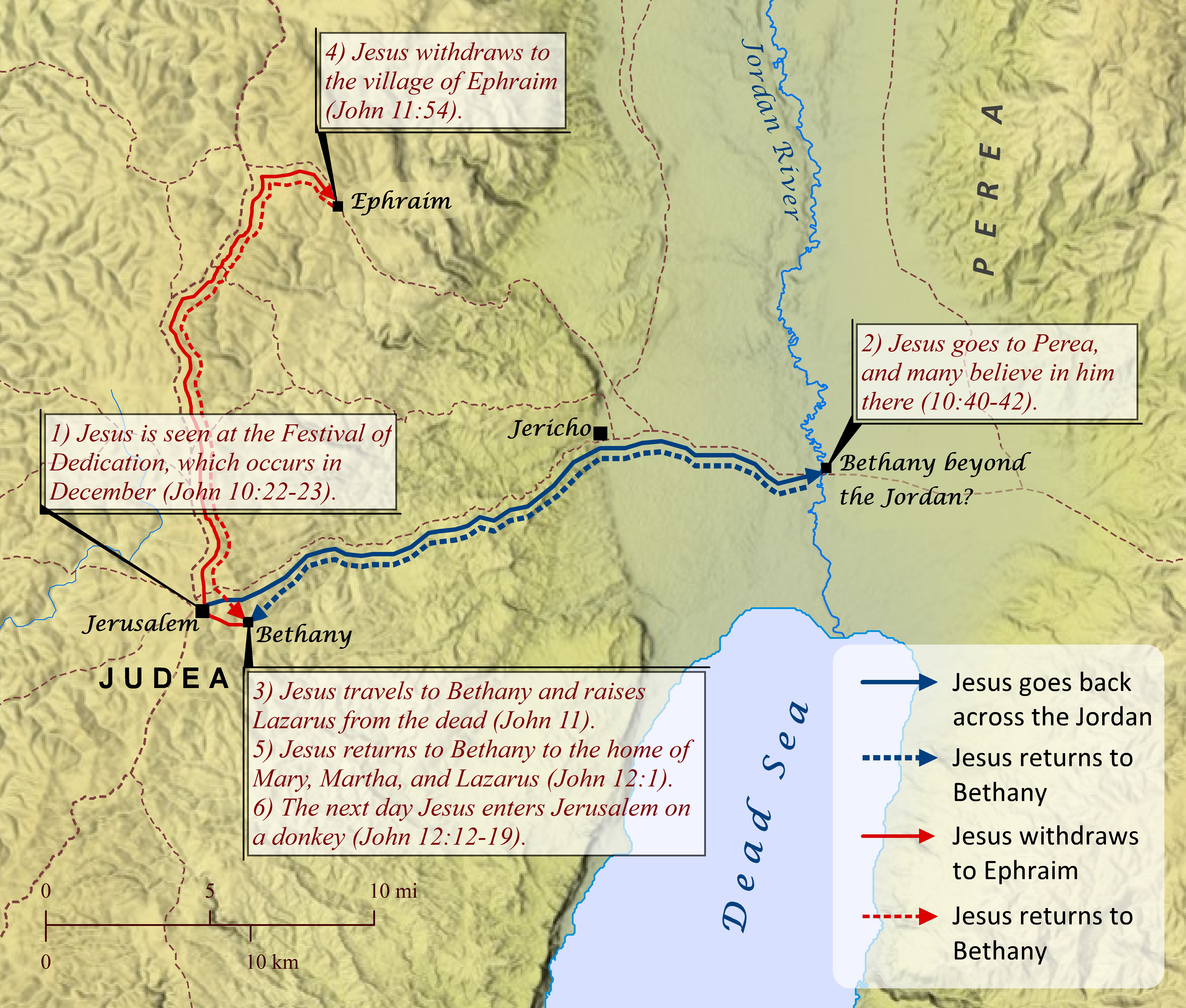
Much like the difficulties of discerning the Israelites’ journey to the Promised Land (see here), the task of reconciling the four Gospel accounts of Jesus’ final journey to Jerusalem into one coherent itinerary has proven very challenging for Bible scholars. As with many other events during Jesus’ ministry, the accounts of Matthew, Mark, and Luke (often referred to as the Synoptic Gospels) present a noticeably similar account of Jesus’ final travels, while John’s Gospel presents an itinerary that is markedly different from the others. In general, the Synoptic Gospels present Jesus as making a single journey to Jerusalem, beginning in Capernaum (Luke 9:51), passing through Perea (Matthew 19:1-2; Mark 10:1) and Jericho (Matthew 20:29-34; Mark 10:46-52; Luke 18:35-19:10), and ending at Bethany and Bethphage, where he enters Jerusalem riding on a donkey (Matthew 21:1-11; Mark 11:1-11; Luke 19:28-44). John, on the other hand, mentions several trips to Jerusalem by Jesus (John 2:13-17; 5:1-15; 7:1-13; 10:22-23), followed by a trip to Perea across the Jordan River (John 10:40-42), a return to Bethany where he raises Lazarus from the dead (John 11), a withdrawal to the village of Ephraim for a few months (John 11:54), and a return trip to Bethany, where he then enters Jerusalem riding on a donkey (John 12:1-19). The differences between the Synoptics’ and John’s accounts are noteworthy, but they are not irreconcilable. The Synoptics, after noting that Jesus began his trip at Capernaum, likely condensed their accounts (as occurs elsewhere in the Gospels) to omit Jesus’ initial arrival in Jerusalem and appearance at the Festival of Dedication, thus picking up with Jesus in Perea (stage 2 of John’s itinerary). Then all the Gospels recount Jesus’ trip (back) to Bethany and Jerusalem, passing through Jericho along the way. Likewise, the Synoptics must have simply omitted the few months Jesus spent in Ephraim to escape the Jewish leaders (stage 4 of John’s itinerary) and rejoined John’s account where Jesus is preparing to enter Jerusalem on a donkey.
Open Bible Data site copyright © 2023–2026 Freely-Given.org.
Python source code for creating these static pages is available on GitHub under an open licence.
For Bible data copyrights, see the details for each displayed Bible version.
The Open English Translation (OET) main site is at OpenEnglishTranslation.Bible or OET.Bible.