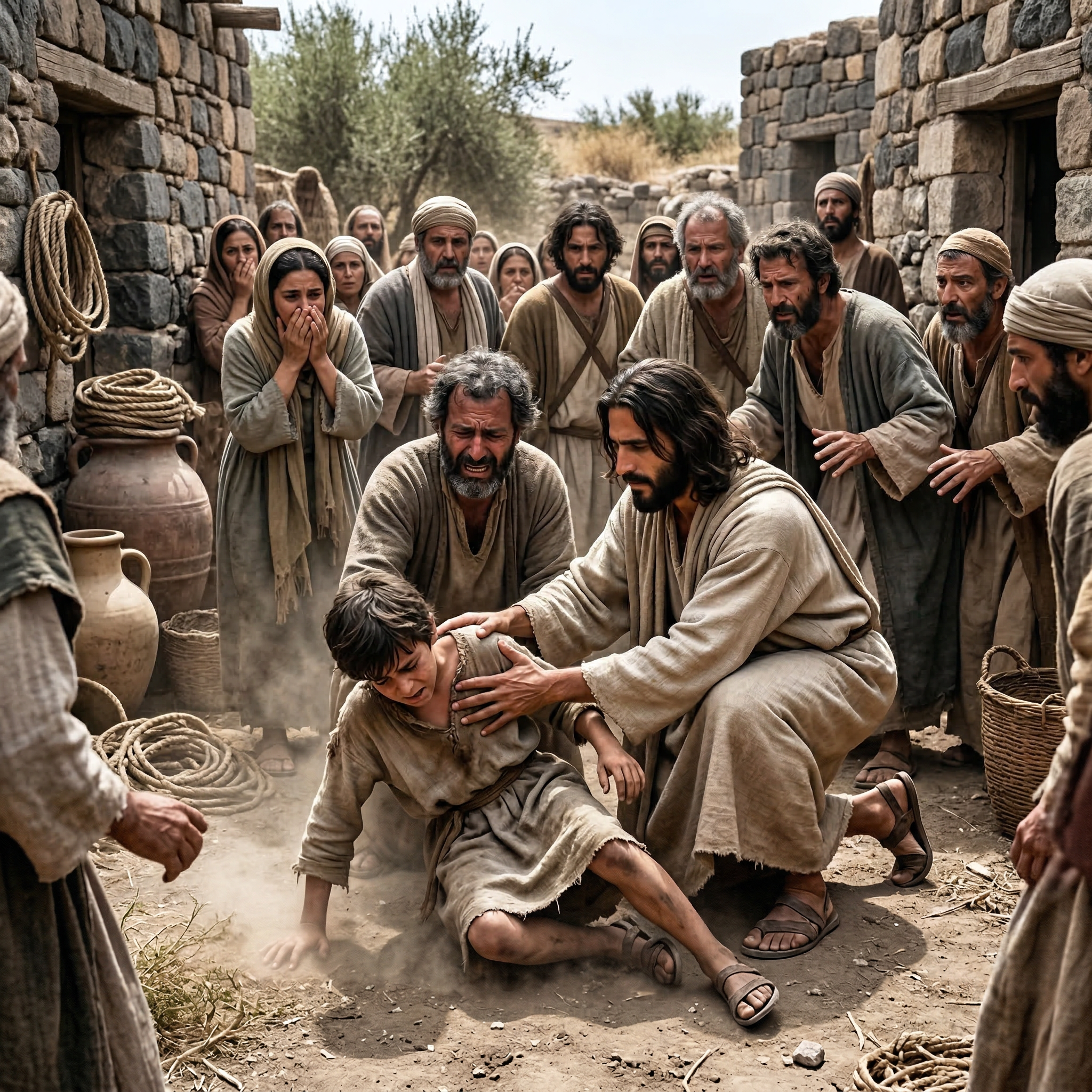
 While they were still approaching, the demon attacked the boy and threw him in a convulsion, but Yeshua rebuked the evil spirit and healed the boy and led him back to his father.
OET OET-RV OET-LV GHT ULT UST BSB MSB BLB AICNT OEB WEBBE WMBB NET LSV FBV TCNT T4T LEB BBE Moff JPS Wymth ASV DRA YLT Drby RV SLT Wbstr KJB-1769 KJB-1611 Bshps Gnva Cvdl TNT Wycl SR-GNT UHB BrLXX BrTr Related Parallel Simple Interlinear Topics Reference Dictionary Search
ParallelVerse GEN EXO LEV NUM DEU JOB JOS JDG RUTH 1 SAM 2 SAM PSA AMOS HOS 1 KI 2 KI 1 CHR 2 CHR PROV ECC SNG JOEL MIC ISA ZEP HAB JER LAM YNA (JNA) NAH OBA DAN EZE EZRA EST NEH HAG ZEC MAL LAO GES LES ESG DNG 2 PS TOB JDT WIS SIR BAR LJE PAZ SUS BEL MAN 1 MAC 2 MAC 3 MAC 4 MAC YHN (JHN) MARK MAT LUKE ACTs YAC (JAM) GAL 1 TH 2 TH 1 COR 2 COR ROM COL PHM EPH PHP 1 TIM TIT 1 PET 2 PET 2 TIM HEB YUD (JUD) 1 YHN (1 JHN) 2 YHN (2 JHN) 3 YHN (3 JHN) REV
Luke Intro C1 C2 C3 C4 C5 C6 C7 C8 C10 C11 C12 C13 C14 C15 C16 C17 C18 C19 C20 C21 C22 C23 C24
Luke 9 V1 V4 V7 V10 V13 V16 V19 V22 V25 V28 V31 V34 V37 V40 V43 V46 V49 V52 V55 V58 V61
Note: This view shows ‘verses’ which are not necessarily natural language units and hence sometimes only part of a sentence will be visible—click on any Bible version abbreviation down the left-hand side to see the verse in more of its context. Normally the OET discourages the reading of individual ‘verses’, but this view is only designed as a tool for Bible-translators and others doing comparisons of different translations—the older translations are further down the page (so you can read up from the bottom to trace the English translation history). The OET segments on this page are still early looks into the drafted texts of the Open English Translation of the Bible—please double-check these texts in advance before using in public.
Text critical issues=small word differences Clarity of original=clear Importance to us=normal Speaker(s)=Narrator (All still tentative.)
OET (OET-RV)
While they were still approaching, the demon attacked the boy and threw him in a convulsion, but Yeshua rebuked the evil spirit and healed the boy and led him back to his father.
OET-LV And still approaching of_him, the demon attacked him and threw_into_convulsions him.
But the Yaʸsous gave_rebuke to_the the unclean spirit, and he_healed the boy and gave_ him _back to_the father of_him.
SR-GNT Ἔτι δὲ προσερχομένου αὐτοῦ, ἔρρηξεν αὐτὸν τὸ δαιμόνιον καὶ συνεσπάραξεν. Ἐπετίμησεν δὲ ὁ ˚Ἰησοῦς τῷ πνεύματι τῷ ἀκαθάρτῳ, καὶ ἰάσατο τὸν παῖδα καὶ ἀπέδωκεν αὐτὸν τῷ πατρὶ αὐτοῦ. ‡
(Eti de proserⱪomenou autou, erraʸxen auton to daimonion kai sunesparaxen. Epetimaʸsen de ho ˚Yaʸsous tōi pneumati tōi akathartōi, kai iasato ton paida kai apedōken auton tōi patri autou.)
Key: khaki:verbs, light-green:nominative/subject, orange:accusative/object, pink:genitive/possessor, cyan:dative/indirect object.
Note: Automatic aligning of the OET-RV to the LV is done by some temporary software, hence the RV alignments are incomplete (and may occasionally be wrong).
GHT Moreover, still of {being-come-toward same} the demon tears same and together-convulses; moreover, the Jesus adjudges-valuation-upon to {the spirit, the unclean} and cures the child and gives-off/away same to {the father} of {same}.
ULT And while he was coming, the demon threw him down and shook, him with convulsions. But Jesus rebuked the unclean spirit and healed the boy and gave him back to his father.
UST While they were bringing the boy to him, the demon threw the boy down to the ground and shook him severely. But Jesus rebuked the evil spirit and healed the boy. Then he returned him to his father.
BSB & MSB Even while [the boy] was approaching, the demon slammed him to the ground in a convulsion. But Jesus rebuked the unclean spirit, healed the boy, and gave him back to his father.
BLB And while he was coming near, the demon threw him down, and threw him into convulsions. And Jesus rebuked the unclean spirit and healed the boy, and gave him back to his father.
AICNT While he was still approaching, the demon threw him down and convulsed him. But Jesus rebuked the unclean spirit, {healed the boy},[fn] and gave him back to his father.
9:42, healed the boy: D(05) and an early Latin manuscript (e) reads “And it left him.”
OEB While the boy was coming up to Jesus, the demon dashed him down and threw him into convulsions. But Jesus rebuked the foul spirit, and cured the boy, and gave him back to his father.
WEBBE While he was still coming, the demon threw him down and convulsed him violently. But Jesus rebuked the unclean spirit, healed the boy, and gave him back to his father.
WMBB While he was still coming, the demon threw him down and convulsed him violently. But Yeshua rebuked the unclean spirit, healed the boy, and gave him back to his father.
NET As the boy was approaching, the demon threw him to the ground and shook him with convulsions. But Jesus rebuked the unclean spirit, healed the boy, and gave him back to his father.
LSV and as he is yet coming near, the demon threw him down, and convulsed [him], and Jesus rebuked the unclean spirit, and healed the youth, and gave him back to his father.
FBV Even as the boy came over, the demon sent him into convulsions, throwing him to the ground. But Jesus intervened, rebuking the evil spirit and healing the boy, and then gave him back to his father.
TCNT Now as the boy was approaching, the demon threw him down and shook him with convulsions. But Jesus rebuked the unclean spirit, healed the boy, and gave him back to his father.
T4T While they were bringing the boy to Jesus, the demon attacked the boy, threw him to the ground, and shook him severely. But Jesus rebuked the evil spirit and healed the boy. Then he returned him to his father’s care.
LEB And while[fn] he was still approaching, the demon threw him down and convulsed him.[fn] But Jesus rebuked the unclean spirit and healed the boy, and gave him back to his father.
9:42 *Here “while” is supplied as a component of the temporal genitive absolute participle (“approaching”)
9:42 *Here the direct object is supplied from context in the English translation
BBE And while he was coming, he was pushed violently down and twisted by the evil spirit. But Jesus gave sharp orders to the unclean spirit, and made the boy well, and gave him back to his father.
Moff Before the boy could reach Jesus, the daemon dashed him down and convulsed him, but Jesus checked the unclean spirit, cured the boy, and handed him back to his father.
Wymth Now while the youth was coming, the spirit dashed him to the ground and cruelly convulsed him. But Jesus rebuked the foul spirit, and cured the youth and gave him back to his father.
ASV And as he was yet a coming, the demon dashed him down, and tare him grievously. But Jesus rebuked the unclean spirit, and healed the boy, and gave him back to his father.
DRA And as he was coming to him, the devil threw him down, and tore him.
YLT and as he is yet coming near, the demon rent him, and tore [him] sore, and Jesus rebuked the unclean spirit, and healed the youth, and gave him back to his father.
Drby But as he was yet coming, the demon tore him and dragged him all together. And Jesus rebuked the unclean spirit, and healed the child and gave him back to his father.
RV And as he was yet a coming, the devil dashed him down, and tare him grievously. But Jesus rebuked the unclean spirit, and healed the boy, and gave him back to his father.
SLT And he yet coming near, the demon rent him, and tare him. And Jesus censured the unclean spirit, and healed the child, and gave him back to his father.
Wbstr And as he was yet coming, the demon threw him down, and tore him . And Jesus rebuked the unclean spirit, and healed the child, and delivered him again to his father.
KJB-1769 And as he was yet a coming, the devil threw him down, and tare him. And Jesus rebuked the unclean spirit, and healed the child, and delivered him again to his father.
KJB-1611 And as he was yet a comming, the deuill threw him downe, and tare him: and Iesus rebuked the vncleane spirit, and healed the child, and deliuered him againe to his father.
(Modernised spelling is same as from KJB-1769 above, apart from capitalisation and punctuation)
Bshps As he was yet a commyng, the fiende rent hym, and tare hym: And Iesus rebuked the vncleane spirite, and healed the chylde, and deliuered hym to his father.
(As he was yet a coming, the fiend/devil rent/tear him, and tare him: And Yesus/Yeshua rebuked the unclean spirit, and healed the child, and delivered him to his father.)
Gnva And whiles he was yet comming, the deuill rent him, and tare him: and Iesus rebuked the vncleane spirite, and healed the childe, and deliuered him to his father.
(And whilst/while he was yet coming, the devil rent/tear him, and tare him: and Yesus/Yeshua rebuked the unclean spirit, and healed the child, and delivered him to his father.)
Cvdl And whan he came to him, the deuell rente him and tare him. But Iesus rebuked the foule sprete, and healed the chylde, and delyuered him vnto his father agayne.
(And when he came to him, the devil rent/tear him and tare him. But Yesus/Yeshua rebuked the foul spirit, and healed the child, and delivered him unto his father again.)
TNT As he yet was a cominge the fende ret him and tare him. And Iesus rebuked the vnclene sprete and healed the childe and delivered him to his father. And they were all amased at the mighty power of God.
(As he yet was a coming the fiend/devil tear(n) him and tare him. And Yesus/Yeshua rebuked the unclean spirit and healed the child and delivered him to his father. And they were all amazed at the mighty power of God.)
Wycl And whanne he cam nyy, the deuel hurtlide hym doun, and to-braidide hym. And Jhesus blamyde `the vnclene spirit, and heelide the child, and yeldide him to his fadir.
(And when he came nigh/near, the devil hurled him down, and to-braidide him. And Yesus/Yeshua blamed the unclean spirit, and healed the child, and yielded him to his father.)
Luth Und da er zu ihm kam, riß ihn der Teufel und zerrete ihn. JEsus aber bedräuete den unsaubern Geist und machte den Knaben gesund und gab ihn seinem Vater wieder.
(And there he to/for him came, ripped/tore/cracked him/it the/of_the devil and tore him/it. Yesus but threatened the unclean spirit and made/did the boys/lads healed and gave him/it his father again.)
ClVg Et cum accederet, elisit illum dæmonium, et dissipavit.[fn]
(And when/with would_approach, struck him demon, and dissipated.)
9.42 Et cum accederet. Dum puer ad Dominum accedit, eliditur, quia conversi ad Dominum plerumque a dæmonio gravius pulsantur, ut vel ad vitia reducantur, vel de sua expulsione diabolus se vindicet. Sicut in principio nascentis Ecclesiæ multa et gravia opposuit certamina illis quos suo regno subtrahi videbat.
9.42 And when/with would_approach. While child to the_Master comes, is_struck, because converted to the_Master usually/frequently from demon heavier they_are_beaten, as or to vices they_may_be_brought_back, or from/about his_own expulsion the_devil himself may_claim. Like in/into/on at_the_beginning being_born Assemblies/Churches fine and heavy_(things) opposed competitions to_them which his_own kingdom to_be_carried_off he_saw.
UGNT ἔτι δὲ προσερχομένου αὐτοῦ, ἔρρηξεν αὐτὸν τὸ δαιμόνιον καὶ συνεσπάραξεν. ἐπετίμησεν δὲ ὁ Ἰησοῦς τῷ πνεύματι τῷ ἀκαθάρτῳ, καὶ ἰάσατο τὸν παῖδα καὶ ἀπέδωκεν αὐτὸν τῷ πατρὶ αὐτοῦ.
(eti de proserⱪomenou autou, erraʸxen auton to daimonion kai sunesparaxen. epetimaʸsen de ho Yaʸsous tōi pneumati tōi akathartōi, kai iasato ton paida kai apedōken auton tōi patri autou.)
SBL-GNT ἔτι δὲ προσερχομένου αὐτοῦ ἔρρηξεν αὐτὸν τὸ δαιμόνιον καὶ συνεσπάραξεν· ἐπετίμησεν δὲ ὁ Ἰησοῦς τῷ πνεύματι τῷ ἀκαθάρτῳ, καὶ ἰάσατο τὸν παῖδα καὶ ἀπέδωκεν αὐτὸν τῷ πατρὶ αὐτοῦ.
(eti de proserⱪomenou autou erraʸxen auton to daimonion kai sunesparaxen; epetimaʸsen de ho Yaʸsous tōi pneumati tōi akathartōi, kai iasato ton paida kai apedōken auton tōi patri autou.)
RP-GNT Ἔτι δὲ προσερχομένου αὐτοῦ, ἔρρηξεν αὐτὸν τὸ δαιμόνιον καὶ συνεσπάραξεν· ἐπετίμησεν δὲ ὁ Ἰησοῦς τῷ πνεύματι τῷ ἀκαθάρτῳ, καὶ ἰάσατο τὸν παῖδα, καὶ ἀπέδωκεν αὐτὸν τῷ πατρὶ αὐτοῦ.
(Eti de proserⱪomenou autou, erraʸxen auton to daimonion kai sunesparaxen; epetimaʸsen de ho Yaʸsous tōi pneumati tōi akathartōi, kai iasato ton paida, kai apedōken auton tōi patri autou.)
TC-GNT ἔτι δὲ προσερχομένου αὐτοῦ, ἔρρηξεν αὐτὸν τὸ δαιμόνιον καὶ συνεσπάραξεν· ἐπετίμησε δὲ ὁ Ἰησοῦς τῷ πνεύματι τῷ ἀκαθάρτῳ, καὶ ἰάσατο τὸν παῖδα, καὶ ἀπέδωκεν αὐτὸν τῷ πατρὶ αὐτοῦ.
(eti de proserⱪomenou autou, erraʸxen auton to daimonion kai sunesparaxen; epetimaʸse de ho Yaʸsous tōi pneumati tōi akathartōi, kai iasato ton paida, kai apedōken auton tōi patri autou.)
Key for above GNTs: yellow:punctuation differs, red:words differ (from our SR-GNT base).
Earlier Jesus had given power to his twelve apostles to cast out demons (9:1). However, after Jesus came down from the mountain with Peter, James, and John, he heard that the other disciples had not been able to make an evil spirit leave a man’s son. When the boy approached Jesus, the unclean spirit caused the boy to convulse violently. Then Jesus cast out the unclean spirit, and the people were filled with awe.
Some other examples of headings for this section are:
The Healing of a Boy with an Evil Spirit (NIV)
Jesus Heals a Boy with an Evil Spirit (GNT)
There are parallel passages for this section in Matthew 17:14–21 and Mark 9:14–29.
Even while the boy was approaching,
As the boy approached Jesus,
But before the child reached Jesus,
Even while the boy was approaching: The BSB has supplied the phrase the boy. The Greek text says “While he was coming,” and several English versions translate the phrase that way. Your translation should clearly indicate that it was the son who was coming. It should also indicate clearly that he was coming to Jesus. Some ways to do this in English are:
Even while the boy was approaching Jesus
But before the boy could reach him (REB)
the boy: If you use a term such as the boy here, it should refer to a male probably less than thirteen years old and more than three years old.
the demon slammed him to the ground in a convulsion.
the demon caused him to fall to the ground in a fit.
the evil spirit knocked/threw him to the ground and caused him to convulse/jerk violently.
the demon slammed him to the ground in a convulsion: In Greek, the clause that the BSB translates as slammed him to the ground in a convulsion is literally “the demon threw him down and convulsed him.” It means that the demon caused the boy to fall violently to the ground and to jerk around in a fit or convulsion. Other ways to translate this include:
the demon violently caused him to fall down and made him shake/jerk all over
the demon knocked the boy to the ground and threw him into convulsions (GW)
demon: The word demon occurs in 9:1b. See the note there for information about translating this term.
But Jesus rebuked the unclean spirit,
But Jesus spoke sternly to the evil spirit.
Jesus commanded the demon to leave the boy, and it left!
Jesus rebuked the unclean spirit: The clause Jesus rebuked the unclean spirit means that Jesus gave a stern command to the demon. It does not mean here that Jesus merely scolded the demon. Luke did not record what Jesus said, but it is clear from the parallel passages that Jesus commanded the unclean spirit to leave the boy. In some languages it may be necessary to make this information explicit. For example:
Jesus sternly commanded the evil spirit to leave the boy
unclean spirit: The Greek phrase that the BSB translates literally as unclean spirit refers to the same type of spirit as the terms “evil spirit” and “demon.” These terms all refer to a spirit that is evil and can control people’s actions.
See the note on 4:33a. You may translate unclean spirit the same way that you translated the word “demon” in 9:42b, or you may use a different term. Be sure to use an expression that clearly refers to the same being as the word “demon” in 9:42b.
If the term for “unclean spirit” is a single word in your language, you can omit the word for unclean. In other words, it is not necessary to say “unclean demon” if a demon is already unclean. Do not literally translate the words unclean and spirit unless this is a natural way in your language to refer to this type of being.
See the word demon in the Glossary.
healed the boy, and gave him back to his father.
He healed the boy and presented/led him to his father.
He healed the boy and said to the boy’s father, “Here is your son.”
healed the boy: There are two ways to interpret the phrase healed the boy:
Jesus healed the boy by casting out the demon. For example:
and thus healed the boy
Jesus cast out the demon and also healed the boy of his injuries. For example:
He also/then healed the boy
The English versions are ambiguous. If possible, you should translate in a way that allows either meaning. If you cannot do this, it is recommended that you follow interpretation (1). This interpretation is supported by a majority of scholars.
gave him back to his father: The phrase gave him back to his father means that Jesus led or presented the boy to his father. See the note on 7:15b.
Note 1 topic: writing-pronouns
ἔτι & προσερχομένου αὐτοῦ
still & approaching ˱of˲_him
The pronoun he refers to the boy, not to the father. Alternate translation: [while the boy was coming]
Open Bible Data site copyright © 2023–2026 Freely-Given.org.
Python source code for creating these static pages is available on GitHub under an open licence.
For Bible data copyrights, see the details for each displayed Bible version.
The Open English Translation (OET) main site is at OpenEnglishTranslation.Bible or OET.Bible.