
OET OET-RV OET-LV GHT ULT UST BSB MSB BLB AICNT OEB WEBBE WMBB NET LSV FBV TCNT T4T LEB BBE Moff JPS Wymth ASV DRA YLT Drby RV SLT Wbstr KJB-1769 KJB-1611 Bshps Gnva Cvdl TNT Wycl SR-GNT UHB BrLXX BrTr Related Parallel Simple Interlinear Topics Reference Dictionary Search
ParallelVerse GEN EXO LEV NUM DEU JOB JOS JDG RUTH 1 SAM 2 SAM PSA AMOS HOS 1 KI 2 KI 1 CHR 2 CHR PROV ECC SNG JOEL MIC ISA ZEP HAB JER LAM YNA (JNA) NAH OBA DAN EZE EZRA EST NEH HAG ZEC MAL 2 PS WIS TOB MAN BAR LJE DNG SUS PAZ BEL GES LES ESG JDT 3 MAC SIR 1 MAC 2 MAC 4 MAC YHN (JHN) MARK MAT LUKE ACTs YAC (JAM) GAL 1 TH 2 TH 1 COR 2 COR ROM COL LAO PHM EPH PHP 1 TIM TIT 1 PET 2 PET 2 TIM HEB YUD (JUD) 1 YHN (1 JHN) 2 YHN (2 JHN) 3 YHN (3 JHN) REV
2 Ki Intro C1 C2 C3 C4 C5 C6 C7 C8 C9 C10 C11 C12 C13 C14 C15 C16 C17 C18 C19 C20 C21 C23 C24 C25
2 Ki 22 V0 V1 V2 V3 V4 V5 V6 V7 V8 V9 V10 V11 V12 V13 V14 V15 V16 V18 V19 V20
Note: This view shows ‘verses’ which are not necessarily natural language units and hence sometimes only part of a sentence will be visible—click on any Bible version abbreviation down the left-hand side to see the verse in more of its context. Normally the OET discourages the reading of individual ‘verses’, but this view is only designed as a tool for Bible-translators and others doing comparisons of different translations—the older translations are further down the page (so you can read up from the bottom to trace the English translation history). The OET segments on this page are still early looks into the drafted texts of the Open English Translation of the Bible—please double-check these texts in advance before using in public.
B I ◄ ← 2 Ki 22:17 ↓ → ► ≡ ═ ©
Text critical issues=none Clarity of original=clear Importance to us=normal Speaker(s)=Narrator (All still tentative.)
OET (OET-RV) because they abandoned me. They offered sacrifices to other gods in order to make me angry at everything they do, so now my anger will be directed against this place and it’s not stoppable.
OET-LV Because that they_have_abandoned_me and_they_have_made_smoke to_gods other so_as to_provoke_me_to_anger by_all_of the_work_of their_hands_of_their and_ rage_of_my _it_will_be_kindled on_place the_this and_not it_will_be_quenched.
UHB תַּ֣חַת ׀ אֲשֶׁ֣ר עֲזָב֗וּנִי וַֽיְקַטְּרוּ֙ לֵאלֹהִ֣ים אֲחֵרִ֔ים לְמַ֨עַן֙ הַכְעִיסֵ֔נִי בְּכֹ֖ל מַעֲשֵׂ֣ה יְדֵיהֶ֑ם וְנִצְּתָ֧ה חֲמָתִ֛י בַּמָּק֥וֹם הַזֶּ֖ה וְלֹ֥א תִכְבֶּֽה׃ ‡
(taḩat ʼₐsher ˊₐzāⱱūnī vayəqaţţərū lēʼlohim ʼₐḩērim ləmaˊan hakˊīşēnī bəkol maˊₐsēh yədēyhem vəniʦʦətāh ḩₐmātiy bammāqōm hazzeh vəloʼ tikbeh.)
Key: khaki:verbs.
Note: Automatic aligning of the OET-RV to the LV is done by some temporary software, hence the OET-RV alignments are incomplete (and may occasionally be wrong).
BrLXX ἀνθʼ ὧν ἐγκατέλιπόν με, καὶ ἐθυμίων θεοῖς ἑτέροις, ὅπως παροργίσωσί με ἐν τοῖς ἔργοις τῶν χειρῶν αὐτῶν, καὶ ἐκκαυθήσεται θυμός μου ἐν τῷ τόπῳ τούτῳ καὶ οὐ σβεσθήσεται.
(anthʼ hōn egkatelipon me, kai ethumiōn theois heterois, hopōs parorgisōsi me en tois ergois tōn ⱪeirōn autōn, kai ekkauthaʸsetai thumos mou en tōi topōi toutōi kai ou sbesthaʸsetai.)
BrTr because they have forsaken me, and burnt incense to other gods, that they might provoke me with the works of their hands: therefore my wrath shall burn forth against this place, and shall not be quenched.
ULT because they abandoned me and burned incense to other gods, so that they made me angry by all of the works of their hands. So my heat is kindled against this place, and it will not extinguish.’ ” ’
UST He is going to do that because they stopped worshiping him and burned incense to honor other gods. They made many idols, and that made him very angry. He is so angry with them that he is going punish them.
BSB & MSB because they have forsaken Me and burned incense to other gods, that they might provoke Me to anger with all the works of their hands. My wrath will be kindled against this place and will not be quenched.’
OEB No OEB KI2 22:17 book available
WEBBE & WMBB Because they have forsaken me and have burnt incense to other gods, that they might provoke me to anger with all the work of their hands, therefore my wrath shall be kindled against this place, and it will not be quenched.’ ”
NET This will happen because they have abandoned me and offered sacrifices to other gods, angering me with all the idols they have made. My anger will ignite against this place and will not be extinguished!’ ”
LSV because that they have forsaken Me, and make incense to other gods, so as to provoke Me to anger with every work of their hands, and My wrath has been kindled against this place, and it is not quenched.
FBV They have abandoned me and offered sacrifices to other gods, making me angry by everything they've done. My anger will be poured out upon this place and will not be stopped.
T4T I will do that because they have abandoned me, and they burn incense to honor other gods. They have caused me to become very angry by worshiping all the idols that they have made (OR, by all the wicked things that they have done), and my anger is like [MET] a fire that will not be put out.”
LEB because they have abandoned me and they have burned incense to other gods, provoking me to anger with all of the works of their hands. My wrath shall be kindled against this place and not be quenched.’ ”
BBE Because they have given me up, burning offerings to other gods and moving me to wrath by all the work of their hands; so my wrath will be on fire against this place, and will not be put out.
Moff No Moff KI2 22:17 book available
JPS because they have forsaken Me, and have offered unto other gods, that they might provoke Me with all the work of their hands; therefore My wrath shall be kindled against this place, and it shall not be quenched.
ASV Because they have forsaken me, and have burned incense unto other gods, that they might provoke me to anger with all the work of their hands, therefore my wrath shall be kindled against this place, and it shall not be quenched.
DRA Because they have forsaken me, and have sacrificed to strange gods, provoking me by all the works of their hands: therefore my indignation shall be kindled against this place, and shall not be quenched.
YLT because that they have forsaken Me, and make perfume to other gods, so as to provoke Me to anger with every work of their hands, and My wrath hath been kindled against this place, and it is not quenched.
Drby Because they have forsaken me, and have burned incense unto other [fn]gods, that they might provoke me to anger with all the work of their hands, therefore my fury is kindled against this place, and shall not be quenched.
22.17 Elohim
RV Because they have forsaken me, and have burned incense unto other gods, that they might provoke me to anger with all the work of their hands; therefore my wrath shall be kindled against this place, and it shall not be quenched.
(Because they have forsaken me, and have burnt incense unto other gods, that they might provoke me to anger with all the work of their hands; therefore my wrath shall be kindled against this place, and it shall not be quenched.)
SLT Because they forsook me, and they will burn incense to other gods to irritate me in all the work of their hands; and my wrath burnt upon this place and it shall not be quenched.
Wbstr Because they have forsaken me, and have burned incense to other gods, that they might provoke me to anger with all the works of their hands; therefore my wrath shall be kindled against this place and shall not be quenched.
KJB-1769 Because they have forsaken me, and have burned incense unto other gods, that they might provoke me to anger with all the works of their hands; therefore my wrath shall be kindled against this place, and shall not be quenched.
(Because they have forsaken me, and have burnt incense unto other gods, that they might provoke me to anger with all the works of their hands; therefore my wrath shall be kindled against this place, and shall not be quenched.)
KJB-1611 Because they haue forsaken me, and haue burnt incense vnto other gods, that they might prouoke mee to anger with all the woorkes of their handes: therefore my wrath shall bee kindled against this place, and shall not be quenched.
(Modernised spelling is same as from KJB-1769 above, apart from punctuation)
Bshps Because they haue forsaken me, and haue burnt incense vnto other gods, to anger me with all the workes of their handes: My wrath also shalbe kindled against this place, and shall not be quenched.
(Because they have forsaken me, and have burnt incense unto other gods, to anger me with all the works of their hands: My wrath also shall be kindled against this place, and shall not be quenched.)
Gnva Because they haue forsaken mee, and haue burnt incense vnto other gods, to anger me with all ye works of their hands: my wrath also shalbe kindled against this place and shall not be queched:
(Because they have forsaken me, and have burnt incense unto other gods, to anger me with all ye/you_all works of their hands: my wrath also shall be kindled against this place and shall not be quenched:)
Cvdl because they haue forsaken me, and brent incense vnto other goddes, to prouoke me vnto wrath with all the workes of their handes. Therfore is my wrath kindled agaynst this cite, and shall not be quenched.
(because they have forsaken me, and burnt incense unto other gods, to provoke me unto wrath with all the works of their hands. Therefore is my wrath kindled against this city, and shall not be quenched.)
Wycl for thei forsoken me, and maden sacrifice to alien goddis, and terriden me to ire in alle the werkis of her hondis; and myn indignacioun schal be kyndlid in this place, and schal not be quenchid.
(for they forsook me, and made sacrifice to alien/foreign(er) gods, and provoked me to ire in all the works of her hands; and mine indignation shall be kindled in this place, and shall not be quenched.)
Luth darum daß sie mich verlassen und andern Göttern geräuchert haben, daß sie mich erzürneten mit allen Werken ihrer Hände; darum wird mein Grimm sich wider diese Stätte anzünden und nicht ausgelöschet werden.
(therefore that they/she/them me leave and other gods smoked have, that they/she/them me enraged with all/everyone works of_their/her hands; therefore becomes my wrath/fury itself/yourself/themselves against this/these site/place kindle/ignite and not extinguished/blotted_out become.)
ClVg quia dereliquerunt me, et sacrificaverunt diis alienis, irritantes me in cunctis operibus manuum suarum: et succendetur indignatio mea in loco hoc, et non extinguetur.
(because they_abandoned me, and they_sacrificed gods strangers, irritating me in/into/on to_all works hands of_their_own: and will_be_lit indignation my in/into/on instead hoc, and not/no will_be_extinguished.)
Note 1 topic: figures-of-speech / quotesinquotes
תַּ֣חַת ׀ אֲשֶׁ֣ר עֲזָב֗וּנִי וַֽיְקַטְּרוּ֙ לֵאלֹהִ֣ים אֲחֵרִ֔ים לְמַ֨עַן֙ הַכְעִיסֵ֔נִי בְּכֹ֖ל מַעֲשֵׂ֣ה יְדֵיהֶ֑ם וְנִצְּתָ֧ה חֲמָתִ֛י בַּמָּק֥וֹם הַזֶּ֖ה וְלֹ֥א תִכְבֶּֽה
(Some words not found in UHB: below/instead_of which/who they,have_forsaken_me and,they_have_made_smoke to,gods other that to,provoke_me_to_anger by,all_of work_of their_hands_of,their and,it_will_be_kindled rage_of,my on,place the=this and=not quenched )
If you have decided to translate all of this long quotation in such a way that there will not be quotations within quotations, you can continue doing that in this verse. Alternate translation: [because they abandoned him and burned incense to other gods, so that they have made him angry by all of the works of their hands. So his heat is kindled against this place, and it will not extinguish]
Note 2 topic: figures-of-speech / synecdoche
וַֽיְקַטְּרוּ֙ לֵאלֹהִ֣ים אֲחֵרִ֔ים
(Some words not found in UHB: below/instead_of which/who they,have_forsaken_me and,they_have_made_smoke to,gods other that to,provoke_me_to_anger by,all_of work_of their_hands_of,their and,it_will_be_kindled rage_of,my on,place the=this and=not quenched )
Yahweh is using one act of worship, burning incense, to mean worship in general. If it would be helpful in your language, you could state the meaning plainly. Alternate translation: [and worshiped other gods]
Note 3 topic: figures-of-speech / metonymy
בְּכֹ֖ל מַעֲשֵׂ֣ה יְדֵיהֶ֑ם
(Some words not found in UHB: below/instead_of which/who they,have_forsaken_me and,they_have_made_smoke to,gods other that to,provoke_me_to_anger by,all_of work_of their_hands_of,their and,it_will_be_kindled rage_of,my on,place the=this and=not quenched )
Yahweh is using the phrase the works of their hands to mean the idols that the Judeans made with their hands. If it would be helpful in your language, you could use an equivalent expression or plain language. Alternate translation: [by all the idols that they made] or [by making all those idols]
Note 4 topic: figures-of-speech / metonymy
וְנִצְּתָ֧ה חֲמָתִ֛י בַּמָּק֥וֹם הַזֶּ֖ה וְלֹ֥א תִכְבֶּֽה
(Some words not found in UHB: below/instead_of which/who they,have_forsaken_me and,they_have_made_smoke to,gods other that to,provoke_me_to_anger by,all_of work_of their_hands_of,their and,it_will_be_kindled rage_of,my on,place the=this and=not quenched )
Here, this place represents the people who live in that place. If it would be helpful in your language, you could use an equivalent expression or plain language. Alternate translation: [So my heat is kindled against the people who live in this place, and it will not extinguish]
Note 5 topic: figures-of-speech / metaphor
וְנִצְּתָ֧ה חֲמָתִ֛י בַּמָּק֥וֹם הַזֶּ֖ה וְלֹ֥א תִכְבֶּֽה
(Some words not found in UHB: below/instead_of which/who they,have_forsaken_me and,they_have_made_smoke to,gods other that to,provoke_me_to_anger by,all_of work_of their_hands_of,their and,it_will_be_kindled rage_of,my on,place the=this and=not quenched )
See how you translated the similar expression in 22:13. Alternate translation: [So I have become very angry with the people who live in this place, and I will not stop being angry]
Note 6 topic: figures-of-speech / quotemarks
וְלֹ֥א תִכְבֶּֽה
and=not (Some words not found in UHB: below/instead_of which/who they,have_forsaken_me and,they_have_made_smoke to,gods other that to,provoke_me_to_anger by,all_of work_of their_hands_of,their and,it_will_be_kindled rage_of,my on,place the=this and=not quenched )
This verse is the conclusion of the second-level, third-level, and fourth-level quotations that began in the previous two verses. If you have decided to use punctuation to mark levels of quotation, end this verse with the appropriate punctuation for closing those levels of quotation.
2 Kings 22-23; 2 Chronicles
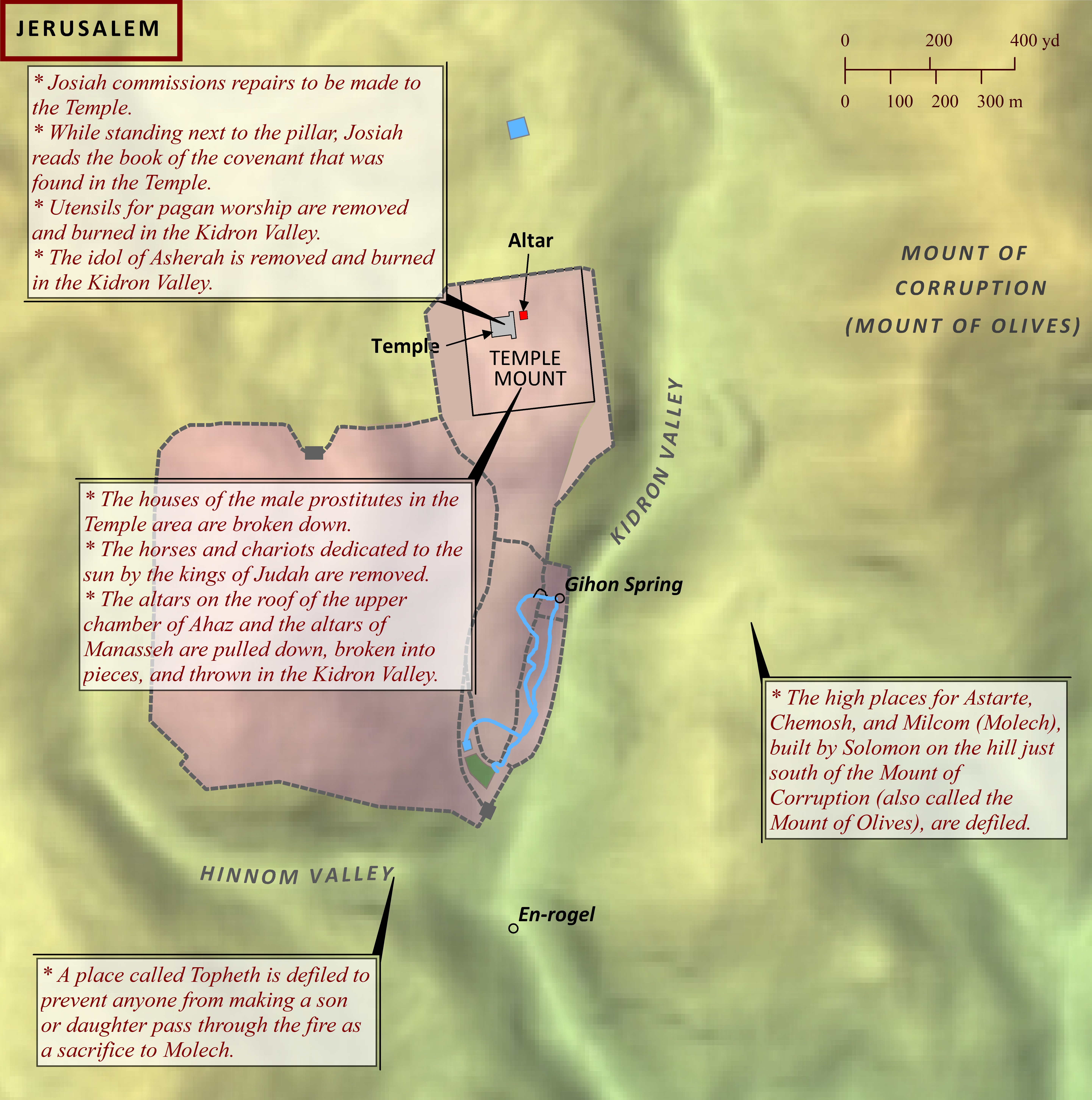
If ever there was a point in biblical history when the worship of Yahweh seemed all but extinguished, it was during the years leading up to King Josiah’s birth. Yet it was against this incredibly dark backdrop that the Lord raised up Josiah of Judah to bring about one of the greatest spiritual reforms his nation had ever seen. Josiah was the grandson of Manasseh, one of the most wicked and idolatrous kings of Judah (2 Kings 21:1-9; 2 Chronicles 33:1-9), though Manasseh later repented (2 Chronicles 33:12-19), and the son of Amon, another wicked, idolatrous king (2 Kings 21:18-22; 2 Chronicles 33:20-23). After his father’s death, Josiah became king at the young age of eight, so perhaps it was this lack of influence from his wicked father during some of his most formative years as a leader that enabled him to become such a force for spiritual renewal throughout Judah. Whatever the reason for his spiritual fervor, Josiah’s passion also coincided with a period of Assyrian decline, which allowed him to expand his renewal even to the lands once ruled by the northern kingdom of Israel. Josiah began his reforms by commissioning repairs to be made to the Temple of the Lord in Jerusalem. During these repairs, the book of the law, likely the book of Deuteronomy, was found in the Temple and brought to Josiah. When Josiah read the book, he tore his clothes in anguish over the punishment that surely awaited the nation for their disobedience to the laws of Moses. He called for all the elders of Judah and Jerusalem to gather by the pillar of the Temple, and he read the law to them as well and led them to establish a new covenant to follow the laws of Moses. Josiah then began a great purge of idolatry throughout Jerusalem, Judah, and even Israel. Utensils used for pagan worship were removed from the Temple in Jerusalem and burned in the Kidron Valley, and their ashes were carried to Bethel. The image of Asherah was also removed and burned in the Kidron Valley, and the remains were ground to dust and spread over graves of the common people. The houses of the male prostitutes in the Temple area were also broken down. The horses and chariots dedicated to the sun by the kings of Judah were removed, and the chariots were burned. The altars on the roof of the upper chamber of Ahaz and the altars that Manasseh had made in Temple courtyard were pulled down and broken in pieces, and the rubble was thrown into the Kidron Valley. A place called Topheth in the Hinnom Valley was defiled so that no one would make a son or daughter pass through fire as an offering to Molech. Just east of Jerusalem the high places built by King Solomon for his pagan wives on the Mount of Corruption (also called the Mount of Olives; 1 Kings 11:7-8) were defiled. Josiah’s reforms throughout Judah included putting away the mediums, wizards, teraphim, idols, and all the abominations that were seen in the land. At Bethel he tore down the altar and the high place erected by Jeroboam son of Nebat. He burned the high place, crushing it to dust, and burned the sacred pole. There he also saw tombs of people who must have been associated with the pagan rituals there, so he removed the bones and burned them on the altar, thus defiling it, as was prophesied years earlier (1 Kings 13:1-10). Josiah then extended his reforms to lands that formerly belonged to Israel but were now directly governed by Assyria. Throughout the towns of Samaria all the shrines of the high places were removed, the priests of the high places were slaughtered on the pagan altars, and their bones were burned on them. Throughout the rest of the land of Israel and Judah–in Manasseh, Ephraim, Simeon, and as far as Naphtali–Josiah also broke down the altars, ground the sacred poles and images into powder, and demolished all the incense altars. When Josiah returned to Jerusalem, he celebrated the Passover in a way that exceeded all the Passover celebrations since the time of the Judges.
Open Bible Data site copyright © 2023–2026 Freely-Given.org.
Python source code for creating these static pages is available on GitHub under an open licence.
For Bible data copyrights, see the details for each displayed Bible version.
The Open English Translation (OET) main site is at OpenEnglishTranslation.Bible or OET.Bible.