OET OET-RV OET-LV GHT ULT UST BSB MSB BLB AICNT OEB WEBBE WMBB NET LSV FBV TCNT T4T LEB BBE Moff JPS Wymth ASV DRA YLT Drby RV SLT Wbstr KJB-1769 KJB-1611 Bshps Gnva Cvdl TNT Wycl SR-GNT UHB BrLXX BrTr Related Parallel Simple Interlinear Topics Reference Dictionary Search
ParallelVerse GEN EXO LEV NUM DEU JOB JOS JDG RUTH 1 SAM 2 SAM PSA AMOS HOS 1 KI 2 KI 1 CHR 2 CHR PROV ECC SNG JOEL MIC ISA ZEP HAB JER LAM YNA (JNA) NAH OBA DAN EZE EZRA EST NEH HAG ZEC MAL LAO GES LES ESG DNG 2 PS TOB JDT WIS SIR BAR LJE PAZ SUS BEL MAN 1 MAC 2 MAC 3 MAC 4 MAC YHN (JHN) MARK MAT LUKE ACTs YAC (JAM) GAL 1 TH 2 TH 1 COR 2 COR ROM COL PHM EPH PHP 1 TIM TIT 1 PET 2 PET 2 TIM HEB YUD (JUD) 1 YHN (1 JHN) 2 YHN (2 JHN) 3 YHN (3 JHN) REV
Luke Intro C1 C2 C3 C4 C5 C6 C7 C8 C9 C10 C11 C12 C13 C14 C15 C16 C17 C18 C20 C21 C22 C23 C24
Luke 19 V1 V3 V5 V7 V9 V11 V13 V15 V17 V19 V21 V23 V25 V27 V29 V31 V33 V35 V37 V39 V41 V43 V45 V47
Note: This view shows ‘verses’ which are not necessarily natural language units and hence sometimes only part of a sentence will be visible—click on any Bible version abbreviation down the left-hand side to see the verse in more of its context. Normally the OET discourages the reading of individual ‘verses’, but this view is only designed as a tool for Bible-translators and others doing comparisons of different translations—the older translations are further down the page (so you can read up from the bottom to trace the English translation history). The OET segments on this page are still early looks into the drafted texts of the Open English Translation of the Bible—please double-check these texts in advance before using in public.
B I ◄ ← Luke 19:46 ↓ → ► ≡ ═ ©
Text critical issues=small word differences Clarity of original=clear Importance to us=normal Speaker(s)=Narrator,Yeshua (All still tentative.)
OET (OET-RV) telling them, “It’s been written that ‘my house will be a place of prayer,’ but you’ve made it into a den for robbers.”[ref]
OET-LV saying to_them:
It_has_been_written:
The house of_me will_be a_house of_prayer, but you_all made it a_hideout of_robbers.
SR-GNT λέγων αὐτοῖς, “Γέγραπται, ‘Ὁ οἶκός μου οἶκος προσευχῆς’, ὑμεῖς δὲ αὐτὸν ἐποιήσατε ‘σπήλαιον λῃστῶν’.” ‡
(legōn autois, “Gegraptai, ‘Ho oikos mou oikos proseuⱪaʸs’, humeis de auton epoiaʸsate ‘spaʸlaion laʸstōn’.”)
Key: khaki:verbs, light-green:nominative/subject, orange:accusative/object, pink:genitive/possessor, cyan:dative/indirect object.
Note: Automatic aligning of the OET-RV to the LV is done by some temporary software, hence the RV alignments are incomplete (and may occasionally be wrong).
GHT saying to {same}, "It-has-been-written, 'The house of {me} is-being [a] house of {prayer};' moreover, you make same [a] cave of {robbers},"
ULT saying to them, “It has been written, ‘My house, will be a house of prayer,’ but you made it a ‘den of robbers.’ ”
UST He told them, “The Scriptures say, ‘God’s temple should be a place where people pray.’ But you have made it ‘a hideout for thieves’!”
BSB He declared to them, “It is written: ‘My house will be a house of prayer.’[fn] But you have made it ‘a den of robbers.’[fn]”
OET editor’s note on BSB: prayer for all the nations: Sounds like 'a place to pray for all nations' but should be 'a place for all nations to pray'
MSB He declared to them, “It is written: ‘My house [is][fn] a house of prayer.’[fn] But you have made it ‘a den of robbers.’[fn]”
BLB saying to them, "It has been written: 'And My house will be a house of prayer.' But you have made it 'a den of robbers.'"
AICNT saying to them, “It is written [[that]],[fn] ‘My house will be [[called]][fn] a house of prayer,’ but you have made it a den of robbers.”[fn]
19:46, that: Included in A(02) C(04) D(05) W(032).
19:46, called: Included in Latin(e).
19:46, Isaiah 56:7, Jeremiah 7:11.
OEB saying as he did so, ‘Scripture says – “My house will be a house of prayer”; but you have made it a den of robbers.’
WEBBE & WMBB saying to them, “It is written, ‘My house is a house of prayer,’ but you have made it a ‘den of robbers’!”
NET saying to them, “It is written, ‘ My house will be a house of prayer,’ but you have turned it into a den of robbers!”
LSV saying to them, “It has been written, My house is a house of prayer—but you made it a den of robbers.”
FBV He told them, “Scriptures state that my house will be a house of prayer,[fn] but you've turned it into a den of thieves.”[fn]
19:46 Quoting Isaiah 56:7.
19:46 Quoting Jeremiah 7:11.
TCNT He said to them, “It is written, ‘My house [fn]is a house of prayer,’ but you have made it a den of robbers.”
19:46 is ¦ shall be CT
T4T and he began to chase them out. He said to them, “It has been written {A prophet wrote} in the Scriptures that God said, ‘I want my house to be a place where people pray’; but you bandits have made it a cave where you can hide!”
LEB saying to them, “It is written, ‘And my house will be a house of prayer,’[fn] but you have made it a cave of robbers!”
19:46 A quotation from Isa 56:7
BBE Saying to them, It has been said, My house is to be a house of prayer, but you have made it a hole of thieves.
Moff "It is written," he told them, "my house shall be a house of prayer, but you have made it a den of robbers."
Wymth "It is written," He said, "`And My house shall be the House of Prayer,' but you have made it a robbers' cave."
ASV saying unto them, It is written, And my house shall be a house of prayer: but ye have made it a den of robbers.
DRA Saying to them: It is written: My house is the house of prayer. But you have made it a den of thieves.
YLT saying to them, 'It hath been written, My house is a house of prayer — but ye made it a den of robbers.'
Drby saying to them, It is written, My house is a house of prayer, but ye have made it a den of robbers.
RV saying unto them, It is written, And my house shall be a house of prayer: but ye have made it a den of robbers.
(saying unto them, It is written, And my house shall be a house of prayer: but ye/you_all have made it a den of robbers.)
SLT Saying to them, It has been written, My house is the house of prayer: and ye have made it a den of robbers.
Wbstr Saying to them, It is written, My house is the house of prayer, but ye have made it a den of thieves.
KJB-1769 Saying unto them, It is written, My house is the house of prayer: but ye have made it a den of thieves.
(Saying unto them, It is written, My house is the house of prayer: but ye/you_all have made it a den of thieves.)
KJB-1611 Saying vnto them, It is written, My house is the house of prayer: but ye haue made it a denne of theeues.
(Modernised spelling is same as from KJB-1769 above)
Bshps Saying vnto them, it is written: My house is the house of prayer, but ye haue made it a denne of thieues.
(Modernised spelling is same as from KJB-1769 above, apart from capitalisation and punctuation)
Gnva Saying vnto them, It is written, Mine house is the house of prayer, but ye haue made it a denne of theeues.
(Saying unto them, It is written, Mine house is the house of prayer, but ye/you_all have made it a den of thieves.)
Cvdl and sayde vnto them: It is wrytten: My house is an house of prayer, but ye haue made it a denne of murthurers.
(and said unto them: It is written: My house is an house of prayer, but ye/you_all have made it a den of murderers.)
TNT sayinge vnto them that is written: my housse is the housse of prayer: but ye have made it a den of theves.
(saying unto them that is written: my house is the house of prayer: but ye/you_all have made it a den of thieves.)
Wycl and seide to hem, It is writun, That myn hous is an hous of preyer, but ye han maad it a den of theues.
(and said to them, It is written, That mine house is an house of prayer, but ye/you_all have made it a den of thieves.)
Luth und sprach zu ihnen: Es stehet geschrieben: Mein Haus ist ein Bethaus; ihr aber habt‘s gemacht zur Mördergrube.
(and spoke to/for to_them: It stands written: My house is a prayer_house; you(pl)/their/her but have_it made to/for den_of_murderers.)
ClVg dicens illis: Scriptum est: Quia domus mea domus orationis est: vos autem fecistis illam speluncam latronum.
(saying to_them: Written it_is: Because home my home prayers it_is: you(pl) however you_did her cave of_thieves.)
UGNT λέγων αὐτοῖς, γέγραπται, ὁ οἶκός μου οἶκος προσευχῆς; ὑμεῖς δὲ αὐτὸν ἐποιήσατε σπήλαιον λῃστῶν.
(legōn autois, gegraptai, ho oikos mou oikos proseuⱪaʸs; humeis de auton epoiaʸsate spaʸlaion laʸstōn.)
SBL-GNT λέγων αὐτοῖς· Γέγραπται· ⸂Καὶ ἔσται⸃ ὁ οἶκός μου οἶκος ⸀προσευχῆς, ὑμεῖς δὲ αὐτὸν ἐποιήσατε σπήλαιον λῃστῶν.
(legōn autois; Gegraptai; ⸂Kai estai⸃ ho oikos mou oikos ⸀proseuⱪaʸs, humeis de auton epoiaʸsate spaʸlaion laʸstōn.)
RP-GNT λέγων αὐτοῖς, Γέγραπται, Ὁ οἶκός μου οἶκος προσευχῆς ἐστίν· ὑμεῖς δὲ αὐτὸν ἐποιήσατε σπήλαιον λῃστῶν.
(legōn autois, Gegraptai, Ho oikos mou oikos proseuⱪaʸs estin; humeis de auton epoiaʸsate spaʸlaion laʸstōn.)
TC-GNT λέγων αὐτοῖς, [fn]Γέγραπται, [fn]Ὁ οἶκός μου οἶκος προσευχῆς ἐστιν· ὑμεῖς δὲ αὐτὸν ἐποιήσατε σπήλαιον λῃστῶν.
(legōn autois, Gegraptai, Ho oikos mou oikos proseuⱪaʸs estin; humeis de auton epoiaʸsate spaʸlaion laʸstōn.)
19:46 γεγραπται ¦ γεγραπται οτι ᴀɴᴛ
19:46 ο οικος μου οικος προσευχης εστιν ¦ και εσται ο οικος μου οικος προσευχης ᴄᴛ
Key for above GNTs: yellow:punctuation differs, red:words differ (from our SR-GNT base).
In this section, Jesus went to the temple in the city of Jerusalem. There he drove out the people who were selling things in the temple area. Then he quoted what God said in Isaiah 56:7: God intended his temple to be a place of prayer. Then Jesus told them that in contrast, they had made it “a den of robbers.” This is a reference to Jeremiah 7:11, where God used this phrase to accuse people who had done evil things in his temple. By using this phrase, Jesus implied that the sellers were cheating people and working against God’s purpose for the temple.
At the end of this section, Luke summarized the events of the next few days. Jesus taught in the temple. The Jewish leaders were angry and wanted to kill him. But they could not do it because he was surrounded by many people who listened eagerly to his teachings.
Other examples of headings for this section are:
Jesus Goes to the Temple (GNT)
Jesus Clears the Temple (NLT)
Jesus sends the merchants from the temple
Parallel passages for this section occur in Matthew 21:12–17, Mark 11:15–18, and John 2:13–16.
He declared to them, “It is written:
He told them, “It is written in the Scriptures:
He said to them, “God said in the Scriptures that
saying to them, “The words of God that men wrote in the Scriptures say this:
He declared to them: The BSB has put the clause He declared to them before Jesus’ statement, where it also occurs in the Greek text. The NIV places it in the middle of the statement. Place it where it is natural in your language.
Jesus quoted the scripture in 19:46b to the sellers as he was driving them out of the temple. He was explaining why he was making them leave the temple. He did not speak to them first and then drive them out. Another way to translate this is:
saying to them (GNT)
Use an appropriate verb form in your language.
It is written: Jesus often used the expression It is written to introduce a quotation from the OT Scriptures. Here are some things to consider as you decide how to introduce it in your language:
Some languages have a specific phrase to introduce a quotation from sacred writings. Consider if you could use that phrase here or adapt it for this context.
In some languages you will need to make explicit that the quotation comes from Scripture, God’s writings. For example:
It is written in the Scriptures (NCV)
As we/people read in the Scriptures
In some languages it may be helpful to specify God as the source. For example:
God said in the Scriptures that
God said in his writings/Bible
See how you translated this expression in 4:4 and 4:8.
‘My house will be a house of prayer.’
‘My house will be a prayer house’;
his house will be a place where people pray.
‘My temple will be a place for people to pray to me.’
The statement here in 19:46b was quoted from Isaiah 56:7. It may be helpful to include this information as a cross-reference or footnote.
My house will be a house of prayer: The word house refers here to the temple in Jerusalem. In the Old Testament, “the house of God” was a common way to refer to the temple. In some languages it may be necessary to use an expression which is more explicit than house. For example:
My temple
The place where people come to worship me.
My: The pronoun My refers to God. Make sure in your translation that it does not refer to Jesus. In some languages it may be necessary to make this explicit. For example:
God said, “My Temple…” (GNT)
a house of prayer: The Greek phrase that the BSB translates as a house of prayer means a place where people pray. It may be helpful to include a reference to God. For example:
a place/house where people pray to me/God
Use a term here that people will not confuse with the terms for synagogue and church.
But you have made it ‘a den of robbers.’”
but you(plur) have made it into a robbers’ cave.”
But you(plur) have caused it to become like a gathering place for thieves!”
The clause in 19:46c is not part of the quotation from Isaiah. It is similar to words in Jeremiah 7:11 “Has this house, which bears my Name, become a den of robbers to you?” Jesus used these words to severely condemn what the sellers were doing in the temple.
But you have made it ‘a den of robbers’: This clause is an emphatic contrast to the clause in 19:46b. God wanted his house to be a place for prayer. In contrast, they had made it like a den for robbers. The phrase a den of robbers is a metaphor. In some languages it may be necessary to use a simile. For example:
But you have made it like a den of robbers
But you are treating it as if it were a den for robbers
Here Jesus compared the sellers in the temple to robbers. These merchants were robbing people by charging them very high prices for animals that they needed for sacrificing to God. They were also robbing God and his people by using the temple to sell things. God wanted the temple to be a place for people to pray.
It may be helpful to include a footnote to explain some of this information. For example:
Jesus rebuked the sellers because they were destroying the purpose of God’s temple. God wanted people to pray in his temple, but the sellers were using it like a market. They were also cheating people by charging them too much for things they needed to make their sacrifices.
a den of robbers: The Greek word that the BSB translates as den describes a cave or hole large enough for people to enter. There were many caves in the hill country of Judea, and it was common for robbers to use these caves as places to live or hide.
Some ways to translate den of robbers are:
a gathering place for robbers
a cave/place where robbers hide/meet
Some other English versions punctuate the phrase den of robbers as a quotation, as the BSB does, since it comes from Jeremiah 7:11. For example:
but you have made it a ‘den of thieves’ (NKJV)
As Jesus spoke, he quoted from the Old Testament Scriptures where God was speaking. In some languages it may be more natural to use indirect speech for the Old Testament quotation. For example:
He said to them, “It is written that God’s house will be a house of prayer; but you have made it a den of robbers.”
If your language would naturally use direct speech for both Jesus’ words and the Old Testament quotation, be careful to show this in a natural way. For example:
He said to them, “God said this in the Scriptures/Bible, ‘My house will be a house of prayer,’ but you have made it a den of thieves.”
Note 1 topic: figures-of-speech / quotesinquotes
γέγραπται, ὁ οἶκός μου οἶκος προσευχῆς; ὑμεῖς δὲ αὐτὸν ἐποιήσατε σπήλαιον λῃστῶν
(Some words not found in SR-GNT: λέγων αὐτοῖς Γέγραπται Ὁ οἶκος μού οἶκος προσευχῆς ὑμεῖς δέ αὐτόν ἐποιήσατε Σπήλαιον λῃστῶν)
If it would be helpful in your language, you could translate this so that there is not a quotation within a quotation. Alternate translation: [God has said in the Scriptures that “his temple will be a place of prayer,” but you made it “a den of robbers]
Note 2 topic: figures-of-speech / activepassive
γέγραπται
(Some words not found in SR-GNT: λέγων αὐτοῖς Γέγραπται Ὁ οἶκος μού οἶκος προσευχῆς ὑμεῖς δέ αὐτόν ἐποιήσατε Σπήλαιον λῃστῶν)
If it would be helpful in your language, you could express this with an active form, and you could state who has done the action. Alternate translation: [God has said in the Scriptures]
Note 3 topic: figures-of-speech / metaphor
ὁ οἶκός μου οἶκος
(Some words not found in SR-GNT: λέγων αὐτοῖς Γέγραπται Ὁ οἶκος μού οἶκος προσευχῆς ὑμεῖς δέ αὐτόν ἐποιήσατε Σπήλαιον λῃστῶν)
God, speaking through the prophet Isaiah, refers to his temple as his house, because his presence is there. Alternate translation: [My temple will be a house]
Note 4 topic: figures-of-speech / metaphor
οἶκος προσευχῆς
house ˓a˒_house ˱of˲_prayer
God, speaking through the prophet Isaiah, refers to a place where people would pray as a house. Alternate translation: [will be a place where people pray to me]
Note 5 topic: figures-of-speech / metaphor
σπήλαιον λῃστῶν
(Some words not found in SR-GNT: λέγων αὐτοῖς Γέγραπται Ὁ οἶκος μού οἶκος προσευχῆς ὑμεῖς δέ αὐτόν ἐποιήσατε Σπήλαιον λῃστῶν)
God, speaking through the prophet Jeremiah, refers to a place where thieves would gather to hide and plot their crimes as if it were a wild animal’s den or lair. Alternate translation: [a place where thieves gather]
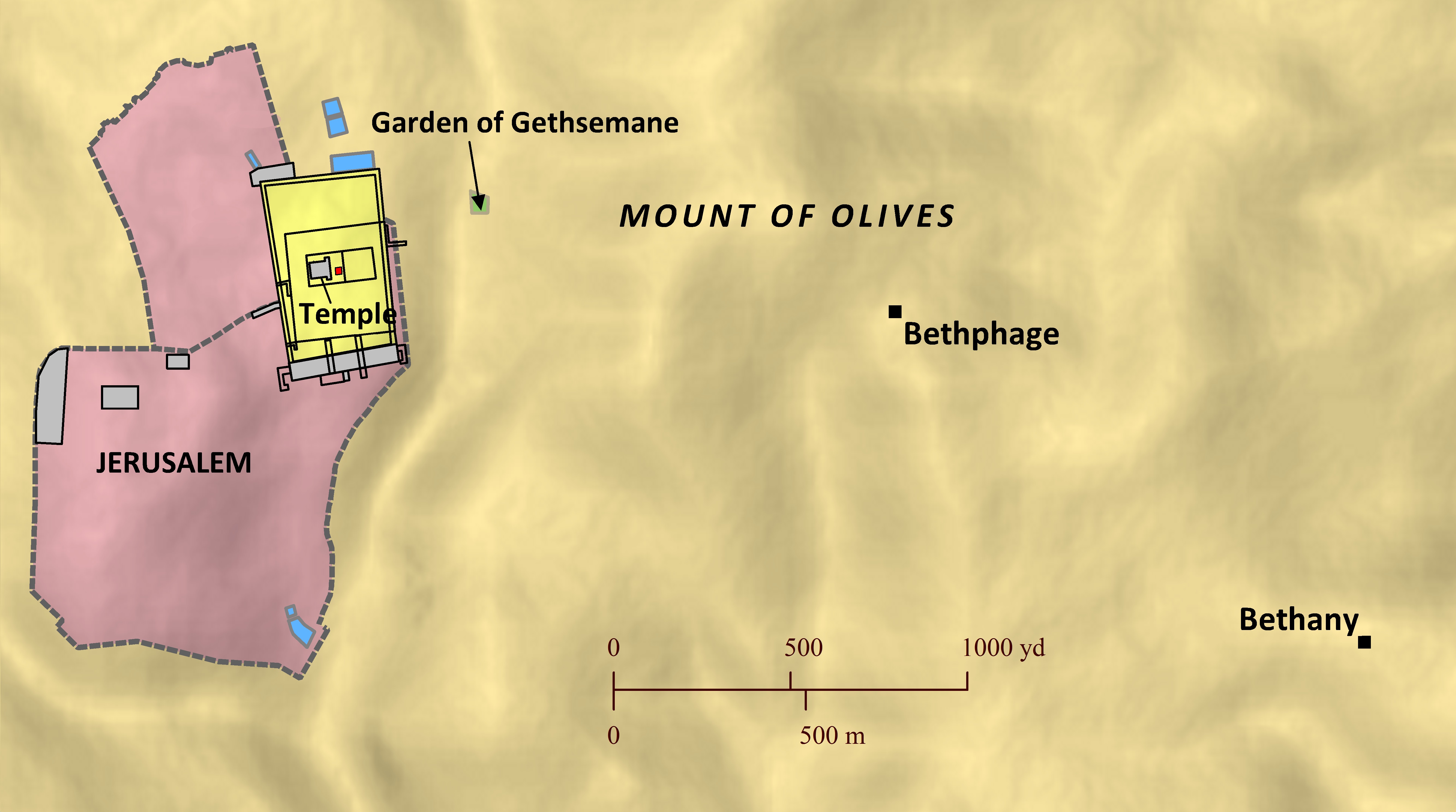
Matthew 21:1-17; Mark 11:1-11; Luke 19:28-48; John 12:1-19; see also Matthew 26:6-13; Mark 14:3-9
At the start of Passover one week before he was crucified, Jesus and his disciples traveled to Jerusalem, approaching the city from the east. When they arrived at the village of Bethphage, Jesus mounted a donkey and rode down the Mount of Olives as a humble king entering his capital city. Along the way, many people laid branches and cloaks in his path to welcome him. After Jesus entered the city, he immediately went up to the Temple and drove out the moneychangers and merchants there, and he healed the blind and the lame. Then he traveled nearly two miles outside the city to the village of Bethany to spend the night, which appears to have been where he typically lodged each night while visiting Jerusalem during the crowded Passover festival. Bethany is also where Jesus’ close friends Mary, Martha, and Lazarus lived. One evening while Jesus was there at a large dinner party given in his honor, Martha served the food, and Mary poured expensive perfume on Jesus’ feet and wiped his feet with her hair.
Open Bible Data site copyright © 2023–2026 Freely-Given.org.
Python source code for creating these static pages is available on GitHub under an open licence.
For Bible data copyrights, see the details for each displayed Bible version.
The Open English Translation (OET) main site is at OpenEnglishTranslation.Bible or OET.Bible.