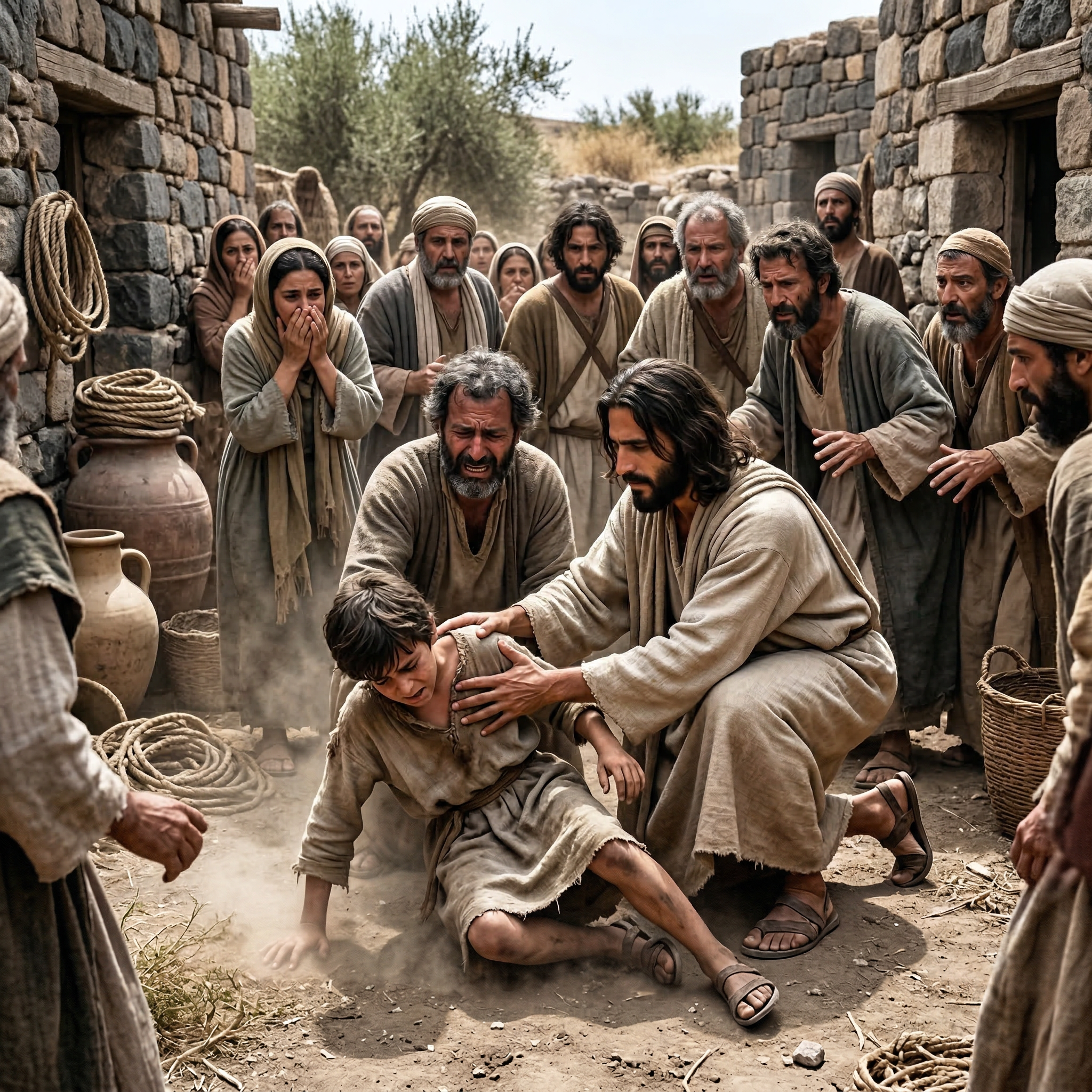
 A spirit takes control of him and suddenly he cries out and it makes him convulse and foam at the mouth, and only leaves him after a long time when he’s bruised and battered.
OET OET-RV OET-LV GHT ULT UST BSB MSB BLB AICNT OEB WEBBE WMBB NET LSV FBV TCNT T4T LEB BBE Moff JPS Wymth ASV DRA YLT Drby RV SLT Wbstr KJB-1769 KJB-1611 Bshps Gnva Cvdl TNT Wycl SR-GNT UHB BrLXX BrTr Related Parallel Simple Interlinear Topics Reference Dictionary Search
ParallelVerse GEN EXO LEV NUM DEU JOB JOS JDG RUTH 1 SAM 2 SAM PSA AMOS HOS 1 KI 2 KI 1 CHR 2 CHR PROV ECC SNG JOEL MIC ISA ZEP HAB JER LAM YNA (JNA) NAH OBA DAN EZE EZRA EST NEH HAG ZEC MAL LAO GES LES ESG DNG 2 PS TOB JDT WIS SIR BAR LJE PAZ SUS BEL MAN 1 MAC 2 MAC 3 MAC 4 MAC YHN (JHN) MARK MAT LUKE ACTs YAC (JAM) GAL 1 TH 2 TH 1 COR 2 COR ROM COL PHM EPH PHP 1 TIM TIT 1 PET 2 PET 2 TIM HEB YUD (JUD) 1 YHN (1 JHN) 2 YHN (2 JHN) 3 YHN (3 JHN) REV
Luke Intro C1 C2 C3 C4 C5 C6 C7 C8 C10 C11 C12 C13 C14 C15 C16 C17 C18 C19 C20 C21 C22 C23 C24
Luke 9 V1 V4 V7 V10 V13 V16 V19 V22 V25 V28 V31 V34 V37 V40 V43 V46 V49 V52 V55 V58 V61
Note: This view shows ‘verses’ which are not necessarily natural language units and hence sometimes only part of a sentence will be visible—click on any Bible version abbreviation down the left-hand side to see the verse in more of its context. Normally the OET discourages the reading of individual ‘verses’, but this view is only designed as a tool for Bible-translators and others doing comparisons of different translations—the older translations are further down the page (so you can read up from the bottom to trace the English translation history). The OET segments on this page are still early looks into the drafted texts of the Open English Translation of the Bible—please double-check these texts in advance before using in public.
Text critical issues=small word differences Clarity of original=clear Importance to us=normal Speaker(s)=Narrator (All still tentative.)
OET (OET-RV)
A spirit takes control of him and suddenly he cries out and it makes him convulse and foam at the mouth, and only leaves him after a long time when he’s bruised and battered.
OET-LV And see, a_spirit is_taking him, and suddenly he_is_crying_out and it_is_convulsing him with foam, and is_going_away from him, with_difficultly, bruising him.
SR-GNT Καὶ ἰδοὺ, πνεῦμα λαμβάνει αὐτόν, καὶ ἐξαίφνης κράζει καὶ σπαράσσει αὐτὸν μετὰ ἀφροῦ, καὶ μόγις ἀποχωρεῖ ἀπʼ αὐτοῦ, συντρῖβον αὐτόν. ‡
(Kai idou, pneuma lambanei auton, kai exaifnaʸs krazei kai sparassei auton meta afrou, kai mogis apoⱪōrei apʼ autou, suntribon auton.)
Key: khaki:verbs, light-green:nominative/subject, orange:accusative/object, pink:genitive/possessor.
Note: Automatic aligning of the OET-RV to the LV is done by some temporary software, hence the RV alignments are incomplete (and may occasionally be wrong).
GHT and behold, [a] spirit is-taking same and out-suddenly/unexpectedly is-crying-out, and is-convulsing same alongside of {foam} and excruciatingly it-is-separating-off/away-from from of {same}, wearing-down-together same,
ULT And behold, a spirit seizes him and he suddenly cries out, and it throws him into convulsions with foam. And it departs from him with difficulty, crushing him.
UST Here is what is happening. An evil spirit suddenly seizes him and causes him to scream. It shakes him violently and causes him to foam at the mouth. This spirit hardly ever leaves my child and, when it does, it injures him severely.
BSB & MSB A spirit keeps seizing him, and he screams abruptly. It throws him into convulsions [so that] he foams at the mouth. It keeps mauling him [and] rarely departs from him.
BLB And behold, a spirit takes him, and suddenly he cries out, and it throws him into convulsions with foaming, and with difficulty it departs from him, crushing him.
AICNT {And behold, a spirit seizes him, and he suddenly cries out and it convulses him},[fn] with foam, and it hardly departs from him crushing[fn] him.
9:39, And behold, a spirit seizes him, and he suddenly cries out and it convulses him: Some manuscripts read “For a spirit seizes him suddenly, and he shrieks and convulses.” D(05) Latin(a e ff2).
9:39, crushing: Or “bruising.”
OEB all at once a spirit will seize him, suddenly shriek out, and throw him into convulsions until he foams, and will leave him only when he is utterly exhausted.
WEBBE & WMBB Behold, a spirit takes him, he suddenly cries out, and it convulses him so that he foams; and it hardly departs from him, bruising him severely.
NET A spirit seizes him, and he suddenly screams; it throws him into convulsions and causes him to foam at the mouth. It hardly ever leaves him alone, torturing him severely.
LSV and behold, a spirit takes him, and suddenly he cries out, and it convulses him, with foaming, and it hardly departs from him, bruising him,
FBV A spirit possesses him and he screams immediately. It sends him into convulsions and makes him foam at the mouth. It hardly ever leaves him alone and it causes him a lot of pain.
TCNT A spirit seizes him, and he suddenly cries out; it convulses him so that he foams at the mouth. It hardly ever leaves him alone, bruising him severely.
T4T At various times an evil spirit suddenly seizes him and causes him to scream. The evil spirit shakes him violently and causes him to foam at the mouth. It does not leave until my child is completely exhausted.
LEB And behold, a spirit seizes him and suddenly he screams, and it convulses him with foam and rarely withdraws from him, battering him severely.
BBE And see, a spirit takes him, and suddenly he gives a cry, twisted in pain and streaming at the lips, and when it goes away from him at last, he is marked as from blows.
Moff and a spirit gets hold of him till he suddenly shrieks; it convulses him till he foams; indeed it will hardly leave off tearing him to pieces.
Wymth At times a spirit seizes him and he suddenly cries out. It convulses him, and makes him foam at the mouth, and does not leave him till it has well-nigh covered him with bruises.
ASV and behold, a spirit taketh him, and he suddenly crieth out; and it teareth him that he foameth, and it hardly departeth from him, bruising him sorely.
DRA And lo, a spirit seizeth him, and he suddenly crieth out, and he throweth him down and teareth him, so that he foameth; and bruising him, he hardly departeth from him.
YLT and lo, a spirit doth take him, and suddenly he doth cry out, and it teareth him, with foaming, and it hardly departeth from him, bruising him,
Drby and behold, a spirit takes him, and suddenly he cries out, and it tears him with foaming, and with difficulty departs from him after crushing him.
RV and behold, a spirit taketh him, and he suddenly crieth out; and it teareth him that he foameth, and it hardly departeth from him, bruising him sorely.
(and behold, a spirit taketh/takes him, and he suddenly crieth/cries out; and it teareth him that he foameth/foams, and it hardly departeth from him, bruising him sorely.)
SLT And, behold, a spirit takes him, and suddenly he cries out; and it tears him with foam, and with difficulty withdraws from him, bruising him.
Wbstr And lo, a spirit taketh him, and he suddenly crieth out; and it teareth him that he foameth, and bruising him, hardly departeth from him.
KJB-1769 And, lo, a spirit taketh him, and he suddenly crieth out; and it teareth him that he foameth again, and bruising him hardly departeth from him.
(And, lo, a spirit taketh/takes him, and he suddenly crieth/cries out; and it teareth him that he foameth/foams again, and bruising him hardly departeth from him.)
KJB-1611 And loe, a spirit taketh him, and hee suddenly crieth out, and it teareth him that he fometh againe, and bruising him, hardly departeth from him.
(Modernised spelling is same as from KJB-1769 above, apart from punctuation)
Bshps And see, a spirite taketh hym, and sodenly he cryeth, and teareth hym, that he fometh agayne, & with much payne departeth from him, when he hath rent hym.
(And see, a spirit taketh/takes him, and suddenly he crieth/cries, and teareth him, that he foameth/foams again, and with much pain departeth from him, when he hath/has rent/tear him.)
Gnva And loe, a spirit taketh him, and suddenly he crieth, and he teareth him, that he fometh, and hardly departeth from him, when he hath bruised him.
(And lo, a spirit taketh/takes him, and suddenly he crieth/cries, and he teareth him, that he foameth/foams, and hardly departeth from him, when he hath/has bruised him.)
Cvdl beholde, the sprete taketh him, and sodenly he crieth, and he teareth him, that he fometh, and with payne departeth he from him, whan he hath rente him. And
(behold, the spirit taketh/takes him, and suddenly he crieth/cries, and he teareth him, that he foameth/foams, and with pain departeth he from him, when he hath/has rent/tear him. And)
TNT and se a sprete taketh him and sodenly he cryeth and he teareth him that he fometh agayne and with moche payne departeth from him when he hath rent him
(and see a spirit taketh/takes him and suddenly he crieth/cries and he teareth him that he foameth/foams again and with much pain departeth from him when he hath/has rent/tear him)
Wycl a spirit takith hym, and sudenli he crieth, and hurtlith doun, and to-drawith hym with fome, and vnneth he goith awei al to-drawynge hym.
(a spirit taketh/takes him, and suddenly he crieth/cries, and hurtleth/hurtles down, and to-drawith him with foam, and hardly he goeth/goes away all to-drawing him.)
Luth Siehe, der Geist ergreift ihn, so schreiet er alsbald; und reißet ihn, daß er schäumet; und mit Not weichet er von ihm, wenn er ihn gerissen hat.
(See/Look, the/of_the spirit seizes him/it, so screams/cries_out he soon; and tears(v) him/it, that he foams; and with emergency give_way/yield he from him, if/when he him/it ripped has.)
ClVg et ecce spiritus apprehendit eum, et subito clamat, et elidit, et dissipat eum cum spuma, et vix discedit dilanians eum:[fn]
(and behold spirit apprehends him, and suddenly shouts, and strikes, and scatters him when/with foam, and barely departs tearing_to_pieces him:)
9.39 Et ecce spiritus apprehendit. Matthæus lunaticum, Marcus surdum et mutum describit. Significat autem illos qui ut luna mutantur, nunquam in eodem statu manentes, sed per diversa vitia crescunt et decrescunt, qui nec fidem confitentur, nec ipsius fidei audire volunt sermonem.
9.39 And behold spirit apprehends. Matthew lunaticum, Marcus deaf and mute describes. It_means however those who/which as moon they_are_changed, never/certainly_not in/into/on the_same state staying, but through different vices they_grow and they_decrease, who/which but_not faith they_confess, but_not of_his/her_own of_faith to_hear they_want conversation.
UGNT καὶ ἰδοὺ, πνεῦμα λαμβάνει αὐτόν, καὶ ἐξαίφνης κράζει καὶ σπαράσσει αὐτὸν μετὰ ἀφροῦ, καὶ μόγις ἀποχωρεῖ ἀπ’ αὐτοῦ, συντρῖβον αὐτόν.
(kai idou, pneuma lambanei auton, kai exaifnaʸs krazei kai sparassei auton meta afrou, kai mogis apoⱪōrei ap’ autou, suntribon auton.)
SBL-GNT καὶ ἰδοὺ πνεῦμα λαμβάνει αὐτόν, καὶ ἐξαίφνης κράζει, καὶ σπαράσσει αὐτὸν μετὰ ἀφροῦ καὶ ⸀μόγις ἀποχωρεῖ ἀπʼ αὐτοῦ συντρῖβον αὐτόν·
(kai idou pneuma lambanei auton, kai exaifnaʸs krazei, kai sparassei auton meta afrou kai ⸀mogis apoⱪōrei apʼ autou suntribon auton;)
RP-GNT καὶ ἰδού, πνεῦμα λαμβάνει αὐτόν, καὶ ἐξαίφνης κράζει, καὶ σπαράσσει αὐτὸν μετὰ ἀφροῦ, καὶ μόγις ἀποχωρεῖ ἀπ' αὐτοῦ, συντρῖβον αὐτόν.
(kai idou, pneuma lambanei auton, kai exaifnaʸs krazei, kai sparassei auton meta afrou, kai mogis apoⱪōrei ap' autou, suntribon auton.)
TC-GNT καὶ ἰδού, πνεῦμα λαμβάνει αὐτόν, καὶ [fn]ἐξαίφνης κράζει, καὶ σπαράσσει αὐτὸν μετὰ ἀφροῦ, καὶ [fn]μόγις ἀποχωρεῖ ἀπ᾽ αὐτοῦ, συντρῖβον αὐτόν.
(kai idou, pneuma lambanei auton, kai exaifnaʸs krazei, kai sparassei auton meta afrou, kai mogis apoⱪōrei ap autou, suntribon auton.)
Key for above GNTs: yellow:punctuation differs, orange:accents differ, red:words differ (from our SR-GNT base).
Earlier Jesus had given power to his twelve apostles to cast out demons (9:1). However, after Jesus came down from the mountain with Peter, James, and John, he heard that the other disciples had not been able to make an evil spirit leave a man’s son. When the boy approached Jesus, the unclean spirit caused the boy to convulse violently. Then Jesus cast out the unclean spirit, and the people were filled with awe.
Some other examples of headings for this section are:
The Healing of a Boy with an Evil Spirit (NIV)
Jesus Heals a Boy with an Evil Spirit (GNT)
There are parallel passages for this section in Matthew 17:14–21 and Mark 9:14–29.
A spirit keeps seizing him, and he screams abruptly.
What happens is this: An evil spirit often grabs/possesses him and immediately makes him scream!
Often a demon suddenly attacks/controls him and causes him to shriek/screech!
9:39 begins with a phrase that is literally “and behold” in Greek. The BSB and most English versions do not translate this phrase. In this context, this phrase introduces significant information in the story. Here is another way to translate this phrase:
what happens is: (TRT)
A spirit: The Greek word that the BSB translates literally as spirit here refers to an unclean spirit or a demon. Later in the story this same spirit is referred to as a “demon” (9:42b) and an “unclean spirit” (9:42c). In some languages it may be natural to refer to the spirit in the same way in all these places. See the note on “demons” in 9:1b. See also demon in the Glossary.
keeps seizing him: The Greek verb that the BSB translates as keeps seizing means “takes possession of” or “takes control of.” The form of the verb indicates that this action occurred from time to time or repeatedly. Another way to translate this is:
attacks him (GNT)
and he screams abruptly: This clause tells the result of the spirit seizing the boy. There are two ways to interpret the Greek words that the BSB translates as he screams abruptly:
It means that the boy screamed whenever the spirit seized him. For example:
he shrieks (GW) (BSB, NIV, KJV, NASB, RSV, NET, NLT, CEV, NCV, GW)
It means that the spirit screamed when it seized the boy. For example:
all at once it gives a sudden cry (NJB) (REB, GNT, NJB)
In Greek, the subject of “screamed” is ambiguous. It can mean either “he” or “it.” If it is natural in your language to translate ambiguously, as the Greek does, you should do so. If you need to specify the subject, it is recommended that you follow interpretation (1), along with most English versions.
It throws him into convulsions so that he foams at the mouth.
It makes him shake/jerk around so much/badly that foam/froth comes from his mouth.
The demon causes the boy to have convulsions/seizures, and this makes him foam at the mouth.
It throws him into convulsions: The Greek clause that the BSB translates as It throws him into convulsions indicates that the demon caused the boy to have seizures. These seizures made him roll around on the ground and jerk uncontrollably. Such seizures are sometimes a symptom of the disease called epilepsy. Here Luke identified the cause as an unclean spirit. Other ways to translate this are:
causes him to have seizures
convulses him
shakes him (CEV)
so that he foams at the mouth: The Greek phrase that the BSB translates as so that he foams at the mouth is literally “with foam.” In addition to causing the boy to have convulsions, the unclean spirit caused him to foam at the mouth. Use an expression in your language that describes what happens when a person has a seizure and white froth or bubbles come out of his mouth. For example:
and causes him to foam at the mouth (NET)
until he foams at the mouth (NRSV)
and froth/bubbles come from his mouth
It keeps mauling him and rarely departs from him.
It almost never leaves him, and it is destroying/injuring him.
The demon is doing him great harm and is almost always controlling/possessing him.
It keeps mauling him: The Greek verb that the BSB translates as mauling is translated in various ways in different contexts. In this context, it probably means to mistreat, wound, bruise badly, or torture. The demon was badly hurting the boy. Other ways to translate this include:
destroying him (NIV)
torturing him severely (NET)
keeps on tormenting him (REB)
and rarely departs from him: The clause rarely departs from him means that the demon rarely left the boy alone. Most of the time it was possessing and controlling him. In some languages it may be more natural to translate this as:
It is almost always in control of him
It has him in its grip/power almost all of the time
The BSB reverses the order of the two clauses in 9:39c. It may be more natural in your language to follow the Greek order. For example:
It hardly ever leaves him alone, torturing him severely. (NET)
Note 1 topic: figures-of-speech / metaphor
ἰδοὺ
(Some words not found in SR-GNT: Καί ἰδού πνεῦμα λαμβάνει αὐτόν καί ἐξαίφνης κράζει καί σπαράσσει αὐτόν μετά ἀφροῦ καί μόγις ἀποχωρεῖ ἀπʼ αὐτοῦ συντρῖβον αὐτόν)
The man uses the term behold to calls Jesus’ attention to what he is about to say. Your language may have a similar expression that you can use here.
Note 2 topic: writing-participants
πνεῦμα
˓a˒_spirit
The man uses this phrase to introduce the spirit into his story. If your language has its own way of doing that, you could use it here in your translation. Alternate translation: [there is an evil spirit that]
Note 3 topic: translate-unknown
μετὰ ἀφροῦ
(Some words not found in SR-GNT: Καί ἰδού πνεῦμα λαμβάνει αὐτόν καί ἐξαίφνης κράζει καί σπαράσσει αὐτόν μετά ἀφροῦ καί μόγις ἀποχωρεῖ ἀπʼ αὐτοῦ συντρῖβον αὐτόν)
When a person is having convulsions, they can have trouble breathing or swallowing. This causes white foam to form around their mouths. Alternate translation: [and foam comes out of his mouth]
Note 4 topic: figures-of-speech / litotes
μόγις ἀποχωρεῖ ἀπ’ αὐτοῦ
˱with˲_difficultly ˓is˒_going_away from him
The man is expressing a positive meaning by using a negative word together with a word that is the opposite of the intended meaning. Alternate translation: [it attacks him very often]
Note 5 topic: figures-of-speech / metaphor
συντρῖβον αὐτόν
bruising him
The man speaks of the spirit as if it were a heavy weight whose attacks crush the boy. This is a reference to the injuries that the spirit causes. Alternate translation: [injuring him badly]
Open Bible Data site copyright © 2023–2026 Freely-Given.org.
Python source code for creating these static pages is available on GitHub under an open licence.
For Bible data copyrights, see the details for each displayed Bible version.
The Open English Translation (OET) main site is at OpenEnglishTranslation.Bible or OET.Bible.