
OET OET-RV OET-LV GHT ULT UST BSB MSB BLB AICNT OEB WEBBE WMBB NET LSV FBV TCNT T4T LEB BBE Moff JPS Wymth ASV DRA YLT Drby RV SLT Wbstr KJB-1769 KJB-1611 Bshps Gnva Cvdl TNT Wycl SR-GNT UHB BrLXX BrTr Related Parallel Simple Interlinear Topics Reference Dictionary Search
ParallelVerse GEN EXO LEV NUM DEU JOB JOS JDG RUTH 1 SAM 2 SAM PSA AMOS HOS 1 KI 2 KI 1 CHR 2 CHR PROV ECC SNG JOEL MIC ISA ZEP HAB JER LAM YNA (JNA) NAH OBA DAN EZE EZRA EST NEH HAG ZEC MAL LAO GES LES ESG DNG 2 PS TOB JDT WIS SIR BAR LJE PAZ SUS BEL MAN 1 MAC 2 MAC 3 MAC 4 MAC YHN (JHN) MARK MAT LUKE ACTs YAC (JAM) GAL 1 TH 2 TH 1 COR 2 COR ROM COL PHM EPH PHP 1 TIM TIT 1 PET 2 PET 2 TIM HEB YUD (JUD) 1 YHN (1 JHN) 2 YHN (2 JHN) 3 YHN (3 JHN) REV
Jdg Intro C1 C2 C3 C4 C5 C6 C7 C8 C10 C11 C12 C13 C14 C15 C16 C17 C18 C19 C20 C21
Jdg 9 V1 V3 V5 V7 V9 V11 V13 V15 V17 V19 V21 V23 V25 V27 V29 V31 V33 V35 V37 V41 V43 V45 V47 V49 V51 V53 V55 V57
Note: This view shows ‘verses’ which are not necessarily natural language units and hence sometimes only part of a sentence will be visible—click on any Bible version abbreviation down the left-hand side to see the verse in more of its context. Normally the OET discourages the reading of individual ‘verses’, but this view is only designed as a tool for Bible-translators and others doing comparisons of different translations—the older translations are further down the page (so you can read up from the bottom to trace the English translation history). The OET segments on this page are still early looks into the drafted texts of the Open English Translation of the Bible—please double-check these texts in advance before using in public.
Text critical issues=none Clarity of original=clear Importance to us=normal Speaker(s)=Narrator (All still tentative.)
OET (OET-RV) So Ga’al went out in front of Shekem’s citizens and fought against Abimelek.
OET-LV and_ Gaˊal _he/it_went_out to_(the)_face_of/in_front_of/before the_citizens_of Shəkem and_he_fought against_ʼAⱱīmelek.
UHB וַיֵּ֣צֵא גַ֔עַל לִפְנֵ֖י בַּעֲלֵ֣י שְׁכֶ֑ם וַיִּלָּ֖חֶם בַּאֲבִימֶֽלֶךְ׃ ‡
(vayyēʦēʼ gaˊal lifənēy baˊₐlēy shəkem vayyillāḩem baʼₐⱱīmelek.)
Key: khaki:verbs.
Note: Automatic aligning of the OET-RV to the LV is done by some temporary software, hence the OET-RV alignments are incomplete (and may occasionally be wrong).
BrLXX Καὶ ἐξῆλθε Γαὰλ ἐνώπιον ἀνδρῶν Συχὲμ, καὶ παρετάξατο πρὸς Ἀβιμέλεχ.
(Kai exaʸlthe Gaʼal enōpion andrōn Suⱪem, kai paretaxato pros Abimeleⱪ.)
BrTr And Gaal went forth before the men of Sychem, and set the battle in array against Abimelech.
ULT So Gaal went out to the face of the lords of Shechem, and he fought with Abimelech.
UST So Gaal and his men went out of the city and fought against the army of Abimelech. The leaders of Shechem were watching to see what would happen.
BSB & MSB So Gaal went out before the leaders of Shechem and fought against Abimelech,
OEB No OEB JDG 9:39 book available
WEBBE & WMBB Gaal went out before the men of Shechem, and fought with Abimelech.
NET So Gaal led the leaders of Shechem out and fought Abimelech.
LSV And Gaal goes out before the masters of Shechem, and fights against Abimelech,
FBV So Gaal led the leaders of Shechem out of the town and fought with Abimelech.
T4T So Gaal led the men of Shechem outside the city to fight Abimelech and his men.
LEB So Gaal went out before the lords of Shechem and fought against Abimelech.
BBE So Gaal went out at the head of the townsmen of Shechem and made war on Abimelech.
Moff No Moff JDG 9:39 book available
JPS And Gaal went out before the men of Shechem, and fought with Abimelech.
ASV And Gaal went out before the men of Shechem, and fought with Abimelech.
DRA So Gaal went out in the sight of the people of Sichem, and fought against Abimelech,
YLT And Gaal goeth out before the masters of Shechem, and fighteth against Abimelech,
Drby And Gaal went out before the citizens of Shechem, and fought against Abimelech.
RV And Gaal went out before the men of Shechem, and fought with Abimelech.
SLT And Gaal will go forth before the lords of Shechem, and he will fight against Abimelech.
Wbstr And Gaal went out before the men of Shechem, and fought with Abimelech.
KJB-1769 And Gaal went out before the men of Shechem, and fought with Abimelech.
KJB-1611 And Gaal went out before the men of Shechem, and fought with Abimelech.
(Same as from KJB-1769 above)
Bshps And Gaal went out before the citezins of Sichem, & fought with Abimelech.
(And Gaal went out before the citizens of Sichem, and fought with Abimelech.)
Gnva And Gaal went out before the men of Shechem, and fought with Abimelech.
(Same as from KJB-1769 above)
Cvdl Gaal wente forth before the citesyns of Sichem, and foughte with Abimelech.
(Gaal went forth before the citizens of Sichem, and fought with Abimelech.)
Wycl Therfor Gaal yede, while the puple of Sichen abood; and he fauyt ayens Abymelech.
(Therefore Gaal went, while the people of Sichen abode/stayed; and he fought against Abimelech.)
Luth Gaal zog aus vor den Männern zu Sichem her und stritt mit Abimelech.
(Gaal pulled out_of before/in_front_of the men to/for Sichem her and argued/fought with Abimelech.)
ClVg Abiit ergo Gaal, spectante Sichimorum populo, et pugnavit contra Abimelech,
(He_went_away therefore Gaal, observing Shechemites to_the_people, and fought on_the_contrary Abimelech,)
Note 1 topic: figures-of-speech / synecdoche
וַיֵּ֣צֵא גַ֔עַל & וַיִּלָּ֖חֶם בַּאֲבִימֶֽלֶךְ
(Some words not found in UHB: and=he/it_went_out Gaˊal to=(the)_face_of/in_front_of/before masters_of Shekem and,he_fought against,Abimelech )
As the Introduction to Judges discusses, the author is using Gaal and Abimelech to represent them and their armies. If it would be helpful in your language, you could state the meaning plainly. Alternate translation: [So Gaal led his soldiers into battle … against Abimelech and his soldiers]
Note 2 topic: figures-of-speech / metonymy
לִפְנֵ֖י בַּעֲלֵ֣י שְׁכֶ֑ם
to=(the)_face_of/in_front_of/before (Some words not found in UHB: and=he/it_went_out Gaˊal to=(the)_face_of/in_front_of/before masters_of Shekem and,he_fought against,Abimelech )
See the discussion of the term to the face in the Introduction to Judges. Alternate translation: [before the lords of Shechem]
Judges 9
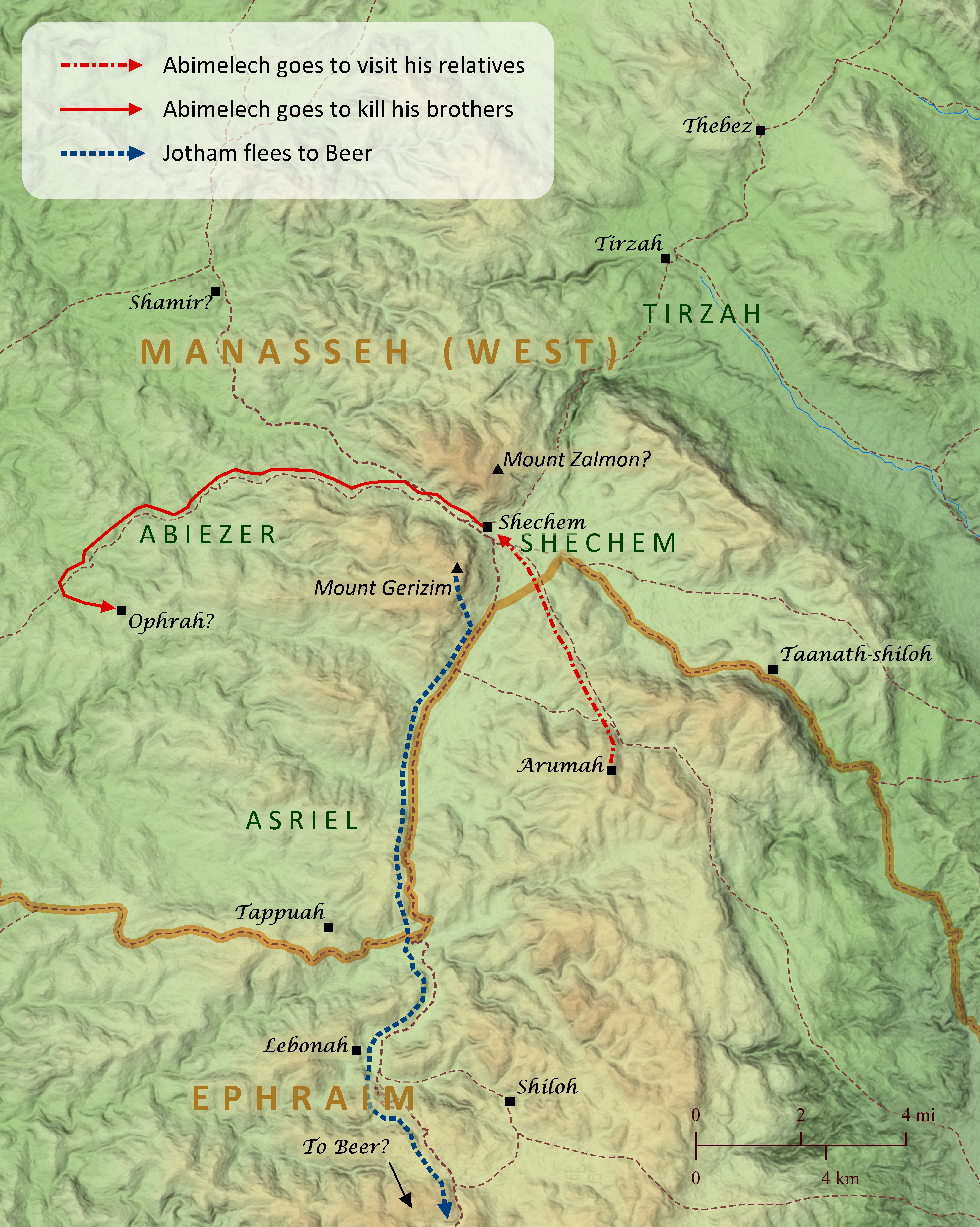
Virtually every account in the book of Judges paints this formative period in Israel’s history as a very dark, brutal time when everyone did what was right in their own eyes (Judges 17:6; 21:25). The story of Abimelech’s rise to power is no exception. Judges 6-8 recounts the heroic deeds of Gideon, a Manassite from the clan of Abiezer who rescued the Israelites from the Midianites. After Gideon’s victory, he returned to his hometown of Ophrah, and Israel enjoyed peace for the rest of his lifetime. But Gideon also left a legacy of idolatry by him, by his family, and by many Israelites. Gideon had many wives and seventy sons, as well as a concubine in Shechem who gave birth to another son named Abimelech (Judges 8:29-32). It appears that when Abimelech grew up, he settled in Arumah, (Judges 9:31), just outside Manassite territory in the tribal allotment of Ephraim (Joshua 16-17; see “Poster Map of the Tribe of Manasseh (West) and Its Surroundings, circa 1200 B.C.” map). Perhaps this move to non-Manassite territory reflected Abimelech’s lack of a legitimate heritage from his Manassite father. Later, Abimelech visited his relatives in Shechem and convinced them to persuade the leaders of Shechem to make him ruler over the city. To ensure that none of his seventy brothers, who were legitimate heirs to Gideon, challenged his authority, Abimelech went to Ophrah and killed all but one of them. The only brother to escape was Jotham, the youngest, and he went to the top of Mount Gerizim and warned them against betraying Gideon by making Abimelech king. Then he fled to the town of Beer, perhaps the same as Beeroth near the town of Gibeon. After three years, however, the leaders of Shechem began to grow dissatisfied with Abimelech as their king, and a man named Gaal offered to rule in place of him. Abimelech’s ally Zebul, who was one of the leaders of Shechem, went to Arumah and told Abimelech what Gaal was planning to do. So Gideon and his men split up into four groups and secretly surrounded the city at night. Then they attacked Gaal’s men, and Gaal’s men retreated into Shechem. Zebul drove them back out into the fields, and Abimelech’s men defeated them and captured the city. Some of the leaders of Shechem fled into the temple of El-berith (or Baal-berith), but Abimelech and his men cut down branches from Mount Zalmon (likely Mount Ebal just north of Shechem) and set fire to the temple, killing about 1000 people inside. Then Abimelech and his men went to Thebez and attacked the city. Many of the citizens took refuge inside a strong tower in the town, and Abimelech prepared to set fire to the entrance. But a woman on the roof dropped a millstone on his head, crushing his skull, so Abimelech commanded his armor bearer to kill him.
Open Bible Data site copyright © 2023–2026 Freely-Given.org.
Python source code for creating these static pages is available on GitHub under an open licence.
For Bible data copyrights, see the details for each displayed Bible version.
The Open English Translation (OET) main site is at OpenEnglishTranslation.Bible or OET.Bible.