
ParallelVerse GEN EXO LEV NUM DEUT JOB YEHO (JOS) HERO (JDG) RUTH 1 SAM 2 SAM PSA AMOS HOS 1 KI 2 KI 1 CHR 2 CHR PROV ECC SNG YOEL (JOEL) MIC ISA ZEP HAB YIR (JER) LAM YNA (JNA) NAH OBAD DAN EZEK EZRA EST NEH HAG ZEC MAL 2 PS WIS TOB MAN BAR L JER G DAN SUS PR AZ BEL G ESD L ESD ESG JDT 3 MAC SIR 1 MAC 2 MAC 4 MAC YHN (JHN) MARK MAT LUKE ACTs YAC (JAM) GAL 1 TH 2 TH 1 COR 2 COR ROM COL LAOD PHM EPH PHP 1 TIM TIT 1 PET 2 PET 2 TIM HEB YUD (JUD) 1 YHN (1 JHN) 2 YHN (2 JHN) 3 YHN (3 JHN) REV
ParallelVerse Hero Intro C1 C2 C3 C4 C5 C6 C7 C8 C10 C11 C12 C13 C14 C15 C16 C17 C18 C19 C20 C21
Hero 9 V0 V1 V3 V5 V7 V9 V11 V13 V15 V17 V19 V21 V23 V25 V27 V29 V31 V33 V35 V37 V39 V41 V43 V45 V47 V49 V51 V53 V55 V57
Note: This view shows ‘verses’ which are not necessarily natural language units and hence sometimes only part of a sentence will be visible—click on any Bible version abbreviation down the left-hand side to see the verse in more of its context. Normally the OET discourages the reading of individual ‘verses’, but this view is only designed as a tool for Bible-translators and others doing comparisons of different translations—the older translations are further down the page (so you can read up from the bottom to trace the English translation history). The OET segments on this page are still early looks into the drafted texts of the Open English Translation of the Bible—please double-check these texts in advance before using in public.
Text critical issues=small word differences Clarity of original=clear Importance to us=normal Speaker(s)=Narrator (All still tentative.)
OET (OET-RV) Once the trees went about in order to appoint a king for themselves, So they said to the olive tree, ‘Reign over us.’
OET-LV Indeed_(go) the_trees they_went to_anoint over_them a_king and_they_said to_tree mmm[fn] over_us.
9:8 OSHB variant note: מלוכ/ה: (x-qere) ’מָלְכָ֥/ה’: lemma=4427 a morph=HVqv2ms/Sh id=07UZY מָלְכָ֥/ה
UHB הָל֤וֹךְ הָֽלְכוּ֙ הָעֵצִ֔ים לִמְשֹׁ֥חַ עֲלֵיהֶ֖ם מֶ֑לֶךְ וַיֹּאמְר֥וּ לַזַּ֖יִת מָלְכָ֥ה [fn] עָלֵֽינוּ׃ ‡
(hālōk hāləkū hāˊēʦim liməshoaḩ ˊₐlēyhem melek vayyoʼmərū lazzayit māləkāh ˊālēynū.)
Key: khaki:verbs.
Note: Automatic aligning of the OET-RV to the LV is done by some temporary software, hence the OET-RV alignments are incomplete (and may occasionally be wrong).
K מלוכה
BrLXX Πορευόμενα ἐπορεύθη τὰ ξύλα τοῦ χρίσαι ἐφʼ ἑαυτὰ βασιλέα, καὶ εἶπον τῇ ἐλαίᾳ, βασίλευσον ἐφʼ ἡμῶν.
(Poreuomena eporeuthaʸ ta xula tou ⱪrisai efʼ heauta basilea, kai eipon taʸ elaia, basileuson efʼ haʸmōn.)
BrTr The trees [fn]went forth on a time to anoint a king over them; and they said to the olive, Reign over us.
9:8 Gr. went going.
ULT Going, the trees went to anoint a king over them. And they said to the olive tree, ‘Reign over us.’
UST One day the trees decided to choose one tree to be their king. First they told the olive tree, ‘We would like you to be our king.’
BSB One day the trees set out
⇔ to anoint a king for themselves.
⇔ They said to the olive tree,
⇔ ‘Reign over us.’
OEB No OEB JDG 9:8 book available
WEBBE The trees set out to anoint a king over themselves. They said to the olive tree, ‘Reign over us.’
NET “The trees were determined to go out and choose a king for themselves. They said to the olive tree, ‘Be our king!’
LSV The trees have diligently gone to anoint a king over them, and they say to the olive, Reign over us.
FBV Once upon a time the trees were determined to anoint a king to rule over them. They said to the olive tree, ‘You shall be our king.’
T4T One day the trees decided to appoint a king to rule over all of them. So they said to the olive tree, ‘You be our king!’
LEB •
“The trees went certainly,
•
to anoint a king over themselves.
•
And they said to the olive tree,
•
‘Rule over us.’
BBE One day the trees went out to make a king for themselves; and they said to the olive-tree, Be king over us.
Moff No Moff JDG 9:8 book available
JPS The trees went forth on a time to anoint a king over them; and they said unto the olive-tree: Reign thou over us.
ASV The trees went forth on a time to anoint a king over them; and they said unto the olive-tree, Reign thou over us.
DRA The trees went to anoint a king over them: and they said to the olive tree: Reign thou over us.
YLT 'The trees have diligently gone to anoint over them a king, and they say to the olive, Reign thou over us.
Drby The trees once went forth to anoint a king over them; and they said to the olive-tree, Reign over us.
RV The trees went forth on a time to anoint a king over them; and they said unto the olive tree, Reign thou over us.
(The trees went forth on a time to anoint a king over them; and they said unto the olive tree, Reign thou/you over us.)
SLT The trees going forth went to anoint over them a king; and they will say to the olive, Reign thou over us.
Wbstr The trees went forth on a time to anoint a king over them; and they said to the olive-tree, Reign thou over us.
KJB-1769 The trees went forth on a time to anoint a king over them; and they said unto the olive tree, Reign thou over us.
(The trees went forth on a time to anoint a king over them; and they said unto the olive tree, Reign thou/you over us.)
KJB-1611 The trees went foorth on a time to annoint a King ouer them, and they said vnto the Oliue tree, Reigne thou ouer vs.
(Modernised spelling is same as from KJB-1769 above, apart from capitalisation and punctuation)
Bshps The trees went foorth to annoynt a kyng ouer them, and sayde vnto the Olyue tree: Raigne thou ouer vs.
(The trees went forth to anoint a king over them, and said unto the Olive tree: Reign thou/you over us.)
Gnva The trees went foorth to anoynt a King ouer them, and sayde vnto the oliue tree, Reigne thou ouer vs.
(The trees went forth to anoint a King over them, and said unto the olive tree, Reign thou/you over us.)
Cvdl The trees wente to anointe a kinde ouer them, and sayde vnto the Olyue tre: Be thou oure kynge.
(The trees went to anoint a kind over them, and said unto the Olive tree: Be thou/you our king.)
Wycl Trees yeden to anoynte a kyng on hem; and tho seiden to the olyue tre, Comaunde thou to vs.
(Trees went to anoint a king on hem; and those said to the olive tree, Command thou/you to us.)
Luth Die Bäume gingen hin, daß sie einen König über sich salbeten, und sprachen zum Ölbaum: Sei unser König!
(The trees went there/therefore, that they/she/them a king above itself/yourself/themselves anointed, and said for_the olive_tree: Be our king!)
ClVg Ierunt ligna, ut ungerent super se regem: dixeruntque olivæ: Impera nobis.
(They_went wood, as they_would_anoint over himself the_king: and_they_said olives: Command us.)
Note 1 topic: figures-of-speech / parables
הָל֤וֹךְ הָֽלְכוּ֙ הָעֵצִ֔ים לִמְשֹׁ֥חַ עֲלֵיהֶ֖ם מֶ֑לֶךְ
to_go_out they_went_out the,trees (Some words not found in UHB: to_go_out they_went_out the,trees to,anoint over,them king and=they_said to,tree מלוכ,ה over,us )
To make the lords of Shechem recognize that they will have much trouble because they have made Abimelech their king, Jotham tells them a story. If it would be helpful to your readers, you could state that explicitly. You could also begin this story in the way that made-up stories usually begin in your language. Alternate translation: [Then Jotham told the lords of Shechem a story to make them realize that they would have much trouble because they had made Abimelech their king. He said, “Once upon a time, the trees went to anoint a king over them]
Note 2 topic: figures-of-speech / reduplication
הָל֤וֹךְ הָֽלְכוּ֙ הָעֵצִ֔ים לִמְשֹׁ֥חַ עֲלֵיהֶ֖ם מֶ֑לֶךְ
to_go_out they_went_out the,trees (Some words not found in UHB: to_go_out they_went_out the,trees to,anoint over,them king and=they_said to,tree מלוכ,ה over,us )
Jotham is repeating the verb “go” (saying Going and went) in order to intensify the idea that it expresses. If your language can repeat words for intensification, it would be appropriate to do that here in your translation. If not, your language may have another way of expressing the emphasis. Alternate translation: [The trees went around looking for someone they could anoint as their king]
Note 3 topic: figures-of-speech / quotesinquotes
וַיֹּאמְר֥וּ לַזַּ֖יִת מָלְכָ֥ה עָלֵֽינוּ
(Some words not found in UHB: to_go_out they_went_out the,trees to,anoint over,them king and=they_said to,tree מלוכ,ה over,us )
If it would be clearer in your language, you could translate this so that there is not a quotation within a quotation. Alternate translation: [And they asked the olive tree to reign over them]
Note 4 topic: figures-of-speech / imperative
מָלְכָ֥ה עָלֵֽינוּ
(Some words not found in UHB: to_go_out they_went_out the,trees to,anoint over,them king and=they_said to,tree מלוכ,ה over,us )
This is an imperative, but it communicates a respectful request rather than a command. Use a form in your language that communicates a respectful request. It may be helpful to add an expression such as “please” to make this clear. Alternate translation: [Please reign over us]
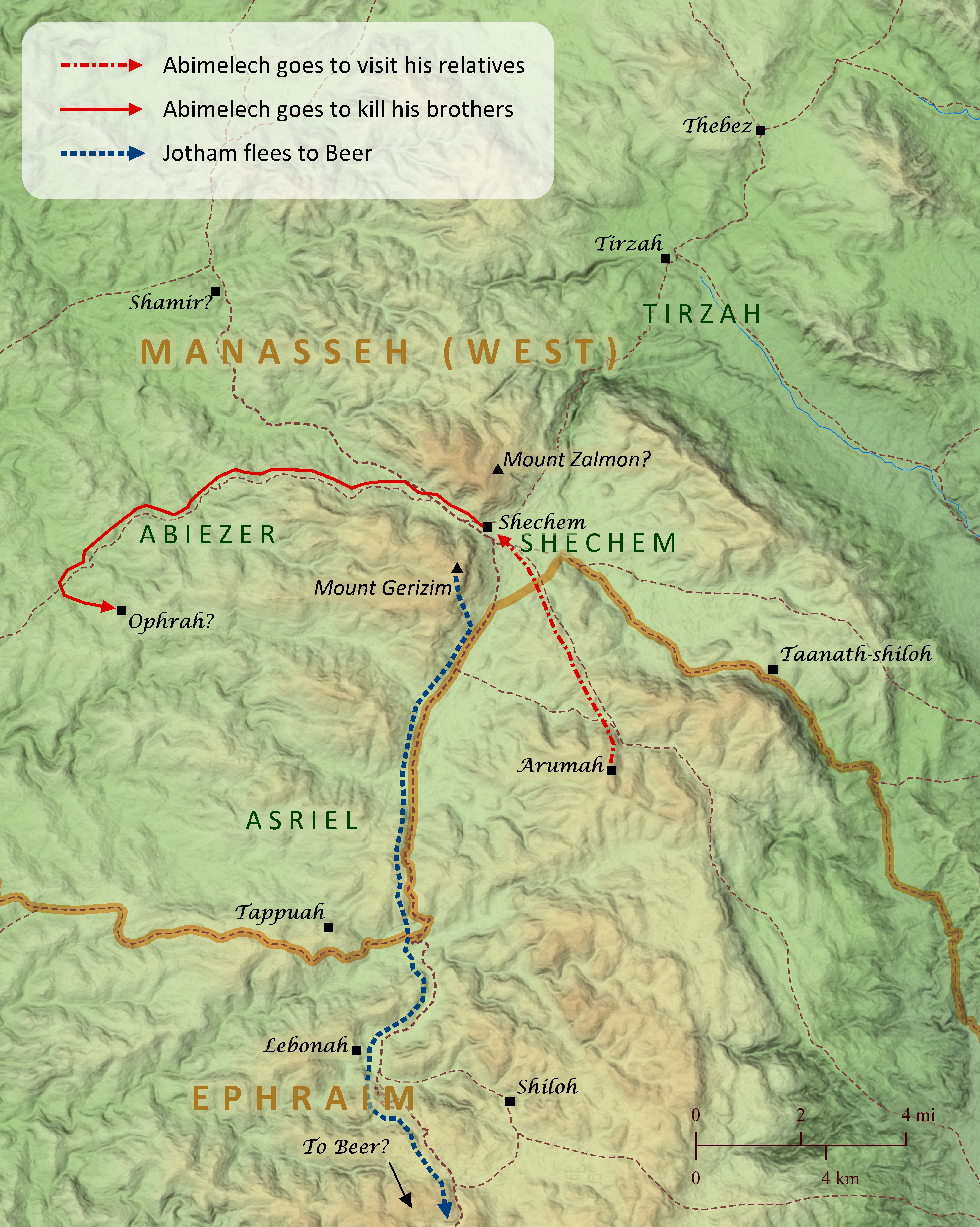
Judges 9
Virtually every account in the book of Judges paints this formative period in Israel’s history as a very dark, brutal time when everyone did what was right in their own eyes (Judges 17:6; 21:25). The story of Abimelech’s rise to power is no exception. Judges 6-8 recounts the heroic deeds of Gideon, a Manassite from the clan of Abiezer who rescued the Israelites from the Midianites. After Gideon’s victory, he returned to his hometown of Ophrah, and Israel enjoyed peace for the rest of his lifetime. But Gideon also left a legacy of idolatry by him, by his family, and by many Israelites. Gideon had many wives and seventy sons, as well as a concubine in Shechem who gave birth to another son named Abimelech (Judges 8:29-32). It appears that when Abimelech grew up, he settled in Arumah, (Judges 9:31), just outside Manassite territory in the tribal allotment of Ephraim (Joshua 16-17; see “Poster Map of the Tribe of Manasseh (West) and Its Surroundings, circa 1200 B.C.” map). Perhaps this move to non-Manassite territory reflected Abimelech’s lack of a legitimate heritage from his Manassite father. Later, Abimelech visited his relatives in Shechem and convinced them to persuade the leaders of Shechem to make him ruler over the city. To ensure that none of his seventy brothers, who were legitimate heirs to Gideon, challenged his authority, Abimelech went to Ophrah and killed all but one of them. The only brother to escape was Jotham, the youngest, and he went to the top of Mount Gerizim and warned them against betraying Gideon by making Abimelech king. Then he fled to the town of Beer, perhaps the same as Beeroth near the town of Gibeon. After three years, however, the leaders of Shechem began to grow dissatisfied with Abimelech as their king, and a man named Gaal offered to rule in place of him. Abimelech’s ally Zebul, who was one of the leaders of Shechem, went to Arumah and told Abimelech what Gaal was planning to do. So Gideon and his men split up into four groups and secretly surrounded the city at night. Then they attacked Gaal’s men, and Gaal’s men retreated into Shechem. Zebul drove them back out into the fields, and Abimelech’s men defeated them and captured the city. Some of the leaders of Shechem fled into the temple of El-berith (or Baal-berith), but Abimelech and his men cut down branches from Mount Zalmon (likely Mount Ebal just north of Shechem) and set fire to the temple, killing about 1000 people inside. Then Abimelech and his men went to Thebez and attacked the city. Many of the citizens took refuge inside a strong tower in the town, and Abimelech prepared to set fire to the entrance. But a woman on the roof dropped a millstone on his head, crushing his skull, so Abimelech commanded his armor bearer to kill him.
Open Bible Data site copyright © 2023–2026 Freely-Given.org.
Python source code for creating these static pages is available on GitHub under an open licence.
For Bible data copyrights, see the details for each displayed Bible version.
The Open English Translation (OET) main site is at OpenEnglishTranslation.Bible or OET.Bible.