
ParallelVerse GEN EXO LEV NUM DEUT JOB YEHO (JOS) HERO (JDG) RUTH 1 SAM 2 SAM PSA AMOS HOS 1 KI 2 KI 1 CHR 2 CHR PROV ECC SNG YOEL (JOEL) MIC ISA ZEP HAB YIR (JER) LAM YNA (JNA) NAH OBAD DAN EZEK EZRA EST NEH HAG ZEC MAL 2 PS WIS TOB MAN BAR L JER G DAN SUS PR AZ BEL G ESD L ESD ESG JDT 3 MAC SIR 1 MAC 2 MAC 4 MAC YHN (JHN) MARK MAT LUKE ACTs YAC (JAM) GAL 1 TH 2 TH 1 COR 2 COR ROM COL LAOD PHM EPH PHP 1 TIM TIT 1 PET 2 PET 2 TIM HEB YUD (JUD) 1 YHN (1 JHN) 2 YHN (2 JHN) 3 YHN (3 JHN) REV
ParallelVerse 2 Ki Intro C1 C2 C3 C4 C5 C6 C7 C8 C9 C10 C11 C12 C13 C14 C15 C16 C17 C18 C19 C20 C21 C22 C24 C25
2 Ki 23 V0 V1 V2 V3 V4 V5 V6 V7 V8 V10 V11 V12 V13 V14 V15 V16 V17 V18 V19 V20 V21 V22 V23 V24 V25 V26 V27 V28 V29 V30 V31 V32 V33 V34 V35 V36 V37
Note: This view shows ‘verses’ which are not necessarily natural language units and hence sometimes only part of a sentence will be visible—click on any Bible version abbreviation down the left-hand side to see the verse in more of its context. Normally the OET discourages the reading of individual ‘verses’, but this view is only designed as a tool for Bible-translators and others doing comparisons of different translations—the older translations are further down the page (so you can read up from the bottom to trace the English translation history). The OET segments on this page are still early looks into the drafted texts of the Open English Translation of the Bible—please double-check these texts in advance before using in public.
Text critical issues=none Clarity of original=clear Importance to us=normal Speaker(s)=Narrator (All still tentative.)
OET (OET-RV) However those priests from those hilltop shrines weren’t allowed to serve at the altar in Yerushalem, but they were allowed to eat unleavened bread like the other priests.
OET-LV Nevertheless not the_priests_of the_high_places they_went_up to the_altar_of YHWH in_Yərūshālaim/(Jerusalem) if/because (if) they_ate unleavened_bread(s) in_the_middle brothers_of_their.
UHB אַ֗ךְ לֹ֤א יַֽעֲלוּ֙ כֹּהֲנֵ֣י הַבָּמ֔וֹת אֶל־מִזְבַּ֥ח יְהוָ֖ה בִּירוּשָׁלִָ֑ם כִּ֛י אִם־אָכְל֥וּ מַצּ֖וֹת בְּת֥וֹךְ אֲחֵיהֶֽם׃ ‡
(ʼak loʼ yaˊₐlū kohₐnēy habāmōt ʼel-mizbaḩ yhwh biyrūshālāim kiy ʼim-ʼākəlū maʦʦōt bətōk ʼₐḩēyhem.)
Key: khaki:verbs.
Note: Automatic aligning of the OET-RV to the LV is done by some temporary software, hence the OET-RV alignments are incomplete (and may occasionally be wrong).
People tagged in the matching LV passage: God
Places tagged in the matching LV passage: Jerusalem
Dictionary: Jerusalem
BrLXX Πλὴν οὐκ ἀνέβησαν οἱ ἱερεῖς τῶν ὑψηλῶν πρὸς τὸ θυσιαστήριον Κυρίου ἐν Ἰερουσαλήμ, ὅτι εἰ μὴ ἔφαγον ἄζυμα ἐν μέσῳ τῶν ἀδελφῶν αὐτῶν.
(Plaʸn ouk anebaʸsan hoi hiereis tōn hupsaʸlōn pros to thusiastaʸrion Kuriou en Ierousalaʸm, hoti ei maʸ efagon azuma en mesōi tōn adelfōn autōn.)
BrTr Only the priests of the high places went not up to the altar of the Lord in Jerusalem, for they only ate leavened bread in the midst of their brethren.
ULT (However, the priests of the high places did not go up to the altar of Yahweh in Jerusalem. Rather, they ate unleavened bread in the midst of their brothers.)
UST (Josiah did not allow the priests he had brought to Jerusalem from the hilltop shrines to offer sacrifices on the altar in the temple courtyard in Jerusalem. But he did allow them to eat the food that the priests received as their share of sacrifices that people brought.)
BSB Although the priests of the high places did not come up to the altar of the LORD in Jerusalem, they ate unleavened bread with their fellow priests.
OEB No OEB KI2 23:9 book available
WEBBE Nevertheless the priests of the high places didn’t come up to the LORD’s altar in Jerusalem, but they ate unleavened bread amongst their brothers.
NET (Now the priests of the high places did not go up to the altar of the Lord in Jerusalem, but they did eat unleavened cakes among their fellow priests.)
LSV only, the priests of the high places do not come up to the altar of YHWH in Jerusalem, but they have eaten unleavened things in the midst of their brothers.
FBV Though the priests of the high places did not serve at the altar of the Lord in Jerusalem, they did eat unleavened bread with their brother priests.
T4T 8-9 Josiah also brought to Jerusalem all the priests who were offering sacrifices in the other cities in Judah. He also desecrated the places on the tops of hills where the priests had burned incense to honor idols, from Geba in the north to Beersheba in the south. Those priests were not allowed to offer sacrifices in the temple, but they were allowed to eat the unleavened bread that the priests who worked in the temple ate. He also commanded that the altars that were dedicated to the goat demons near the gate built by Joshua, the mayor of Jerusalem, be destroyed. Those altars were at the left of the main gate into the city.
LEB However, the priests of the high places did not come up to the altar of Yahweh in Jerusalem, but they ate unleavened bread in the midst of their relatives.
BBE Still the priests of the high places never came up to the altar of the Lord in Jerusalem; but they took their food of unleavened bread among their brothers.
Moff No Moff KI2 23:9 book available
JPS Nevertheless the priests of the high places came not up to the altar of the LORD in Jerusalem, but they did eat unleavened bread among their brethren.
ASV Nevertheless the priests of the high places came not up to the altar of Jehovah in Jerusalem, but they did eat unleavened bread among their brethren.
DRA However the priests of the high places came not up to the altar of the Lord in Jerusalem: but only ate of the unleavened bread among their brethren.
YLT only, the priests of the high places come not up unto the altar of Jehovah in Jerusalem, but they have eaten unleavened things in the midst of their brethren.
Drby Nevertheless the priests of the high places came not up to the altar of Jehovah in Jerusalem, but they ate of the unleavened bread among their brethren.
RV Nevertheless the priests of the high places came not up to the altar of the LORD in Jerusalem, but they did eat unleavened bread among their brethren.
(Nevertheless the priests of the high places came not up to the altar of the LORD in Yerusalem, but they did eat unleavened bread among their brethren/brothers.)
SLT But the priests of the heights will not come up to the altar of Jehovah in Jerusalem, but they ate the unleavened in the midst of their brethren.
Wbstr Nevertheless, the priests of the high places came not up to the altar of the LORD in Jerusalem, but they ate of the unleavened bread among their brethren.
KJB-1769 Nevertheless the priests of the high places came not up to the altar of the LORD in Jerusalem, but they did eat of the unleavened bread among their brethren.
(Nevertheless the priests of the high places came not up to the altar of the LORD in Yerusalem, but they did eat of the unleavened bread among their brethren/brothers.)
KJB-1611 Neuerthelesse, the priests of the high places came not vp to the Altar of the LORD in Ierusalem, but they did eate of the vnleauened bread among their brethren.
(Modernised spelling is same as from KJB-1769 above, apart from capitalisation and punctuation)
Bshps Neuerthelesse, the priestes of the high places came not vp to the aulter of the Lorde in Hierusalem, saue onely they did eate of the sweete bread among their brethren.
(Nevertheless, the priests of the high places came not up to the altar of the Lord in Yerusalem, save only they did eat of the sweet bread among their brethren/brothers.)
Gnva Neuerthelesse the Priests of the hie places came not vp to the altar of the Lord in Ierusalem, saue onely they did eate of the vnleauened bread among their brethren.
(Nevertheless the Priests of the high places came not up to the altar of the Lord in Yerusalem, save only they did eat of the unleavened bread among their brethren/brothers.)
Cvdl Yet had not the prestes of the hye places offred vpon the altare of the LORDE at Ierusalem, but ate vnleuended bred amonge their brethren.
(Yet had not the priests of the high places offered upon the altar of the LORD at Yerusalem, but ate unleavened bread among their brethren/brothers.)
Wycl Netheles the preestis of hiye thingis stieden not to the auter of the Lord in Jerusalem, but oneli thei eten therf looues in the myddis of her britheren.
(Nevertheless the priests of high things ascended not to the altar of the Lord in Yerusalem, but only they eaten unleavened loaves in the midst of her brethren/brothers.)
Luth Doch hatten die Priester der Höhen nie geopfert auf dem Altar des HErr’s zu Jerusalem, sondern aßen des ungesäuerten Brots unter ihren Brüdern.
(But had the priest(s) the/of_the heights never sacrificed on/in/to to_him altar the LORD’s to/for Jerusalem, rather ate the unleavened bread under your(pl) brothers.)
ClVg Verumtamen non ascendebant sacerdotes excelsorum ad altare Domini in Jerusalem: sed tantum comedebant azyma in medio fratrum suorum.
(Nevertheless not/no they_were_going_up priests of_the_heights to the_altar Master in/into/on Yerusalem: but only they_were_eating unleavened_bread in/into/on in_the_middle brothers of_his_own.)
Note 1 topic: writing-background
אַ֗ךְ לֹ֤א יַֽעֲלוּ֙ כֹּהֲנֵ֣י הַבָּמ֔וֹת אֶל־מִזְבַּ֥ח יְהוָ֖ה בִּירוּשָׁלִָ֑ם כִּ֛י אִם־אָכְל֥וּ מַצּ֖וֹת בְּת֥וֹךְ אֲחֵיהֶֽם
however not come_up (Some words not found in UHB: however not come_up priests_of of,the_high_places to/towards altar_of YHWH in,Jerusalem that/for/because/then/when if ate unleavened_bread in_the=middle brothers_of,their )
The author is providing background information about the priests he described in the previous verse. In your translation, introduce this information in a way that would be natural in your own language and culture.
Note 2 topic: translate-symaction
לֹ֤א יַֽעֲלוּ֙ כֹּהֲנֵ֣י הַבָּמ֔וֹת אֶל־מִזְבַּ֥ח יְהוָ֖ה בִּירוּשָׁלִָ֑ם
not come_up (Some words not found in UHB: however not come_up priests_of of,the_high_places to/towards altar_of YHWH in,Jerusalem that/for/because/then/when if ate unleavened_bread in_the=middle brothers_of,their )
Not allowing the priests who had previously served at the high places was a symbolic action by which Josiah kept any trace of false worship away from the Jerusalem temple. These priests were descendants of Aaron who had been burning incense to Yahweh, but they had been doing so at unauthorized locations. This worship was therefore impure, and those who had led the people in it had to be kept away from Yahweh’s altar. If it would be helpful to your readers, you could explain the significance of this action in the text of your translation or in a footnote.
Note 3 topic: figures-of-speech / idiom
לֹ֤א יַֽעֲלוּ֙ & אֶל־מִזְבַּ֥ח יְהוָ֖ה
not come_up & to/towards (Some words not found in UHB: however not come_up priests_of of,the_high_places to/towards altar_of YHWH in,Jerusalem that/for/because/then/when if ate unleavened_bread in_the=middle brothers_of,their )
The author is using go up to the altar as a common expression of his culture to mean “offer sacrifices on the altar.” If this phrase does not have that meaning in your language, you could use a comparable expression from your language that does have that meaning, or you could state the meaning plainly. Alternate translation: [serve at the altar of Yahweh] or [offer sacrifices on the altar of Yahweh]
Note 4 topic: figures-of-speech / synecdoche
כִּ֛י אִם־אָכְל֥וּ מַצּ֖וֹת
(Some words not found in UHB: however not come_up priests_of of,the_high_places to/towards altar_of YHWH in,Jerusalem that/for/because/then/when if ate unleavened_bread in_the=middle brothers_of,their )
The author is using one kind of food that the priests received as their share of sacrifices, the unleavened bread that they made from grain offerings, to mean all of the food that the priests received from sacrifices for their support. If it would be helpful in your language, you could state the meaning plainly. Alternate translation: [However, they were allowed to live off the food from the priests’ share of the sacrifices]
Note 5 topic: figures-of-speech / metaphor
בְּת֥וֹךְ אֲחֵיהֶֽם
(Some words not found in UHB: however not come_up priests_of of,the_high_places to/towards altar_of YHWH in,Jerusalem that/for/because/then/when if ate unleavened_bread in_the=middle brothers_of,their )
The author is speaking as if the other priests were actually the brothers of these priests who had been serving at hilltop shrines. If it would be helpful in your language, you could state the meaning plainly. Alternate translation: [together with their fellow priests]
2 Kings 22-23; 2 Chronicles
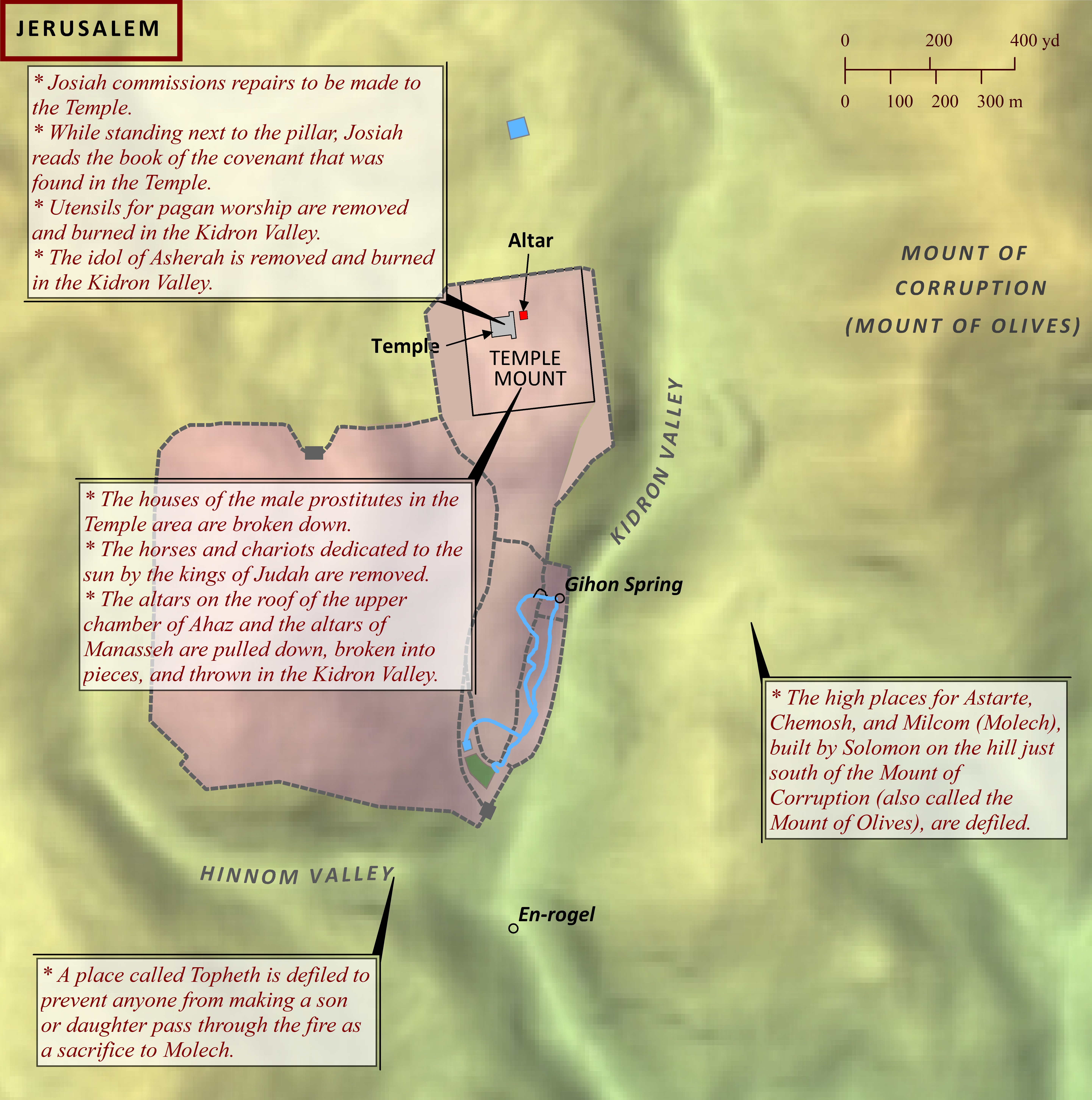
If ever there was a point in biblical history when the worship of Yahweh seemed all but extinguished, it was during the years leading up to King Josiah’s birth. Yet it was against this incredibly dark backdrop that the Lord raised up Josiah of Judah to bring about one of the greatest spiritual reforms his nation had ever seen. Josiah was the grandson of Manasseh, one of the most wicked and idolatrous kings of Judah (2 Kings 21:1-9; 2 Chronicles 33:1-9), though Manasseh later repented (2 Chronicles 33:12-19), and the son of Amon, another wicked, idolatrous king (2 Kings 21:18-22; 2 Chronicles 33:20-23). After his father’s death, Josiah became king at the young age of eight, so perhaps it was this lack of influence from his wicked father during some of his most formative years as a leader that enabled him to become such a force for spiritual renewal throughout Judah. Whatever the reason for his spiritual fervor, Josiah’s passion also coincided with a period of Assyrian decline, which allowed him to expand his renewal even to the lands once ruled by the northern kingdom of Israel. Josiah began his reforms by commissioning repairs to be made to the Temple of the Lord in Jerusalem. During these repairs, the book of the law, likely the book of Deuteronomy, was found in the Temple and brought to Josiah. When Josiah read the book, he tore his clothes in anguish over the punishment that surely awaited the nation for their disobedience to the laws of Moses. He called for all the elders of Judah and Jerusalem to gather by the pillar of the Temple, and he read the law to them as well and led them to establish a new covenant to follow the laws of Moses. Josiah then began a great purge of idolatry throughout Jerusalem, Judah, and even Israel. Utensils used for pagan worship were removed from the Temple in Jerusalem and burned in the Kidron Valley, and their ashes were carried to Bethel. The image of Asherah was also removed and burned in the Kidron Valley, and the remains were ground to dust and spread over graves of the common people. The houses of the male prostitutes in the Temple area were also broken down. The horses and chariots dedicated to the sun by the kings of Judah were removed, and the chariots were burned. The altars on the roof of the upper chamber of Ahaz and the altars that Manasseh had made in Temple courtyard were pulled down and broken in pieces, and the rubble was thrown into the Kidron Valley. A place called Topheth in the Hinnom Valley was defiled so that no one would make a son or daughter pass through fire as an offering to Molech. Just east of Jerusalem the high places built by King Solomon for his pagan wives on the Mount of Corruption (also called the Mount of Olives; 1 Kings 11:7-8) were defiled. Josiah’s reforms throughout Judah included putting away the mediums, wizards, teraphim, idols, and all the abominations that were seen in the land. At Bethel he tore down the altar and the high place erected by Jeroboam son of Nebat. He burned the high place, crushing it to dust, and burned the sacred pole. There he also saw tombs of people who must have been associated with the pagan rituals there, so he removed the bones and burned them on the altar, thus defiling it, as was prophesied years earlier (1 Kings 13:1-10). Josiah then extended his reforms to lands that formerly belonged to Israel but were now directly governed by Assyria. Throughout the towns of Samaria all the shrines of the high places were removed, the priests of the high places were slaughtered on the pagan altars, and their bones were burned on them. Throughout the rest of the land of Israel and Judah–in Manasseh, Ephraim, Simeon, and as far as Naphtali–Josiah also broke down the altars, ground the sacred poles and images into powder, and demolished all the incense altars. When Josiah returned to Jerusalem, he celebrated the Passover in a way that exceeded all the Passover celebrations since the time of the Judges.
Open Bible Data site copyright © 2023–2026 Freely-Given.org.
Python source code for creating these static pages is available on GitHub under an open licence.
For Bible data copyrights, see the details for each displayed Bible version.
The Open English Translation (OET) main site is at OpenEnglishTranslation.Bible or OET.Bible.