
OET OET-RV OET-LV GHT ULT UST BSB MSB BLB AICNT OEB WEBBE WMBB NET LSV FBV TCNT T4T LEB BBE Moff JPS Wymth ASV DRA YLT Drby RV SLT Wbstr KJB-1769 KJB-1611 Bshps Gnva Cvdl TNT Wycl SR-GNT UHB BrLXX BrTr Related Parallel Simple Interlinear Topics Reference Dictionary Search
ParallelVerse GEN EXO LEV NUM DEU JOB JOS JDG RUTH 1 SAM 2 SAM PSA AMOS HOS 1 KI 2 KI 1 CHR 2 CHR PROV ECC SNG JOEL MIC ISA ZEP HAB JER LAM YNA (JNA) NAH OBA DAN EZE EZRA EST NEH HAG ZEC MAL LAO GES LES ESG DNG 2 PS TOB JDT WIS SIR BAR LJE PAZ SUS BEL MAN 1 MAC 2 MAC 3 MAC 4 MAC YHN (JHN) MARK MAT LUKE ACTs YAC (JAM) GAL 1 TH 2 TH 1 COR 2 COR ROM COL PHM EPH PHP 1 TIM TIT 1 PET 2 PET 2 TIM HEB YUD (JUD) 1 YHN (1 JHN) 2 YHN (2 JHN) 3 YHN (3 JHN) REV
2 Ki Intro C1 C2 C3 C4 C5 C6 C7 C8 C9 C10 C11 C12 C13 C14 C15 C16 C17 C18 C19 C20 C21 C22 C24 C25
2 Ki 23 V1 V2 V3 V4 V5 V6 V7 V8 V9 V10 V11 V12 V14 V15 V16 V17 V18 V19 V20 V21 V22 V23 V24 V25 V26 V27 V28 V29 V30 V31 V32 V33 V34 V35 V36 V37
Note: This view shows ‘verses’ which are not necessarily natural language units and hence sometimes only part of a sentence will be visible—click on any Bible version abbreviation down the left-hand side to see the verse in more of its context. Normally the OET discourages the reading of individual ‘verses’, but this view is only designed as a tool for Bible-translators and others doing comparisons of different translations—the older translations are further down the page (so you can read up from the bottom to trace the English translation history). The OET segments on this page are still early looks into the drafted texts of the Open English Translation of the Bible—please double-check these texts in advance before using in public.
B I ◄ ← 2 Ki 23:13 ↓ → ► ≡ ═ ©
Text critical issues=none Clarity of original=clear Importance to us=normal Speaker(s)=Narrator (All still tentative.)
OET (OET-RV) The king desecrated the hilltop shrines that faced Yerushalem—they were south of the Mt. of Destruction’ (the Mt. of Olives). King Shelomoh had built shrines for Ashtarot (the disgusting god of the Sidonians) and for Kemosh (the disgusting god of Moab) and for Molek (the disgusting god of the Ammonites).
OET-LV And_DOM the_high_places which were_on the_face_of Yərūshālam/(Jerusalem) which were_from_the_south_of the_mountain_of (the)_destruction which Shəlomoh/(Solomon) the_king_of Yisrāʼēl/(Israel) he_had_built to_Astarte the_detestable_thing_of the_Tsīdonī/(Sidonians) and_to_Kəmōsh/(Chemosh) the_detestable_thing_of Mōʼāⱱ and_to_Malkām the_abomination_of the_people_of ˊAmmōn the_king he_made_unclean.
UHB וְֽאֶת־הַבָּמ֞וֹת אֲשֶׁ֣ר ׀ עַל־פְּנֵ֣י יְרוּשָׁלִַ֗ם אֲשֶׁר֮ מִימִ֣ין לְהַר־הַמַּשְׁחִית֒ אֲשֶׁ֣ר בָּ֠נָה שְׁלֹמֹ֨ה מֶֽלֶךְ־יִשְׂרָאֵ֜ל לְעַשְׁתֹּ֣רֶת ׀ שִׁקֻּ֣ץ צִידֹנִ֗ים וְלִכְמוֹשׁ֙ שִׁקֻּ֣ץ מוֹאָ֔ב וּלְמִלְכֹּ֖ם תּוֹעֲבַ֣ת בְּנֵֽי־עַמּ֑וֹן טִמֵּ֖א הַמֶּֽלֶךְ׃ ‡
(vəʼet-habāmōt ʼₐsher ˊal-pənēy yərūshālaim ʼₐsher miymin ləhar-hammashḩīt ʼₐsher bānāh shəlomoh melek-yisrāʼēl ləˊashtoret shiqquʦ ʦīdonim vəlikəmōsh shiqquʦ mōʼāⱱ ūləmilkom tōˊₐⱱat bənēy-ˊammōn ţimmēʼ hammelek.)
Key: khaki:verbs.
Note: Automatic aligning of the OET-RV to the LV is done by some temporary software, hence the OET-RV alignments are incomplete (and may occasionally be wrong).
BrLXX Καὶ τὸν οἶκον τὸν ἐπὶ πρόσωπον Ἱερουσαλὴμ τὸν ἐκ δεξιῶν τοῦ ὄρους τοῦ Μοσθὰθ, ὃν ᾠκοδόμησε Σαλωμὼν βασιλεὺς Ἰσραὴλ τῇ Ἀστάρτῃ προσοχθίσματι Σιδωνίων, καὶ τῷ Χαμὼς προσοχθίσματι Μωὰβ, καὶ τῷ Μολὸχ βδελύγματι υἱῶν Ἀμμὼν, ἐμίανεν ὁ βασιλεύς.
(Kai ton oikon ton epi prosōpon Hierousalaʸm ton ek dexiōn tou orous tou Mosthath, hon ōkodomaʸse Salōmōn basileus Israaʸl taʸ Astartaʸ prosoⱪthismati Sidōniōn, kai tōi Ⱪamōs prosoⱪthismati Mōab, kai tōi Moloⱪ bdelugmati huiōn Ammōn, emianen ho basileus.)
BrTr And the king defiled the house that was before Jerusalem, on the right hand of the mount of Mosthath, which Solomon king of Israel built to Astarte the abomination of the Sidonians, and to Chamos the abomination of Moab, and to Moloch the abomination of the children of Ammon.
ULT And the king defiled the high places that, were on the face of Jerusalem, which, were on the right of the Mount of Destruction, which Solomon, the king of Israel, had built for Ashtoreth, the abomination of the Sidonians, and for Chemosh, the abomination of Moab, and for Milcom, the abomination of the sons of Ammon.
UST King Solomon had built shrines east of Jerusalem, on the south side of the Mount of Destruction, for the disgusting gods that other people groups worshiped. He built a shrine for Ashtoreth, whom the Sidonians worshiped. He built one for Chemosh, whom the Moabites worshiped. And he built one for Milcom, whom the Ammonites worshiped. Josiah commanded his servants to ruin those shrines.
BSB & MSB The king also desecrated the high places east of Jerusalem, to the south of the Mount of Corruption, which King Solomon of Israel had built for Ashtoreth the abomination of the Sidonians, for Chemosh the abomination of the Moabites, and for Milcom[fn] the abomination of the Ammonites.
23:13 Milcom is a variant of Molech; see Leviticus 18:21 and 1 Kings 11:7.
OEB No OEB KI2 23:13 book available
WEBBE & WMBB The king defiled the high places that were before Jerusalem, which were on the right hand of the mountain of corruption, which Solomon the king of Israel had built for Ashtoreth the abomination of the Sidonians, and for Chemosh the abomination of Moab, and for Milcom the abomination of the children of Ammon.
NET The king ruined the high places east of Jerusalem, south of the Mount of Destruction, that King Solomon of Israel had built for the detestable Sidonian goddess Astarte, the detestable Moabite god Chemosh, and the horrible Ammonite god Milcom.
LSV And the high places that [are] on the front of Jerusalem, that [are] on the right of the Mount of Corruption, that Solomon king of Israel had built to Ashtoreth, abomination of the Zidonians, and Chemosh, abomination of Moab, and to Milcom, abomination of the sons of Ammon, the king has defiled.
FBV The king also defiled the high places to the east of Jerusalem, to the south of the Mount of Corruption, the places which King Solomon of Israel had built for Ashtoreth, the vile goddess of the Sidonians, for Chemosh, the vile god of the Moabites, and for Molech, the vile god of the Ammonites.
T4T He also commanded that the altars that King Solomon had built east of Jerusalem, south of Olive Tree Hill, be desecrated. Solomon had built them for the worship of the disgusting idols—the statue of the goddess Astarte worshiped by the people in Sidon city, Chemosh the god of the Moab people-group, and Molech the god of the Ammon people-group.
LEB The high places which were east of Jerusalem, which were on the south of the Mountain of Destruction which Solomon king of Israel had built for Ashtoreth the abomination of the Sidonians and for Chemosh the abomination of Moab and for Molech the detestable thing of the ⌊Ammonites⌋,[fn] the king defiled.
23:13 Literally “sons/children of Ammon”
BBE And the high places before Jerusalem, on the south side of the mountain of destruction, which Solomon, king of Israel, had made for Ashtoreth, the disgusting god of the Zidonians, and for Chemosh, the disgusting god of Moab, and for Milcom, the disgusting god of the children of Ammon, the king made unclean.
Moff No Moff KI2 23:13 book available
JPS And the high places that were before Jerusalem, which were on the right hand of the mount of corruption, which Solomon the king of Israel had builded for Ashtoreth the detestation of the Zidonians, and for Chemosh the detestation of Moab, and for Milcom the abomination of the children of Ammon, did the king defile.
ASV And the high places that were before Jerusalem, which were on the right hand of the mount of corruption, which Solomon the king of Israel had builded for Ashtoreth the abomination of the Sidonians, and for Chemosh the abomination of Moab, and for Milcom the abomination of the children of Ammon, did the king defile.
DRA The high places also that were at Jerusalem on the right side of the Mount of Offence, O which Solomon king of Israel had built to Astaroth the idol of the Sidonians, and to Chamos the scandal of Moab, and to Melchom the abomination of the children of Ammon, the king defiled.
YLT And the high places that [are] on the front of Jerusalem, that [are] on the right of the mount of corruption, that Solomon king of Israel had built to Ashtoreth abomination of the Zidonians, and Chemosh abomination of Moab, and to Milcom abomination of the sons of Ammon, hath the king defiled.
Drby And the high places that were before Jerusalem, which were on the right hand of the mount of corruption, which Solomon the king of Israel had built for Ashtoreth the abomination of the Zidonians, and for Chemosh the abomination of the Moabites, and for Milcom the abomination of the children of Ammon, did the king defile.
RV And the high places that were before Jerusalem, which were on the right hand of the mount of corruption, which Solomon the king of Israel had builded for Ashtoreth the abomination of the Zidonians, and for Chemosh the abomination of Moab, and for Milcom the abomination of the children of Ammon, did the king defile.
(And the high places that were before Yerusalem, which were on the right hand of the mount of corruption, which Solomon the king of Israel had built for Ashtoreth the abomination/disgusting_thing of the Zidonians, and for Chemosh the abomination/disgusting_thing of Moab, and for Milcom the abomination/disgusting_thing of the children of Ammon, did the king defile.)
SLT And the heights which were before Jerusalem which were from the right to the mount of destruction which Solomon king of Israel built to Ashtaroth the abomination of the Sidonians, and to Chemosh the abomination of Moab, and to Milcom the abomination of the sons of Ammon the king defiled.
Wbstr And the high places that were before Jerusalem, which were on the right hand of the mount of corruption, which Solomon the king of Israel had built for Ashtoreth the abomination of the Zidonians, and for Chemosh the abomination of the Moabites, and for Milcom the abomination of the children of Ammon, did the king defile.
KJB-1769 And the high places that were before Jerusalem, which were on the right hand of the mount of corruption, which Solomon the king of Israel had builded for Ashtoreth the abomination of the Zidonians, and for Chemosh the abomination of the Moabites, and for Milcom the abomination of the children of Ammon, did the king defile.[fn]
(And the high places that were before Yerusalem, which were on the right hand of the mount of corruption, which Solomon the king of Israel had built for Ashtoreth the abomination/disgusting_thing of the Zidonians, and for Chemosh the abomination/disgusting_thing of the Moabites, and for Milcom the abomination/disgusting_thing of the children of Ammon, did the king defile.)
23.13 the mount…: that is, the mount of Olives
KJB-1611 And the high places that were before Ierusalem, which were on the right hand of the [fn]mount of corruption, which Solomon the king of Israel had builded for Ashtoreth, the abomination of the Zidonians, and for Chemosh the abomination of the Moabites, and for Milchom the abomination of the children of Ammon, did the king defile.
(And the high places that were before Yerusalem, which were on the right hand of the mount of corruption, which Solomon the king of Israel had built for Ashtoreth, the abomination/disgusting_thing of the Zidonians, and for Chemosh the abomination/disgusting_thing of the Moabites, and for Milchom the abomination/disgusting_thing of the children of Ammon, did the king defile.)
23:13 That is, the mount of Oliues.
Bshps And the high places that were before Hierusalem, on the right hand of the mount Oliuet, which Solomon the king of Israel had builded for Astaroth the idol of the Zidons, and for Chamos the idol of the Moabites, and for Milthon the abhominable idoll of the children of Ammon, those the king defiled:
(And the high places that were before Yerusalem, on the right hand of the mount Olivet, which Solomon the king of Israel had built for Astaroth the idol of the Zidons, and for Chamos the idol of the Moabites, and for Milthon the abominable/revolting idol of the children of Ammon, those the king defiled:)
Gnva Moreouer the King defiled the hie places that were before Ierusalem and on the right hand of the mount of corruption (which Salomon the King of Israel had buylt for Ashtoreth the idole of the Zidonians, and for Chemosh the idole of the Moabites, and for Milchom the abomination of the children of Ammon)
(Moreover/What’s_more the King defiled the high places that were before Yerusalem and on the right hand of the mount of corruption (which Solomon the King of Israel had built for Ashtoreth the idol of the Zidonians, and for Chemosh the idol of the Moabites, and for Milchom the abomination/disgusting_thing of the children of Ammon))
Cvdl And the hye places that were before Ierusalem on the righte hande of Mount Mashith which Salomon the kynge of Israel had buylded vnto Astaroth the abhomynacion of Sidon, and to Camos the abhominacion of Moab, and to Malcom the abhominacion of the children of Ammon, those did the kynge suspende,
(And the high places that were before Yerusalem on the right hand of Mount Mashith which Solomon the king of Israel had built unto Astaroth the abomination/disgusting_thing of Sidon, and to Camos the abomination/disgusting_thing of Moab, and to Malcom the abomination/disgusting_thing of the children of Ammon, those did the king suspend,)
Wycl Also the kyng defoulide the hiye thingis, that weren in Jerusalem at the riyt part of the hil of offencioun, whiche Salomon, kyng of Israel, hadde bildid to Astroth, the ydol of Sidoneis, and to Chamos, the offencioun of Moab, and to Melchon, abhominacioun of the sones of Amon;
(Also the king defiled the high things, that were in Yerusalem at the right part of the hill of offence, which Solomon, king of Israel, had built to Astroth, the idol of Sidoneis, and to Chamos, the offence of Moab, and to Melchon, disgusting_thing of the sons of Amon;)
Luth Auch die Höhen, die vor Jerusalem waren, zur Rechten am Berge Mashith, die Salomo, der König Israels, gebauet hatte Asthoreth, dem Greuel von Zidon, und Kamos, dem Greuel von Moab, und Milkom, dem Greuel der Kinder Ammon, verunreinigte der König.
(Also the heights, the before/in_front_of Jerusalem were, to/for law/right in/at/on_the mountains/hills corruption, the Salomo, the/of_the king Israel’s, built had Ashtoreth, to_him abomination/disgusting_thing from Zidon, and Chemosh, to_him abomination/disgusting_thing from Moab, and Milcom, to_him abomination/disgusting_thing the/of_the children Ammon, contaminated the/of_the king.)
ClVg Excelsa quoque, quæ erant in Jerusalem ad dexteram partem montis offensionis, quæ ædificaverat Salomon rex Israël Astaroth idolo Sidoniorum, et Chamos offensioni Moab, et Melchom abominationi filiorum Ammon, polluit rex.[fn]
(High too, which they_were in/into/on Yerusalem to right_hand part mountain displeasure, which had_built Solomon king Israel Astaroth idol Of_Sidonians, and Chemosh displeasure Moab, and Milcom abomination of_children Ammon, pollutes king.)
23.13 Excelsa. RAB. Dicit Scriptura loca in collibus posita frondentibus, in quibus vel dæmonibus immolabant; vel Domino, locorum amœnitate illecti, contra interdictum, relicto altari quod erat in templo, illuc oblaturi confluebant: unde sæpius in hoc libro dicitur de regibus minus perfectis: Verumtamen excelsa non abstulit. Quæ ædificaverat. ID. Hic ostenditur quod Salomon de admisso idololatriæ scelere nunquam perfecte pœnituit: si enim vere pœnituisset, sategisset ante omnia ut idola quæ ædificaverat de civitate tollerentur: et non in scandalum stultorum, quæ ipse cum esset sapientissimus erronea fecerat, quasi sapienter facta relinqueret. Et Chamos. RAB. Alibi legitur quod ædificavit Salomon fanum Chamos in monte, qui est contra Jerusalem. Sed non est contrarium; quia mons iste in tanta erat urbis vicinia, ut ad ipsam pertinere, ipsamque sordibus, quæ in eo congerebantur, contaminare videretur. Offensioni Moab. ID. Idola dicuntur offensio, quia vel illis offenditur Deus, vel offensionem et ruinam suis afferunt cultoribus.
23.13 High. RAB. He_says Scripture/Writing places in/into/on hills placed being_leafy, in/into/on to_whom or demons they_sacrificed; or Master, of_places pleasantness allured, on_the_contrary prohibition, leaving altar that was in/into/on temple, there/to_that_place about_to_offer they_were_flowing_together: from_where/who more_often in/into/on this book it_is_said from/about kings minus perfect: Nevertheless high not/no took_away. Which had_built. ID. Here/This is_shown that Solomon from/about admitted idolatry criminally never/certainly_not perfectly repented: when/but_if because really/truly would_have_repented, would_have_endeavoured before everything as idols which had_built from/about city they_would_be_removed: and not/no in/into/on scandal of_fools, which exactly_that/himself when/with was wisest wandering had_done, as_if wisely facts would_leave. And Chemosh. RAB. Alibi it_is_read that he_built Solomon temple Chemosh in/into/on mountain, who/which it_is on_the_contrary Yerusalem. But not/no it_is opposite/reverse; because mountain this in/into/on such_a_great_deal was of_the_city neighbourhood, as to itself to_belong, and_himself dirt, which in/into/on by_him they_were_collected, to_contaminate it_would_seem. Displeasure Moab. ID. Idols are_said displeasure, because or to_them is_offended God, or offence and ruin to_his_own they_bring inhabitants.
Note 1 topic: figures-of-speech / metonymy
אֲשֶׁ֣ר ׀ עַל־פְּנֵ֣י יְרוּשָׁלִַ֗ם
(Some words not found in UHB: and=DOM the_high,places which/who on/upon/above/on_account_of//he/it_went_in face/surface_of Yerushalayim which/who [were]_from_[the],south_of of,the_mountain_of of_(the),destruction which/who built Shəlomoh/(Solomon) king Yisrael to,Astarte abomination_of Tsīdonī/(Sidonians) and,to,Chemosh abomination_of Mōʼāⱱ and,to,Milcom abomination_of sons_of ˊAmmōn defiled the,king )
See how you translated the similar expression in [4:12](../04/12.md). Alternate translation: [that were in front of Jerusalem] or [that were opposite Jerusalem]
Note 2 topic: figures-of-speech / explicit
אֲשֶׁר֮ מִימִ֣ין
(Some words not found in UHB: and=DOM the_high,places which/who on/upon/above/on_account_of//he/it_went_in face/surface_of Yerushalayim which/who [were]_from_[the],south_of of,the_mountain_of of_(the),destruction which/who built Shəlomoh/(Solomon) king Yisrael to,Astarte abomination_of Tsīdonī/(Sidonians) and,to,Chemosh abomination_of Mōʼāⱱ and,to,Milcom abomination_of sons_of ˊAmmōn defiled the,king )
The author is speaking of directions in the way characteristic of his culture, in which people described directions as if a person were facing east, toward the sunrise. The south would be to the right of such a person. So the author means these high places were on the south side of the mountain. Alternate translation: [that were on the south side of]
Note 3 topic: translate-names
לְהַר־הַמַּשְׁחִית֒
of,the_mountain_of (Some words not found in UHB: and=DOM the_high,places which/who on/upon/above/on_account_of//he/it_went_in face/surface_of Yerushalayim which/who [were]_from_[the],south_of of,the_mountain_of of_(the),destruction which/who built Shəlomoh/(Solomon) king Yisrael to,Astarte abomination_of Tsīdonī/(Sidonians) and,to,Chemosh abomination_of Mōʼāⱱ and,to,Milcom abomination_of sons_of ˊAmmōn defiled the,king )
See the discussion of this name in the introduction to this chapter. Alternate translation: [the Mount of Olives]
Note 4 topic: figures-of-speech / metaphor
בְּנֵֽי־עַמּ֑וֹן
(Some words not found in UHB: and=DOM the_high,places which/who on/upon/above/on_account_of//he/it_went_in face/surface_of Yerushalayim which/who [were]_from_[the],south_of of,the_mountain_of of_(the),destruction which/who built Shəlomoh/(Solomon) king Yisrael to,Astarte abomination_of Tsīdonī/(Sidonians) and,to,Chemosh abomination_of Mōʼāⱱ and,to,Milcom abomination_of sons_of ˊAmmōn defiled the,king )
See how you translated the similar expression in [8:12](../08/12.md). Alternate translation: [the Ammonites]
2 Kings 22-23; 2 Chronicles
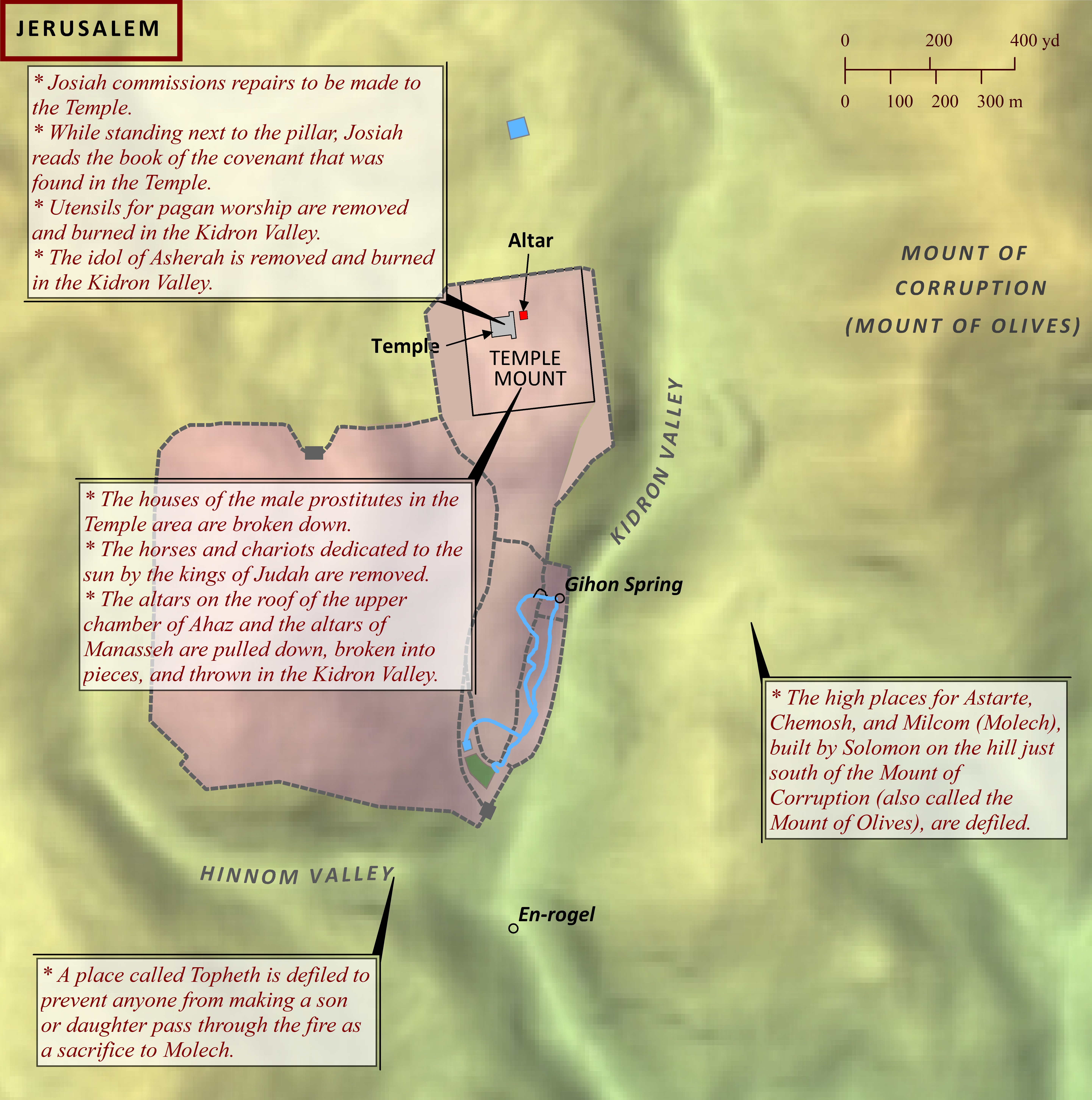
If ever there was a point in biblical history when the worship of Yahweh seemed all but extinguished, it was during the years leading up to King Josiah’s birth. Yet it was against this incredibly dark backdrop that the Lord raised up Josiah of Judah to bring about one of the greatest spiritual reforms his nation had ever seen. Josiah was the grandson of Manasseh, one of the most wicked and idolatrous kings of Judah (2 Kings 21:1-9; 2 Chronicles 33:1-9), though Manasseh later repented (2 Chronicles 33:12-19), and the son of Amon, another wicked, idolatrous king (2 Kings 21:18-22; 2 Chronicles 33:20-23). After his father’s death, Josiah became king at the young age of eight, so perhaps it was this lack of influence from his wicked father during some of his most formative years as a leader that enabled him to become such a force for spiritual renewal throughout Judah. Whatever the reason for his spiritual fervor, Josiah’s passion also coincided with a period of Assyrian decline, which allowed him to expand his renewal even to the lands once ruled by the northern kingdom of Israel. Josiah began his reforms by commissioning repairs to be made to the Temple of the Lord in Jerusalem. During these repairs, the book of the law, likely the book of Deuteronomy, was found in the Temple and brought to Josiah. When Josiah read the book, he tore his clothes in anguish over the punishment that surely awaited the nation for their disobedience to the laws of Moses. He called for all the elders of Judah and Jerusalem to gather by the pillar of the Temple, and he read the law to them as well and led them to establish a new covenant to follow the laws of Moses. Josiah then began a great purge of idolatry throughout Jerusalem, Judah, and even Israel. Utensils used for pagan worship were removed from the Temple in Jerusalem and burned in the Kidron Valley, and their ashes were carried to Bethel. The image of Asherah was also removed and burned in the Kidron Valley, and the remains were ground to dust and spread over graves of the common people. The houses of the male prostitutes in the Temple area were also broken down. The horses and chariots dedicated to the sun by the kings of Judah were removed, and the chariots were burned. The altars on the roof of the upper chamber of Ahaz and the altars that Manasseh had made in Temple courtyard were pulled down and broken in pieces, and the rubble was thrown into the Kidron Valley. A place called Topheth in the Hinnom Valley was defiled so that no one would make a son or daughter pass through fire as an offering to Molech. Just east of Jerusalem the high places built by King Solomon for his pagan wives on the Mount of Corruption (also called the Mount of Olives; 1 Kings 11:7-8) were defiled. Josiah’s reforms throughout Judah included putting away the mediums, wizards, teraphim, idols, and all the abominations that were seen in the land. At Bethel he tore down the altar and the high place erected by Jeroboam son of Nebat. He burned the high place, crushing it to dust, and burned the sacred pole. There he also saw tombs of people who must have been associated with the pagan rituals there, so he removed the bones and burned them on the altar, thus defiling it, as was prophesied years earlier (1 Kings 13:1-10). Josiah then extended his reforms to lands that formerly belonged to Israel but were now directly governed by Assyria. Throughout the towns of Samaria all the shrines of the high places were removed, the priests of the high places were slaughtered on the pagan altars, and their bones were burned on them. Throughout the rest of the land of Israel and Judah–in Manasseh, Ephraim, Simeon, and as far as Naphtali–Josiah also broke down the altars, ground the sacred poles and images into powder, and demolished all the incense altars. When Josiah returned to Jerusalem, he celebrated the Passover in a way that exceeded all the Passover celebrations since the time of the Judges.
Open Bible Data site copyright © 2023–2026 Freely-Given.org.
Python source code for creating these static pages is available on GitHub under an open licence.
For Bible data copyrights, see the details for each displayed Bible version.
The Open English Translation (OET) main site is at OpenEnglishTranslation.Bible or OET.Bible.