
OET OET-RV OET-LV GHT ULT UST BSB MSB BLB AICNT OEB WEBBE WMBB NET LSV FBV TCNT T4T LEB BBE Moff JPS Wymth ASV DRA YLT Drby RV SLT Wbstr KJB-1769 KJB-1611 Bshps Gnva Cvdl TNT Wycl SR-GNT UHB BrLXX BrTr Related Parallel Simple Interlinear Topics Reference Dictionary Search
ParallelVerse GEN EXO LEV NUM DEU JOB JOS JDG RUTH 1 SAM 2 SAM PSA AMOS HOS 1 KI 2 KI 1 CHR 2 CHR PROV ECC SNG JOEL MIC ISA ZEP HAB JER LAM YNA (JNA) NAH OBA DAN EZE EZRA EST NEH HAG ZEC MAL LAO GES LES ESG DNG 2 PS TOB JDT WIS SIR BAR LJE PAZ SUS BEL MAN 1 MAC 2 MAC 3 MAC 4 MAC YHN (JHN) MARK MAT LUKE ACTs YAC (JAM) GAL 1 TH 2 TH 1 COR 2 COR ROM COL PHM EPH PHP 1 TIM TIT 1 PET 2 PET 2 TIM HEB YUD (JUD) 1 YHN (1 JHN) 2 YHN (2 JHN) 3 YHN (3 JHN) REV
2 Ki Intro C1 C2 C3 C4 C5 C6 C7 C8 C9 C10 C11 C12 C13 C14 C15 C16 C17 C18 C19 C20 C21 C22 C24 C25
2 Ki 23 V1 V2 V3 V4 V5 V6 V7 V8 V9 V10 V12 V13 V14 V15 V16 V17 V18 V19 V20 V21 V22 V23 V24 V25 V26 V27 V28 V29 V30 V31 V32 V33 V34 V35 V36 V37
Note: This view shows ‘verses’ which are not necessarily natural language units and hence sometimes only part of a sentence will be visible—click on any Bible version abbreviation down the left-hand side to see the verse in more of its context. Normally the OET discourages the reading of individual ‘verses’, but this view is only designed as a tool for Bible-translators and others doing comparisons of different translations—the older translations are further down the page (so you can read up from the bottom to trace the English translation history). The OET segments on this page are still early looks into the drafted texts of the Open English Translation of the Bible—please double-check these texts in advance before using in public.
B I ◄ ← 2 Ki 23:11 ↓ → ► ≡ ═ ©
Text critical issues=none Clarity of original=clear Importance to us=normal Speaker(s)=Narrator (All still tentative.)
OET (OET-RV) The horses that the kings of Yehudah had offered to the sun, he prevented from approaching the hall of the official Natan-Melek that was in the courtyards of Yahweh’s temple, and he set fire to the chariots of the sun.
OET-LV And_he_removed DOM the_horses which the_kings_of Yəhūdāh/(Judah) they_had_dedicated to_sun from_the_going of_the_house_of of_YHWH at the_room_of Nathan the_court-official which was_in_Parbar and_DOM the_chariots_of the_sun he_burnt with_fire.
UHB וַיַּשְׁבֵּ֣ת אֶת־הַסּוּסִ֗ים אֲשֶׁ֣ר נָתְנוּ֩ מַלְכֵ֨י יְהוּדָ֤ה לַשֶּׁ֨מֶשׁ֙ מִבֹּ֣א בֵית־יְהוָ֔ה אֶל־לִשְׁכַּת֙ נְתַן־מֶ֣לֶךְ הַסָּרִ֔יס אֲשֶׁ֖ר בַּפַּרְוָרִ֑ים וְאֶת־מַרְכְּב֥וֹת הַשֶּׁ֖מֶשׁ שָׂרַ֥ף בָּאֵֽשׁ׃ ‡
(vayyashbēt ʼet-haşşūşim ʼₐsher nātənū malkēy yəhūdāh lashshemesh miboʼ ⱱēyt-yhwh ʼel-lishkat nətan-melek haşşāriş ʼₐsher baparvārim vəʼet-markəⱱōt hashshemesh sāraf bāʼēsh.)
Key: khaki:verbs.
Note: Automatic aligning of the OET-RV to the LV is done by some temporary software, hence the OET-RV alignments are incomplete (and may occasionally be wrong).
BrLXX Καὶ κατέκαυσε τοὺς ἵππους οὓς ἔδωκαν βασιλεῖς Ἰούδα τῷ ἡλίῳ ἐν τῇ εἰσόδῳ οἴκου Κυρίου εἰς τὸ γαζοφυλάκιον Ναθὰν βασιλέως τοῦ εὐνούχου ἐν φαρουρείμ· καὶ τὸ ἅρμα τοῦ ἡλίου κατέκαυσεν πυρί,
(Kai katekause tous hippous hous edōkan basileis Youda tōi haʸliōi en taʸ eisodōi oikou Kuriou eis to gazofulakion Nathan basileōs tou eunouⱪou en faroureim; kai to harma tou haʸliou katekausen puri,)
BrTr And he burned the horses which the kings of Juda had given to the sun in the entrance of the house of the Lord, [fn]by the treasury of Nathan the [fn]king's eunuch, in the [fn]suburbs; and he burned the chariot of the sun with fire.
ULT And he removed the horses that the kings of Judah had dedicated to the sun from the entrance of the house of Yahweh, by the chamber of Nathan Melech the eunuch, which, was in the precincts. And he burned the chariots of the sun with fire.
UST Previous kings of Judah had dedicated horses to pull chariots in processions in honor of the sun. There were stables for those horses near the entrance to the temple. A royal official whose name was Nathan Melech was responsible for the horses, and he lived in an apartment near the stables. King Josiah had his servants take the horses away from the temple and destroy the chariots by burning them.
BSB & MSB And he removed from the entrance to the house of the LORD the horses that the kings of Judah had dedicated to the sun. They were in the court[fn] near the chamber of an official named Nathan-melech. And [Josiah] burned up the chariots of the sun.
23:11 Hebrew parbarim
OEB No OEB KI2 23:11 book available
WEBBE & WMBB He took away the horses that the kings of Judah had dedicated to the sun, at the entrance of the LORD’s house, by the room of Nathan Melech the officer who was in the court; and he burnt the chariots of the sun with fire.
NET He removed from the entrance to the Lord’s temple the statues of horses that the kings of Judah had placed there in honor of the sun god. (They were kept near the room of Nathan Melech the eunuch, which was situated among the courtyards.) He burned up the chariots devoted to the sun god.
LSV And he causes to cease the horses that the kings of Judah have given to the sun from the entering in of the house of YHWH, by the chamber of Nathan-Melech the eunuch, that [is] in the outskirts; and he has burned the chariots of the sun with fire.
FBV He removed the horses that the kings of Judah had dedicated to the sun from the entrance to the Lord's Temple. They were in the courtyard near the room of a eunuch named Nathan-melech. Josiah also burned the chariots dedicated to the sun.
T4T He also removed the horses that the previous kings of Judah had dedicated to worshiping the sun, and he burned the chariots that were used in that worship. Those horses and chariots were kept in the courtyard outside the temple, near the entrance to the temple, and near the room where one of Josiah’s officials, whose name was Nathan-Melech, lived.
LEB He kept the horses that the kings of Judah had dedicated to the sun from coming to the temple of Yawheh at the side room of Nathan-Melech the eunuch, which was in the court; and the chariots of the sun he burned with fire.
BBE And he took away the horses which the kings of Judah had given to the sun, at the way into the house of the Lord, by the room of Nathan-melech, the unsexed servant, which was in the outer part of the building, and the carriages of the sun he put on fire.
Moff No Moff KI2 23:11 book available
JPS And he took away the horses that the kings of Judah had given to the sun, at the entrance of the house of the LORD, by the chamber of Nethan-melech the officer, which was in the precincts; and he burned the chariots of the sun with fire.
ASV And he took away the horses that the kings of Judah had given to the sun, at the entrance of the house of Jehovah, by the chamber of Nathan-melech the chamberlain, which was in the precincts; and he burned the chariots of the sun with fire.
DRA And he took away the horses which the kings of Juda had given to the sun, at the entering in of the temple of the Lord, near the chamber of Nathanmelech the eunuch, who was in Pharurim: and he burnt the chariots of the sun with fire.
YLT And he causeth to cease the horses that the kings of Judah have given to the sun from the entering in of the house of Jehovah, by the chamber of Nathan-Melech the eunuch, that [is] in the suburbs, and the chariots of the sun he hath burnt with fire.
Drby And he abolished the horses that the kings of Judah had appointed to the sun at the entrance of the house of Jehovah, by the chamber of Nathan-melech the chamberlain, which was in the suburbs, and burned the chariots of the sun, with fire.
RV And he took away the horses that the kings of Judah had given to the sun, at the entering in of the house of the LORD, by the chamber of Nathan-melech the chamberlain, which was in the precincts; and he burned the chariots of the sun with fire.
(And he took away the horses that the kings of Yudah had given to the sun, at the entering in of the house of the LORD, by the chamber/room of Nathan-melech the chamberlain, which was in the precincts; and he burnt the chariots of the sun with fire.)
SLT And he will take away the horses which the kings of Judah gave to the sun at the going in of the house of Jehovah into the chamber the king gave the eunuch which was in the open portico, and he burnt the chariots of the sun in fire.
Wbstr And he took away the horses that the kings of Judah had given to the sun, at the entrance of the house of the LORD, by the chamber of Nathan-melech the chamberlain, which was in the suburbs, and burned the chariots of the sun with fire.
KJB-1769 And he took away the horses that the kings of Judah had given to the sun, at the entering in of the house of the LORD, by the chamber of Nathan-melech the chamberlain, which was in the suburbs, and burned the chariots of the sun with fire.[fn]
(And he took away the horses that the kings of Yudah had given to the sun, at the entering in of the house of the LORD, by the chamber/room of Nathan-melech the chamberlain, which was in the suburbs, and burnt the chariots of the sun with fire.)
23.11 chamberlain: or, eunuch, or, officer
KJB-1611 And he tooke away the horses that the kings of Iudah had giuen to the Sunne, at the entring in of the house of the LORD, by the chamber of Nathanmelech the [fn]chamberlaine, which was in the suburbs, and burnt the charets of the Sunne with fire,
(And he took away the horses that the kings of Yudah had given to the Sun, at the entering in of the house of the LORD, by the chamber/room of Nathanmelech the chamberlain, which was in the suburbs, and burnt the chariots of the Sun with fire,)
23:11 Or, Eunuch, or Officer.
Bshps He put downe the horses that the kinges of Iuda had geuen to the sunne, at the entering in of the house of the Lorde, by the chambre of Nathanmelech the chamberlayne, which was ruler of the suburbes, and burnt the charets of the sunne with fire.
(He put down the horses that the kings of Yudah had given to the sun, at the entering in of the house of the Lord, by the chamber/room of Nathanmelech the chamberlain, which was ruler of the suburbs, and burnt the chariots of the sun with fire.)
Gnva He put downe also the horses that the Kings of Iudah had giuen to the sunne at the entring in of the house of the Lord, by the chamber of Nethan-melech the eunuche, which was ruler of the suburbes, and burnt the charets of the sunne with fire.
(He put down also the horses that the Kings of Yudah had given to the sun at the entering in of the house of the Lord, by the chamber/room of Nethan-melech the eunuch, which was ruler of the suburbs, and burnt the chariots of the sun with fire.)
Cvdl And he put downe the horses, which ye kynges of Iuda had set vnto the Sonne, at the intringe in to the house of the LORDE, besyde the chest of Netham Melech the chamberlayne which was at Paruarim, and the charettes of the Sonne brent he with fyre,
(And he put down the horses, which ye/you_all kings of Yudah had set unto the Son, at the entering in to the house of the LORD, beside the chest of Netham Melech the chamberlain which was at Paruarim, and the chariots of the Son burnt he with fire,)
Wycl Also he dide awei horsis, whiche the kyngis of Juda hadden youe to the sunne, in the entryng of the temple of the Lord, bisidis the chaumbir of Nathanmalech, geldyng, that was in Pharurym; forsothe he brente bi fier the charis of the sunne.
(Also he did away horses, which the kings of Yudah had given to the sun, in the entering of the temple of the Lord, besides the chamber/room of Nathanmalech, gelding, that was in Pharurym; for_certain/truly he burnt by fire the chariots of the sun.)
Luth Und tat ab die Rosse, welche die Könige Judas hatten der Sonne gesetzt im Eingange des HErr’s Hauses an der Kammer Nethan-Melechs, des Kämmerers, der zu Parwarim war; und die Wagen der Sonne verbrannte er mit Feuer.
(And did ab the horses, which the king(s) Yudas had the/of_the sun set(v) in_the entrance the LORD’s houses(n) at/to the/of_the chamber/room Nathan-melech’s, the chamberlain/administrators, the/of_the to/for Parbar was; and the wagon/cart/chariot the/of_the sun burnt he with fire(n).)
ClVg Abstulit quoque equos quos dederant reges Juda soli in introitu templi Domini juxta exedram Nathanmelech eunuchi, qui erat in Pharurim: currus autem solis combussit igni.[fn]
(He_took_it_away too the_horses which they_had_given kings Yuda alone in/into/on entrance temple Master next_to hall_for_conversation Nathanmelech eunuchs, who/which was in/into/on Pharurim: chariot/coach however of_the_sun burnt fire.)
23.11 Abstulit. RAB. Judæi superstitionibus gentium se mancipaverant, qui inter cætera solent pingere vel facere simulacrum solis ut puerum imberbem, quia nullum per sæcula senium incidit, quotidie novo ortu natus. Cui currus et equos tribuunt, quia curru igneo et equis igneis Elias raptus est ad cœlum, quod inter alia in pariete depictum vident, et vicinia nominis decipiuntur: Elios enim Græce sol dicitur.
23.11 He_took_it_away. RAB. Jews superstitions of_Gentile_nations himself they_had_transferred, who/which between the_rest they_usually to_paint or to_do image of_the_sun as boy beardless, because none through forever old_age it_happened, daily new rising born. To_whom chariot/coach and the_horses they_give, because chariot fiery and horses fires Elias raptured/abducted it_is to sky, that between other in/into/on wall painted they_see, and neighbourhood of_the_name they_are_deceived: Elios because Greece the_sun it_is_said.
Note 1 topic: figures-of-speech / explicitinfo
וְאֶת־מַרְכְּב֥וֹת הַשֶּׁ֖מֶשׁ שָׂרַ֥ף בָּאֵֽשׁ
and=DOM (Some words not found in UHB: and,he_removed DOM the,horses which/who dedicated kings_of Yehuda to,sun from,the_going house_of YHWH to/towards chamber_of Nathan- king the,court-official which/who [was]_in,Parbar and=DOM chariots_of of,the_sun burnt with,fire )
It might seem that this expression contains extra information that would not be natural to express in your language. If so, you can use an expression that would be natural. Alternate translation: [And he burned up the chariots of the sun]
2 Kings 22-23; 2 Chronicles
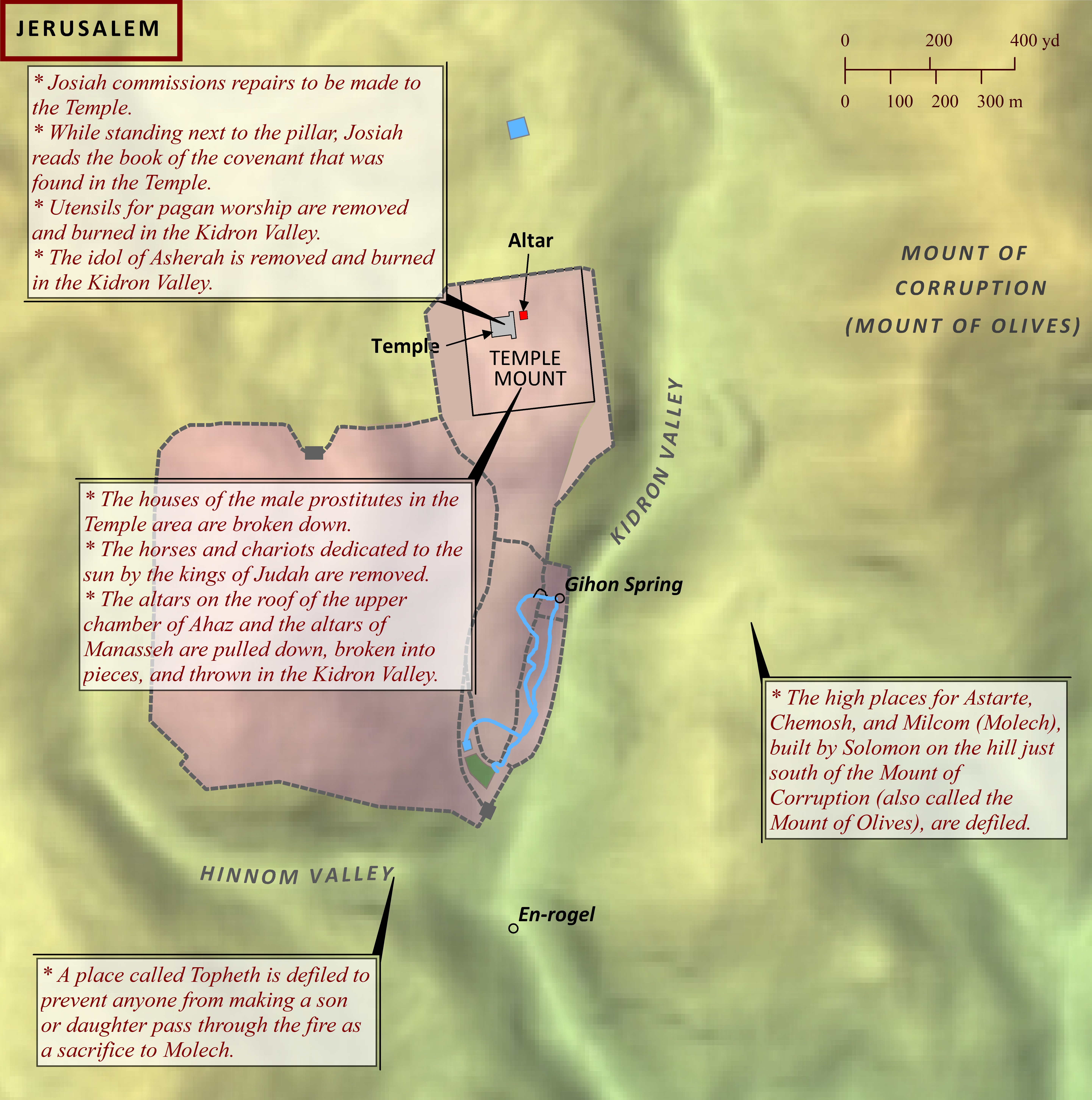
If ever there was a point in biblical history when the worship of Yahweh seemed all but extinguished, it was during the years leading up to King Josiah’s birth. Yet it was against this incredibly dark backdrop that the Lord raised up Josiah of Judah to bring about one of the greatest spiritual reforms his nation had ever seen. Josiah was the grandson of Manasseh, one of the most wicked and idolatrous kings of Judah (2 Kings 21:1-9; 2 Chronicles 33:1-9), though Manasseh later repented (2 Chronicles 33:12-19), and the son of Amon, another wicked, idolatrous king (2 Kings 21:18-22; 2 Chronicles 33:20-23). After his father’s death, Josiah became king at the young age of eight, so perhaps it was this lack of influence from his wicked father during some of his most formative years as a leader that enabled him to become such a force for spiritual renewal throughout Judah. Whatever the reason for his spiritual fervor, Josiah’s passion also coincided with a period of Assyrian decline, which allowed him to expand his renewal even to the lands once ruled by the northern kingdom of Israel. Josiah began his reforms by commissioning repairs to be made to the Temple of the Lord in Jerusalem. During these repairs, the book of the law, likely the book of Deuteronomy, was found in the Temple and brought to Josiah. When Josiah read the book, he tore his clothes in anguish over the punishment that surely awaited the nation for their disobedience to the laws of Moses. He called for all the elders of Judah and Jerusalem to gather by the pillar of the Temple, and he read the law to them as well and led them to establish a new covenant to follow the laws of Moses. Josiah then began a great purge of idolatry throughout Jerusalem, Judah, and even Israel. Utensils used for pagan worship were removed from the Temple in Jerusalem and burned in the Kidron Valley, and their ashes were carried to Bethel. The image of Asherah was also removed and burned in the Kidron Valley, and the remains were ground to dust and spread over graves of the common people. The houses of the male prostitutes in the Temple area were also broken down. The horses and chariots dedicated to the sun by the kings of Judah were removed, and the chariots were burned. The altars on the roof of the upper chamber of Ahaz and the altars that Manasseh had made in Temple courtyard were pulled down and broken in pieces, and the rubble was thrown into the Kidron Valley. A place called Topheth in the Hinnom Valley was defiled so that no one would make a son or daughter pass through fire as an offering to Molech. Just east of Jerusalem the high places built by King Solomon for his pagan wives on the Mount of Corruption (also called the Mount of Olives; 1 Kings 11:7-8) were defiled. Josiah’s reforms throughout Judah included putting away the mediums, wizards, teraphim, idols, and all the abominations that were seen in the land. At Bethel he tore down the altar and the high place erected by Jeroboam son of Nebat. He burned the high place, crushing it to dust, and burned the sacred pole. There he also saw tombs of people who must have been associated with the pagan rituals there, so he removed the bones and burned them on the altar, thus defiling it, as was prophesied years earlier (1 Kings 13:1-10). Josiah then extended his reforms to lands that formerly belonged to Israel but were now directly governed by Assyria. Throughout the towns of Samaria all the shrines of the high places were removed, the priests of the high places were slaughtered on the pagan altars, and their bones were burned on them. Throughout the rest of the land of Israel and Judah–in Manasseh, Ephraim, Simeon, and as far as Naphtali–Josiah also broke down the altars, ground the sacred poles and images into powder, and demolished all the incense altars. When Josiah returned to Jerusalem, he celebrated the Passover in a way that exceeded all the Passover celebrations since the time of the Judges.
Open Bible Data site copyright © 2023–2026 Freely-Given.org.
Python source code for creating these static pages is available on GitHub under an open licence.
For Bible data copyrights, see the details for each displayed Bible version.
The Open English Translation (OET) main site is at OpenEnglishTranslation.Bible or OET.Bible.