¶ So they left his bones alone, along with the bones of the other prophet who came from Shomron (Samaria).

ParallelVerse GEN EXO LEV NUM DEUT JOB YEHO (JOS) HERO (JDG) RUTH 1 SAM 2 SAM PSA AMOS HOS 1 KI 2 KI 1 CHR 2 CHR PROV ECC SNG YOEL (JOEL) MIC ISA ZEP HAB YIR (JER) LAM YNA (JNA) NAH OBAD DAN EZEK EZRA EST NEH HAG ZEC MAL 2 PS WIS TOB MAN BAR LJE G DAN SUS PAZ BEL G ESD L ESD ESG JDT 3 MAC SIR 1 MAC 2 MAC 4 MAC YHN (JHN) MARK MAT LUKE ACTs YAC (JAM) GAL 1 TH 2 TH 1 COR 2 COR ROM COL LAOD PHM EPH PHP 1 TIM TIT 1 PET 2 PET 2 TIM HEB YUD (JUD) 1 YHN (1 JHN) 2 YHN (2 JHN) 3 YHN (3 JHN) REV
ParallelVerse 2 Ki Intro C1 C2 C3 C4 C5 C6 C7 C8 C9 C10 C11 C12 C13 C14 C15 C16 C17 C18 C19 C20 C21 C22 C24 C25
2 Ki 23 V0 V1 V2 V3 V4 V5 V6 V7 V8 V9 V10 V11 V12 V13 V14 V15 V16 V17 V19 V20 V21 V22 V23 V24 V25 V26 V27 V28 V29 V30 V31 V32 V33 V34 V35 V36 V37
Note: This view shows ‘verses’ which are not necessarily natural language units and hence sometimes only part of a sentence will be visible—click on any Bible version abbreviation down the left-hand side to see the verse in more of its context. Normally the OET discourages the reading of individual ‘verses’, but this view is only designed as a tool for Bible-translators and others doing comparisons of different translations—the older translations are further down the page (so you can read up from the bottom to trace the English translation history). The OET segments on this page are still early looks into the drafted texts of the Open English Translation of the Bible—please double-check these texts in advance before using in public.
B I ◄ ← 2 Ki 23:18 ↓ → ► ≡ ═ ©
Text critical issues=none Clarity of original=clear Importance to us=normal Speaker(s)=Narrator (All still tentative.)
OET (OET-RV) “Don’t disturb it then,” the king ordered. “Don’t let anyone remove his bones.”
¶ So they left his bones alone, along with the bones of the other prophet who came from Shomron (Samaria).
OET-LV And_he/it_said leave_alone to_him/it anyone not let_him_disturb bones_of_his and_they_left_undisturbed bones_of_his with the_bones_of the_prophet who he_had_come from_Shomrōn.
UHB וַיֹּ֨אמֶר֙ הַנִּ֣יחוּ ל֔וֹ אִ֖ישׁ אַל־יָנַ֣ע עַצְמֹתָ֑יו וַֽיְמַלְּטוּ֙ עַצְמֹתָ֔יו אֵ֚ת עַצְמ֣וֹת הַנָּבִ֔יא אֲשֶׁר־בָּ֖א מִשֹּׁמְרֽוֹן׃ ‡
(vayyoʼmer hanniyḩū lō ʼiysh ʼal-yānaˊ ˊaʦmotāyv vayəmalləţū ˊaʦmotāyv ʼēt ˊaʦmōt hannāⱱiyʼ ʼₐsher-bāʼ mishshomrōn.)
Key: khaki:verbs.
Note: Automatic aligning of the OET-RV to the LV is done by some temporary software, hence the OET-RV alignments are incomplete (and may occasionally be wrong).
Places tagged in the matching LV passage: Samaria
BrLXX Καὶ εἶπεν, ἄφετε αὐτὸν, ἀνὴρ μὴ κινησάτωσαν τὰ ὀστᾶ αὐτοῦ· καὶ ἐῤῥύσθησαν τὰ ὀστᾶ αὐτοῦ μετὰ τῶν ὀστῶν τοῦ προφήτου τοῦ ἥκοντος ἐκ Σαμαρείας.
(Kai eipen, afete auton, anaʸr maʸ kinaʸsatōsan ta osta autou; kai eɽɽusthaʸsan ta osta autou meta tōn ostōn tou profaʸtou tou haʸkontos ek Samareias.)
BrTr And he said, Let him alone; let no one disturb his bones. So his bones were [fn]spared, together with the bones of the prophet that came out of Samaria.
23:18 Gr. delivered.
ULT And he said, “Let him stay. Let not a man disturb his bones.” And they rescued his bones, with the bones of the prophet who came from Samaria.
UST Josiah replied, “Leave the bones of that prophet in his tomb.” So the people did not remove his bones or the bones of the old prophet who had lived in that area and who had deceived the other prophet so that he died.
BSB “Let him rest said [Josiah]. “Do not let anyone disturb his bones.”
§ So they left his bones undisturbed, along with those of the prophet who had come from Samaria.
OEB No OEB KI2 23:18 book available
WEBBE He said, “Let him be! Let no one move his bones.” So they let his bones alone, with the bones of the prophet who came out of Samaria.
NET The king said, “Leave it alone! No one must touch his bones.” So they left his bones undisturbed, as well as the bones of the Israelite prophet buried beside him.
LSV And he says, “Leave him alone, let no man touch his bones”; and they let his bones escape with the bones of the prophet who came out of Samaria.
FBV “Let him rest in peace,” said Josiah. “Don't anyone touch his bones.” So they left his bones undisturbed, together with the bones of the prophet who came from Samaria.
T4T Josiah replied, “Allow his tomb to remain as it is. Do not remove the prophet’s bones from the tomb.”
¶ So the people did not remove those bones, or the bones of the other prophet, the one who had come from Samaria.
LEB So Josiah said, “Let him rest and let no man move his bones.” So they left his bones undisturbed with the bones of the prophet who had come from Samaria.
BBE So he said, Let him be; let not his bones be moved. So they let his bones be with the bones of the prophet who came from Samaria.
Moff No Moff KI2 23:18 book available
JPS And he said: 'Let him be; let no man move his bones.' So they let his bones alone, with the bones of the prophet that came out of Samaria.
ASV And he said, Let him be; let no man move his bones. So they let his bones alone, with the bones of the prophet that came out of Samaria.
DRA And he said: Let him alone, let no man move his bones. So his bones were left untouched with the bones of the prophet that came out of Samaria.
YLT And he saith, 'Let him alone, let no man touch his bones;' and they let his bones escape, with the bones of the prophet who came out of Samaria.
Drby And he said, Let him alone; let no man move his bones. And they saved his bones, with the bones of the prophet that came out of Samaria.
RV And he said, Let him be; let no man move his bones. So they let his bones alone, with the bones of the prophet that came out of Samaria.
SLT And he will say, Give rest to him; a man shall not move his bones; and they will let escape his bones and the bones of the prophet who came from Shomeron.
Wbstr And he said, Let him alone; let no man move his bones. So they let his bones alone, with the bones of the prophet that came out of Samaria.
KJB-1769 And he said, Let him alone; let no man move his bones. So they let his bones alone, with the bones of the prophet that came out of Samaria.[fn]
23.18 bones alone: Heb. bones to escape
KJB-1611 And he said, Let him alone: let no man moue his bones: so they let his bones [fn]alone, with the bones of the Prophet that came out of Samaria.
(Modernised spelling is same as from KJB-1769 above, apart from capitalisation and punctuation and footnotes)
23:18 Hebr. to escape.
Bshps And he saide, let him be: see that no man moue his bones. And so his bones were saued, with the bones of a prophete that came out of Samaria.
(And he said, let him be: see that no man move his bones. And so his bones were saved, with the bones of a prophet that came out of Samaria.)
Gnva Then sayde he, Let him alone: let none remooue his bones. So his bones were saued with the bones of the Prophet that came from Samaria.
(Then said he, Let him alone: let none remove his bones. So his bones were saved with the bones of the Prophet that came from Samaria.)
Cvdl And he sayde: Let him lye, no man touche his bones. Thus were his bones delyuered with the bones of the prophet that came from Samaria.
(And he said: Let him lie, no man touch his bones. Thus were his bones delivered with the bones of the prophet that came from Samaria.)
Wycl And the kyng seide, Suffre ye hym; no man moue hise boonys. And hise boonys dwelliden vntouchid with the boones of the prophete, that cam fro Samarie.
(And the king said, Suffer ye/you_all him; no man move his bones. And his bones dwelled/dwelt untouched with the bones of the prophet, that came from Samaria.)
Luth Und er sprach: Laßt ihn liegen; niemand bewege seine Gebeine! Also wurden seine Gebeine errettet mit den Gebeinen des Propheten, der von Samaria kommen war.
(And he spoke: Let him/it lie/lay; no_one move_around his bones! So became his bones saved/rescued with the bones the prophet(s), the/of_the from Samaria coming was.)
ClVg Et ait: Dimitte eum: nemo commoveat ossa ejus. Et intacta manserunt ossa illius cum ossibus prophetæ qui venerat de Samaria.
(And he_said: Let_go him: nobody/no_one may_move bones his/her. And untouched they_stayed bones of_that when/with bones prophets who/which had_come from/about Samaria.)
Note 1 topic: figures-of-speech / parallelism
הַנִּ֣יחוּ ל֔וֹ אִ֖ישׁ אַל־יָנַ֣ע עַצְמֹתָ֑יו
(Some words not found in UHB: and=he/it_said rest to=him/it (a)_man not disturb bones_of,his and,they_left_undisturbed bones_of,his DOM bones_of of,the_prophet which/who he/it_came from,Samaria )
Josiah is using two phrases to say basically the same thing, first positively and then negatively. The repetition emphasizes the idea that the phrases convey. If it would be helpful to your readers, you could combine the phrases and express the emphasis in another way. Alternate translation: [Let no one disturb his bones at all]
Note 2 topic: writing-pronouns
וַֽיְמַלְּטוּ֙ עַצְמֹתָ֔יו
(Some words not found in UHB: and=he/it_said rest to=him/it (a)_man not disturb bones_of,his and,they_left_undisturbed bones_of,his DOM bones_of of,the_prophet which/who he/it_came from,Samaria )
Here the author is using the pronoun they in a general sense, not to refer to specific people. Use an expression for this that would be natural in your language. Alternate translation: [So the men of the city rescued his bones]
Note 3 topic: translate-names
הַנָּבִ֔יא אֲשֶׁר־בָּ֖א מִשֹּׁמְרֽוֹן
(Some words not found in UHB: and=he/it_said rest to=him/it (a)_man not disturb bones_of,his and,they_left_undisturbed bones_of,his DOM bones_of of,the_prophet which/who he/it_came from,Samaria )
To translate the name Samaria, meaning the northern kingdom of Israel, here and in the next verse, see how you decided to represent it in 17:24. Alternate translation: [the prophet who was from the northern kingdom]
2 Kings 22-23; 2 Chronicles
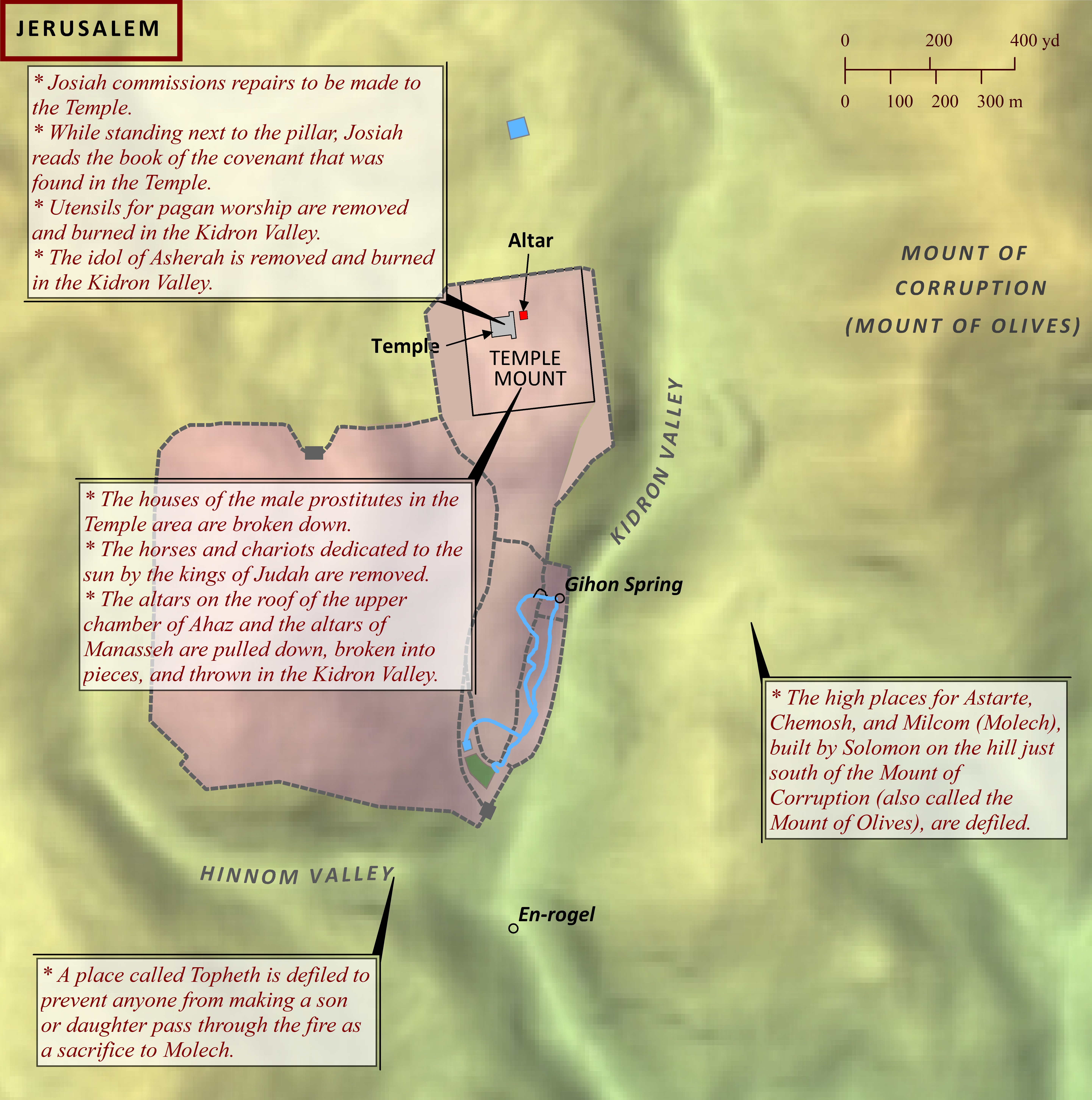
If ever there was a point in biblical history when the worship of Yahweh seemed all but extinguished, it was during the years leading up to King Josiah’s birth. Yet it was against this incredibly dark backdrop that the Lord raised up Josiah of Judah to bring about one of the greatest spiritual reforms his nation had ever seen. Josiah was the grandson of Manasseh, one of the most wicked and idolatrous kings of Judah (2 Kings 21:1-9; 2 Chronicles 33:1-9), though Manasseh later repented (2 Chronicles 33:12-19), and the son of Amon, another wicked, idolatrous king (2 Kings 21:18-22; 2 Chronicles 33:20-23). After his father’s death, Josiah became king at the young age of eight, so perhaps it was this lack of influence from his wicked father during some of his most formative years as a leader that enabled him to become such a force for spiritual renewal throughout Judah. Whatever the reason for his spiritual fervor, Josiah’s passion also coincided with a period of Assyrian decline, which allowed him to expand his renewal even to the lands once ruled by the northern kingdom of Israel. Josiah began his reforms by commissioning repairs to be made to the Temple of the Lord in Jerusalem. During these repairs, the book of the law, likely the book of Deuteronomy, was found in the Temple and brought to Josiah. When Josiah read the book, he tore his clothes in anguish over the punishment that surely awaited the nation for their disobedience to the laws of Moses. He called for all the elders of Judah and Jerusalem to gather by the pillar of the Temple, and he read the law to them as well and led them to establish a new covenant to follow the laws of Moses. Josiah then began a great purge of idolatry throughout Jerusalem, Judah, and even Israel. Utensils used for pagan worship were removed from the Temple in Jerusalem and burned in the Kidron Valley, and their ashes were carried to Bethel. The image of Asherah was also removed and burned in the Kidron Valley, and the remains were ground to dust and spread over graves of the common people. The houses of the male prostitutes in the Temple area were also broken down. The horses and chariots dedicated to the sun by the kings of Judah were removed, and the chariots were burned. The altars on the roof of the upper chamber of Ahaz and the altars that Manasseh had made in Temple courtyard were pulled down and broken in pieces, and the rubble was thrown into the Kidron Valley. A place called Topheth in the Hinnom Valley was defiled so that no one would make a son or daughter pass through fire as an offering to Molech. Just east of Jerusalem the high places built by King Solomon for his pagan wives on the Mount of Corruption (also called the Mount of Olives; 1 Kings 11:7-8) were defiled. Josiah’s reforms throughout Judah included putting away the mediums, wizards, teraphim, idols, and all the abominations that were seen in the land. At Bethel he tore down the altar and the high place erected by Jeroboam son of Nebat. He burned the high place, crushing it to dust, and burned the sacred pole. There he also saw tombs of people who must have been associated with the pagan rituals there, so he removed the bones and burned them on the altar, thus defiling it, as was prophesied years earlier (1 Kings 13:1-10). Josiah then extended his reforms to lands that formerly belonged to Israel but were now directly governed by Assyria. Throughout the towns of Samaria all the shrines of the high places were removed, the priests of the high places were slaughtered on the pagan altars, and their bones were burned on them. Throughout the rest of the land of Israel and Judah–in Manasseh, Ephraim, Simeon, and as far as Naphtali–Josiah also broke down the altars, ground the sacred poles and images into powder, and demolished all the incense altars. When Josiah returned to Jerusalem, he celebrated the Passover in a way that exceeded all the Passover celebrations since the time of the Judges.
Open Bible Data site copyright © 2023–2026 Freely-Given.org.
Python source code for creating these static pages is available on GitHub under an open licence.
For Bible data copyrights, see the details for each displayed Bible version.
The Open English Translation (OET) main site is at OpenEnglishTranslation.Bible or OET.Bible.