
OET OET-RV OET-LV GHT ULT UST BSB MSB BLB AICNT OEB WEBBE WMBB NET LSV FBV TCNT T4T LEB BBE Moff JPS Wymth ASV DRA YLT Drby RV SLT Wbstr KJB-1769 KJB-1611 Bshps Gnva Cvdl TNT Wycl SR-GNT UHB BrLXX BrTr Related Parallel Simple Interlinear Topics Reference Dictionary Search
ParallelVerse GEN EXO LEV NUM DEU JOB JOS JDG RUTH 1 SAM 2 SAM PSA AMOS HOS 1 KI 2 KI 1 CHR 2 CHR PROV ECC SNG JOEL MIC ISA ZEP HAB JER LAM YNA (JNA) NAH OBA DAN EZE EZRA EST NEH HAG ZEC MAL LAO GES LES ESG DNG 2 PS TOB JDT WIS SIR BAR LJE PAZ SUS BEL MAN 1 MAC 2 MAC 3 MAC 4 MAC YHN (JHN) MARK MAT LUKE ACTs YAC (JAM) GAL 1 TH 2 TH 1 COR 2 COR ROM COL PHM EPH PHP 1 TIM TIT 1 PET 2 PET 2 TIM HEB YUD (JUD) 1 YHN (1 JHN) 2 YHN (2 JHN) 3 YHN (3 JHN) REV
Luke Intro C1 C2 C3 C4 C5 C6 C7 C8 C9 C10 C11 C12 C13 C14 C15 C16 C17 C18 C19 C20 C21 C23 C24
Luke 22 V1 V4 V7 V10 V13 V16 V19 V22 V25 V28 V31 V34 V37 V40 V43 V46 V49 V52 V55 V58 V61 V64 V67 V70
Note: This view shows ‘verses’ which are not necessarily natural language units and hence sometimes only part of a sentence will be visible—click on any Bible version abbreviation down the left-hand side to see the verse in more of its context. Normally the OET discourages the reading of individual ‘verses’, but this view is only designed as a tool for Bible-translators and others doing comparisons of different translations—the older translations are further down the page (so you can read up from the bottom to trace the English translation history). The OET segments on this page are still early looks into the drafted texts of the Open English Translation of the Bible—please double-check these texts in advance before using in public.
Text critical issues=small word differences Clarity of original=clear Importance to us=normal Speaker(s)=Narrator (All still tentative.)
OET (OET-RV) Then Satan entered Yudas Iscariot, one of the twelve apprentices.
OET-LV And Satan/(Sāţān) came_in into Youdas/(Yəhūdāh), the one being_called Iskariōtaʸs, being of the number of_the twelve.
SR-GNT Εἰσῆλθεν δὲ Σατανᾶς εἰς Ἰούδαν, τὸν καλούμενον Ἰσκαριώτην, ὄντα ἐκ τοῦ ἀριθμοῦ τῶν δώδεκα. ‡
(Eisaʸlthen de Satanas eis Youdan, ton kaloumenon Iskariōtaʸn, onta ek tou arithmou tōn dōdeka.)
Key: khaki:verbs, light-green:nominative/subject, orange:accusative/object, pink:genitive/possessor.
Note: Automatic aligning of the OET-RV to the LV is done by some temporary software, hence the RV alignments are incomplete (and may occasionally be wrong).
GHT Moreover, [the] Satan/adversary comes-into into Judas, the being-upon-called Iscariot, being out of {the number} of {the twelve},
ULT Then Satan entered into Judas, the one called Iscariot, being from the number of the Twelve.
UST Then Satan entered into Judas, whose other name was Iscariot. He was one of 12 men whom Jesus had chosen to represent him.
BSB & MSB Then Satan entered Judas Iscariot, who was [one] of the Twelve.
BLB And Satan entered into Judas the one being called Iscariot, being of the number of the Twelve.
AICNT Then Satan entered into Judas {called}[fn] Iscariot, who was of the number of the twelve.
22:3, called: ℵ(01) B(03) D(05) W(032) NA28 SBLGNT THGNT ‖ Some manuscripts read “surnamed.” A(02) C(04) BYZ TR.
OEB Now Satan took possession of Judas, who was known as Iscariot, and who belonged to the Twelve;
WEBBE Satan entered into Judas, who was also called Iscariot, who was counted with the twelve.
WMBB Satan entered into Judah, who was also called Iscariot, who was counted with the twelve.
NET Then Satan entered Judas, the one called Iscariot, who was one of the twelve.
LSV And Satan entered into Judas, who is surnamed Iscariot, being of the number of the Twelve,
FBV Satan entered into Judas, surnamed Iscariot, one of the twelve disciples.
TCNT Then Satan entered into Judas, the one called Iscariot, who was numbered among the twelve.
T4T Then even though Judas, who was called the man from Kerioth village, was one of the twelve disciples, Satan entered him.
LEB ¶ And Satan entered into Judas, the one called Iscariot, who was of the number of the twelve.
BBE And Satan came into Judas Iscariot, who was one of the twelve.
Moff and Satan entered Judas called Iscariot, a member of the twelve,
Wymth Satan, however, entered into Judas (the man called Iscariot) who was one of the Twelve.
ASV And Satan entered into Judas who was called Iscariot, being of the number of the twelve.
DRA And Satan entered into Judas, who was surnamed Iscariot, one of the twelve.
YLT And the Adversary entered into Judas, who is surnamed Iscariot, being of the number of the twelve,
Drby And Satan entered into Judas, who was surnamed Iscariote, being of the number of the twelve.
RV And Satan entered into Judas who was called Iscariot, being of the number of the twelve.
(And Satan entered into Yudas who was called Iscariot, being of the number of the twelve.)
SLT And Satan came into Judas called Iscariot, being of the number of the twelve.
Wbstr Then Satan entered into Judas surnamed Iscariot, being of the number of the twelve.
KJB-1769 ¶ Then entered Satan into Judas surnamed Iscariot, being of the number of the twelve.
(¶ Then entered Satan into Yudas surnamed Iscariot, being of the number of the twelve.)
KJB-1611 ¶ Then entred Satan into Iudas surnamed Iscariot, being of the number of the twelue.
(Modernised spelling is same as from KJB-1769 above)
Bshps Then entred Satan into Iudas, whose sirname was Iscariot, whiche was of the number of the twelue.
(Then entered Satan into Yudas, whose surname was Iscariot, which was of the number of the twelve.)
Gnva Then entred Satan into Iudas, who was called Iscariot, and was of the nomber of the twelue.
(Then entered Satan into Yudas, who was called Iscariot, and was of the number of the twelve.)
Cvdl But Satan was entred in to Iudas, named Iscarioth (which was of ye nombre of ye twolue)
(But Satan was entered in to Yudas, named Iscariot (which was of ye/you_all number of ye/you_all twelve))
TNT Then entred Satan into Iudas whose syr name was Iscariot (which was of the nombre of the twelve)
(Then entered Satan into Yudas whose sir name was Iscariot (which was of the number of the twelve))
Wycl And Sathanas entride in to Judas, that was clepid Scarioth, oon of the twelue.
(And Satan entered in to Yudas, that was called Iscariot, one of the twelve.)
Luth Es war aber der Satanas gefahren in den Judas, genannt Ischariot, der da war aus der Zahl der Zwölfe.
(It what/which but the/of_the Satan driven in the Yudas, named Iscariot, the/of_the there what/which out_of the/of_the number the/of_the twelve_(ones).)
ClVg Intravit autem Satanas in Judam, qui cognominabatur Iscariotes, unum de duodecim:[fn]
(He_entered however Satan in/into/on Yudas, who/which was_surnamed Iscariot, one from/about twelve:)
22.3 Intravit. Dicit Joannes, quod post buccellam a Domino traditam intravit Satanas in Judam. Sed et ante buccellam invaserat eum Satanas, et quem prius intraverat ut deciperet, postmodum intravit, ut jam sibi traditum plenius possideret.
22.3 He_entered. He_says Yohan, that after a_mouthful from Master handed_over he_entered Satan in/into/on Yudas. But and before a_mouthful had_invaded him Satan, and which first/before had_entered as would_deceive, afterwards/later he_entered, as already to_himself tradition more_fully would_possess.
UGNT εἰσῆλθεν δὲ Σατανᾶς εἰς Ἰούδαν, τὸν καλούμενον Ἰσκαριώτην, ὄντα ἐκ τοῦ ἀριθμοῦ τῶν δώδεκα.
(eisaʸlthen de Satanas eis Youdan, ton kaloumenon Iskariōtaʸn, onta ek tou arithmou tōn dōdeka.)
SBL-GNT Εἰσῆλθεν δὲ Σατανᾶς εἰς Ἰούδαν τὸν ⸀καλούμενον Ἰσκαριώτην, ὄντα ἐκ τοῦ ἀριθμοῦ τῶν δώδεκα·
(Eisaʸlthen de Satanas eis Youdan ton ⸀kaloumenon Iskariōtaʸn, onta ek tou arithmou tōn dōdeka;)
RP-GNT Εἰσῆλθεν δὲ Σατανᾶς εἰς Ἰούδαν τὸν ἐπικαλούμενον Ἰσκαριώτην, ὄντα ἐκ τοῦ ἀριθμοῦ τῶν δώδεκα.
(Eisaʸlthen de Satanas eis Youdan ton epikaloumenon Iskariōtaʸn, onta ek tou arithmou tōn dōdeka.)
TC-GNT Εἰσῆλθε δὲ [fn]Σατανᾶς εἰς Ἰούδαν τὸν [fn]ἐπικαλούμενον Ἰσκαριώτην, ὄντα ἐκ τοῦ ἀριθμοῦ τῶν δώδεκα.
(Eisaʸlthe de Satanas eis Youdan ton epikaloumenon Iskariōtaʸn, onta ek tou arithmou tōn dōdeka.)
Key for above GNTs: yellow:punctuation differs, red:words differ (from our SR-GNT base).
The Jewish leaders wanted to get rid of Jesus in a private way so that the crowds would not oppose them. Before Passover began, they learned that Judas was willing to help them. Judas offered to lead them to Jesus at a time when the crowds were not with him so they could arrest him without causing trouble for themselves.
The first verse of this section mentions the terms “Feast of Unleavened Bread” and “Passover.” These terms are names for a festival that the Jews celebrated each year. At one time, these terms referred to two different festivals. The festival of Passover lasted one day, and on the next day, the Feast of Unleavened Bread began and was celebrated for seven days. However, in Jesus’ lifetime, the two festivals were often considered to be one eight-day festival. Either term could be used for both festivals. See the notes at 22:1a–b for more information. During the festival time the Jews remembered how God delivered their ancestors from slavery in Egypt. See the notes on the “Passover” in 22:1a–b and 22:7a–b for more details.
It is good to translate this section before you decide on a heading for it. Other examples of headings for this section are:
The Plot to Kill Jesus (NRSV)
Judas Agrees to Betray Jesus (NLT)
There are parallel passages for this section in Matthew 26:1–5, Mark 14:1–2, and John 11:45–53.
Then Satan entered Judas Iscariot,
¶ Then Satan entered the heart/mind of Judas Iscariot,
¶ At that time Satan began to control Judas, whom people called “Iscariot.”
Satan entered Judas Iscariot: The clause Satan entered Judas Iscariot means that Satan began to control Judas by influencing his mind and heart. In this context the phrase probably does not describe the type of control that a person cannot resist, as in demon possession. Judas allowed Satan to influence and control him. Other ways to translate this are:
Satan began to control himWestern Bukidnon Manobo back translation on TW.
Satan entered the heart/mind of Judas Iscariot
Satan began to use Judas Iscariot
In some languages there is an idiom to describe this type of control. Translate the phrase in a natural way in your language.
Satan: The word Satan is the Hebrew name of the chief or leader of all the evil spirits. In Hebrew his name means “enemy.” He is the enemy of God and God’s people. Here are some ways to translate Satan:
Use a local name or idiom that refers to the chief of all demons. For example:
the left-handed one
the barking one
Use a descriptive phrase such as:
the chief/leader of the evil spirits
the spirit enemy of God
Transliterate the name Satan or borrow a word from another language. If this word is not already known in your area, you may also want to add a descriptive phrase. For example:
Satanas, the ruler of demons
Shaitan
If you transliterate Satan or borrow a word from another language, be sure that it communicates the biblical meaning to people in your culture. It is important to check this in each biblical context.
Use a term that will be acceptable to churches in the area. It is suggested that you also add a footnote or glossary entry that further explains who Satan is. For example:
Satan is the leader of all the evil spirits or demons. Once he was an angel in heaven, but he rebelled against God. God expelled him from heaven, and now he tempts people on earth. Other names for him are “Beelzebul,” “the Devil,” “the Evil One,” “the Enemy,” and “the Tempter.”
See “Satan” in KBT for more information.
Judas Iscariot: In Greek, this phrase is literally “Judas, the one called Iscariot.” People probably called Judas Iscariot because he was from the town of Kerioth. A slight variation of this name was used in 6:16.Bock (p. 1704, note 7) mentions that the name “occurs here in its Grecized form,” rather than its Semitic form, as in 6:16. For more discussion of the origin and meaning of the name see Bock, pp. 546–47.) You may use the same form of the name here.
who was one of the Twelve.
who was one of the twelve apostles.
Judas was one of Jesus’ twelve apostles.
who was one of the Twelve: The Greek phrase that the BSB translates as who was one of the Twelve is more literally “who was of the number of the twelve,” as in the RSV. The phrase indicates that Judas belonged to the group of Jesus’ twelve special disciples, whom he called “apostles” (6:16). In some languages it may be helpful to include the word “apostles” here. For example:
one of the twelve apostles (CEV)
εἰσῆλθεν & εἰς
came_in & into
This was probably very similar to demon possession. Alternate translation: [took control of]
Note 1 topic: figures-of-speech / activepassive
τὸν καλούμενον Ἰσκαριώτην
(Some words not found in SR-GNT: εἰσῆλθεν Δέ Σατανᾶς εἰς Ἰούδαν τόν καλούμενον Ἰσκαριώτην ὄντα ἐκ τοῦ ἀριθμοῦ τῶν δώδεκα)
If it would be helpful in your language, you could express this with an active form. Alternate translation: [whom people called Iscariot]
Note 2 topic: figures-of-speech / nominaladj
ὄντα ἐκ τοῦ ἀριθμοῦ τῶν δώδεκα
being of the number ˱of˲_the twelve
See how you translated this phrase in [8:1](../08/01.md). You may have decided to translate the nominal adjective Twelve with an equivalent phrase. Alternate translation: [who was one of the 12 disciples whom Jesus had appointed to be apostles]
Note 3 topic: translate-names
τῶν δώδεκα
˱of˲_the twelve
You may have decided instead in [8:1](../08/01.md) to translate this as a title, even if your language does not ordinarily use adjectives as nouns. If so, you can do the same thing here.
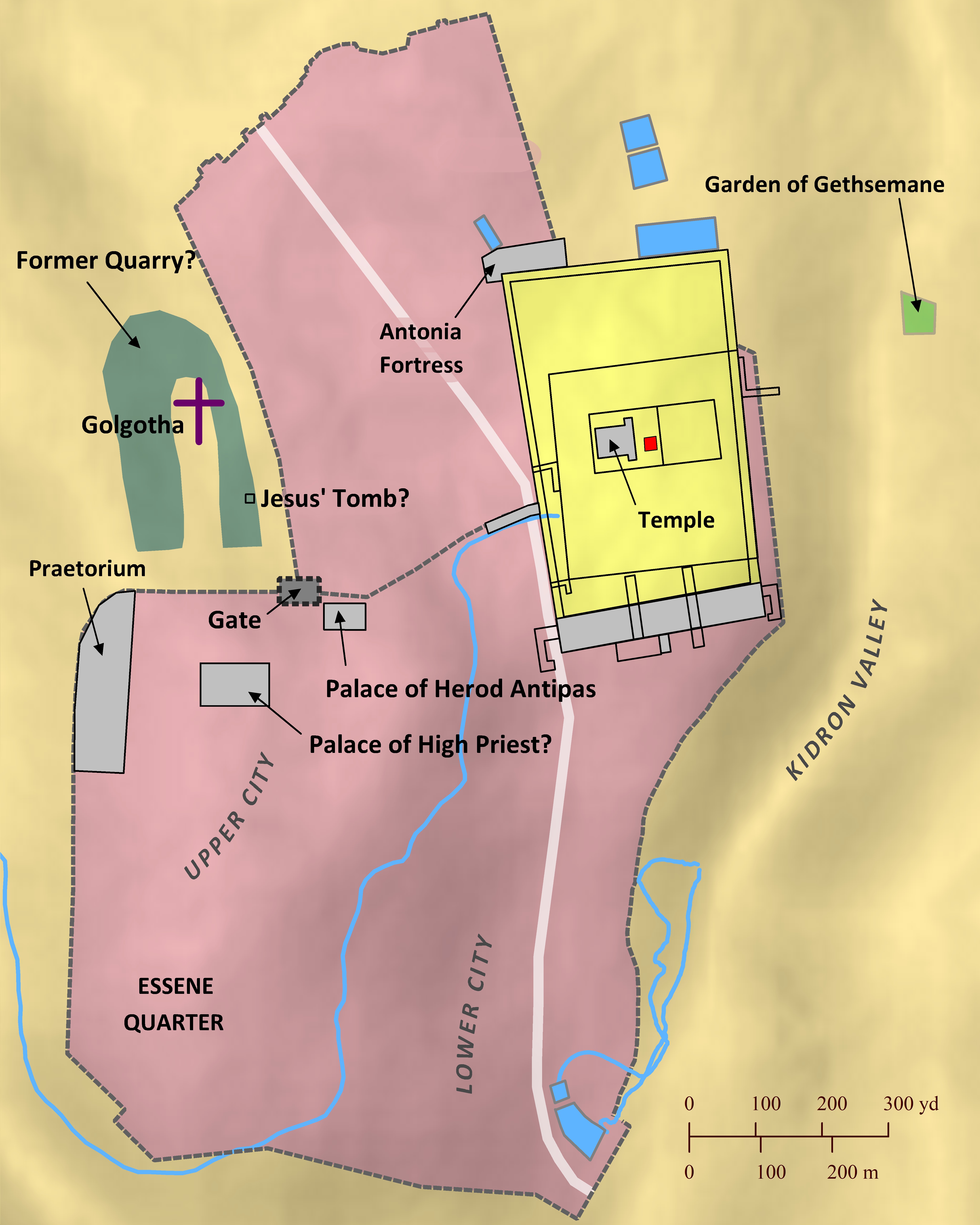
Matthew 26-27; Mark 14-15; Luke 22-23; John 13-19
On the Thursday before he was crucified, Jesus had arranged to share the Passover meal with his disciples in an upper room, traditionally thought to be located in the Essene Quarter of Jerusalem. After they finished the meal, they went to the Garden of Gethsemane, where Jesus often met with his disciples. There Judas Iscariot, one of Jesus’ own disciples, betrayed him to soldiers sent from the High Priest, and they took Jesus to the High Priest’s residence. In the morning the leading priests and teachers of the law put Jesus on trial and found him guilty of blasphemy. The council sent Jesus to stand trial for treason before the Roman governor Pontius Pilate, who resided at the Praetorium while in Jerusalem. The Praetorium was likely located at the former residence of Herod the Great, who had died over 30 years earlier. When Pilate learned that Jesus was from Galilee, he sent him to Herod Antipas, who had jurisdiction over Galilee. But when Jesus gave no answer to Herod’s many questions, Herod and his soldiers sent him back to Pilate, who conceded to the people’s demands that Jesus be crucified. Jesus was forced to carry his cross out of the city gate to Golgotha, meaning Skull Hill, referring to what may have been a small unquarried hill in the middle of an old quarry just outside the gate. After Jesus was unable to carry his cross any further, a man named Simon from Cyrene was forced to carry it for him. There at Golgotha they crucified Jesus. After Jesus died, his body was hurriedly taken down before nightfall and placed in a newly cut, rock tomb owned by Joseph of Arimathea, a member of the Jewish high council. This tomb was likely located at the perimeter of the old quarry.
Open Bible Data site copyright © 2023–2026 Freely-Given.org.
Python source code for creating these static pages is available on GitHub under an open licence.
For Bible data copyrights, see the details for each displayed Bible version.
The Open English Translation (OET) main site is at OpenEnglishTranslation.Bible or OET.Bible.