
OET OET-RV OET-LV GHT ULT UST BSB MSB BLB AICNT OEB WEBBE WMBB NET LSV FBV TCNT T4T LEB BBE Moff JPS Wymth ASV DRA YLT Drby RV SLT Wbstr KJB-1769 KJB-1611 Bshps Gnva Cvdl TNT Wycl SR-GNT UHB BrLXX BrTr Related Parallel Simple Interlinear Topics Reference Dictionary Search
ParallelVerse GEN EXO LEV NUM DEU JOB JOS JDG RUTH 1 SAM 2 SAM PSA AMOS HOS 1 KI 2 KI 1 CHR 2 CHR PROV ECC SNG JOEL MIC ISA ZEP HAB JER LAM YNA (JNA) NAH OBA DAN EZE EZRA EST NEH HAG ZEC MAL LAO GES LES ESG DNG 2 PS TOB JDT WIS SIR BAR LJE PAZ SUS BEL MAN 1 MAC 2 MAC 3 MAC 4 MAC YHN (JHN) MARK MAT LUKE ACTs YAC (JAM) GAL 1 TH 2 TH 1 COR 2 COR ROM COL PHM EPH PHP 1 TIM TIT 1 PET 2 PET 2 TIM HEB YUD (JUD) 1 YHN (1 JHN) 2 YHN (2 JHN) 3 YHN (3 JHN) REV
Luke Intro C1 C2 C3 C4 C5 C6 C7 C8 C9 C10 C11 C12 C13 C14 C15 C16 C17 C18 C19 C20 C21 C23 C24
Luke 22 V1 V4 V7 V10 V13 V16 V19 V22 V25 V28 V31 V34 V37 V40 V43 V46 V49 V52 V55 V58 V61 V64 V67 V70
Note: This view shows ‘verses’ which are not necessarily natural language units and hence sometimes only part of a sentence will be visible—click on any Bible version abbreviation down the left-hand side to see the verse in more of its context. Normally the OET discourages the reading of individual ‘verses’, but this view is only designed as a tool for Bible-translators and others doing comparisons of different translations—the older translations are further down the page (so you can read up from the bottom to trace the English translation history). The OET segments on this page are still early looks into the drafted texts of the Open English Translation of the Bible—please double-check these texts in advance before using in public.
B I ◄ ← Luke 22:42 ↓ → ► ≡ ═ ©
Text critical issues=small word differences Clarity of original=clear Importance to us=normal Speaker(s)=Yeshua (All still tentative.)
OET (OET-RV) “Father, if you want, allow me to avoid this suffering, however, I want to do what you want—not just what I want.”
OET-LV saying:
father, if you_are_wishing, take_away this the cup from me, however not the will of_me, but the let_ your will _be_becoming.
SR-GNT λέγων, “Πάτερ, εἰ βούλει, παρένεγκε τοῦτο τὸ ποτήριον ἀπʼ ἐμοῦ· πλὴν μὴ τὸ θέλημά μου, ἀλλὰ τὸ σὸν γινέσθω.” ‡
(legōn, “Pater, ei boulei, parenegke touto to potaʸrion apʼ emou; plaʸn maʸ to thelaʸma mou, alla to son ginesthō.”)
Key: khaki:verbs, light-green:nominative/subject, orange:accusative/object, pink:genitive/possessor, magenta:vocative.
Note: Automatic aligning of the OET-RV to the LV is done by some temporary software, hence the RV alignments are incomplete (and may occasionally be wrong).
GHT saying, "Father, if you-are-intending, carry-aside the cup, the-same, from of {emphatically-me}; more-ly, not the will-effect of {me}; contrariwise, the yours: be-become."
ULT saying, “Father, if you are willing, remove this cup from me. Yet, let not my will, but yours, happen.”
UST He said, “Father, if you are willing, please allow me not to experience the terrible things that are about to happen. But do not do what I want. Do what you want.”
BSB “Father, if You are willing, take this cup from Me. Yet not My will, but Yours be done.”
MSB “Father, if You are willing, take this cup from Me. Yet not My will, but Yours be done.”
BLB saying, "Father, if You are willing, take away this cup from Me. Yet not My will, but Yours be done."
AICNT saying, “Father, {if you are willing, remove this cup from me; yet not my will, but yours be done}.”[fn]
22:42, if you are willing...: Some manuscripts read “not my will, but yours be done. If you wish, remove this cup from me.” D(05) Latin(a c e ff2).
OEB ‘Father,’ he said, ‘if it is your pleasure, spare me this cup; only, not my will but yours be done.’
WEBBE & WMBB saying, “Father, if you are willing, remove this cup from me. Nevertheless, not my will, but yours, be done.”
NET “Father, if you are willing, take this cup away from me. Yet not my will but yours be done.”
LSV saying, “Father, if You are willing, remove this cup from Me, but not My will, but Yours be done.”
FBV “Father,” he prayed, “if you're willing, please take away this cup of suffering from me. But I want to do what you want, not what I want.”
TCNT “Father, if yoʋ are [fn]willing to take this cup away from me, do so; nevertheless, not my will, but yoʋrs be done.”
22:42 willing to take this cup away from me, do so ¦ willing, take this cup away from me CT SCR
T4T “My Father, if you are willing to do it, force me to have to undergo these terrible things that are about to happen to me [MTY]. But do not do what I want. Instead, do what you want.”
LEB saying, “Father, if you are willing, take away this cup from me. Nevertheless, not my will but yours be done.” 〚
BBE Father, if it is your pleasure, take this cup from me: but still, let your pleasure, not mine, be done.
Moff saying, "Father, if it please thee, take this cup away from me. But thy will, not mine, be done."
Wymth "Father, if it be Thy will, take this cup away from me; yet not my will but Thine be done!"
ASV saying, Father, if thou be willing, remove this cup from me: nevertheless not my will, but thine, be done.
DRA Saying: Father, if thou wilt, remove this chalice from me: but yet not my will, but thine be done.
YLT saying, 'Father, if Thou be counselling to make this cup pass from me — ;but, not my will, but Thine be done.' —
Drby saying, Father, if thou wilt remove this cup from me: — but then, not my will, but thine be done.
RV saying, Father, if thou be willing, remove this cup from me: nevertheless not my will, but thine, be done.
(saying, Father, if thou/you be willing, remove this cup from me: nevertheless not my will, but thine, be done.)
SLT Saying, Father, If thou art willing, turn aside this cup from me: but not my will, but thine, be done.
Wbstr Saying, Father, if thou art willing, remove this cup from me: nevertheless not my will, but thine be done.
KJB-1769 Saying, Father, if thou be willing, remove this cup from me: nevertheless not my will, but thine, be done.
(Saying, Father, if thou/you be willing, remove this cup from me: nevertheless not my will, but thine, be done.)
KJB-1611 Saying, Father, if thou be willing, remooue this cup from me: neuerthelesse, not my will, but thine be done.
(Saying, Father, if thou/you be willing, remove this cup from me: nevertheless, not my will, but thine/your be done.)
Bshps Saying: Father, yf thou wylt, remoue this cuppe from me. Neuerthelesse, not my wyl, but thine be fulfilled.
(Saying: Father, if thou/you wilt/will, remove this cup from me. Nevertheless, not my will, but thine/your be fulfilled.)
Gnva Saying, Father, if thou wilt, take away this cuppe from mee: neuerthelesse, not my will, but thine be done.
(Saying, Father, if thou/you wilt/will, take away this cup from me: nevertheless, not my will, but thine/your be done.)
Cvdl & sayde: Father, yf thou wilt, take awaye this cuppe fro me: Neuerthelesse, not my wyll, but thyne be fulfylled.
(and said: Father, if thou/you wilt/will, take away this cup from me: Nevertheless, not my will, but thine/your be fulfilled.)
TNT sayinge: Father yf thou wilt withdrawe this cup from me. Neverthelesse not my will but thyne be be fulfilled.
(saying: Father if thou/you wilt/will withdraw this cup from me. Nevertheless not my will but thine/your be be fulfilled.)
Wycl and preyede, and seide, Fadir, if thou wolt, do awei this cuppe fro me; netheles not my wille be don, but thin.
(and prayed, and said, Father, if thou/you wilt/will, do away this cup from me; nevertheless not my will be done, but thin.)
Luth und sprach: Vater, willst du, so nimm diesen Kelch von mir; doch nicht mein, sondern dein Wille geschehe.
(and spoke: father, want you(sg), so take this chalice/goblet/cup from to_me; though/but not my, rather your(s) will(n) happen.)
ClVg dicens: Pater, si vis, transfer calicem istum a me: verumtamen non mea voluntas, sed tua fiat.[fn]
(saying: Father/Chief, when/but_if you_want, transfer chalice/cup that from me: nevertheless not/no my will/desire(n), but your let_it_be.)
22.42 Orabat dicens. Orat non tam timore patiendi, quam misericordia prioris populi, ne ab illo bibat calicem propinatum. Unde et signanter dicit: Istum, id est, populi Judæorum qui non habent excusationem ignorantiæ in meam mortem, quia quotidie annuntior illis in lege et prophetis. Si ergo fieri potest, ut sine interitu Judæorum credat multitudo gentium, recuso passionem. Si vero illi excæcandi sunt, ut alii videant, non mea, sed tua fiat voluntas. Pater, si vis, etc. AMBR. Pro me doluit cum pro se nihil habuit quod doleret. Suscepit enim tristitiam meam ut mihi largiretur suam lætitiam. Confidenter ergo tristitiam nomino, qui crucem prædico. Verumtamen, etc. Appropinquans Dominus passioni, infirmantium vocem et timorem ut abstraheret, in se suscepit: et rursus per obedientiam fortitudinem mentis ostendit, ut cum nobis imminet quod fieri nolumus, sic per infirmitatem petamus ne fiat, ut tamen per fortitudinem parati simus ad implendum conditoris voluntatem potius quam nostram.
22.42 Prayed saying. Prays not/no tam with_fear to_suffer, how mercy former of_the_people, not away that/there drink chalice/cup given_to_drink. From_where/who and they_sign/sealer he_says: That, that it_is, of_the_people Jews who/which not/no they_have excuse of_ignorance in/into/on of_mine death, because daily I_am_announced to_them in/into/on lawfully and prophets. When/But_if therefore to_be_done can, as without destruction Jews believe multitude/crowd of_Gentile_nations, I_reject passion. When/But_if indeed/however them to_be_blinded are, as others let_them_see, not/no my, but your let_it_be will/desire(n). Father/Chief, when/but_if you_want, etc. AMBR. For me hurt when/with for himself nothing had that would_hurt. He_accepted because sadness of_mine as to_me would_give_generously his_own happiness. Confidently therefore sadness I_name, who/which cross/frame I_preach. Nevertheless, etc. Approaching Master passion, weakening voice and fear(n) as would_drag_away_from, in/into/on himself he_accepted: and again through obedience strength/courage of_the_mind he_showed, as when/with us looming that to_be_done we_are_unwilling, so through weakness we_ask not let_it_be, as nevertheless through strength/courage ready we_are to to_be_fulfilled of_the_founder will(n) rather how ours.
UGNT λέγων, Πάτερ, εἰ βούλει, παρένεγκε τοῦτο τὸ ποτήριον ἀπ’ ἐμοῦ; πλὴν μὴ τὸ θέλημά μου, ἀλλὰ τὸ σὸν γινέσθω.
(legōn, Pater, ei boulei, parenegke touto to potaʸrion ap’ emou; plaʸn maʸ to thelaʸma mou, alla to son ginesthō.)
SBL-GNT λέγων· Πάτερ, εἰ βούλει ⸀παρένεγκε ⸂τοῦτο τὸ ποτήριον⸃ ἀπʼ ἐμοῦ· πλὴν μὴ τὸ θέλημά μου ἀλλὰ τὸ σὸν ⸀γινέσθω.
(legōn; Pater, ei boulei ⸀parenegke ⸂touto to potaʸrion⸃ apʼ emou; plaʸn maʸ to thelaʸma mou alla to son ⸀ginesthō.)
RP-GNT λέγων, Πάτερ, εἰ βούλει παρενεγκεῖν τὸ ποτήριον τοῦτο ἀπ' ἐμοῦ· πλὴν μὴ τὸ θέλημά μου, ἀλλὰ τὸ σὸν γενέσθω.
(legōn, Pater, ei boulei parenegkein to potaʸrion touto ap' emou; plaʸn maʸ to thelaʸma mou, alla to son genesthō.)
TC-GNT λέγων, Πάτερ, εἰ βούλει [fn]παρενεγκεῖν [fn]τὸ ποτήριον τοῦτο ἀπ᾽ ἐμοῦ· πλὴν μὴ τὸ θέλημά μου, ἀλλὰ τὸ σὸν [fn]γενέσθω.
(legōn, Pater, ei boulei parenegkein to potaʸrion touto ap emou; plaʸn maʸ to thelaʸma mou, alla to son genesthō.)
22:42 παρενεγκειν ¦ παρενεγκε ᴄᴛ ꜱᴄʀ
22:42 το ποτηριον τουτο ¦ τουτο το ποτηριον ᴀɴᴛ ᴄᴛ
22:42 γενεσθω ʙpt ¦ γινεσθω ʙpt ᴀɴᴛ ɴᴀ ꜱʙʟ ᴡʜ ¦ γεινεσθω ᴛʜ
Key for above GNTs: yellow:punctuation differs, red:words differ (from our SR-GNT base).
Jesus then went out to the Mount of Olives with his disciples. There he prayed to God about his coming suffering, and there his enemies, whom Judas was leading, arrested him.
Jesus knew that his enemies would soon arrest him. So during this last time that he had with his disciples, he prayed to God and encouraged them to pray to God. He told his disciples to pray that they would not be overcome by temptation. Jesus also prayed that he himself would do what his heavenly Father wanted rather than what he himself wanted.
Other examples of headings for this section are:
Jesus Prays on the Mount of Olives (GNT)
Jesus Prays Alone (NCV)
The Garden of Gethsemane
There are parallel passages for this section in Matthew 26:36–46 and Mark 14:32–42.
“Father, if You are willing,
“Father, if it is your(sing) will,
“My Father, if you(sing) decide that it is good/right,
In Greek this verse begins with another verb of speech that versions such as the NASB translate as “saying.” It introduces the words of Jesus’ prayer. In some languages a verb of speech is not necessary here. Introduce the prayer in a natural way in your language.
Father: Jesus addressed God as his father at the beginning of his prayer. In some languages there may be a special form of address that is used to introduce a prayer. For example:
O Father
In some languages a word like “father” must specify whose father is referred to. For example:
My Father
Jesus also addressed God as Father in the prayer in 10:21. Refer to how you translated that prayer.
if You are willing: The Greek clause that the BSB translates as if You are willing is a limit or condition for Jesus’ prayer. It implies that Jesus will accept whatever God decides. It also implies that God decides what should happen. Other Scriptures indicate that God had already decided that Jesus must suffer and die to save the world from sin. Jesus was about to pray that he would escape that suffering and death.
Some other ways to translate if You are willing are:
if you agree/approve
if it is your will (GW)
if it agrees with your purpose/decision
if you decide that it is good/right
take this cup from Me.
take away from me this cup of suffering.
please save me from the torment that otherwise I will endure.
take this cup from Me: The Greek word that the BSB translates literally as cup is a figure of speech. It refers to the suffering that Jesus was about to endure, especially as he died on the cross. Jesus was asking God to rescue him from that suffering. If your readers would not understand this, some other ways to translate it are:
Translate the figure of speech and indicate that it refers to suffering. For example:
please take this cup of suffering away from me (NLT)
Translate the meaning without the figure of speech. For example:
save/spare me from the suffering that otherwise I will suffer
allow me to escape/avoid the torment that I must soon endure
Use a different figure of speech that has the same meaning in your language. For example:
please remove from my path this suffering that is almost striking meUma back translation on TW.
Translate this prayer in a meaningful way in your language. Since it is a humble prayer, express it in a respectful way in your language.
Yet not My will, but Yours be done.”
But please do(sing) not do what I want/desire. Do what you want/desire.”
However, do(sing) what you want to do about this. If you do not want to do what I requested, do not do it.”
Yet: The Greek conjunction that the BSB translates as Yet introduces a limit or condition that Jesus added to his request. It is very similar to the limiting condition in 22:42a. Jesus asked in 22:42b to be saved from suffering, but he did not want God to save him from it if that was not God’s will.
Some other ways to introduce this limit to his prayer are:
but if what I ask is not what you want/plan
even though I have prayed this
However (GW)
But if You want Me to go through it (TRT)
not My will, but Yours be done: This clause means “It is not My will that should happen, but Your will should happen.” It indicates that Jesus accepted whatever his Father wanted to happen to him. Another way to translate the clause is:
what I want should not be followed but what You wantWestern Bukidnon Manobo back translation on TW.
In some languages it may be more natural to change the order of phrases in this clause so that God’s will is mentioned first. For example:
…your will must be done, not mine. (GW)
I want your will, not mine.
In some languages it may be more natural to translate the clause without using a passive verb. For example:
do what you want, and not what I want (CEV)
My will: The Greek word that the BSB translates as will here refers to what someone wants to happen. It is based on a different verb from the word that the BSB translates as “willing” in 22:42a. The phrase My will refers to what Jesus wanted to happen in the situation that he prayed about.
but Yours: The Greek conjunction that the BSB translates as but indicates a contrast between two choices. In this context Jesus had to choose either what he wanted to happen or what God wanted to happen. The word Yours refers to what God wanted to happen, and that is what Jesus chose.
Note 1 topic: guidelines-sonofgodprinciples
Πάτερ
Father
Father is an important title for God.
Note 2 topic: figures-of-speech / youformal
εἰ βούλει & τὸ σὸν
if ˱you˲_˓are˒_wishing & (Some words not found in SR-GNT: λέγων Πάτερ εἰ βούλει παρένεγκε τοῦτο τό ποτήριον ἀπʼ ἐμοῦ πλήν μή τό θέλημα μού ἀλλά τό σόν γινέσθω)
Use your best judgment about whether the formal or informal forms of you and yours would be more natural in your language here. Jesus is speaking as an adult son would to a father with whom he had a close relationship.
Note 3 topic: figures-of-speech / metaphor
παρένεγκε τοῦτο τὸ ποτήριον ἀπ’ ἐμοῦ
take_away this (Some words not found in SR-GNT: λέγων Πάτερ εἰ βούλει παρένεγκε τοῦτο τό ποτήριον ἀπʼ ἐμοῦ πλήν μή τό θέλημα μού ἀλλά τό σόν γινέσθω)
Jesus is referring to the sufferings he will soon experience as if they were a cup of bitter-tasting liquid that he would have to drink. Alternate translation: [please spare me from these sufferings]
Note 4 topic: figures-of-speech / imperative
παρένεγκε τοῦτο τὸ ποτήριον ἀπ’ ἐμοῦ
take_away this (Some words not found in SR-GNT: λέγων Πάτερ εἰ βούλει παρένεγκε τοῦτο τό ποτήριον ἀπʼ ἐμοῦ πλήν μή τό θέλημα μού ἀλλά τό σόν γινέσθω)
This is an imperative, but it should be translated as a request rather than as a command. It may be helpful to add an expression such as “please” to make this clear. Alternate translation: [please spare me from these sufferings]
Note 5 topic: figures-of-speech / imperative
πλὴν μὴ τὸ θέλημά μου, ἀλλὰ τὸ σὸν γινέσθω
(Some words not found in SR-GNT: λέγων Πάτερ εἰ βούλει παρένεγκε τοῦτο τό ποτήριον ἀπʼ ἐμοῦ πλήν μή τό θέλημα μού ἀλλά τό σόν γινέσθω)
This is another imperative that should be translated as a request rather than as a command. Alternate translation: [However, please do what is according to your will, rather than what is according to my will]
Matthew 26-27; Mark 14-15; Luke 22-23; John 13-19
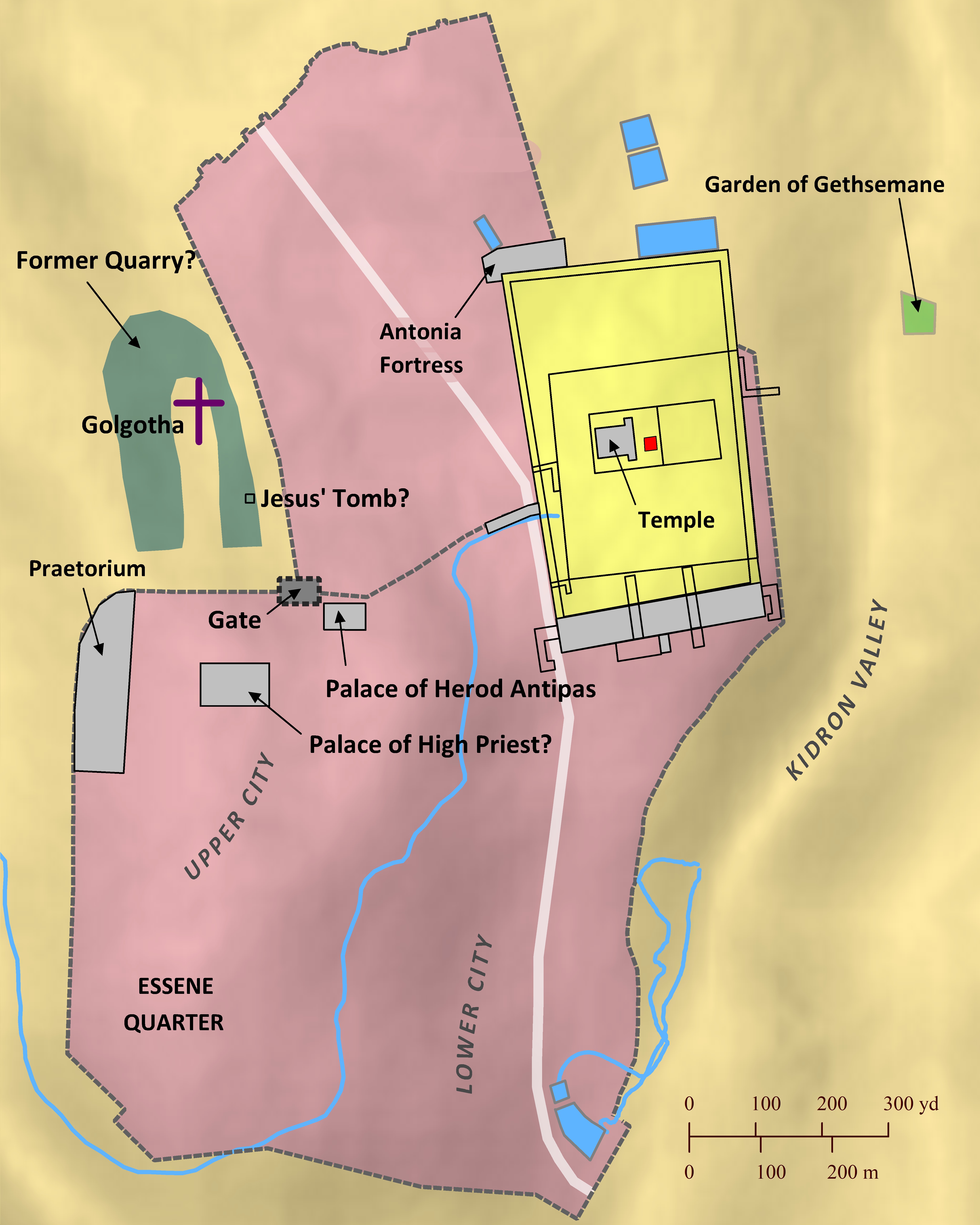
On the Thursday before he was crucified, Jesus had arranged to share the Passover meal with his disciples in an upper room, traditionally thought to be located in the Essene Quarter of Jerusalem. After they finished the meal, they went to the Garden of Gethsemane, where Jesus often met with his disciples. There Judas Iscariot, one of Jesus’ own disciples, betrayed him to soldiers sent from the High Priest, and they took Jesus to the High Priest’s residence. In the morning the leading priests and teachers of the law put Jesus on trial and found him guilty of blasphemy. The council sent Jesus to stand trial for treason before the Roman governor Pontius Pilate, who resided at the Praetorium while in Jerusalem. The Praetorium was likely located at the former residence of Herod the Great, who had died over 30 years earlier. When Pilate learned that Jesus was from Galilee, he sent him to Herod Antipas, who had jurisdiction over Galilee. But when Jesus gave no answer to Herod’s many questions, Herod and his soldiers sent him back to Pilate, who conceded to the people’s demands that Jesus be crucified. Jesus was forced to carry his cross out of the city gate to Golgotha, meaning Skull Hill, referring to what may have been a small unquarried hill in the middle of an old quarry just outside the gate. After Jesus was unable to carry his cross any further, a man named Simon from Cyrene was forced to carry it for him. There at Golgotha they crucified Jesus. After Jesus died, his body was hurriedly taken down before nightfall and placed in a newly cut, rock tomb owned by Joseph of Arimathea, a member of the Jewish high council. This tomb was likely located at the perimeter of the old quarry.
Open Bible Data site copyright © 2023–2026 Freely-Given.org.
Python source code for creating these static pages is available on GitHub under an open licence.
For Bible data copyrights, see the details for each displayed Bible version.
The Open English Translation (OET) main site is at OpenEnglishTranslation.Bible or OET.Bible.