
ParallelVerse GEN EXO LEV NUM DEUT JOB YEHO (JOS) HERO (JDG) RUTH 1 SAM 2 SAM PSA AMOS HOS 1 KI 2 KI 1 CHR 2 CHR PROV ECC SNG YOEL (JOEL) MIC ISA ZEP HAB YIR (JER) LAM YNA (JNA) NAH OBAD DAN EZEK EZRA EST NEH HAG ZEC MAL 2 PS WIS TOB MAN BAR LJE G DAN SUS PAZ BEL G ESD L ESD ESG JDT 3 MAC SIR 1 MAC 2 MAC 4 MAC YHN (JHN) MARK MAT LUKE ACTs YAC (JAM) GAL 1 TH 2 TH 1 COR 2 COR ROM COL LAOD PHM EPH PHP 1 TIM TIT 1 PET 2 PET 2 TIM HEB YUD (JUD) 1 YHN (1 JHN) 2 YHN (2 JHN) 3 YHN (3 JHN) REV
ParallelVerse 2 Sam Intro C1 C2 C3 C4 C5 C6 C7 C8 C9 C10 C11 C12 C13 C14 C16 C17 C18 C19 C20 C21 C22 C23 C24
2 Sam 15 V0 V1 V2 V3 V4 V5 V6 V7 V8 V9 V10 V11 V12 V14 V15 V16 V17 V18 V19 V20 V21 V22 V23 V24 V25 V26 V27 V28 V29 V30 V31 V32 V33 V34 V35 V36 V37
Note: This view shows ‘verses’ which are not necessarily natural language units and hence sometimes only part of a sentence will be visible—click on any Bible version abbreviation down the left-hand side to see the verse in more of its context. Normally the OET discourages the reading of individual ‘verses’, but this view is only designed as a tool for Bible-translators and others doing comparisons of different translations—the older translations are further down the page (so you can read up from the bottom to trace the English translation history). The OET segments on this page are still early looks into the drafted texts of the Open English Translation of the Bible—please double-check these texts in advance before using in public.
B I ◄ ← 2 Sam 15:13 ↓ → ► ≡ ═ ©
Text critical issues=none Clarity of original=clear Importance to us=normal Speaker(s)=Narrator (All still tentative.)
OET (OET-RV) Eventually, someone went and told David, “The loyalty of the Israeli people is turning towards Avshalom (Absalom).”
OET-LV And_ the_messenger _he_came to Dāvid to_say the_heart_of the_man_of Yisrāʼēl/(Israel) it_is after ʼAⱱīshālōm.
UHB וַיָּבֹא֙ הַמַּגִּ֔יד אֶל־דָּוִ֖ד לֵאמֹ֑ר הָיָ֛ה לֶב־אִ֥ישׁ יִשְׂרָאֵ֖ל אַחֲרֵ֥י אַבְשָׁלֽוֹם׃ ‡
(vayyāⱱoʼ hammaggid ʼel-dāvid lēʼmor hāyāh leⱱ-ʼiysh yisrāʼēl ʼaḩₐrēy ʼaⱱshālōm.)
Key: khaki:verbs.
Note: Automatic aligning of the OET-RV to the LV is done by some temporary software, hence the OET-RV alignments are incomplete (and may occasionally be wrong).
People tagged in the matching LV passage: Absalom · David
Dictionary: David
BrLXX Καὶ παρεγένετο ἀπαγγέλων πρὸς Δαυὶδ, λέγων, ἐγενήθη ἡ καρδία ἀνδρῶν Ἰσραὴλ ὀπίσω Ἀβεσσαλώμ.
(Kai paregeneto apangelōn pros Dawid, legōn, egenaʸthaʸ haʸ kardia andrōn Israaʸl opisō Abessalōm.)
BrTr And there came a messenger to David, saying, The heart of the men of Israel is gone after Abessalom.
ULT And a declarer came to David, saying, “The heart of a man of Israel, is behind Absalom.”
UST Then someone came to David and warned him, “The Israelites now want Absalom to be their king!”
BSB Then a messenger came to David and reported, “The hearts of the men of Israel are with Absalom.”
OEB No OEB SA2 15:13 book available
WEBBE A messenger came to David, saying, “The hearts of the men of Israel are after Absalom.”
NET Then a messenger came to David and reported, “The men of Israel are loyal to Absalom!”
LSV And he who is declaring tidings comes to David, saying, “The heart of the men of Israel has been after Absalom.”
FBV A messenger came to tell David, “Absalom has the loyalty of the men of Israel.”
T4T Soon a messenger came to David and said to him, “All [HYP] the Israeli people [SYN] are joining Absalom to rebel against you!”
LEB ¶ Then the messenger came to David, saying, “The hearts[fn] of the men of Israel have gone after Absalom.”
15:13 Hebrew “heart”
BBE And one came to David and said, The hearts of the men of Israel have gone after Absalom.
Moff No Moff SA2 15:13 book available
JPS And there came a messenger to David, saying: 'The hearts of the men of Israel are after Absalom.'
ASV And there came a messenger to David, saying, The hearts of the men of Israel are after Absalom.
DRA And there came a messenger to David, saying: All Israel with their whole heart followeth Absalom.
YLT And he who is declaring tidings cometh in unto David, saying, 'The heart of the men of Israel hath been after Absalom.'
Drby And there came one to David who reported saying, The hearts of the men of Israel are after Absalom.
RV And there came a messenger to David, saying, The hearts of the men of Israel are after Absalom.
SLT And he announcing, will come to David, saying, The heart of the man Israel was after Absalom.
Wbstr And there came a messenger to David, saying, The hearts of the men of Israel are after Absalom.
KJB-1769 ¶ And there came a messenger to David, saying, The hearts of the men of Israel are after Absalom.
KJB-1611 ¶ And there came a messenger to Dauid, saying, The hearts of the men of Israel are after Absalom.
(Modernised spelling is same as from KJB-1769 above)
Bshps And ther came a messenger to Dauid, and sayde: The heartes of the men of Israel are turned after Absalom.
(And there came a messenger to David, and said: The hearts of the men of Israel are turned after Absalom.)
Gnva Then came a messenger to Dauid, saying, The hearts of the men of Israel are turned after Absalom.
(Then came a messenger to David, saying, The hearts of the men of Israel are turned after Absalom.)
Cvdl Then came one which tolde Dauid, and sayde, that the hert of euery man in Israel folowed Absalom.
(Then came one which told David, and said, that the heart of every man in Israel followed Absalom.)
Wycl Therfor a messanger cam to Dauid, and seide, With al herte al Israel sueth Absolon.
(Therefore a messenger came to David, and said, With all heart all Israel follows Absalom.)
Luth Da kam einer, der sagte es David an und sprach: Das Herz jedermanns in Israel folget Absalom nach.
(So came one/a, the/of_the said it David at/to and spoke: The heart everyone’s in Israel follows Absalom after.)
ClVg Venit igitur nuntius ad David, dicens: Toto corde universus Israël sequitur Absalom.
(He_came therefore messenger to David, saying: Whole heart the_whole Israel follows Absalom.)
Note 1 topic: figures-of-speech / genericnoun
הָיָ֛ה לֶב־אִ֥ישׁ יִשְׂרָאֵ֖ל אַחֲרֵ֥י אַבְשָׁלֽוֹם
it_became hearts_of (a)_man (Some words not found in UHB: and,he_came the,messenger to/towards Dāvid to=say it_became hearts_of (a)_man Yisrael after ʼAⱱīshālōm )
Here, a man of Israel represents the people of Israel in general, not a specific person. If it would be helpful to your readers, you could use an expression that would be more natural in your language. Alternate translation: [The heart of the people of Israel is behind Absalom]
Note 2 topic: grammar-collectivenouns
הָיָ֛ה לֶב־אִ֥ישׁ יִשְׂרָאֵ֖ל אַחֲרֵ֥י אַבְשָׁלֽוֹם
it_became hearts_of (a)_man (Some words not found in UHB: and,he_came the,messenger to/towards Dāvid to=say it_became hearts_of (a)_man Yisrael after ʼAⱱīshālōm )
In this verse, the word heart is singular in form, but it refers to all the people of Israel as a group. If it would be helpful in your language, you could use the plural form of “heart.” Alternate translation: [The hearts of the people of Israel are behind Absalom]
Note 3 topic: figures-of-speech / metaphor
הָיָ֛ה לֶב־אִ֥ישׁ יִשְׂרָאֵ֖ל אַחֲרֵ֥י אַבְשָׁלֽוֹם
it_became hearts_of (a)_man (Some words not found in UHB: and,he_came the,messenger to/towards Dāvid to=say it_became hearts_of (a)_man Yisrael after ʼAⱱīshālōm )
Here, the heart represents people’s commitments and intentions. You may have a comparable expression in your language, or you could state the meaning plainly. Alternate translation: [The people of Israel are now supporting Absalom]
2 Samuel 15-16
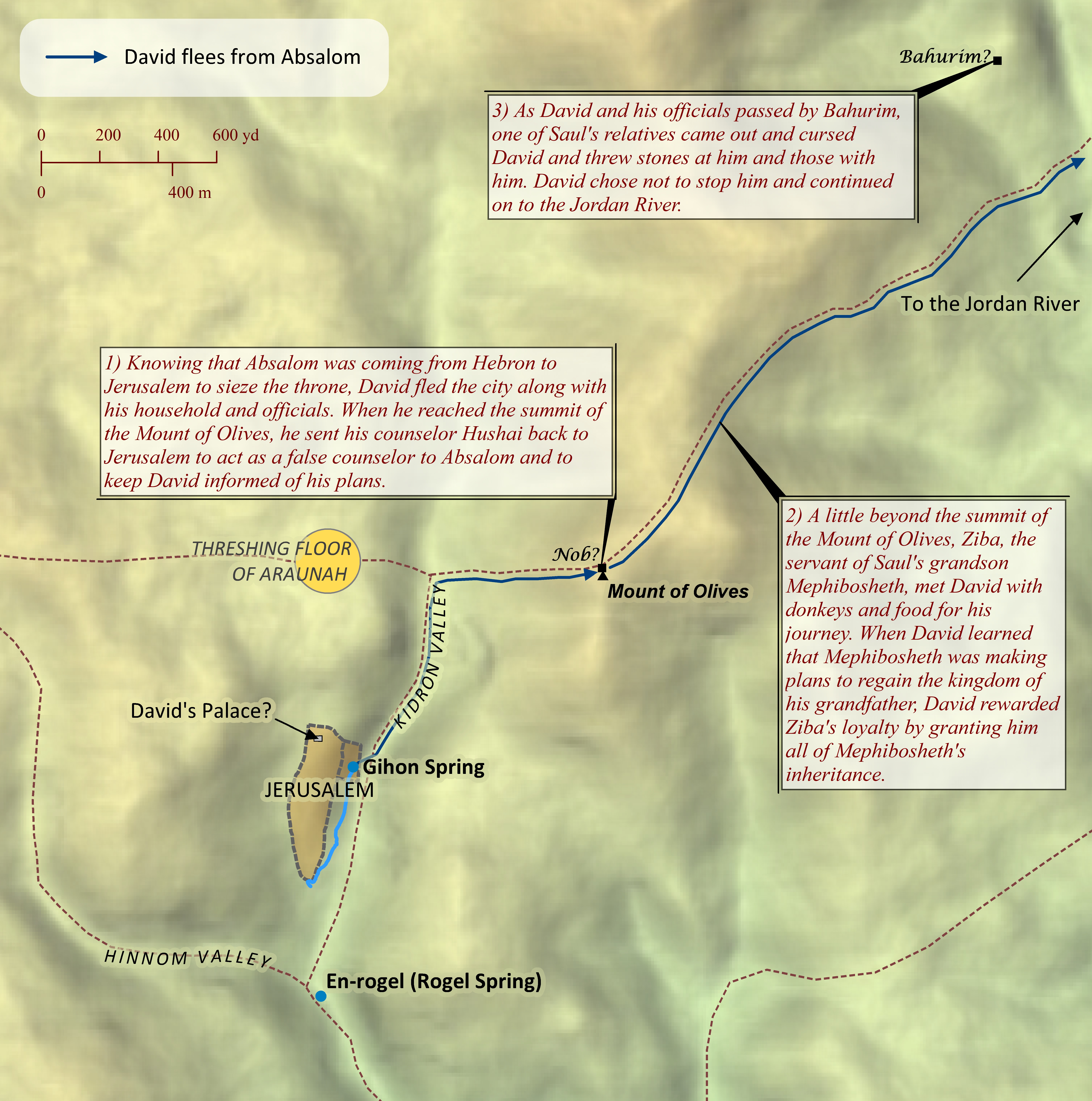
Several years after killing his half brother Amnon and his brothers, Absalom was reconciled to his father David (2 Samuel 13-14). Then Absalom spent the next four years grooming the people of Israel to favor him over his father, all in preparation to eventually rebel against his father’s rule. When it appeared to Absalom that the time had finally come to act on his plan, he staged a coup in the town of Hebron about 19 miles (30 km) south of Jerusalem. A messenger came to David and told him that the people of Israel had declared Absalom king, and David chose to flee Jerusalem with his household and many of his officials. They left the city and crossed the Kidron Valley to take the road that went up the Mount of Olives before heading toward Jericho and the Jordan Valley much further east. When he reached the summit of the Mount of Olives, he sent his counselor Hushai back to Jerusalem to act as a false counselor to Absalom and to keep David informed of his plans. Interestingly, 2 Samuel 15:32 notes that the summit of the Mount of Olives was “where God was worshiped.” Sometime during the ministry of Samuel, the Philistines defeated the Israelites in battle at Ebenezer near Aphek and captured the Ark of the Covenant. They took it to Ashdod, Gath, and Ekron but eventually returned it to Israel, where the Ark was then taken to Kiriath-jearim (1 Samuel 4-5; also see “The Ark of the Covenant Is Captured and Returned” map). After the battle, the worship center of Shiloh appears to have been overrun as well (Psalm 78:60; Jeremiah 7:12-14; 26:6). Many of the priests apparently relocated to the town of Nob near Jerusalem, perhaps on the summit of the Mount of Olives (1 Samuel 22:11; Isaiah 10:32; see “The Ark of the Covenant in the Promised Land” map), while the Tabernacle and altar were relocated to the High Place at Gibeon/Gibeah (1 Chronicles 16:39-40; 21:29; see “David Transports the Ark of the Covenant to Jerusalem” map). A little beyond the summit of the Mount of Olives, Ziba, the servant of Saul’s grandson Mephibosheth, met David with donkeys and food for his journey. When David learned that Mephibosheth was making plans to regain the kingdom of his grandfather, David rewarded Ziba’s loyalty by granting him all of Mephibosheth’s inheritance. As David and his officials passed by Bahurim, one of Saul’s relatives came out and cursed David and threw stones at him and those with him. David chose not to stop him and continued on to the Jordan River (see also “Absalom Rebels against David” map).
Open Bible Data site copyright © 2023–2026 Freely-Given.org.
Python source code for creating these static pages is available on GitHub under an open licence.
For Bible data copyrights, see the details for each displayed Bible version.
The Open English Translation (OET) main site is at OpenEnglishTranslation.Bible or OET.Bible.