
OET OET-RV OET-LV GHT ULT UST BSB MSB BLB AICNT OEB WEBBE WMBB NET LSV FBV TCNT T4T LEB BBE Moff JPS Wymth ASV DRA YLT Drby RV SLT Wbstr KJB-1769 KJB-1611 Bshps Gnva Cvdl TNT Wycl SR-GNT UHB BrLXX BrTr Related Parallel Simple Interlinear Topics Reference Dictionary Search
ParallelVerse GEN EXO LEV NUM DEU JOB JOS JDG RUTH 1 SAM 2 SAM PSA AMOS HOS 1 KI 2 KI 1 CHR 2 CHR PROV ECC SNG JOEL MIC ISA ZEP HAB JER LAM YNA (JNA) NAH OBA DAN EZE EZRA EST NEH HAG ZEC MAL 2 PS WIS TOB MAN BAR LJE DNG SUS PAZ BEL GES LES ESG JDT 3 MAC SIR 1 MAC 2 MAC 4 MAC YHN (JHN) MARK MAT LUKE ACTs YAC (JAM) GAL 1 TH 2 TH 1 COR 2 COR ROM COL LAO PHM EPH PHP 1 TIM TIT 1 PET 2 PET 2 TIM HEB YUD (JUD) 1 YHN (1 JHN) 2 YHN (2 JHN) 3 YHN (3 JHN) REV
2 Sam Intro C1 C2 C3 C4 C5 C6 C7 C8 C9 C10 C11 C12 C13 C14 C16 C17 C18 C19 C20 C21 C22 C23 C24
2 Sam 15 V0 V1 V2 V3 V4 V5 V6 V7 V9 V10 V11 V12 V13 V14 V15 V16 V17 V18 V19 V20 V21 V22 V23 V24 V25 V26 V27 V28 V29 V30 V31 V32 V33 V34 V35 V36 V37
Note: This view shows ‘verses’ which are not necessarily natural language units and hence sometimes only part of a sentence will be visible—click on any Bible version abbreviation down the left-hand side to see the verse in more of its context. Normally the OET discourages the reading of individual ‘verses’, but this view is only designed as a tool for Bible-translators and others doing comparisons of different translations—the older translations are further down the page (so you can read up from the bottom to trace the English translation history). The OET segments on this page are still early looks into the drafted texts of the Open English Translation of the Bible—please double-check these texts in advance before using in public.
B I ◄ ← 2 Sam 15:8 ↓ → ► ≡ ═ ©
Text critical issues=small word differences Clarity of original=clear Importance to us=normal Speaker(s)=Narrator (All still tentative.)
OET (OET-RV) because when I was living in Geshur (in Aram (Syria)) I promised Yahweh that if he brought me back to Yerushalem (Jerusalem), then I’d worship him in Hevron.”
OET-LV If/because a_vow servant_of_your he_vowed when_dwelt_I at_Gəshūr in_ʼArām to_say if indeed_(dwell)[fn] bring_back_will_bring_me_back YHWH Yərūshālaim/(Jerusalem) and_I_will_serve DOM YHWH.
15:8 OSHB variant note: ישיב: (x-qere) ’יָשׁ֨וֹב’: lemma=7725 morph=HVqa id=10poz יָשׁ֨וֹב
UHB כִּי־נֵ֨דֶר֙ נָדַ֣ר עַבְדְּךָ֔ בְּשִׁבְתִּ֥י בִגְשׁ֛וּר בַּאֲרָ֖ם לֵאמֹ֑ר אִם־יָשׁ֨וֹב [fn] יְשִׁיבֵ֤נִי יְהוָה֙ יְר֣וּשָׁלִַ֔ם וְעָבַדְתִּ֖י אֶת־יְהוָֽה׃ ‡
(kī-nēder nādar ˊaⱱdəkā bəshiⱱtiy ⱱigəshūr baʼₐrām lēʼmor ʼim-yāshōⱱ yəshīⱱēnī yhwh yərūshālaim vəˊāⱱadtiy ʼet-yhwh.)
Key: khaki:verbs.
Note: Automatic aligning of the OET-RV to the LV is done by some temporary software, hence the OET-RV alignments are incomplete (and may occasionally be wrong).
K ישיב
BrLXX Ὅτι εὐχὴν ηὔξατο ὁ δοῦλός σου ἐν τῷ οἰκεῖν με ἐν Γεδσοὺρ ἐν Συρίᾳ, λέγων, ἐὰν ἐπιστρέφων ἐπιστρέψῃ με Κύριος εἰς Ἰερουσαλὴμ, καὶ λατρεύσω τῷ Κυρίῳ.
(Hoti euⱪaʸn aʸuxato ho doulos sou en tōi oikein me en Gedsour en Suria, legōn, ean epistrefōn epistrepsaʸ me Kurios eis Ierousalaʸm, kai latreusō tōi Kuriōi.)
BrTr For thy servant vowed a vow when I dwelt at Gedsur in Syria, saying, If the Lord should indeed restore me to Jerusalem, then will I serve the Lord.
ULT For your servant vowed a vow when I was living in Geshur in Aram, saying, ‘If bringing back, Yahweh brings me back, to Jerusalem, then I will serve Yahweh.’ ”
UST I ask this because when I was living in Geshur, in Aram, I promised Yahweh that if he made it possible for me to return to Jerusalem, then I would worship him in Hebron and thank him publicly.”
BSB & MSB For your servant made a vow while dwelling in Geshur of Aram, saying: ‘If indeed the LORD brings me back to Jerusalem, I will worship the LORD [in Hebron].’[fn]”
15:8 Some LXX manuscripts; Hebrew does not include in Hebron.
OEB No OEB SA2 15:8 book available
WEBBE & WMBB For your servant vowed a vow while I stayed at Geshur in Syria, saying, ‘If the LORD shall indeed bring me again to Jerusalem, then I will serve the LORD.’ ”
NET For I made this vow when I was living in Geshur in Aram: ‘If the Lord really does allow me to return to Jerusalem, I will serve the Lord.’ ”
LSV for your servant has vowed a vow in my dwelling in Geshur, in Aram, saying, If YHWH certainly brings me back to Jerusalem, then I have served YHWH.”
FBV For I, your servant, made this promise while living at Geshur in Aram, saying: ‘If the Lord does bring me back to Jerusalem, I will worship the Lord in Hebron.’ ”
T4T When I was living in Geshur, in Syria, I promised Yahweh that if he brought me back to Jerusalem, I would worship him in Hebron.”
LEB for your servant made a vow while I was staying in Geshur in Aram, saying, ‘⌊If Yahweh will indeed let me return⌋[fn] to Jerusalem, then I will worship Yahweh.’ ”
15:8 Literally (following Qere) “If returning Yahweh will return me”
BBE For while I was living in Geshur in Aram, your servant made an oath, saying, If ever the Lord lets me come back to Jerusalem, I will give him worship in Hebron.
Moff No Moff SA2 15:8 book available
JPS For thy servant vowed a vow while I abode at Geshur in Aram, saying: If the LORD shall indeed bring me back to Jerusalem, then I will serve the LORD.'
ASV For thy servant vowed a vow while I abode at Geshur in Syria, saying, If Jehovah shall indeed bring me again to Jerusalem, then I will serve Jehovah.
DRA For thy servant made avow, when he was in Gessur of Syria, saying: If the Lord shall bring me again into Jerusalem I will offer sacrifice to the Lord.
YLT for a vow hath thy servant vowed in my dwelling in Geshur, in Aram, saying, If Jehovah doth certainly bring me back to Jerusalem, then I have served Jehovah.'
Drby For thy servant vowed a vow while I abode in Geshur in Syria, saying, If Jehovah shall bring me again indeed to Jerusalem, then I will serve Jehovah.
RV For thy servant vowed a vow while I abode at Geshur in Syria, saying, If the LORD shall indeed bring me again to Jerusalem, then I will serve the LORD.
(For thy/your servant vowed a vow while I abode/stayed at Geshur in Syria, saying, If the LORD shall indeed bring me again to Yerusalem, then I will serve the LORD.)
SLT For thy servant vowed a vow in my dwelling in Geshur in Aram, saying, If turning back, Jehovah shall turn me back to Jerusalem, and I served Jehovah.
Wbstr For thy servant vowed a vow while I abode at Geshur in Syria, saying, If the LORD shall bring me again indeed to Jerusalem, then I will serve the LORD.
KJB-1769 For thy servant vowed a vow while I abode at Geshur in Syria, saying, If the LORD shall bring me again indeed to Jerusalem, then I will serve the LORD.
(For thy/your servant vowed a vow while I abode/stayed at Geshur in Syria, saying, If the LORD shall bring me again indeed to Yerusalem, then I will serve the LORD.)
KJB-1611 For thy seruant vowed a vowe while I abode at Geshur in Syria, saying, If the LORD shall bring mee againe in deed to Ierusalem, then I will serue the LORD.
(Modernised spelling is same as from KJB-1769 above)
Bshps For thy seruaunt vowed a vowe (when I was in Gesur in Siria) saying: If the Lorde shall bring me againe in deede to Hierusalem, I wil serue the Lorde.
(For thy/your servant vowed a vow (when I was in Gesur in Syria) saying: If the Lord shall bring me again indeed to Yerusalem, I will serve the Lord.)
Gnva For thy seruant vowed a vowe when I remayned at Geshur, in Aram, saying, If the Lord shall bring me againe in deede to Ierusalem, I will serue the Lord.
(For thy/your servant vowed a vow when I remained at Geshur, in Aram, saying, If the Lord shall bring me again indeed to Yerusalem, I will serve the Lord.)
Cvdl For thy seruaunt made a vowe, whan I dwelt at Gesur in Siria, and saide: Whan ye LORDE bryngeth me agayne to Ierusalem, I shal do a Gods seruyce vnto the LORDE.
(For thy/your servant made a vow, when I dwelt at Gesur in Syria, and said: When ye/you_all LORD bringeth/brings me again to Yerusalem, I shall do a Gods service unto the LORD.)
Wycl for thi seruaunt vowynge vowide, whanne he was in Gessur of Sirie, and seide, If the Lord bryngith ayen me in to Jerusalem, Y schal make sacrifice to the Lord.
(for thy/your servant vowing vowed, when he was in Gessur of Syria, and said, If the Lord bringeth/brings again me in to Yerusalem, I shall make sacrifice to the Lord.)
Luth Denn dein Knecht tat ein Gelübde, da ich zu Gesur in Syrien wohnete, und sprach: Wenn mich der HErr wieder gen Jerusalem bringet, so will ich dem HErr’s einen Gottesdienst tun.
(Because your(s) servant/farmhand did a vow/pledge, there I to/for Geshur in Syria lived/resided, and spoke: If/When me the/of_the LORD again to/toward Jerusalem brings/gets, so will I to_him LORD’s a worship(n) do/put.)
ClVg Vovens enim vovit servus tuus cum esset in Gessur Syriæ, dicens: Si reduxerit me Dominus in Jerusalem, sacrificabo Domino.
(Vowing because vowed servant your(sg) when/with was in/into/on Geshur Syria, saying: When/But_if may_have_brought_back me Master in/into/on Yerusalem, I_will_sacrifice Master.)
Note 1 topic: figures-of-speech / reduplication
אִם־יָשׁ֨וֹב יְשִׁיבֵ֤נִי יְהוָה֙
if (Some words not found in UHB: that/for/because/then/when vow vowed servant_of,your when,dwelt,I at,Geshur in,Aram to=say if X bring back,will_bring_me_back YHWH Yerushalayim and,I_will_serve DOM YHWH )
Absalom is repeating forms of the verb brings in order to intensify his expression of the idea that it conveys. If your language can repeat words for intensification, it would be appropriate to do that here in your translation. If not, your language may have another way of expressing the intensification. Alternate translation: [If Yahweh indeed brings me back]
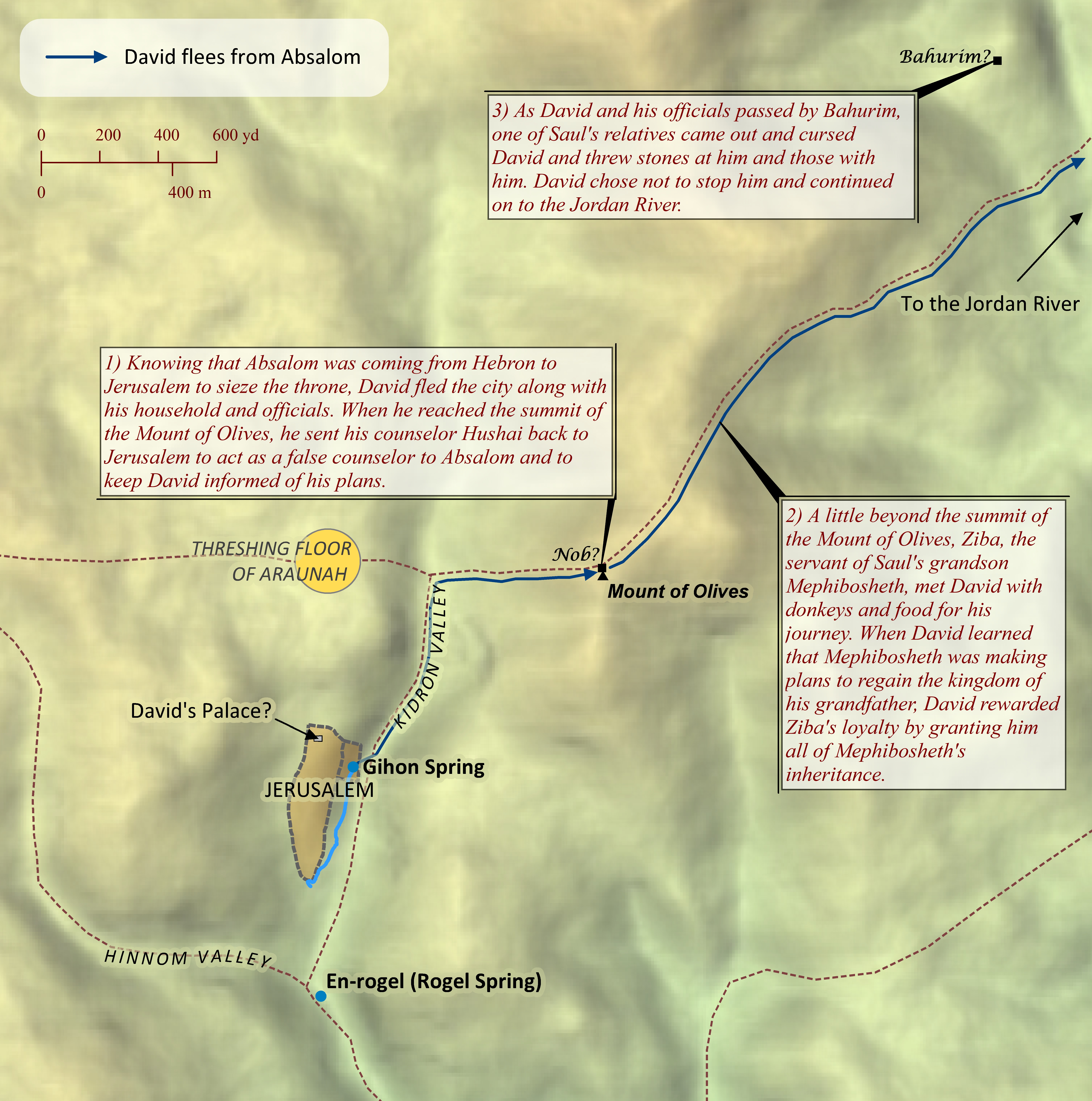
2 Samuel 15-16
Several years after killing his half brother Amnon and his brothers, Absalom was reconciled to his father David (2 Samuel 13-14). Then Absalom spent the next four years grooming the people of Israel to favor him over his father, all in preparation to eventually rebel against his father’s rule. When it appeared to Absalom that the time had finally come to act on his plan, he staged a coup in the town of Hebron about 19 miles (30 km) south of Jerusalem. A messenger came to David and told him that the people of Israel had declared Absalom king, and David chose to flee Jerusalem with his household and many of his officials. They left the city and crossed the Kidron Valley to take the road that went up the Mount of Olives before heading toward Jericho and the Jordan Valley much further east. When he reached the summit of the Mount of Olives, he sent his counselor Hushai back to Jerusalem to act as a false counselor to Absalom and to keep David informed of his plans. Interestingly, 2 Samuel 15:32 notes that the summit of the Mount of Olives was “where God was worshiped.” Sometime during the ministry of Samuel, the Philistines defeated the Israelites in battle at Ebenezer near Aphek and captured the Ark of the Covenant. They took it to Ashdod, Gath, and Ekron but eventually returned it to Israel, where the Ark was then taken to Kiriath-jearim (1 Samuel 4-5; also see “The Ark of the Covenant Is Captured and Returned” map). After the battle, the worship center of Shiloh appears to have been overrun as well (Psalm 78:60; Jeremiah 7:12-14; 26:6). Many of the priests apparently relocated to the town of Nob near Jerusalem, perhaps on the summit of the Mount of Olives (1 Samuel 22:11; Isaiah 10:32; see “The Ark of the Covenant in the Promised Land” map), while the Tabernacle and altar were relocated to the High Place at Gibeon/Gibeah (1 Chronicles 16:39-40; 21:29; see “David Transports the Ark of the Covenant to Jerusalem” map). A little beyond the summit of the Mount of Olives, Ziba, the servant of Saul’s grandson Mephibosheth, met David with donkeys and food for his journey. When David learned that Mephibosheth was making plans to regain the kingdom of his grandfather, David rewarded Ziba’s loyalty by granting him all of Mephibosheth’s inheritance. As David and his officials passed by Bahurim, one of Saul’s relatives came out and cursed David and threw stones at him and those with him. David chose not to stop him and continued on to the Jordan River (see also “Absalom Rebels against David” map).
Open Bible Data site copyright © 2023–2026 Freely-Given.org.
Python source code for creating these static pages is available on GitHub under an open licence.
For Bible data copyrights, see the details for each displayed Bible version.
The Open English Translation (OET) main site is at OpenEnglishTranslation.Bible or OET.Bible.