
OET OET-RV OET-LV GHT ULT UST BSB MSB BLB AICNT OEB WEBBE WMBB NET LSV FBV TCNT T4T LEB BBE Moff JPS Wymth ASV DRA YLT Drby RV SLT Wbstr KJB-1769 KJB-1611 Bshps Gnva Cvdl TNT Wycl SR-GNT UHB BrLXX BrTr Related Parallel Simple Interlinear Topics Reference Dictionary Search
ParallelVerse GEN EXO LEV NUM DEU JOB JOS JDG RUTH 1 SAM 2 SAM PSA AMOS HOS 1 KI 2 KI 1 CHR 2 CHR PROV ECC SNG JOEL MIC ISA ZEP HAB JER LAM YNA (JNA) NAH OBA DAN EZE EZRA EST NEH HAG ZEC MAL LAO GES LES ESG DNG 2 PS TOB JDT WIS SIR BAR LJE PAZ SUS BEL MAN 1 MAC 2 MAC 3 MAC 4 MAC YHN (JHN) MARK MAT LUKE ACTs YAC (JAM) GAL 1 TH 2 TH 1 COR 2 COR ROM COL PHM EPH PHP 1 TIM TIT 1 PET 2 PET 2 TIM HEB YUD (JUD) 1 YHN (1 JHN) 2 YHN (2 JHN) 3 YHN (3 JHN) REV
Luke Intro C1 C2 C3 C4 C5 C6 C7 C8 C9 C10 C11 C12 C13 C14 C15 C16 C17 C18 C19 C20 C21 C22 C24
Luke 23 V1 V3 V5 V7 V9 V11 V13 V15 V17 V19 V21 V23 V25 V27 V29 V31 V33 V35 V37 V39 V41 V43 V45 V47 V49 V51 V53 V55
Note: This view shows ‘verses’ which are not necessarily natural language units and hence sometimes only part of a sentence will be visible—click on any Bible version abbreviation down the left-hand side to see the verse in more of its context. Normally the OET discourages the reading of individual ‘verses’, but this view is only designed as a tool for Bible-translators and others doing comparisons of different translations—the older translations are further down the page (so you can read up from the bottom to trace the English translation history). The OET segments on this page are still early looks into the drafted texts of the Open English Translation of the Bible—please double-check these texts in advance before using in public.
Text critical issues=small word differences Clarity of original=clear Importance to us=normal Speaker(s)=Narrator (All still tentative.)
OET (OET-RV) Herod was very pleased when he saw Yeshua being brought in because he’d been wanting to see him for quite some time because of everything he’d heard about him. He was hoping to see Yeshua do a miracle in front of his eyes
OET-LV And the Haʸrōdaʸs having_seen the Yaʸsous/(Yəhōshūˊa), was_elated exceedingly, because/for he_was of much times wanting to_see him, because_of the thing to_be_hearing concerning him, and he_was_hoping to_see a_certain sign becoming by him.
SR-GNT Ὁ δὲ Ἡρῴδης ἰδὼν τὸν ˚Ἰησοῦν, ἐχάρη λίαν, ἦν γὰρ ἐξ ἱκανῶν χρόνων θέλων ἰδεῖν αὐτὸν, διὰ τὸ ἀκούειν περὶ αὐτοῦ, καὶ ἤλπιζέν τι σημεῖον ἰδεῖν ὑπʼ αὐτοῦ γινόμενον. ‡
(Ho de Haʸrōdaʸs idōn ton ˚Yaʸsoun, eⱪaraʸ lian, aʸn gar ex hikanōn ⱪronōn thelōn idein auton, dia to akouein peri autou, kai aʸlpizen ti saʸmeion idein hupʼ autou ginomenon.)
Key: khaki:verbs, light-green:nominative/subject, orange:accusative/object, pink:genitive/possessor.
Note: Automatic aligning of the OET-RV to the LV is done by some temporary software, hence the RV alignments are incomplete (and may occasionally be wrong).
GHT Moreover, the Herod, behold[ing] the Jesus, is-joyed extremely, for he-has-been-being will-ing out of {sufficient} to-behold same through the to-be-hearing much about of {same} and has-been-expect[ize]ing what[?] sign to-behold being-become under of {same}.
ULT And Herod, having seen Jesus, rejoiced greatly, for he had been desiring to see him for a long time, because he had heard about him, and he was hoping to see some sign happen by him.
UST When Herod saw Jesus, he was very glad, because he had wanted to see Jesus for a long time. This was because Herod had heard many things about Jesus, and he wanted to see him perform a miracle.
BSB When Herod saw Jesus, he was greatly pleased. He had wanted to see Him for a long time, because he had heard about Him and was hoping to see Him perform a miracle.
MSB When Herod saw Jesus, he was greatly pleased. He had wanted to see Him for a long time, because he had heard many things[fn] about Him and was hoping to see Him perform a miracle.
23:8 CT does not include many things.
BLB And Herod, having seen Jesus, was exceedingly glad; for of a long time he is wishing to see Him, because of hearing concerning Him; and he was hoping to see some sign done by Him.
AICNT But Herod, seeing Jesus, rejoiced greatly, for he had wanted to see him for a long time because he had heard [[many things]][fn] about him and hoped to see some sign performed by him.
23:8, many things: Included in A(02) W(032) Latin(a b e ff2 i) BYZ TR ‖ Absent from 𝔓75 ℵ(01) B(03) D(05) NA28 SBLGNT THGNT.
OEB When Herod saw Jesus, he was exceedingly pleased, for he had been wanting to see him for a long time, having heard a great deal about him; and he was hoping to see some sign given by him.
WEBBE Now when Herod saw Jesus, he was exceedingly glad, for he had wanted to see him for a long time, because he had heard many things about him. He hoped to see some miracle done by him.
WMBB Now when Herod saw Yeshua, he was exceedingly glad, for he had wanted to see him for a long time, because he had heard many things about him. He hoped to see some miracle done by him.
NET When Herod saw Jesus, he was very glad, for he had long desired to see him, because he had heard about him and was hoping to see him perform some miraculous sign.
LSV And Herod rejoiced exceedingly having seen Jesus, for he was wishing to see Him for a long [time], because of hearing many things about Him, and he was hoping to see some sign done by Him,
FBV Herod was very pleased to see Jesus since he had wanted to meet him for a long time. He had heard about Jesus and was hoping to see him perform a miracle.
TCNT When Herod saw Jesus he was very glad, for he had long desired to see him, because he had heard [fn]many things about him and was hoping to see him perform some sign.
23:8 many things ¦ — CT
T4T So they did. When Herod saw Jesus, he was very happy. He had heard about Jesus, and he had been hoping for a long time that he could see Jesus perform a miracle.
LEB And when[fn] Herod saw Jesus, he was very glad, for he had been wanting to see him for a long time, because he had heard about him and was hoping to see some miracle performed by him.
23:8 *Here “when” is supplied as a component of the participle (“saw”) which is understood as temporal
BBE Now when Herod saw Jesus he was very glad, having for a long time had a desire to see him, for he had had accounts of him, and was hoping to see some wonders done by him.
Moff Herod was greatly delighted to see Jesus; he had long wanted to see him, because he had heard about him and also because he hoped to see him perform some miracle.
Wymth To Herod the sight of Jesus was a great gratification, for, for a long time, he had been wanting to see Him, because he had heard so much about Him. He hoped also to see some miracle performed by Him.
ASV Now when Herod saw Jesus, he was exceeding glad: for he was of a long time desirous to see him, because he had heard concerning him; and he hoped to see some miracle done by him.
DRA And Herod, seeing Jesus, was very glad; for he was desirous of a long time to see him, because he had heard many things of him; and he hoped to see some sign wrought by him.
YLT And Herod having seen Jesus did rejoice exceedingly, for he was wishing for a long [time] to see him, because of hearing many things about him, and he was hoping some sign to see done by him,
Drby And when Herod saw Jesus he greatly rejoiced, for he had been a long while desirous of seeing him, because of hearing many things concerning him, and he hoped to see some sign done by him;
RV Now when Herod saw Jesus, he was exceeding glad: for he was of a long time desirous to see him, because he had heard concerning him; and he hoped to see some miracle done by him.
SLT And Herod having seen Jesus, rejoiced greatly: for he was wishing a long while since to see him, for hearing many things of him: and he hoped to see some sign done by him.
Wbstr And when Herod saw Jesus, he was exceeding glad: for he had been for a long time, desirous to see him, because he had heard many things of him; and he hoped to see some miracle done by him.
KJB-1769 ¶ And when Herod saw Jesus, he was exceeding glad: for he was desirous to see him of a long season, because he had heard many things of him; and he hoped to have seen some miracle done by him.
KJB-1611 ¶ And when Herode saw Iesus, he was exceeding glad, for hee was desirous to see him of a long season, because he had heard many things of him, and hee hoped to haue seene some miracle done by him.
(Modernised spelling is same as from KJB-1769 above, apart from punctuation)
Bshps And when Herode sawe Iesus, he was exceeding glad: For he was desirous to see hym of a long season, because he had hearde many thinges of hym, and he trusted to haue seene some miracle done by hym.
(And when Herod saw Yesus/Yeshua, he was exceeding glad: For he was desirous to see him of a long season, because he had heard many things of him, and he trusted to have seen some miracle done by him.)
Gnva And when Herod sawe Iesus, hee was exceedingly glad: for he was desirous to see him of a long season, because he had heard many things of him, and trusted to haue seene some signe done by him.
(And when Herod saw Yesus/Yeshua, he was exceedingly glad: for he was desirous to see him of a long season, because he had heard many things of him, and trusted to have seen some sign done by him.)
Cvdl When Herode sawe Iesus, he was exceadinge glad, for he had longe bene desyrous to se him: because he had herde moch of him, & hoped to se a miracle of hi.
(When Herod saw Yesus/Yeshua, he was exceeding glad, for he had long been desirous to see him: because he had herd/heard much of him, and hoped to see a miracle of hi.)
TNT And when Herode sawe Iesus he was excedinglie gladde. For he was desyrous to se him of a longe season because he had hearde many thinges of him and trusted to have sene some myracle done by him.
(And when Herod saw Yesus/Yeshua he was exceedingly glad. For he was desirous to see him of a long season because he had heard many things of him and trusted to have seen some miracle done by him.)
Wycl And whanne Eroude siy Jhesu, he ioyede ful myche; for long tyme he coueitide to se hym, for he herde many thingis of hym, and hopide to see sum tokene `to be don of hym.
(And when Herod saw Yesus/Yeshua, he rejoiced full much; for long time he coveted to see him, for he herd/heard many things of him, and hoped to see some token/sign to be done of him.)
Luth Da aber Herodes JEsum sah, ward er sehr froh, denn er hätte ihn längst gerne gesehen; denn er hatte viel von ihm gehöret und hoffete, er würde ein Zeichen von ihm sehen.
(So but Herod Yesus saw(v), what/which he very pleased/glad, because/than he would_have him/it long_ago gladly/willingly seen; because/than he had many from him belongs/pertains and hoped, he would a sign from him see.)
ClVg Herodes autem viso Jesu, gavisus est valde. Erat enim cupiens ex multo tempore videre eum, eo quod audierat multa de eo, et sperabat signum aliquod videre ab eo fieri.
(Herod however seen Yesu, rejoiced it_is very_much. It_was because desiring from much at_the_time to_see him, by_him that had_heard fine from/about by_him, and was_hoping sign/signal some to_see away by_him to_be_done.)
UGNT ὁ δὲ Ἡρῴδης ἰδὼν τὸν Ἰησοῦν, ἐχάρη λείαν; ἦν γὰρ ἐξ ἱκανῶν χρόνων θέλων ἰδεῖν αὐτὸν, διὰ τὸ ἀκούειν περὶ αὐτοῦ; καὶ ἤλπιζέν τι σημεῖον ἰδεῖν ὑπ’ αὐτοῦ γινόμενον.
(ho de Haʸrōdaʸs idōn ton Yaʸsoun, eⱪaraʸ leian; aʸn gar ex hikanōn ⱪronōn thelōn idein auton, dia to akouein peri autou; kai aʸlpizen ti saʸmeion idein hup’ autou ginomenon.)
SBL-GNT ὁ δὲ Ἡρῴδης ἰδὼν τὸν Ἰησοῦν ἐχάρη λίαν, ἦν γὰρ ⸂ἐξ ἱκανῶν χρόνων θέλων⸃ ἰδεῖν αὐτὸν διὰ τὸ ⸀ἀκούειν περὶ αὐτοῦ, καὶ ἤλπιζέν τι σημεῖον ἰδεῖν ὑπʼ αὐτοῦ γινόμενον.
(ho de Haʸrōdaʸs idōn ton Yaʸsoun eⱪaraʸ lian, aʸn gar ⸂ex hikanōn ⱪronōn thelōn⸃ idein auton dia to ⸀akouein peri autou, kai aʸlpizen ti saʸmeion idein hupʼ autou ginomenon.)
RP-GNT Ὁ δὲ Ἡρῴδης ἰδὼν τὸν Ἰησοῦν ἐχάρη λίαν· ἦν γὰρ θέλων ἐξ ἱκανοῦ ἰδεῖν αὐτόν, διὰ τὸ ἀκούειν πολλὰ περὶ αὐτοῦ· καὶ ἤλπιζέν τι σημεῖον ἰδεῖν ὑπ' αὐτοῦ γινόμενον.
(Ho de Haʸrōdaʸs idōn ton Yaʸsoun eⱪaraʸ lian; aʸn gar thelōn ex hikanou idein auton, dia to akouein polla peri autou; kai aʸlpizen ti saʸmeion idein hup' autou ginomenon.)
TC-GNT ὁ δὲ Ἡρῴδης ἰδὼν τὸν Ἰησοῦν ἐχάρη [fn]λίαν· ἦν γὰρ [fn]θέλων ἐξ ἱκανοῦ ἰδεῖν αὐτόν, διὰ τὸ [fn]ἀκούειν [fn]πολλὰ περὶ αὐτοῦ· καὶ ἤλπιζέ τι σημεῖον ἰδεῖν ὑπ᾽ αὐτοῦ [fn]γινόμενον.
(ho de Haʸrōdaʸs idōn ton Yaʸsoun eⱪaraʸ lian; aʸn gar thelōn ex hikanou idein auton, dia to akouein polla peri autou; kai aʸlpize ti saʸmeion idein hup autou ginomenon.)
23:8 λιαν ¦ λειαν ᴛʜ
23:8 θελων εξ ικανου ¦ εξ ικανου θελων ᴀɴᴛ ¦ εξ ικανων χρονων θελων ᴄᴛ
23:8 ακουειν ¦ ακουειν αυτον ᴀɴᴛ
23:8 πολλα ¦ — ᴄᴛ
23:8 γινομενον ¦ γεινομενον ᴛʜ
Key for above GNTs: yellow:punctuation differs, red:words differ (from our SR-GNT base).
Luke indicates that Jesus had several trials. These trials can also be considered to be several parts of the same trial. Luke recorded the details of four of these trials. The chart here lists them according to who was leading at each trial:
22:66–71 | the Jewish council |
23:1–5 | Pilate |
23:6–12 | Herod |
23:13–25 | Pilate again |
In all of Jesus’ trials, there was no one who could prove that Jesus had broken any law of God or man. However, even though he had not done anything wrong, the Roman governor Pilate sentenced him to die on a cross.
The Notes suggest a section heading for each of the trials in the chart. However, you may decide to have one heading for Section Group 22:66–23:25 like the one suggested in the Section Group box above. Another example of a heading for this section group is:
The leaders tried and condemned Jesus
When Herod saw Jesus, he was greatly pleased.
¶ And seeing Jesus, Herod became very happy
¶ When the men brought Jesus to Herod, Herod was delighted to see him.
When Herod saw Jesus, he was greatly pleased: When Jesus was brought to Herod, Herod was delighted to see him. Some other ways to translate this statement are:
Herod was very pleased when he saw Jesus (GNT)
Herod was delighted at the opportunity to see Jesus (NLT)
He had wanted to see Him for a long time,
because he had long wanted to see Jesus.
For some years/time he had been wishing to meet Jesus.
because he had heard about Him
The things that Herod had heard about Jesus
Herod had heard about him,
and was hoping to see Him perform a miracle.
made him hope that Jesus would do a miracle.
and he wanted to see Jesus do an amazing deed/sign.
In the Greek text, 23:8b begins with a conjunction that is often translated as “because.” For example:
because for a long time he had been wanting to see him (NIV)
The BSB does not translate this word. It leaves the connection between 23:8a and 23:8b implicit. This conjunction introduces a reason or explanation. In 23:8b–d, Luke explained why Herod was so happy to see Jesus. Herod had heard about Jesus and wanted to see him perform a miracle, so Herod had hoped to see Jesus for a long time. Translate these connections in a natural way in your language.
In some languages it may be helpful to change the order of information in this verse. See the General Comment on 23:8a–d below for suggestions.
He had wanted to see Him for a long time: The phrase for a long time in this context probably refers to the two or three preceding years of Jesus’ ministry. Jesus had done many miracles during that time. As 9:9 indicates, Herod had heard about those miracles. That is why Herod wanted to see Jesus, as 23:8c–d says.
he had heard about Him and was hoping to see Him perform a miracle: This statement tells the reason that Herod wanted to see Jesus. Herod had heard other people say that Jesus did miracles, so Herod wanted to see him do such a miracle. Some other ways to translate this statement are:
He had heard many things about Jesus and hoped to see him work a miracle. (CEV)
because he had heard people say that Jesus did amazing things/deeds, and Herod hoped to see him do something like that
perform: The verbs perform or “work” are often used in English with the word “miracle.” Use an appropriate verb in your language to refer to doing a great or supernatural deed.
a miracle: The Greek phrase that the BSB translates as a miracle is literally “some sign.” The word “sign” often refers to a miracle that shows that a person is from God. However, in this context Herod probably used this word in a general way to refer to an amazing deed. The word “some” indicates that the type of sign was not specified. The phrase a miracle could refer to any type of great or amazing deed.
This verse explains why Herod wanted to see Jesus. The explanation has several parts. In some languages it may be more natural to change the order of some of the parts. For example:
8aHerod was very glad to see Jesus, 8cfor he had heard about Jesus 8band had wanted to see him for quite some time. 8dHe was hoping to see Jesus perform some sign.Common English Bible.
In some languages it may be helpful to combine parts of the verse. For example:
8aHerod was delighted at the opportunity to see Jesus, 8cbecause he had heard about him 8b,dand had been hoping for a long time to see him perform a miracle. (NLT)
Translate the connections in a natural way in your language.
Note 1 topic: writing-pronouns
θέλων ἰδεῖν αὐτὸν, διὰ τὸ ἀκούειν περὶ αὐτοῦ
wanting ˓to˒_see (Some words not found in SR-GNT: ὁ Δέ Ἡρῴδης ἰδών τόν Ἰησοῦν ἐχάρη λίαν ἦν γάρ ἐξ ἱκανῶν χρόνων θέλων ἰδεῖν αὐτόν διά τό ἀκούειν περί αὐτοῦ καί ἤλπιζεν τὶ σημεῖον ἰδεῖν ὑπʼ αὐτοῦ γινόμενον)
In these phrases, he refers to Herod and him refers to Jesus. Alternate translation: [wanting to see Jesus … because he had heard about Jesus]
Note 2 topic: figures-of-speech / activepassive
ἤλπιζέν τι σημεῖον ἰδεῖν ὑπ’ αὐτοῦ γινόμενον
(Some words not found in SR-GNT: ὁ Δέ Ἡρῴδης ἰδών τόν Ἰησοῦν ἐχάρη λίαν ἦν γάρ ἐξ ἱκανῶν χρόνων θέλων ἰδεῖν αὐτόν διά τό ἀκούειν περί αὐτοῦ καί ἤλπιζεν τὶ σημεῖον ἰδεῖν ὑπʼ αὐτοῦ γινόμενον)
If it would be helpful in your language, you could express this with an active form. Alternate translation: [Herod wanted to see Jesus perform a miracle]
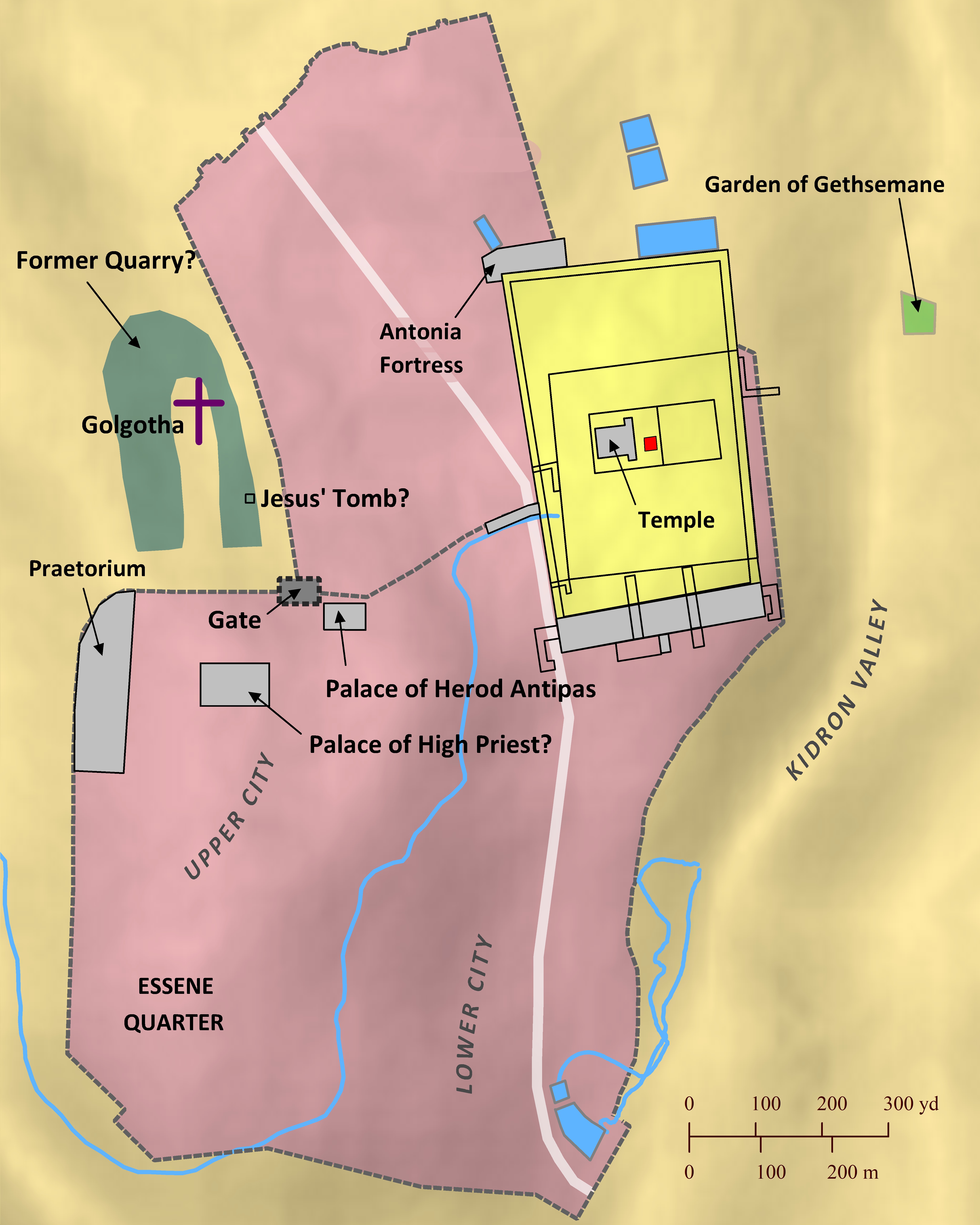
Matthew 26-27; Mark 14-15; Luke 22-23; John 13-19
On the Thursday before he was crucified, Jesus had arranged to share the Passover meal with his disciples in an upper room, traditionally thought to be located in the Essene Quarter of Jerusalem. After they finished the meal, they went to the Garden of Gethsemane, where Jesus often met with his disciples. There Judas Iscariot, one of Jesus’ own disciples, betrayed him to soldiers sent from the High Priest, and they took Jesus to the High Priest’s residence. In the morning the leading priests and teachers of the law put Jesus on trial and found him guilty of blasphemy. The council sent Jesus to stand trial for treason before the Roman governor Pontius Pilate, who resided at the Praetorium while in Jerusalem. The Praetorium was likely located at the former residence of Herod the Great, who had died over 30 years earlier. When Pilate learned that Jesus was from Galilee, he sent him to Herod Antipas, who had jurisdiction over Galilee. But when Jesus gave no answer to Herod’s many questions, Herod and his soldiers sent him back to Pilate, who conceded to the people’s demands that Jesus be crucified. Jesus was forced to carry his cross out of the city gate to Golgotha, meaning Skull Hill, referring to what may have been a small unquarried hill in the middle of an old quarry just outside the gate. After Jesus was unable to carry his cross any further, a man named Simon from Cyrene was forced to carry it for him. There at Golgotha they crucified Jesus. After Jesus died, his body was hurriedly taken down before nightfall and placed in a newly cut, rock tomb owned by Joseph of Arimathea, a member of the Jewish high council. This tomb was likely located at the perimeter of the old quarry.
Open Bible Data site copyright © 2023–2026 Freely-Given.org.
Python source code for creating these static pages is available on GitHub under an open licence.
For Bible data copyrights, see the details for each displayed Bible version.
The Open English Translation (OET) main site is at OpenEnglishTranslation.Bible or OET.Bible.