OET OET-RV OET-LV GHT ULT UST BSB MSB BLB AICNT OEB WEBBE WMBB NET LSV FBV TCNT T4T LEB BBE Moff JPS Wymth ASV DRA YLT Drby RV SLT Wbstr KJB-1769 KJB-1611 Bshps Gnva Cvdl TNT Wycl SR-GNT UHB BrLXX BrTr Related Parallel Simple Interlinear Topics Reference Dictionary Search
ParallelVerse GEN EXO LEV NUM DEU JOB JOS JDG RUTH 1 SAM 2 SAM PSA AMOS HOS 1 KI 2 KI 1 CHR 2 CHR PROV ECC SNG JOEL MIC ISA ZEP HAB JER LAM YNA (JNA) NAH OBA DAN EZE EZRA EST NEH HAG ZEC MAL LAO GES LES ESG DNG 2 PS TOB JDT WIS SIR BAR LJE PAZ SUS BEL MAN 1 MAC 2 MAC 3 MAC 4 MAC YHN (JHN) MARK MAT LUKE ACTs YAC (JAM) GAL 1 TH 2 TH 1 COR 2 COR ROM COL PHM EPH PHP 1 TIM TIT 1 PET 2 PET 2 TIM HEB YUD (JUD) 1 YHN (1 JHN) 2 YHN (2 JHN) 3 YHN (3 JHN) REV
Luke Intro C1 C2 C3 C4 C5 C6 C7 C8 C9 C10 C11 C12 C13 C14 C15 C16 C17 C18 C19 C20 C21 C22 C24
Luke 23 V1 V3 V5 V7 V9 V11 V13 V15 V17 V19 V21 V23 V25 V27 V29 V31 V33 V37 V39 V41 V43 V45 V47 V49 V51 V53 V55
Note: This view shows ‘verses’ which are not necessarily natural language units and hence sometimes only part of a sentence will be visible—click on any Bible version abbreviation down the left-hand side to see the verse in more of its context. Normally the OET discourages the reading of individual ‘verses’, but this view is only designed as a tool for Bible-translators and others doing comparisons of different translations—the older translations are further down the page (so you can read up from the bottom to trace the English translation history). The OET segments on this page are still early looks into the drafted texts of the Open English Translation of the Bible—please double-check these texts in advance before using in public.
B I ◄ ← Luke 23:35 ↓ → ► ≡ ═ ©
Text critical issues=small word differences Clarity of original=clear Importance to us=normal Speaker(s)=Narrator (All still tentative.)
OET (OET-RV) The people observing were standing there, and some of the Jewish leaders were there too, sneering at him and saying, “He saved others, so now if he’s God’s son, the chosen messiah, let him save himself.”[ref]
OET-LV And the people observing had_stood.
and the rulers they_were_sneering_at him also saying, he_saved others, let_him_save himself, if this is the chosen_one/messiah, the son of_ the _god, the chosen one.
SR-GNT Καὶ εἱστήκει ὁ λαὸς θεωρῶν. ἐξεμυκτήριζον δὲ καὶ οἱ ἄρχοντες λέγοντες, “Ἄλλους ἔσωσεν, σωσάτω ἑαυτόν, εἰ οὗτός ἐστιν ὁ ˚Χριστὸς, ὁ υἱὸς τοῦ ˚Θεοῦ, ὁ ἐκλεκτός.” ‡
(Kai heistaʸkei ho laos theōrōn. exemuktaʸrizon de kai hoi arⱪontes legontes, “Allous esōsen, sōsatō heauton, ei houtos estin ho ˚Ⱪristos, ho huios tou ˚Theou, ho eklektos.”)
Key: khaki:verbs, light-green:nominative/subject, orange:accusative/object, pink:genitive/possessor.
Note: Automatic aligning of the OET-RV to the LV is done by some temporary software, hence the RV alignments are incomplete (and may occasionally be wrong).
GHT and the people had-stood observing. Moreover, also the chiefs together-with to {same} have-been-nose-izing-out/mocking-out, saying, "Others he-saves; [he:] save sameself, if the-same is-being the Anointed, the chosen of {the God}."
ULT And the people stood by watching, and the rulers were also ridiculing him, saying, “He saved others; let him save himself, if he is the Christ of God, the Chosen One.”
UST Many people stood nearby, watching. They were making fun of Jesus. The Jewish leaders did the same thing. They said, “He saved other people! If God has really chosen him to be the Messiah, he should save himself!”
BSB The people stood watching, and the rulers sneered at [Him],[fn] saying, “He saved others; let Him save Himself if [He] is the Christ of God, the Chosen [One].”
23:35 See Psalm 22:7.
MSB The people stood watching, and the rulers with them[fn] sneered at [Him],[fn] saying, “He saved others; let Him save Himself if [He] is the Christ, the Chosen [One] of God.[fn]”
23:35 CT does not include with them.
23:35 See Psalm 22:7.
23:35 CT the Christ of God, the Chosen One
BLB And the people stood beholding. And the rulers also were deriding Him, saying, "He saved others; let Him save Himself, if this is the Christ of God, the Chosen One."
AICNT And the people stood by {watching. But the rulers also}[fn] [[with them]][fn] sneered, [saying,][fn] “[He saved others;][fn] Let him save himself, {if this is the Christ[fn] [[, the Son]][fn] of God, the Chosen One}.”[fn]
23:35, watching. But the rulers also: Some manuscripts read “and the rulers with them.” A(02) W(032) ‖ Some manuscripts read “watching and.” D(05).
23:35, with them: Included in B(03) W(032) BYZ TR.
23:35, saying: Absent from D(05).
23:35, He saved others: Absent from Latin(b e ff2).
23:35, Christ: See footnote for Luke 2:11.
23:35, the Son: Included in A(02) BYZ TR.
23:35, if this is the Christ of God, the Chosen One: Some manuscripts read “if this is the Christ, the Chosen One of God.” BYZ TR ‖ Some manuscripts read “if this is the Christ, the Son of God.” 𝔓75 ‖ Some manuscripts read “If Christ is the son of God.” B(03) ‖ Other Manuscripts read “save yourself if you are the Son of God. If you are the Christ.” D(05).
OEB Meanwhile the people stood looking on. Even the leading men said with a sneer, ‘He saved others, let him save himself, if he is God’s Christ, his chosen one.’
WEBBE The people stood watching. The rulers with them also scoffed at him, saying, “He saved others. Let him save himself, if this is the Christ of God, his chosen one!”
WMBB The people stood watching. The rulers with them also scoffed at him, saying, “He saved others. Let him save himself, if this is the Messiah of God, his chosen one!”
NET The people also stood there watching, but the rulers ridiculed him, saying, “He saved others. Let him save himself if he is the Christ of God, his chosen one!”
LSV And the people were standing, looking on, and the rulers were also sneering with them, saying, “He saved others, let Him save Himself, if this be the Christ, the Chosen One of God.”
FBV The people stood and watched and the leaders sneered at Jesus. “He saved others, let him save himself, if he is really God's Messiah, the Chosen One,”[fn] they said.
23:35 SeePsalms 22:7.
TCNT The people stood there looking on, and the rulers [fn]who were with them ridiculed him, saying, “He saved others; let him save himself if he is the [fn]Christ, the Chosen One of God.”
23:35 who were with them ¦ — CT
23:35 Christ, the Chosen One of God ¦ Christ of God, the Chosen One CT
T4T Many people stood nearby, watching. And the Jewish leaders ◄made fun of/ridiculed► Jesus, saying, “He said [IRO] that he saved other people! If he is the Messiah, the one God has chosen, he should save himself!”
LEB And the people stood there watching, but the rulers also ridiculed him,[fn] saying, “He saved others; let him save himself, if this man is the Christ[fn] of God, the Chosen One!”
23:35 *Here the direct object is supplied from context in the English translation
23:35 Or “Messiah”
BBE And the people were looking on. And the rulers made sport of him, saying, He was a saviour of others; let him do something for himself, if he is the Christ, the man of God's selection.
Moff The people stood and looked on, and even the rulers sneered at him, saying, "He saved others, let him save himself, if he is the Christ of God, the Chosen One!"
Wymth and the people stood looking on. The Rulers, too, repeatedly uttered their bitter taunts. "This fellow," they said, "saved others: let him save himself, if he is God's Anointed, the Chosen One."
ASV And the people stood beholding. And the rulers also scoffed at him, saying, He saved others; let him save himself, if this is the Christ of God, his chosen.
DRA And the people stood beholding, and the rulers with them derided him, saying: He saved others; let him save himself, if he be Christ, the elect of God.
YLT And the people were standing, looking on, and the rulers also were sneering with them, saying, 'Others he saved, let him save himself, if this be the Christ, the choice one of God.'
Drby And the people stood beholding, and the rulers also [with them] sneered, saying, He has saved others; let him save himself if this is the Christ, the chosen one of [fn]God.
23.35 Elohim
RV And the people stood beholding. And the rulers also scoffed at him, saying, He saved others; let him save himself, if this is the Christ of God, his chosen.
SLT And the people stood beholding. And the rulers also who with them were deriding, saying, He saved others; let him save himself, if he is Christ, the chosen of God.
Wbstr And the people stood beholding. And the rulers also with them derided him , saying, He saved others; let him save himself, if he is Christ the chosen of God.
KJB-1769 And the people stood beholding. And the rulers also with them derided him, saying, He saved others; let him save himself, if he be Christ, the chosen of God.
KJB-1611 And the people stood beholding, & the rulers also with them derided him, saying, Hee saued others, let him saue himselfe, if he be Christ, ye chosen of God.
(Modernised spelling is same as from KJB-1769 above, apart from capitalisation and punctuation)
Bshps And the people stoode, and behelde: and the rulers mocked him with them, saying: He saued other men let hym saue him selfe, if he be very Christe the chosen of God.
(And the people stood, and beheld: and the rulers mocked him with them, saying: He saved other men let him save himself, if he be very Christ the chosen of God.)
Gnva And the people stoode, and behelde: and the rulers mocked him with them, saying, He saued others: let him saue himselfe, if hee be that Christ, the Chosen of God.
(And the people stood, and beheld: and the rulers mocked him with them, saying, He saved others: let him save himself, if he be that Christ, the Chosen of God.)
Cvdl And the people stode and behelde. And the rulers mocked him with them, and sayde: He hath helped other, let him helpe him self now, yf he be Christ ye chosen of God.
(And the people stood and beheld. And the rulers mocked him with them, and said: He hath/has helped other, let him help him self now, if he be Christ ye/you_all chosen of God.)
TNT And the people stode and behelde. And the rulers mocked him with thee saying: he holpe other men let him helpe him selfe yf he be Christ the chosen of god.
(And the people stood and beheld. And the rulers mocked him with thee/you saying: he helped other men let him help himself if he be Christ the chosen of god.)
Wycl And thei departiden his clothis, and kesten lottis. And the puple stood abidynge; and the princis scorneden hym with hem, and seiden, Othere men he maad saaf; make he hym silf saaf, if this be Crist, the chosun of God.
(And they departed his clothes, and cast/throw lots. And the people stood abiding; and the princes scorned him with hem, and said, Other men he made safe; make he himself safe, if this be Christ, the chosen of God.)
Luth Und das Volk stund und sah zu. Und die Obersten samt ihnen spotteten sein und sprachen: Er hat andern geholfen, er helfe sich selber, ist er Christ, der Auserwählte Gottes!
(And the people stood and saw(v) to/for. And the colonel together_with to_them mocked be and said: He has other helped, he help itself/yourself/themselves himself, is he Christ, the/of_the chosen_(ones) God’s!)
ClVg Et stabat populus spectans, et deridebant eum principes cum eis, dicentes: Alios salvos fecit, se salvum faciat, si hic est Christus Dei electus.[fn]
(And was_standing the_people observing, and they_were_mocking him leaders when/with to_them, saying: Others safe he_did, himself safe let_him_do, when/but_if this/here it_is Christ/Messiah of_God elected.)
23.35 Alios salvos fecit. Sua se sententia damnant, qui etiam nolentes quod alios salvos fecerit, confitentur. Poterat quidem se salvare, sed quia ipse Christus Dei electus, de cruce descendere noluit. Nam qui ideo venit, ut pro nobis crucifigeretur, ideo, se de cruce salvare neglexit, quia cum cæteris peccatoribus etiam crucifixores moriendo curavit salvare.
23.35 Others safe he_did. Sua himself opinion they_condemn, who/which also unwillingly that others safe he_did, they_confess. He_could indeed himself to_save, but because exactly_that/himself Christ/Messiah of_God elected, from/about stake/cross to_descend he_did_not_want. For/Surely who/which therefore/for_that_reason he_came, as for us to_be_crucified, therefore/for_that_reason, himself from/about stake/cross to_save disregarded, because when/with the_rests sinners also crucifiers to_be_died cured to_save.
UGNT καὶ ἵστήκει, ὁ λαὸς θεωρῶν ἐξεμυκτήριζον, δὲ καὶ οἱ ἄρχοντες λέγοντες, ἄλλους ἔσωσεν, σωσάτω ἑαυτόν, εἰ οὗτός ἐστιν ὁ Χριστὸς, τοῦ Θεοῦ, ὁ ἐκλεκτός.
(kai histaʸkei, ho laos theōrōn exemuktaʸrizon, de kai hoi arⱪontes legontes, allous esōsen, sōsatō heauton, ei houtos estin ho Ⱪristos, tou Theou, ho eklektos.)
SBL-GNT καὶ εἱστήκει ὁ λαὸς θεωρῶν. ἐξεμυκτήριζον δὲ καὶ οἱ ⸀ἄρχοντες λέγοντες· Ἄλλους ἔσωσεν, σωσάτω ἑαυτόν, εἰ οὗτός ἐστιν ὁ χριστὸς ⸂τοῦ θεοῦ, ὁ⸃ ἐκλεκτός.
(kai heistaʸkei ho laos theōrōn. exemuktaʸrizon de kai hoi ⸀arⱪontes legontes; Allous esōsen, sōsatō heauton, ei houtos estin ho ⱪristos ⸂tou theou, ho⸃ eklektos.)
RP-GNT Καὶ εἱστήκει ὁ λαὸς θεωρῶν. Ἐξεμυκτήριζον δὲ καὶ οἱ ἄρχοντες σὺν αὐτοῖς, λέγοντες, Ἄλλους ἔσωσεν, σωσάτω ἑαυτόν, εἰ οὗτός ἐστιν ὁ χριστός, ὁ τοῦ θεοῦ ἐκλεκτός.
(Kai heistaʸkei ho laos theōrōn. Exemuktaʸrizon de kai hoi arⱪontes sun autois, legontes, Allous esōsen, sōsatō heauton, ei houtos estin ho ⱪristos, ho tou theou eklektos.)
TC-GNT καὶ [fn]εἱστήκει ὁ λαὸς θεωρῶν. ἐξεμυκτήριζον δὲ καὶ οἱ ἄρχοντες [fn]σὺν αὐτοῖς, λέγοντες, Ἄλλους ἔσωσε, σωσάτω ἑαυτόν, εἰ οὗτός ἐστιν ὁ Χριστός, [fn]ὁ τοῦ Θεοῦ ἐκλεκτός.
(kai heistaʸkei ho laos theōrōn. exemuktaʸrizon de kai hoi arⱪontes sun autois, legontes, Allous esōse, sōsatō heauton, ei houtos estin ho Ⱪristos, ho tou Theou eklektos.)
Key for above GNTs: red:words differ (from our SR-GNT base).
In this section the Roman soldiers did what their commander Pontius Pilate had ordered them to do. They led Jesus outside the town to the place where they crucified criminals. There they nailed Jesus on a cross. They did the same to two other men, who were criminals. Then they made the three men hang there until they died. The Jewish leaders, the soldiers, and even one of the criminals mocked Jesus. But the other criminal believed in him.
Other examples of headings for this section are:
The Crucifixion (NIV)
Jesus Is Nailed to a Cross (CEV)
Roman soldiers nailed Jesus to a cross
There are parallel passages for this section in Matthew 27:31–44, Mark 15:21–32, and John 19:17–27.
The people stood watching,
¶ While the people stood there watching,
¶ The people stood by watching what was happening,
In Greek, 23:35a begins with a common conjunction that versions such as the RSV translate as “And.” It introduces what the people were doing during the events in the preceding paragraph. The BSB and some other English versions do not translate this conjunction. Begin this verse in a way that is natural in your language.
The people stood watching: This clause indicates that people were standing nearby watching what was happening to Jesus. Some other ways to translate the clause are:
The people stood there watching. (NCV)
The crowd watched… (NLT)
In some languages it may be necessary to make explicit what the people were watching. For example:
The people stood nearby and watched what was happening.
The people: The phrase The people refers to people who had come to watch what was happening to Jesus. In some languages it may be necessary to introduce the people in some way. For example:
Many people had come
The people who were there
and the rulers sneered at Him,
the Jewish leaders ridiculed/mocked Jesus.
and the rulers standing there insulted him,
and the rulers sneered at Him: This Greek phrase includes two common conjunctions that many English versions translate as “and” and “even.” This phrase connects what the people did in 23:35a with what the rulers did. Scholars are not sure exactly what the connection is. The three main possibilities are:
It is a general connection that does not indicate whether the people also sneered at Jesus. For example:
and their rulers jeered at him (REB) (BSB, GNT, REB, CEV, NLT, NCV, JBP, NIV)The NIV places the word “even” before “sneered,” which seems to imply that the rulers had already mistreated Jesus and they even sneered at him as he was on the cross. This connection does not seem to imply anything about whether or not the people sneered at Jesus. Liefeld (p. 1046) also interprets the NIV rendering in this way.
It implies that the rulers and also the people (23:35a) sneered at Jesus.Some Greek manuscripts and the KJV add “with them” to indicate that the rulers along with the people ridiculed Jesus. However, the earliest manuscripts and most Bible scholars do not support this. For example:
And even the rulers were sneering at Him (NASB) (NASB, KJV)
It implies a contrast between the rulers and the people. The people stood watching, but the rulers sneered at him. For example:
but the rulers scoffed at him (RSV) (RSV, GW, NET, ESV, NJB)
It is recommended that you follow interpretation (1). The parallel passages in Matthew and Mark indicate that the people did sneer at Jesus, so interpretation (3) is unlikely, and interpretation (2) is not clearly indicated here. In this verse Luke focused on what the rulers said as they sneered at Jesus.
Another way to translate interpretation (1) is:
while the Jewish leaders made fun of him (GNT)
the rulers: The word rulers refers here to the leaders of the Jewish people. The word is used in a general way of all Jewish leaders, so it probably included the priests and other leaders who were members of the council. The same word was used in 23:13. See how you translated it there.
sneered at Him: The Greek word that the BSB translates as sneered at means “to ridicule” someone, especially in a way that shows contempt for the person. Some other ways to translate sneered at Him are:
scoffed at him (RSV)
ridiculed him (NET)
insulted him (CEV)
A related form of the Greek word for sneered refers to using the nose to ridicule someone. In other languages there may be a different gesture or idiom that is used to express ridicule.The Greek word is ἐκμυκτηρίζω. BDAG (p. 307) indicates that “the simplex μυκτηρίζω [fr. μυκτήρ ‘nostril’] refers to using the nose as a means to ridicule.“ Translate the phrase sneered at Him in a way that is natural in your language. Some English examples are:
made fun of Jesus (NCV)
turned their noses up at him
The same word was used in 16:14, where the BSB translates it as “scoffing.” See how you translated it there.
saying, “He saved others;
They said, “He saved other people,
saying, “If he really delivered/rescued other people,
let Him save Himself
so why does he not save himself? He should save himself
he should deliver/rescue himself now
why does he not rescue himself
saying: The Greek word that the BSB literally translates as saying introduces what the rulers said to ridicule Jesus.
He saved others; let Him save Himself: The Greek verb that the BSB translates as saved and save means “rescue.” It can refer to rescuing people from different situations, including disease, danger, demons, and death.
In this context the rulers implied that if Jesus was able to use his power to rescue other people, he should also use that power to rescue himself from dying on the cross. Since they were mocking him, they may not have believed that he really saved others. Some other ways to translate this mocking are:
He helped other people. He should now help himselfUma back translation on TW.
If he really saved/rescued other people, let us see him save/rescue himself
For more information about the meaning of the verb save, see save, Meaning 1, in the Glossary.
let Him save Himself: The rulers were mocking Jesus here. They did not believe that Jesus could save himself from dying on the cross, and they were glad about it. In your translation, make sure that it is clear that the rulers were mocking Jesus. They did not really want him to save himself. They were happy that he was going to die.
if He is the Christ of God, the Chosen One.”
if he is the Messiah, the Chosen One of God.”
and prove that he is the one whom God chose to be our(incl) Savior King!”
if He is the Christ of God: This condition implies that if Jesus was really the Christ sent by God, he should be able to save himself. It also implies that if Jesus did not save himself, it would prove that he was not the Christ. This clause is part of the way that the rulers were mocking Jesus. It implies that they did not believe that he is the Christ of God. Another way to translate this is:
if he is really God’s Messiah (NLT)
Translate this mocking in a natural way in your language.
the Christ of God, the Chosen One: The phrase the Christ of God, the Chosen One refers to the person whom God chose and promised to send as king and savior. The word Christ is the Greek translation of the Hebrew word “Messiah,” and the two words have the same meaning.
The title Christ was used in 23:2. See the note on 23:2d for more information on how to translate it. In some languages the phrases of God and the Chosen One may already be included in the translation of the word Christ. You should translate the whole phrase in a natural way in your language.Scholars have questioned whether the phrase “of God” goes with the word “Christ” or with the phrase “the Chosen One.” Semantically, it goes with both “Christ” and “the Chosen One,” as Marshall (p. 869) says. Some other ways to translate it are:
the Messiah that God has chosen (GW)
the One whom God chose to deliver/save us
the Redeemer King chosen by GodUma back translation on TW.
For more information, see Christ in the Glossary.
In some languages it may be necessary to reorder 23:35c–e. For example:
35cHe saved others. 35eSo if he is really the Christ of God, the Chosen One, 35dhe should be able to save himself!
In some languages it may be natural to express the mockery with a rhetorical question. For example:
He rescued others, so why doesn’t he rescue himself? That will prove that he really is the Savior King that God chose for us!
Note 1 topic: figures-of-speech / explicit
καὶ ἵστήκει, ὁ λαὸς θεωρῶν ἐξεμυκτήριζον, δὲ καὶ οἱ ἄρχοντες
(Some words not found in SR-GNT: Καί εἱστήκει ὁ λαός θεωρῶν ἐξεμυκτήριζον δέ καί οἱ ἄρχοντες λέγοντες ἄλλους ἔσωσεν σωσάτω ἑαυτόν εἰ οὗτος ἐστίν ὁ Χριστός ὁ υἱός τοῦ Θεοῦ ὁ ἐκλεκτός)
The implication is that the people who stood by watching were also ridiculing Jesus. Alternate translation: [People had come to watch the crucifixion and they ridiculed Jesus, and the Jewish leaders ridiculed him as well]
Note 2 topic: figures-of-speech / explicit
οἱ ἄρχοντες
the rulers
Here rulers refers specifically to the Jewish leaders, not to the Roman rulers of the area. Alternate translation: [the Jewish leaders]
Note 3 topic: figures-of-speech / irony
ἄλλους ἔσωσεν
others ˱he˲_saved
Here the Jewish leaders are using irony. They do not really believe that Jesus saved other people. Alternate translation: [He supposedly saved other people]
Note 4 topic: figures-of-speech / explicit
ἄλλους ἔσωσεν
others ˱he˲_saved
In context, the Jewish leaders are implicitly referring to how Jesus saved others by doing miracles on their behalf. If it would be helpful to your readers, you could state that explicitly. Alternate translation: [He supposedly saved other people by doing miracles for them]
Note 5 topic: figures-of-speech / hypo
ἄλλους ἔσωσεν, σωσάτω ἑαυτόν, εἰ οὗτός ἐστιν ὁ Χριστὸς, τοῦ Θεοῦ, ὁ ἐκλεκτός
others ˱he˲_saved ˱him˲_˓let˒_save himself if (Some words not found in SR-GNT: Καί εἱστήκει ὁ λαός θεωρῶν ἐξεμυκτήριζον δέ καί οἱ ἄρχοντες λέγοντες ἄλλους ἔσωσεν σωσάτω ἑαυτόν εἰ οὗτος ἐστίν ὁ Χριστός ὁ υἱός τοῦ Θεοῦ ὁ ἐκλεκτός)
The Jewish leaders are mockingly suggesting a hypothetical situation. Alternate translation: [Suppose he really is the Messiah whom God has sent. Then he ought to be able to save himself; after all, he supposedly saved others]
Note 6 topic: figures-of-speech / explicit
σωσάτω ἑαυτόν
˱him˲_˓let˒_save himself
The implication is that Jesus ought to be able to save himself from dying on the cross, if he is the Messiah and can do miracles. Alternate translation: [let him do a miracle to save himself from dying on the cross]
Note 7 topic: figures-of-speech / nominaladj
ὁ ἐκλεκτός
the the the the chosen_‹one›
The leaders are using the adjective Chosen as a noun. ULT adds the term One to show this. Your language may use adjectives in the same way. If not, you could translate the term with an equivalent phrase. Alternate translation: [the One whom God has chosen]
Note 8 topic: translate-names
ὁ ἐκλεκτός
the the the the chosen_‹one›
This is a title, not a description, so translate it following the conventions in your language for titles, for example, by capitalizing the main words.
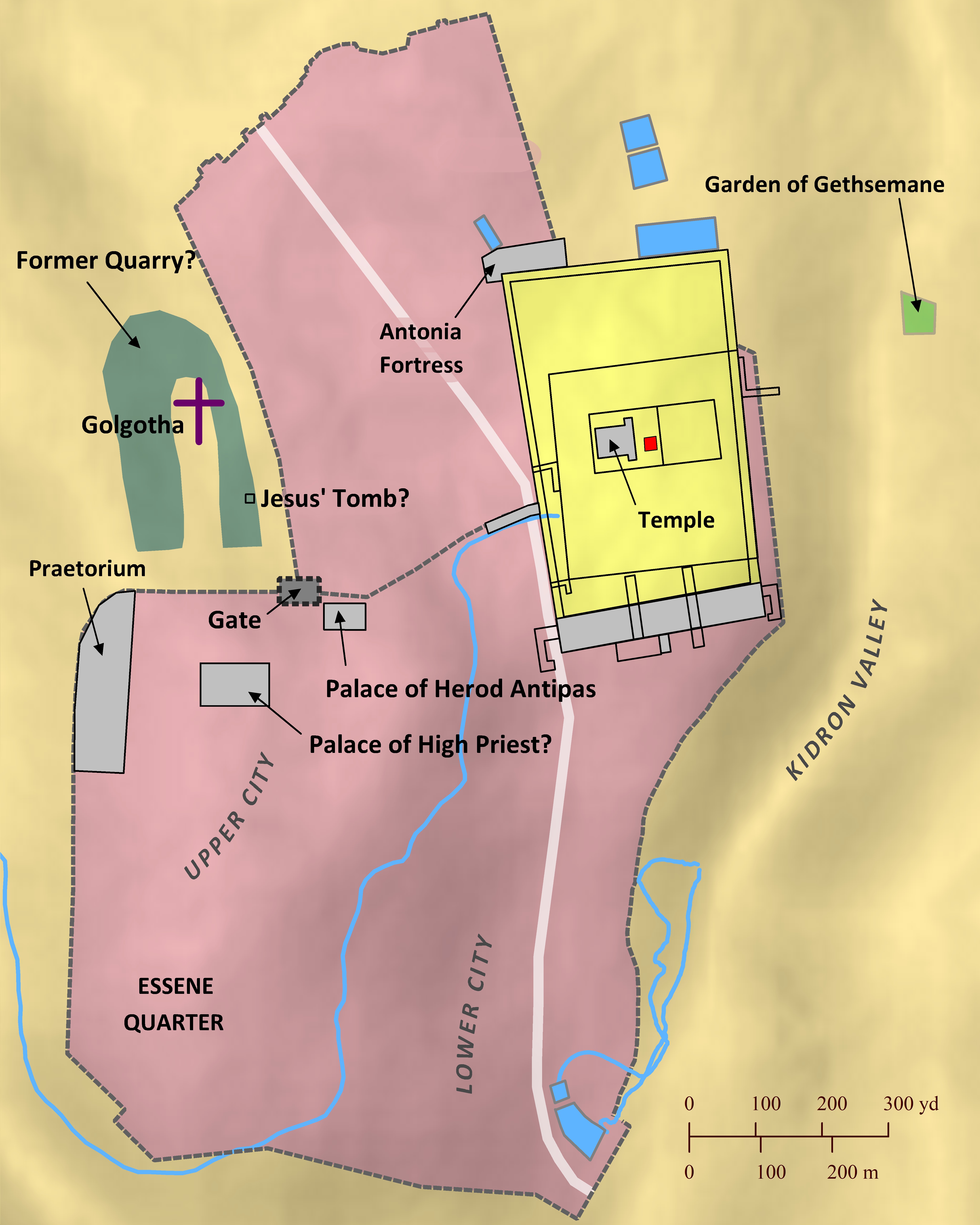
Matthew 26-27; Mark 14-15; Luke 22-23; John 13-19
On the Thursday before he was crucified, Jesus had arranged to share the Passover meal with his disciples in an upper room, traditionally thought to be located in the Essene Quarter of Jerusalem. After they finished the meal, they went to the Garden of Gethsemane, where Jesus often met with his disciples. There Judas Iscariot, one of Jesus’ own disciples, betrayed him to soldiers sent from the High Priest, and they took Jesus to the High Priest’s residence. In the morning the leading priests and teachers of the law put Jesus on trial and found him guilty of blasphemy. The council sent Jesus to stand trial for treason before the Roman governor Pontius Pilate, who resided at the Praetorium while in Jerusalem. The Praetorium was likely located at the former residence of Herod the Great, who had died over 30 years earlier. When Pilate learned that Jesus was from Galilee, he sent him to Herod Antipas, who had jurisdiction over Galilee. But when Jesus gave no answer to Herod’s many questions, Herod and his soldiers sent him back to Pilate, who conceded to the people’s demands that Jesus be crucified. Jesus was forced to carry his cross out of the city gate to Golgotha, meaning Skull Hill, referring to what may have been a small unquarried hill in the middle of an old quarry just outside the gate. After Jesus was unable to carry his cross any further, a man named Simon from Cyrene was forced to carry it for him. There at Golgotha they crucified Jesus. After Jesus died, his body was hurriedly taken down before nightfall and placed in a newly cut, rock tomb owned by Joseph of Arimathea, a member of the Jewish high council. This tomb was likely located at the perimeter of the old quarry.
Open Bible Data site copyright © 2023–2026 Freely-Given.org.
Python source code for creating these static pages is available on GitHub under an open licence.
For Bible data copyrights, see the details for each displayed Bible version.
The Open English Translation (OET) main site is at OpenEnglishTranslation.Bible or OET.Bible.