
OET OET-RV OET-LV GHT ULT UST BSB MSB BLB AICNT OEB WEBBE WMBB NET LSV FBV TCNT T4T LEB BBE Moff JPS Wymth ASV DRA YLT Drby RV SLT Wbstr KJB-1769 KJB-1611 Bshps Gnva Cvdl TNT Wycl SR-GNT UHB BrLXX BrTr Related Parallel Simple Interlinear Topics Reference Dictionary Search
ParallelVerse GEN EXO LEV NUM DEU JOB JOS JDG RUTH 1 SAM 2 SAM PSA AMOS HOS 1 KI 2 KI 1 CHR 2 CHR PROV ECC SNG JOEL MIC ISA ZEP HAB JER LAM YNA (JNA) NAH OBA DAN EZE EZRA EST NEH HAG ZEC MAL LAO GES LES ESG DNG 2 PS TOB JDT WIS SIR BAR LJE PAZ SUS BEL MAN 1 MAC 2 MAC 3 MAC 4 MAC YHN MARK MAT LUKE ACTs YAC (JAM) GAL 1 TH 2 TH 1 COR 2 COR ROM COL PHM EPH PHP 1 TIM TIT 1 PET 2 PET 2 TIM HEB YUD (JUD) 1 YHN (1 JHN) 2 YHN (2 JHN) 3 YHN (3 JHN) REV
Yhn Intro C1 C2 C3 C4 C5 C6 C7 C8 C9 C10 C11 C12 C13 C14 C15 C17 C18 C19 C20 C21
Yhn 16 V1 V2 V3 V4 V5 V6 V7 V8 V9 V10 V11 V12 V13 V14 V15 V16 V17 V18 V19 V20 V21 V22 V23 V24 V25 V26 V27 V28 V29 V30 V31 V32
Note: This view shows ‘verses’ which are not necessarily natural language units and hence sometimes only part of a sentence will be visible—click on any Bible version abbreviation down the left-hand side to see the verse in more of its context. Normally the OET discourages the reading of individual ‘verses’, but this view is only designed as a tool for Bible-translators and others doing comparisons of different translations—the older translations are further down the page (so you can read up from the bottom to trace the English translation history). The OET segments on this page are still early looks into the drafted texts of the Open English Translation of the Bible—please double-check these texts in advance before using in public.
Text critical issues=small word differences Clarity of original=clear Importance to us=important Speaker(s)=Yeshua (All still tentative.)
OET (OET-RV) I’ve told you these things so that you can all have peace in me. You will have troubles in this world, but be courageous because I have overcome the world.”
OET-LV I_have_spoken these things to_you_all, in_order_that you_all_may_be_having peace in me.
You_all_are_having tribulation in the world, but be_having_courage, I have_overcome the world.
SR-GNT Ταῦτα λελάληκα ὑμῖν, ἵνα ἐν ἐμοὶ εἰρήνην ἔχητε. Ἐν τῷ κόσμῳ θλῖψιν ἔχετε, ἀλλὰ θαρσεῖτε, ἐγὼ νενίκηκα τὸν κόσμον.” ‡
(Tauta lelalaʸka humin, hina en emoi eiraʸnaʸn eⱪaʸte. En tōi kosmōi thlipsin eⱪete, alla tharseite, egō nenikaʸka ton kosmon.”)
Key: khaki:verbs, light-green:nominative/subject, orange:accusative/object, cyan:dative/indirect object.
Note: Automatic aligning of the OET-RV to the LV is done by some temporary software, hence the RV alignments are incomplete (and may occasionally be wrong).
GHT I-have-spoken the-same to {you} in-which-place you-may-be-having peace in to {emphatically-me}. You-are-having pressure/constriction/oppression in to {the world}; contrariwise, be-having-courage; I have-conquered the world."
ULT I have spoken these things to you so that you might have peace in me. In the world you have troubles, but have courage. I have conquered the world.”
UST I have told you all these things that will happen in order that you may feel peaceful because you are united with me. In this world you will be afflicted, but be brave! I have defeated the people who oppose God in the world!”
BSB & MSB I have told you these things so that in Me you may have peace. In the world you will have tribulation. But take courage; I have overcome the world!”
BLB I have spoken these things to you so that in Me you may have peace. In the world you have tribulation. But take courage; I have overcome the world."
AICNT “[[But]][fn] These things I have spoken to you, so that in me you may have peace. [In the world {you have}[fn] tribulation.][fn] But take courage, I have overcome the world.”
16:33, But: Included in 𝔓66.
16:33, you have: Some manuscripts read “you will have.” ℵ(01) W(032).
16:33, In the world you have tribulation: Absent from some manuscripts 𝔓66.
OEB I have spoken to you in this way, so that in me you may find peace. In the world you will find trouble; yet, take courage! I have conquered the world.’
CSB I have told you these things so that in me you may have peace. You will have suffering in this world. Be courageous! I have conquered the world.”
NLT I have told you all this so that you may have peace in me. Here on earth you will have many trials and sorrows. But take heart, because I have overcome the world.”
NIV “I have told you these things, so that in me you may have peace. In this world you will have trouble. But take heart! I have overcome the world.”
CEV I have told you this, so that you might have peace in your hearts because of me. While you are in the world, you will have to suffer. But cheer up! I have defeated the world.
ESV I have said these things to you, that in me you may have peace. In the world you will have tribulation. But take heart; I have overcome the world.”
NASB “These things I have spoken to you, so that ain Me you may have peace. bIn the world you have tribulation, but ctake courage; dI have overcome the world.”
LSB These things I have spoken to you, so that in Me you may have peace. In the world you have tribulation, but take courage; I have overcome the world.”
2DT I have spoken these things to you so in me you may have peace. You have trouble in the Kosmos, but be courageous! I have conquered the Kosmos.”
WEBBE & WMBB I have told you these things, that in me you may have peace. In the world you have trouble; but cheer up! I have overcome the world.”
MSG (31-33)Jesus answered them, “Do you finally believe? In fact, you’re about to make a run for it—saving your own skins and abandoning me. But I’m not abandoned. The Father is with me. I’ve told you all this so that trusting me, you will be unshakable and assured, deeply at peace. In this godless world you will continue to experience difficulties. But take heart! I’ve conquered the world.”
NET I have told you these things so that in me you may have peace. In the world you have trouble and suffering, but take courage – I have conquered the world.”
LSV these things I have spoken to you, that in Me you may have peace, in the world you will have tribulation, but take courage—I have overcome the world.”
FBV I've told you all this so that you may have peace because you are one with me.[fn] You will suffer in this world, but be brave—I have defeated the world!”
16:33 Literally, “peace in me.”
TCNT I have said these things to you so that in me you may have peace. In the world you will have tribulation, but take heart; I have overcome the world.”
T4T I have told you these things in order that you may have inner peace because of your relationship with me. In this world you will have trouble. But be courageous! I have defeated those who are opposed to me [MTY], and you can defeat them, too!”
LEB I have said these things to you so that in me you may have peace. In the world you have affliction, but have courage! I have conquered the world.”
NRSV I have said this to you, so that in me you may have peace. In the world you face persecution. But take courage; I have conquered the world!”
NKJV These things I have spoken to you, that in Me you may have peace. In the world you will have tribulation; but be of good cheer, I have overcome the world.”
NAB I have told you this so that you might have peace in me. In the world you will have trouble, but take courage, I have conquered the world.”
BBE I have said all these things to you so that in me you may have peace. In the world you have trouble: but take heart! I have overcome the world.
Moff I have said all this to you that in me you may have peace; in the world you have trouble, but courage! I have conquered the world.
Wymth "I have spoken all this to you in order that in me you may have peace. In the world you have affliction. But keep up your courage: *I* have won the victory over the world."
¶
ASV These things have I spoken unto you, that in me ye may have peace. In the world ye have tribulation: but be of good cheer; I have overcome the world.
DRA These things I have spoken to you, that in me you may have peace. In the world you shall have distress: but have confidence, I have overcome the world.
YLT these things I have spoken to you, that in me ye may have peace, in the world ye shall have tribulation, but take courage — I have overcome the world.'
Drby These things have I spoken to you that in me ye might have peace. In the world ye have tribulation; but be of good courage: I have overcome the world.
RV These things have I spoken unto you, that in me ye may have peace. In the world ye have tribulation: but be of good cheer; I have overcome the world.
(These things have I spoken unto you, that in me ye/you_all may have peace. In the world ye/you_all have tribulation: but be of good cheer; I have overcome the world.)
SLT These have I spoken to you, that in me ye might have peace. In the world shall ye have pressure; but take courage; I have conquered the world.
Wbstr These things I have spoken to you, that in me ye may have peace. In the world ye will have tribulation, but be of good cheer: I have overcome the world.
KJB-1769 These things I have spoken unto you, that in me ye might have peace. In the world ye shall have tribulation: but be of good cheer; I have overcome the world.
( These things I have spoken unto you, that in me ye/you_all might have peace. In the world ye/you_all shall have tribulation: but be of good cheer; I have overcome the world.)
KJB-1611 These things I haue spoken vnto you, that in me ye might haue peace, in the world ye shall haue tribulation: but be of good cheare, I haue ouercome the world.
(Modernised spelling is same as from KJB-1769 above, apart from capitalisation and punctuation)
Bshps These wordes haue I spoken vnto you, that in me ye myght haue peace. For in the worlde shall ye haue tribulation: but be of good cheare, I haue ouercome the worlde.
(These words have I spoken unto you, that in me ye/you_all might have peace. For in the world shall ye/you_all have tribulation: but be of good cheer, I have overcome the world.)
Gnva These thinges haue I spoken vnto you, that in me ye might haue peace: in the world ye shall haue affliction, but be of good comfort: I haue ouercome the world.
(These things have I spoken unto you, that in me ye/you_all might have peace: in the world ye/you_all shall have affliction, but be of good comfort: I have overcome the world.)
Cvdl These thinges haue I spoken vnto you, that in me ye might haue peace. In ye worlde haue ye trouble, but be of good comforte, I haue ouercome the worlde.
(These things have I spoken unto you, that in me ye/you_all might have peace. In ye/you_all world have ye/you_all trouble, but be of good comfort, I have overcome the world.)
TNT These wordes have I spoke vnto you that in me ye might have peace. For in the worlde shall ye have tribulacion: but be of good cheare I have over come the worlde.
(These words have I spoke unto you that in me ye/you_all might have peace. For in the world shall ye/you_all have tribulation: but be of good cheer I have over come the world.)
Wycl These thingis Y haue spokun to you, that ye haue pees in me; in the world ye schulen haue disese, but trust ye, Y haue ouercomun the world.
(These things I have spoken to you, that ye/you_all have peace in me; in the world ye/you_all should have disease, but trust ye/you_all, I have overcome the world.)
Luth Solches habe ich mit euch geredet, daß ihr in mir Frieden habet. In der Welt habt ihr Angst; aber seid getrost, ich habe die Welt überwunden.
(Such have I with you talked, that you(pl)/their/her in to_me peace have. In the/of_the world have you(pl)/their/her fear/anxiety; but are confidently, I have the world overcome.)
ClVg Hæc locutus sum vobis, ut in me pacem habeatis. In mundo pressuram habebitis: sed confidite, ego vici mundum.
(These spoke I_am to_you(pl), as in/into/on me peace you(pl)_have. In to_the_world about_to_press you_will_have: but trust_me, I I_won the_world.)
UGNT ταῦτα λελάληκα ὑμῖν, ἵνα ἐν ἐμοὶ εἰρήνην ἔχητε. ἐν τῷ κόσμῳ θλῖψιν ἔχετε, ἀλλὰ θαρσεῖτε, ἐγὼ νενίκηκα τὸν κόσμον.
(tauta lelalaʸka humin, hina en emoi eiraʸnaʸn eⱪaʸte. en tōi kosmōi thlipsin eⱪete, alla tharseite, egō nenikaʸka ton kosmon.)
SBL-GNT ταῦτα λελάληκα ὑμῖν ἵνα ἐν ἐμοὶ εἰρήνην ἔχητε· ἐν τῷ κόσμῳ θλῖψιν ἔχετε, ἀλλὰ θαρσεῖτε, ἐγὼ νενίκηκα τὸν κόσμον.
(tauta lelalaʸka humin hina en emoi eiraʸnaʸn eⱪaʸte; en tōi kosmōi thlipsin eⱪete, alla tharseite, egō nenikaʸka ton kosmon.)
RP-GNT Ταῦτα λελάληκα ὑμῖν, ἵνα ἐν ἐμοὶ εἰρήνην ἔχητε. Ἐν τῷ κόσμῳ θλίψιν ἔχετε· ἀλλὰ θαρσεῖτε, ἐγὼ νενίκηκα τὸν κόσμον.
(Tauta lelalaʸka humin, hina en emoi eiraʸnaʸn eⱪaʸte. En tōi kosmōi thlipsin eⱪete; alla tharseite, egō nenikaʸka ton kosmon.)
TC-GNT ταῦτα λελάληκα ὑμῖν, ἵνα ἐν ἐμοὶ εἰρήνην ἔχητε. ἐν τῷ κόσμῳ θλῖψιν [fn]ἔχετε· ἀλλὰ θαρσεῖτε, ἐγὼ νενίκηκα τὸν κόσμον.
(tauta lelalaʸka humin, hina en emoi eiraʸnaʸn eⱪaʸte. en tōi kosmōi thlipsin eⱪete; alla tharseite, egō nenikaʸka ton kosmon.)
16:33 εχετε ¦ εξετε ᴀɴᴛ ꜱᴄʀ
Key for above GNTs: yellow:punctuation differs, orange:accents differ (from our SR-GNT base).
Jesus explained to the disciples that he would return to his Father in heaven. The disciples declared their belief that Jesus was from God, but Jesus questioned the strength of their belief. He told them that they would scatter, but he would still have the Father with him. He told them these things so that they would have peace. He said that even though they would face persecution in the world, he had defeated the world (system).
Here are some other possible section headings:
Jesus promised the disciples peace when they would be persecuted
The disciples can have courage when others will persecute them
Jesus warned his disciples that they would soon face hard times. But he would give them inner peace.
I have told you these things so that in Me you may have peace.
I have told you(plur) these things so that you may have peace through me.
I have warned you(plur) about all that will happen so that when it does happen you may have peaceful hearts/minds because you are united with me.
I have told you these things: The Greek word that the BSB translates literally as these things refers to all that Jesus had said that night. Here are other ways to translate this clause:
I have told you this (CEV)
I have told you all this (NLT)
so that in Me you may have peace: This is a purpose clause. Jesus said what he did in order to give his disciples inner peace. They would have this peace as a result of their relationship with him. The Greek text emphasizes the phrase in Me to contrast with “in the world” in 16:33b. Here are other ways to translate this clause:
so that my peace will be with you (GW)
so that you might have peace in your hearts because of me (CEV)
so that you will have peace by being united to me (GNT)
peace: The Greek word that the BSB translates as peace here refers to spiritual and emotional welfare. That means unity with God and an absence of worry and fear, even in bad circumstances. See Peace KBT 3(c). See how you translated this word in 14:27.
In the world you will have tribulation.
Living in this world you(plur) will receive mistreatment/abuse.
As long as you(plur) live in this world of unbelievers, they, will persecute/abuse you.
In the world: This phrase means “in this world full of evil and unbelief.” The Greek text emphasizes this phrase to contrast with “in me” in 16:33a. Jesus gives peace, but the world gives persecution.
you will have tribulation: This clause means “people will persecute you” or “people will make you suffer.” For example:
you will have trouble (NIV)
you will have to suffer (CEV)
you have trouble and suffering (NET)
you will have many trials and sorrows (NLT)
The world will make you suffer. (GNT)
But take courage; I have overcome the world!”
But cheer(plur) up! I have overcome the evil power/system of this world.”
But do not worry(plur). I have defeated the power of this world.”
But: This conjunction introduces what the disciples should do when unbelievers persecute them. The conjunction indicates that what follows is not expected. Instead of being afraid as you might expect someone to be when facing persecution, Jesus tells them to take courage.
take courage: The word the BSB has translated as take courage means “be cheerful.” It is a command. For example:
take heart (NLT)
cheer up! (CEV)
be brave! (NCV)
I have overcome the world!: This clause indicates the reason that the disciples could be cheerful and brave when they were persecuted. They could be cheerful and brave because Jesus had defeated this evil world system. See 12:31. Here are other ways to translate this clause:
I have defeated the world! (GNT)
because I have overcome the world (NLT)
In some languages it may be necessary to indicate that this was not a military victory or a battle against the world’s people. It was a victory against the evil world system under the influence of Satan. For example:
I have destroyed the power of this world. (TH)
I have defeated the boss of my enemies. (Manobo Back Translation)
I: The Greek text emphasizes this pronoun. For example:
I myself have conquered the world!
In some languages it may be difficult to just use the word “world” in both places in this verse. You may need to add some information to make the meaning clear. For example:
Here in this world you will be persecuted by the people who do not follow God. But do not be afraid. I have defeated their leader. (Yakan Back Translation)
It’s true that you will be persecuted in this world. But be brave because I have already defeated the evil that is in this world.
Note 1 topic: figures-of-speech / explicit
ἵνα ἐν ἐμοὶ εἰρήνην ἔχητε
in_order_that in (Some words not found in SR-GNT: ταῦτα Λελάληκα ὑμῖν ἵνα ἐν ἐμοί εἰρήνην ἔχητε ἐν τῷ κόσμῳ θλῖψιν Ἔχετε ἀλλά θαρσεῖτε ἐγώ νενίκηκα τόν κόσμον)
If your language does not use an abstract noun for this idea, you could express the idea behind the abstract noun peace in another way. Alternate translation: [so that you might experience a peaceful feeling in me]
Note 2 topic: figures-of-speech / metaphor
εἰρήνην ἔχητε & θλῖψιν ἔχετε
peace ˱you_all˲_˓may_be˒_having & tribulation (Some words not found in SR-GNT: ταῦτα Λελάληκα ὑμῖν ἵνα ἐν ἐμοί εἰρήνην ἔχητε ἐν τῷ κόσμῳ θλῖψιν Ἔχετε ἀλλά θαρσεῖτε ἐγώ νενίκηκα τόν κόσμον)
Jesus speaks of peace and troubles as if they were objects that someone can possess. If these uses of peace and troubles might confuse your readers, you could use different expressions. Alternate translation: [you might be peaceful … you experience troubles]
Note 3 topic: figures-of-speech / idiom
ἐν ἐμοὶ
in in (Some words not found in SR-GNT: ταῦτα Λελάληκα ὑμῖν ἵνα ἐν ἐμοί εἰρήνην ἔχητε ἐν τῷ κόσμῳ θλῖψιν Ἔχετε ἀλλά θαρσεῖτε ἐγώ νενίκηκα τόν κόσμον)
Here, in me refers to being united with Jesus or having a close relationship with him. If this might confuse your readers, you could express the meaning plainly. Alternate translation: [because of your relationship with me]
Note 4 topic: figures-of-speech / metonymy
ἐγὼ νενίκηκα τὸν κόσμον
(Some words not found in SR-GNT: ταῦτα Λελάληκα ὑμῖν ἵνα ἐν ἐμοί εἰρήνην ἔχητε ἐν τῷ κόσμῳ θλῖψιν Ἔχετε ἀλλά θαρσεῖτε ἐγώ νενίκηκα τόν κόσμον)
Jesus uses world to refer to the people in the world who oppose God. See how you translated world in [14:17](../14/17.md).
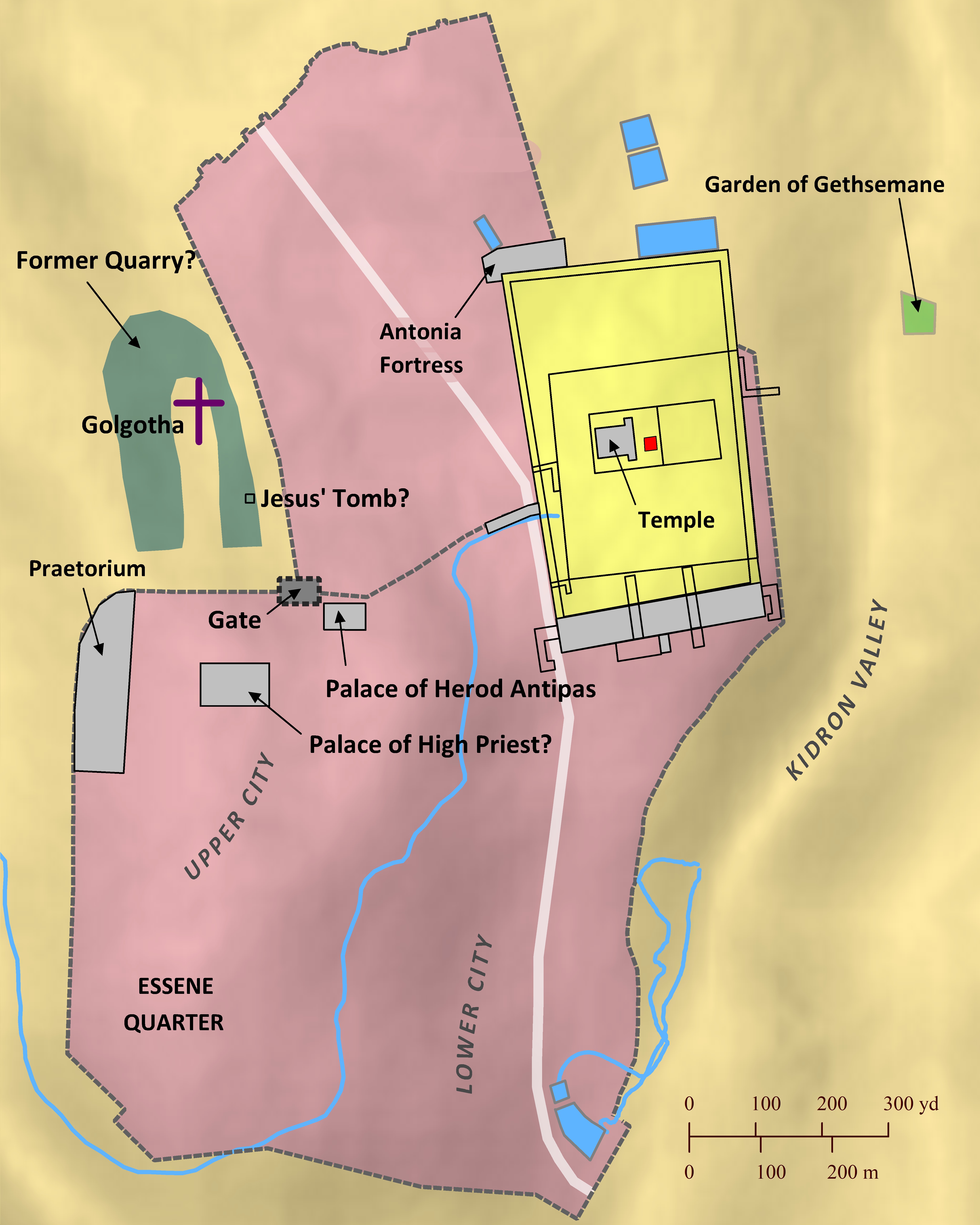
Matthew 26-27; Mark 14-15; Luke 22-23; John 13-19
On the Thursday before he was crucified, Jesus had arranged to share the Passover meal with his disciples in an upper room, traditionally thought to be located in the Essene Quarter of Jerusalem. After they finished the meal, they went to the Garden of Gethsemane, where Jesus often met with his disciples. There Judas Iscariot, one of Jesus’ own disciples, betrayed him to soldiers sent from the High Priest, and they took Jesus to the High Priest’s residence. In the morning the leading priests and teachers of the law put Jesus on trial and found him guilty of blasphemy. The council sent Jesus to stand trial for treason before the Roman governor Pontius Pilate, who resided at the Praetorium while in Jerusalem. The Praetorium was likely located at the former residence of Herod the Great, who had died over 30 years earlier. When Pilate learned that Jesus was from Galilee, he sent him to Herod Antipas, who had jurisdiction over Galilee. But when Jesus gave no answer to Herod’s many questions, Herod and his soldiers sent him back to Pilate, who conceded to the people’s demands that Jesus be crucified. Jesus was forced to carry his cross out of the city gate to Golgotha, meaning Skull Hill, referring to what may have been a small unquarried hill in the middle of an old quarry just outside the gate. After Jesus was unable to carry his cross any further, a man named Simon from Cyrene was forced to carry it for him. There at Golgotha they crucified Jesus. After Jesus died, his body was hurriedly taken down before nightfall and placed in a newly cut, rock tomb owned by Joseph of Arimathea, a member of the Jewish high council. This tomb was likely located at the perimeter of the old quarry.
Open Bible Data site copyright © 2023–2026 Freely-Given.org.
Python source code for creating these static pages is available on GitHub under an open licence.
For Bible data copyrights, see the details for each displayed Bible version.
The Open English Translation (OET) main site is at OpenEnglishTranslation.Bible or OET.Bible.