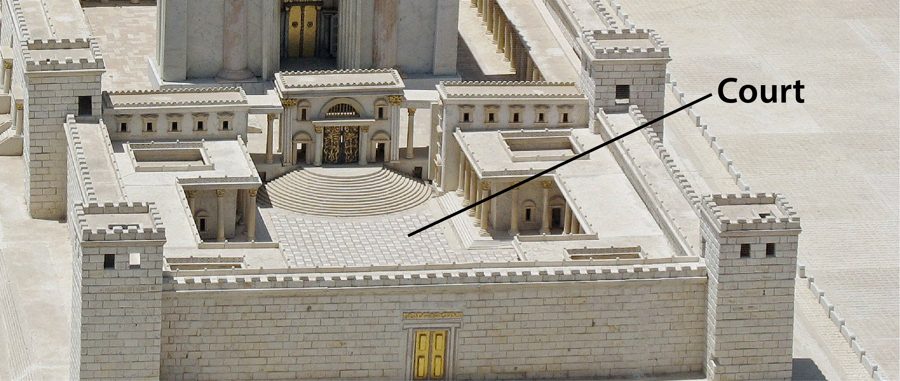
Temple courtyard (© Ariely, CC BY 3.0, via Wikimedia Commons)
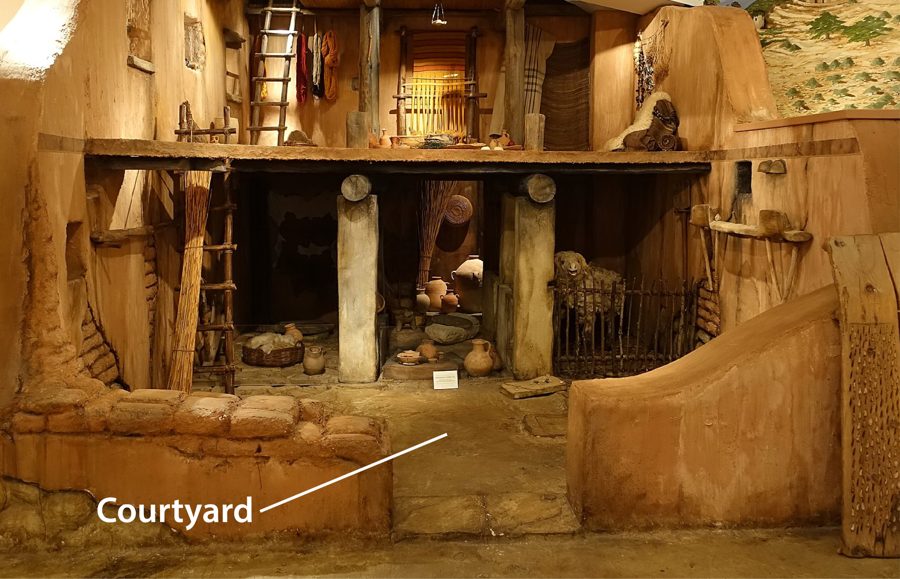
Courtyard of a house (Daderot, CC0, via Wikimedia Commons)
References
- Hebrew חָצֵר chatser: EXO 8:13, EXO 27:9, EXO 27:12, EXO 27:13, EXO 27:16, EXO 27:17, EXO 27:18, EXO 27:19
110 more references
EXO 35:17, EXO 35:18, EXO 38:9, EXO 38:15, EXO 38:16, EXO 38:17, EXO 38:18, EXO 38:20, EXO 38:31, EXO 39:40, EXO 40:8, EXO 40:33, LEV 6:16, LEV 6:26, NUM 3:26, NUM 3:37, NUM 4:26, NUM 4:32, 2 SAM 17:18, 1 KI 6:36, 1 KI 7:8, 1 KI 7:9, 1 KI 7:12, 1 KI 8:64, 2 KI 20:4, 2 KI 21:5, 2 KI 23:12, 1 CHR 23:28, 1 CHR 28:6, 1 CHR 28:12, 2 CHR 4:9, 2 CHR 7:7, 2 CHR 20:5, 2 CHR 23:5, 2 CHR 24:21, 2 CHR 29:16, 2 CHR 33:5, NEH 3:25, NEH 8:16, NEH 13:7, EST 1:5, EST 2:11, EST 4:11, EST 5:1, EST 5:2, EST 6:4, EST 6:5, PSA 65:4, PSA 84:2, PSA 84:10, PSA 92:13, PSA 96:8, PSA 100:4, PSA 116:19, PSA 135:2, ISA 1:12, ISA 62:9, YIR 19:14, YIR 26:2, YIR 32:2, YIR 32:8, YIR 32:12, YIR 33:1, YIR 36:10, YIR 36:20, YIR 37:21, YIR 38:6, YIR 38:13, YIR 38:28, YIR 39:14, YIR 39:15, EZEK 8:7, EZEK 8:16, EZEK 9:7, EZEK 10:3, EZEK 10:4, EZEK 10:5, EZEK 40:14, EZEK 40:17, EZEK 40:19, EZEK 40:20, EZEK 40:23, EZEK 40:27, EZEK 40:28, EZEK 40:31, EZEK 40:32, EZEK 40:34, EZEK 40:37, EZEK 40:44, EZEK 40:47, EZEK 41:15, EZEK 42:1, EZEK 42:3, EZEK 42:6, EZEK 42:7, EZEK 42:8, EZEK 42:9, EZEK 42:10, EZEK 42:14, EZEK 43:5, EZEK 44:17, EZEK 44:19, EZEK 44:21, EZEK 44:27, EZEK 45:19, EZEK 46:1, EZEK 46:20, EZEK 46:21, EZEK 46:22, ZEC 3:7 - Hebrew עֲזָרָה ‘azarah: 2 CHR 4:9, 2 CHR 6:13
- Greek αὐλαῖος aulaios: 2 MAC 14:41
- Greek αὐλή aulē: MAT 26:3, MAT 26:58, MAT 26:69, MARK 14:54, MARK 14:66, MARK 15:16, LUKE 11:21, LUKE 22:55
15 more references
YHN 18:15, REV 11:2, TOB 2:9, ESG 1:1, ESG 2:11, ESG 4:2, L JER 1:17, 1 MAC 4:38, 1 MAC 4:48, 1 MAC 9:54, 1 MAC 11:46, 3 MAC 2:27, 3 MAC 5:10, 3 MAC 5:46, G ESD 9:1 - Greek περιβολή peribolē: SIR 50:11
- Aramaic תְּרַע tera‘: DAN 2:49
Description
The courtyard was an open area enclosed by structures within a building complex, such as the Temple, a palace, or even a house.
———
Translation
As in English, so also in the biblical languages the words for “court” indicate both the physical courtyard and also the place of residence or activity of a king.
A number of times in the Old Testament, particularly in the Psalms, we encounter a phrase like “the courts of Yahweh,” “your courts,” or “my courts.” In these places the word “courts” is a metonym for the Tabernacle or the Temple, and where necessary it may be translated as such. For example, in PSA 65:4GNT has “your sanctuary” and CEV says “your temple.” The translator should avoid using a word that indicates a court of law.
In some places the Greek word aulē refers to the courtyard of a private house. It has this meaning in MAT 26:3 and LUKE 11:21, so CEV renders it “home” in these passages.
REV 11:2: “The court outside the temple” (RSV) was known as the Court of the Gentiles, for that is where they could assemble. They could not get closer to the inner sanctuary, however. In this passage this court and its people stand for the unbelievers, who will not be spared the disasters to come. Another way of expressing the initial clause in this verse is “But do not measure the open spaces with walls around them outside the Temple.”
 Open English Translation (OET)