
OET OET-RV OET-LV GHT ULT UST BSB MSB BLB AICNT OEB WEBBE WMBB NET LSV FBV TCNT T4T LEB BBE Moff JPS Wymth ASV DRA YLT Drby RV SLT Wbstr KJB-1769 KJB-1611 Bshps Gnva Cvdl TNT Wycl SR-GNT UHB BrLXX BrTr Related Parallel Simple Interlinear Topics Reference Dictionary Search
ParallelVerse GEN EXO LEV NUM DEU JOB JOS JDG RUTH 1 SAM 2 SAM PSA AMOS HOS 1 KI 2 KI 1 CHR 2 CHR PROV ECC SNG JOEL MIC ISA ZEP HAB JER LAM YNA (JNA) NAH OBA DAN EZE EZRA EST NEH HAG ZEC MAL LAO GES LES ESG DNG 2 PS TOB JDT WIS SIR BAR LJE PAZ SUS BEL MAN 1 MAC 2 MAC 3 MAC 4 MAC YHN (JHN) MARK MAT LUKE ACTs YAC (JAM) GAL 1 TH 2 TH 1 COR 2 COR ROM COL PHM EPH PHP 1 TIM TIT 1 PET 2 PET 2 TIM HEB YUD (JUD) 1 YHN (1 JHN) 2 YHN (2 JHN) 3 YHN (3 JHN) REV
Yhn Intro C1 C2 C3 C4 C5 C6 C7 C8 C9 C10 C12 C13 C14 C15 C16 C17 C18 C19 C20 C21
Yhn 11 V1 V3 V5 V7 V9 V11 V13 V15 V17 V19 V21 V23 V25 V27 V29 V31 V33 V35 V37 V39 V41 V43 V45 V47 V49 V51 V53 V55 V57
Note: This view shows ‘verses’ which are not necessarily natural language units and hence sometimes only part of a sentence will be visible—click on any Bible version abbreviation down the left-hand side to see the verse in more of its context. Normally the OET discourages the reading of individual ‘verses’, but this view is only designed as a tool for Bible-translators and others doing comparisons of different translations—the older translations are further down the page (so you can read up from the bottom to trace the English translation history). The OET segments on this page are still early looks into the drafted texts of the Open English Translation of the Bible—please double-check these texts in advance before using in public.
Text critical issues=small word differences Clarity of original=clear Importance to us=normal Speaker(s)=Narrator (All still tentative.)
OET (OET-RV) But others went and told the Pharisee party what Yeshua had done.
OET-LV But some of them went_away to the Farisaios_party, and told to_them what Yaʸsous did.
SR-GNT Τινὲς δὲ ἐξ αὐτῶν ἀπῆλθον πρὸς τοὺς Φαρισαίους, καὶ εἶπον αὐτοῖς ἃ ἐποίησεν ˚Ἰησοῦς. ‡
(Tines de ex autōn apaʸlthon pros tous Farisaious, kai eipon autois ha epoiaʸsen ˚Yaʸsous.)
Key: khaki:verbs, light-green:nominative/subject, orange:accusative/object, pink:genitive/possessor, cyan:dative/indirect object.
Note: Automatic aligning of the OET-RV to the LV is done by some temporary software, hence the RV alignments are incomplete (and may occasionally be wrong).
GHT Moreover, some out of {same} come-off/away toward the Pharisees and say to {same} what the Jesus does.
ULT But some of them went away to the Pharisees and told them what Jesus had done.
UST Nevertheless, some of the people there went to the Pharisees and reported to them what Jesus had done.
BSB But some of them went to the Pharisees and told them what Jesus had done.
MSB But some of them went to the Pharisees and told them what[fn] Jesus had done.
11:46 F35 all that
BLB But some of them went to the Pharisees and told them what Jesus had done.
AICNT But some of them went to the Pharisees and told them what Jesus had done.
OEB Some of them, however, went to the Pharisees, and told them what he had done.
WEBBE But some of them went away to the Pharisees and told them the things which Jesus had done.
WMBB But some of them went away to the Pharisees and told them the things which Yeshua had done.
NET But some of them went to the Pharisees and reported to them what Jesus had done.
LSV but certain of them went away to the Pharisees, and told them what Jesus did;
FBV But others went to the Pharisees and told them what Jesus had done.
TCNT But some of them went to the Pharisees and told them [fn]what Jesus had done.
11:46 what ¦ all that PCK
T4T But some of the others went to the Pharisees and told them what Jesus had done.
LEB But some of them went to the Pharisees and told them the things which Jesus had done.
BBE But some of them went to the Pharisees with the news of what Jesus had done.
Moff But some of them went off to the Pharisees and told them what Jesus had done;
Wymth though some of them went off to the Pharisees and told them what He had done.
ASV But some of them went away to the Pharisees, and told them the things which Jesus had done.
DRA But some of them went to the Pharisees, and told them the things that Jesus had done.
YLT but certain of them went away unto the Pharisees, and told them what Jesus did;
Drby but some of them went to the Pharisees and told them what Jesus had done.
RV But some of them went away to the Pharisees, and told them the things which Jesus had done.
SLT But certain of them departed to the Pharisees, and said to them what Jesus did.
Wbstr But some of them went to the Pharisees, and told them what things Jesus had done.
KJB-1769 But some of them went their ways to the Pharisees, and told them what things Jesus had done.
KJB-1611 But some of them went their wayes to the Pharises, and tolde them what things Iesus had done.
(Modernised spelling is same as from KJB-1769 above)
Bshps But some of them went their wayes to the pharisees, and tolde them what Iesus had done.
(But some of them went their ways to the Pharisees, and told them what Yesus/Yeshua had done.)
Gnva But some of them went their way to the Pharises, and told them what things Iesus had done.
(But some of them went their way to the Pharisees, and told them what things Yesus/Yeshua had done.)
Cvdl But some of the wente their waye vnto the pharises, and tolde the what Iesus had done.
(But some of the went their way unto the Pharisees, and told the what Yesus/Yeshua had done.)
TNT But some of them went their wayes to the Pharises and tolde them what Iesus had done.
(But some of them went their ways to the Pharisees and told them what Yesus/Yeshua had done.)
Wycl But summe of hem wente to the Farisees, and seiden to hem, what thingis Jhesus `hadde don.
(But some of hem went to the Pharisees, and said to them, what things Yesus/Yeshua had done.)
Luth Etliche aber von ihnen gingen hin zu den Pharisäern und sagten ihnen, was JEsus getan hatte.
(Several but from to_them went there/therefore to/for the Pharisees and said to_them, what/which Yesus did had.)
ClVg Quidam autem ex ipsis abierunt ad pharisæos, et dixerunt eis quæ fecit Jesus.
(Some however from themselves they_are_gone to Pharisees, and they_said to_them which he_did Yesus.)
UGNT τινὲς δὲ ἐξ αὐτῶν ἀπῆλθον πρὸς τοὺς Φαρισαίους, καὶ εἶπον αὐτοῖς ἃ ἐποίησεν Ἰησοῦς.
(tines de ex autōn apaʸlthon pros tous Farisaious, kai eipon autois ha epoiaʸsen Yaʸsous.)
SBL-GNT τινὲς δὲ ἐξ αὐτῶν ἀπῆλθον πρὸς τοὺς Φαρισαίους καὶ εἶπαν αὐτοῖς ἃ ⸀ἐποίησεν Ἰησοῦς.
(tines de ex autōn apaʸlthon pros tous Farisaious kai eipan autois ha ⸀epoiaʸsen Yaʸsous.)
RP-GNT Τινὲς δὲ ἐξ αὐτῶν ἀπῆλθον πρὸς τοὺς Φαρισαίους, καὶ εἶπον αὐτοῖς ἃ ἐποίησεν ὁ Ἰησοῦς.
(Tines de ex autōn apaʸlthon pros tous Farisaious, kai eipon autois ha epoiaʸsen ho Yaʸsous.)
TC-GNT τινὲς δὲ ἐξ αὐτῶν ἀπῆλθον πρὸς τοὺς Φαρισαίους, καὶ [fn]εἶπον αὐτοῖς [fn]ἃ ἐποίησεν [fn]ὁ Ἰησοῦς.
(tines de ex autōn apaʸlthon pros tous Farisaious, kai eipon autois ha epoiaʸsen ho Yaʸsous.)
Key for above GNTs: yellow:punctuation differs, red:words differ (from our SR-GNT base).
This section tells that many Jews who saw Jesus raise Lazarus believed in him. But others reported him to the Pharisees. The council met to discuss what to do with Jesus. They were afraid that if everyone believed in Jesus, the Roman government would destroy the Jewish temple and nation. The high priest Caiaphas said that it was better for Jesus to die than the whole nation be destroyed. That was true, but not in the way that Caiaphas meant. Jesus’ death would bring salvation to all people.
Jesus no longer walked around in public and stayed in Ephraim. When people went to Jerusalem for the Passover feast, they looked for Jesus, thinking that he would not go there. That was because the chief priests and Pharisees had ordered people to tell them if they knew where Jesus was. Then they could arrest him.
Here are some other possible headings for this section:
The Jewish council decided to kill Jesus
The plot to kill Jesus
The Jews from Judea responded in different ways to the miracle that they just saw. Some believed, and others reported it to the Jewish authorities. The authorities discussed the matter in their council.
But some of them went to the Pharisees
But some of those people went to the Pharisees
However, some others of them went and reported to the religious leaders, the Pharisees,
But: The word But introduces a contrast. While some people who saw the miracle believed, others reported what happened to the Pharisees. They were opposed to Jesus.
some of them went to the Pharisees: The phrase some of them refers to some of the Jewish people from Judea. They were not among the “many” Jewish people who believed in Jesus (11:45a). These Jews reported what Jesus did to the Pharisees. These Pharisees had not been there and were opposed to Jesus.
the Pharisees: The Pharisees were a Jewish religious group or party. It was very important to them to obey all of the Jewish religious laws very carefully and exactly. Here are some ways to translate this word:
Transliterate the word Pharisees according to the sounds of your language and indicate that it refers to people. For example:
Farisi members
Parise adherents
Transliterate the word Pharisees and indicate that it refers to a group of people with certain beliefs. For example:
people belonging to the Farise religious group
members of the religious group called the Farasi
See how you translated this in 1:24 and see the note there.
and told them what Jesus had done.
and told them what Jesus did.
that Jesus brought/raised someone back from the dead.
told them what Jesus had done: The people who went to the Pharisees told the Pharisees that Jesus had raised Lazarus from the dead. Here are other ways to translate this expression:
reported what he had done (REB)
told them about Jesus’ actions/deeds
what Jesus had done: The Greek text here uses the plural form for what (“what things”), but it mainly refers to Jesus’ raising of Lazarus. See how you translated “what Jesus did” in 11:45b.
In some languages it may be natural to use direct speech for what these people told the Pharisees. If you do that, it may be necessary to supply information about what Jesus did. For example:
and told them, “Jesus has raised a man from the dead.”
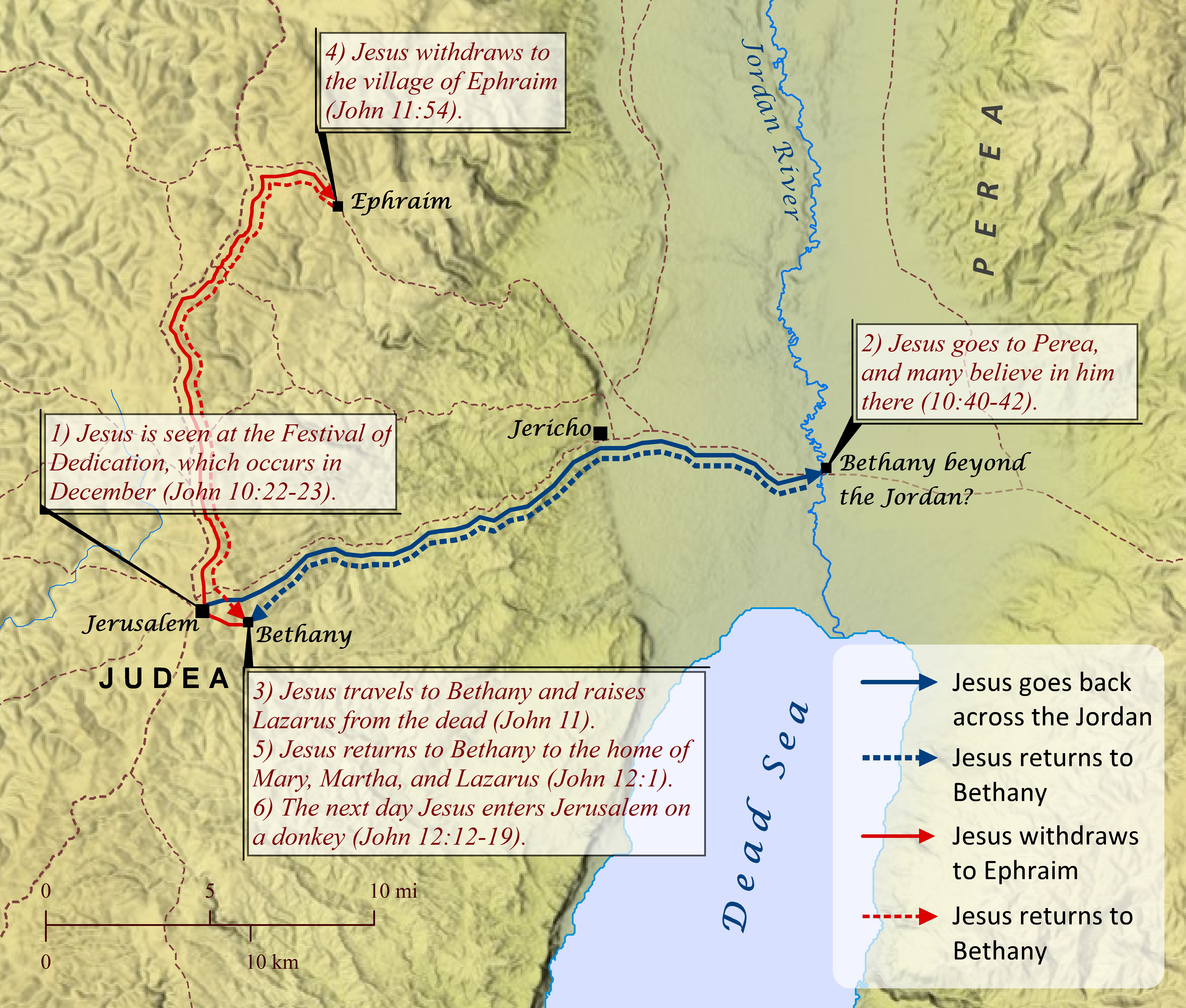
Much like the difficulties of discerning the Israelites’ journey to the Promised Land (see here), the task of reconciling the four Gospel accounts of Jesus’ final journey to Jerusalem into one coherent itinerary has proven very challenging for Bible scholars. As with many other events during Jesus’ ministry, the accounts of Matthew, Mark, and Luke (often referred to as the Synoptic Gospels) present a noticeably similar account of Jesus’ final travels, while John’s Gospel presents an itinerary that is markedly different from the others. In general, the Synoptic Gospels present Jesus as making a single journey to Jerusalem, beginning in Capernaum (Luke 9:51), passing through Perea (Matthew 19:1-2; Mark 10:1) and Jericho (Matthew 20:29-34; Mark 10:46-52; Luke 18:35-19:10), and ending at Bethany and Bethphage, where he enters Jerusalem riding on a donkey (Matthew 21:1-11; Mark 11:1-11; Luke 19:28-44). John, on the other hand, mentions several trips to Jerusalem by Jesus (John 2:13-17; 5:1-15; 7:1-13; 10:22-23), followed by a trip to Perea across the Jordan River (John 10:40-42), a return to Bethany where he raises Lazarus from the dead (John 11), a withdrawal to the village of Ephraim for a few months (John 11:54), and a return trip to Bethany, where he then enters Jerusalem riding on a donkey (John 12:1-19). The differences between the Synoptics’ and John’s accounts are noteworthy, but they are not irreconcilable. The Synoptics, after noting that Jesus began his trip at Capernaum, likely condensed their accounts (as occurs elsewhere in the Gospels) to omit Jesus’ initial arrival in Jerusalem and appearance at the Festival of Dedication, thus picking up with Jesus in Perea (stage 2 of John’s itinerary). Then all the Gospels recount Jesus’ trip (back) to Bethany and Jerusalem, passing through Jericho along the way. Likewise, the Synoptics must have simply omitted the few months Jesus spent in Ephraim to escape the Jewish leaders (stage 4 of John’s itinerary) and rejoined John’s account where Jesus is preparing to enter Jerusalem on a donkey.
Open Bible Data site copyright © 2023–2026 Freely-Given.org.
Python source code for creating these static pages is available on GitHub under an open licence.
For Bible data copyrights, see the details for each displayed Bible version.
The Open English Translation (OET) main site is at OpenEnglishTranslation.Bible or OET.Bible.