
OET OET-RV OET-LV GHT ULT UST BSB MSB BLB AICNT OEB WEBBE WMBB NET LSV FBV TCNT T4T LEB BBE Moff JPS Wymth ASV DRA YLT Drby RV SLT Wbstr KJB-1769 KJB-1611 Bshps Gnva Cvdl TNT Wycl SR-GNT UHB BrLXX BrTr Related Parallel Simple Interlinear Topics Reference Dictionary Search
ParallelVerse GEN EXO LEV NUM DEU JOB JOS JDG RUTH 1 SAM 2 SAM PSA AMOS HOS 1 KI 2 KI 1 CHR 2 CHR PROV ECC SNG JOEL MIC ISA ZEP HAB JER LAM YNA (JNA) NAH OBA DAN EZE EZRA EST NEH HAG ZEC MAL LAO GES LES ESG DNG 2 PS TOB JDT WIS SIR BAR LJE PAZ SUS BEL MAN 1 MAC 2 MAC 3 MAC 4 MAC YHN MARK MAT LUKE ACTs YAC (JAM) GAL 1 TH 2 TH 1 COR 2 COR ROM COL PHM EPH PHP 1 TIM TIT 1 PET 2 PET 2 TIM HEB YUD (JUD) 1 YHN (1 JHN) 2 YHN (2 JHN) 3 YHN (3 JHN) REV
Yhn Intro C1 C2 C3 C4 C5 C6 C7 C8 C9 C10 C11 C12 C13 C14 C15 C16 C17 C19 C20 C21
Yhn 18 V1 V2 V3 V4 V5 V6 V7 V8 V9 V10 V11 V12 V13 V14 V15 V16 V17 V18 V19 V20 V21 V22 V23 V24 V25 V26 V27 V28 V29 V30 V31 V32 V33 V34 V35 V37 V38 V39 V40
Note: This view shows ‘verses’ which are not necessarily natural language units and hence sometimes only part of a sentence will be visible—click on any Bible version abbreviation down the left-hand side to see the verse in more of its context. Normally the OET discourages the reading of individual ‘verses’, but this view is only designed as a tool for Bible-translators and others doing comparisons of different translations—the older translations are further down the page (so you can read up from the bottom to trace the English translation history). The OET segments on this page are still early looks into the drafted texts of the Open English Translation of the Bible—please double-check these texts in advance before using in public.
Text critical issues=small word differences Clarity of original=clear Importance to us=normal Speaker(s)=Yeshua,Narrator,Yeshua (All still tentative.)
OET (OET-RV) “My kingdom isn’t in this world,” Yeshua answered, “because if it was, my supporters would have fought so that I wouldn’t have been handed over to the Jewish leaders. But no, my kingdom isn’t from here.”
OET-LV Yaʸsous/(Yəhōshūˊa) answered:
- my the kingdom is not of the world this, if the my the kingdom was of this the world, the my the attendants would were_fighting, in_order_that I_may_ not _be_given_over to_the Youdaiōns.
But now the my the kingdom is not from_here.
SR-GNT Ἀπεκρίθη ˚Ἰησοῦς, “Ἡ βασιλεία ἡ ἐμὴ οὐκ ἔστιν ἐκ τοῦ κόσμου τούτου· εἰ ἐκ τοῦ κόσμου τούτου ἦν ἡ βασιλεία ἡ ἐμή, οἱ ὑπηρέται οἱ ἐμοὶ ἠγωνίζοντο ἄν, ἵνα μὴ παραδοθῶ τοῖς Ἰουδαίοις. Νῦν δὲ ἡ βασιλεία ἡ ἐμὴ οὐκ ἔστιν ἐντεῦθεν.” ‡
(Apekrithaʸ ˚Yaʸsous, “Haʸ basileia haʸ emaʸ ouk estin ek tou kosmou toutou; ei ek tou kosmou toutou aʸn haʸ basileia haʸ emaʸ, hoi hupaʸretai hoi emoi aʸgōnizonto an, hina maʸ paradothō tois Youdaiois. Nun de haʸ basileia haʸ emaʸ ouk estin enteuthen.”)
Key: khaki:verbs, light-green:nominative/subject, pink:genitive/possessor, cyan:dative/indirect object, red:negative.
Note: Automatic aligning of the OET-RV to the LV is done by some temporary software, hence the RV alignments are incomplete (and may occasionally be wrong).
GHT Jesus responds, "The kingdom, the mine, is_not_being out of {the world, the-same}. If supposing out of {the world, the-same} has-been-being the kingdom, the mine, the subordinates, the to {emphatically-me}, have-been-competing/contending, in-which-place I-would_not_be-given-aside/delivered to {the Judeans}; moreover, now the kingdom, the mine, is_not_being from-here."
ULT Jesus answered, “My kingdom is not from this world. If my kingdom were from this world, my servants would fight so that I would not be handed over to the Jews. But now my kingdom is not from here.”
UST Jesus replied, “The kingdom that I rule over does not belong to this sinful world. If it did, my servants would have fought in order to prevent the Jewish leaders from arresting me. But, as it is, the kingdom that I rule over does not belong to this sinful world.”
BSB & MSB Jesus answered, “My kingdom is not of this world; if [it] were, My servants would fight to prevent My arrest by the Jews. But now My kingdom is not of this realm.”
BLB Jesus answered, "My kingdom is not of this world; if My kingdom were of this world, My attendants would fight that I might not be betrayed to the Jews. But now My kingdom is not from here."
AICNT Jesus answered, “My kingdom is not of this world; if my kingdom were of this world, my servants would have been fighting [perhaps][fn] that I might not be delivered over to the Jews; but now my kingdom is not from here.”
18:36, perhaps: Absent from B(03) Latin(a b e).
OEB ‘My kingly power,’ replied Jesus, ‘is not due to this world. If it had been so, my servants would be doing their utmost to prevent my being given up to the authorities; but my kingly power is not from the world.’
WEBBE Jesus answered, “My Kingdom is not of this world. If my Kingdom were of this world, then my servants would fight, that I wouldn’t be delivered to the Jews. But now my Kingdom is not from here.”
WMBB Yeshua answered, “My Kingdom is not of this world. If my Kingdom were of this world, then my servants would fight, that I wouldn’t be delivered to the Judeans. But now my Kingdom is not from here.”
NET Jesus replied, “My kingdom is not from this world. If my kingdom were from this world, my servants would be fighting to keep me from being handed over to the Jewish authorities. But as it is, my kingdom is not from here.”
LSV Jesus answered, “My kingdom is not of this world; if My kingdom were of this world, My officers had struggled that I might not be delivered up to Jews; but now My kingdom is not from here.”
FBV Jesus answered, “My kingdom is not of this world. If it was of this world, my subjects would fight to keep me from being handed over to the Jews. But my kingdom is not from here.”
TCNT Jesus answered, “My kingdom is not of this world. If my kingdom were of this world, my servants would be fighting to keep me from being delivered up to the Jews. But as it is, my kingdom is not from here.”
T4T Jesus replied, “It is not people in [MTY] this world who are making me king. If it was people in this world who were making me a king, my disciples would have fought in order that the Jewish leaders [SYN] would be prevented {to prevent the Jewish leaders [SYN]} from seizing me. But it is not someone here in this world who is making me a king.”
LEB Jesus replied, “My kingdom is not of this world. If my kingdom were of this world, my servants would be fighting so that I would not be handed over to the Jews. But now my kingdom is not from here.”
BBE Jesus said in answer, My kingdom is not of this world: if my kingdom was of this world, my disciples would have made a good fight to keep me out of the hands of the Jews: but my kingdom is not here.
Moff Jesus replied, "My realm does not belong to this world; if my realm did belong to this world, my men would have fought to prevent me being handed over to the Jews. No, my realm lies elsewhere."
Wymth "My kingdom," replied Jesus, "does not belong to this world. If my kingdom did belong to this world, my subjects would have resolutely fought to save me from being delivered up to the Jews. But, as a matter of fact, my kingdom has not this origin."
ASV Jesus answered, My kingdom is not of this world: if my kingdom were of this world, then would my servants fight, that I should not be delivered to the Jews: but now is my kingdom not from hence.
DRA Jesus answered: My kingdom is not of this world. If my kingdom were of this world, my servants would certainly strive that I should not be delivered to the Jews: but now my kingdom is not from hence.
YLT Jesus answered, 'My kingdom is not of this world; if my kingdom were of this world, my officers had struggled that I might not be delivered up to Jews; but now my kingdom is not from hence.'
Drby Jesus answered, My kingdom is not of this world; if my kingdom were of this world, my servants had fought that I might not be delivered up to the Jews; but now my kingdom is not from hence.
RV Jesus answered, My kingdom is not of this world: if my kingdom were of this world, then would my servants fight, that I should not be delivered to the Jews: but now is my kingdom not from hence.
SLT Jesus answered, My kingdom is not of this world: if my kingdom were of this world, my servants had contended, that I be not delivered to the Jews; and now my kingdom is not hence.
Wbstr Jesus answered, My kingdom is not of this world: if my kingdom were of this world, then would my servants fight, that I should not be delivered to the Jews: but now is my kingdom not from hence.
KJB-1769 Jesus answered, My kingdom is not of this world: if my kingdom were of this world, then would my servants fight, that I should not be delivered to the Jews: but now is my kingdom not from hence.
KJB-1611 Iesus answered, My kingdome is not of this world: if my kingdome were of this world, then would my seruants fight, that I should not be deliuered to the Iewes: but now is my kingdome not from hence.
(Yesus/Yeshua answered, My kingdom is not of this world: if my kingdom were of this world, then would my servants fight, that I should not be delivered to the Jews: but now is my kingdom not from hence.)
Bshps Iesus aunswered: My kyngdome is not of this worlde. Yf my kyngdome were of this worlde, then woulde my seruauntes surely fyght, that I shoulde not be deliuered to the Iewes: but now is my kyngdome not from hence.
(Yesus/Yeshua answered: My kingdom is not of this world. If my kingdom were of this world, then would my servants surely fight, that I should not be delivered to the Jews: but now is my kingdom not from hence.)
Gnva Iesus answered, My kingdome is not of this worlde: if my kingdome were of this worlde, my seruants would surely fight, that I should not be deliuered to the Iewes: but nowe is my kingdome not from hence.
(Yesus/Yeshua answered, My kingdom is not of this world: if my kingdom were of this world, my servants would surely fight, that I should not be delivered to the Jews: but now is my kingdom not from hence.)
Cvdl Iesus answered: My kyugdome is not of this worlde. Yf my kyngdome were of this worlde, my mynisters wolde fight therfore, yt I shulde not be delyuered vnto the Iewes. But now is my kyngdome not from hence.
(Yesus/Yeshua answered: My kyugdome is not of this world. If my kingdom were of this world, my ministers would fight therefore, it I should not be delivered unto the Jews. But now is my kingdom not from hence.)
TNT Iesus answered: my kyngdome is not of this worlde. Yf my kyngdome were of this worlde then wolde my ministres suerly fight that I shuld not be delyvered to the Iewes but now is my kyngdome not from hence.
(Yesus/Yeshua answered: my kingdom is not of this world. If my kingdom were of this world then would my ministers surely fight that I should not be delivered to the Jews but now is my kingdom not from hence.)
Wycl Jhesus answeride, My kingdom is not of this world; if my kingdom were of this world, my mynystris schulden stryue, that Y schulde not be takun to the Jewis; but now my kingdom is not here.
(Yesus/Yeshua answered, My kingdom is not of this world; if my kingdom were of this world, my ministers should strive, that I should not be taken to the Jews; but now my kingdom is not here.)
Luth JEsus antwortete: Mein Reich ist nicht von dieser Welt. Wäre mein Reich von dieser Welt, meine Diener würden drob kämpfen, daß ich den Juden nicht überantwortet würde; aber nun ist mein Reich nicht von dannen.
(Yesus replied: My kingdom is not from this world. Were my kingdom from this world, my servant would thereby/therefore battle(v)/fight, that I the Jews not handed_over would; but now is my kingdom not from then.)
ClVg Respondit Jesus: Regnum meum non est de hoc mundo. Si ex hoc mundo esset regnum meum, ministri mei utique decertarent ut non traderer Judæis: nunc autem regnum meum non est hinc.[fn]
(He_answered Yesus: Regnum mine not/no it_is from/about this to_the_world. When/But_if from this to_the_world was kingdom mine, ministers my/mine certainly they_would_fight as not/no I_would_be_handed_over To_the_Jews: now however kingdom mine not/no it_is from_here.)
18.36 Regnum. Hoc est quod nos scire voluit, sed prius vicissim interrogando voluit ostendere quæ esset de regno suo hominum opinio, Judæorum vel gentilium, qua ostensa utrisque aptius respondet: Regnum meum non est de hoc mundo. Quasi, decepti estis; non enim impedio dominationem vestram in hoc mundo, ne vane timeatis et serviatis, sed ad regnum cœleste credendo venire.
18.36 Regnum. This it_is that us to_know wanted, but first/before in_turn to_be_asked wanted to_show which was from/about kingdom his_own of_men opinion, Jews or Gentile, which shown to_both more_closely responds: Regnum mine not/no it_is from/about this to_the_world. As_if, deceived you_are; not/no because I_hinder domination your in/into/on this to_the_world, not vane be_afraid and you(pl)_may_serve, but to kingdom heavenly by_believing to_come.
UGNT ἀπεκρίθη Ἰησοῦς, ἡ βασιλεία ἡ ἐμὴ οὐκ ἔστιν ἐκ τοῦ κόσμου τούτου; εἰ ἐκ τοῦ κόσμου τούτου ἦν ἡ βασιλεία ἡ ἐμή, οἱ ὑπηρέται οἱ ἐμοὶ ἠγωνίζοντο ἄν, ἵνα μὴ παραδοθῶ τοῖς Ἰουδαίοις. νῦν δὲ ἡ βασιλεία ἡ ἐμὴ οὐκ ἔστιν ἐντεῦθεν.
(apekrithaʸ Yaʸsous, haʸ basileia haʸ emaʸ ouk estin ek tou kosmou toutou; ei ek tou kosmou toutou aʸn haʸ basileia haʸ emaʸ, hoi hupaʸretai hoi emoi aʸgōnizonto an, hina maʸ paradothō tois Youdaiois. nun de haʸ basileia haʸ emaʸ ouk estin enteuthen.)
SBL-GNT ἀπεκρίθη Ἰησοῦς· Ἡ βασιλεία ἡ ἐμὴ οὐκ ἔστιν ἐκ τοῦ κόσμου τούτου· εἰ ἐκ τοῦ κόσμου τούτου ἦν ἡ βασιλεία ἡ ἐμή, οἱ ὑπηρέται ⸂οἱ ἐμοὶ ἠγωνίζοντο ἄν⸃, ἵνα μὴ παραδοθῶ τοῖς Ἰουδαίοις· νῦν δὲ ἡ βασιλεία ἡ ἐμὴ οὐκ ἔστιν ἐντεῦθεν.
(apekrithaʸ Yaʸsous; Haʸ basileia haʸ emaʸ ouk estin ek tou kosmou toutou; ei ek tou kosmou toutou aʸn haʸ basileia haʸ emaʸ, hoi hupaʸretai ⸂hoi emoi aʸgōnizonto an⸃, hina maʸ paradothō tois Youdaiois; nun de haʸ basileia haʸ emaʸ ouk estin enteuthen.)
RP-GNT Ἀπεκρίθη Ἰησοῦς, Ἡ βασιλεία ἡ ἐμὴ οὐκ ἔστιν ἐκ τοῦ κόσμου τούτου· εἰ ἐκ τοῦ κόσμου τούτου ἦν ἡ βασιλεία ἡ ἐμή, οἱ ὑπηρέται ἂν οἱ ἐμοὶ ἠγωνίζοντο, ἵνα μὴ παραδοθῶ τοῖς Ἰουδαίοις· νῦν δὲ ἡ βασιλεία ἡ ἐμὴ οὐκ ἔστιν ἐντεῦθεν.
(Apekrithaʸ Yaʸsous, Haʸ basileia haʸ emaʸ ouk estin ek tou kosmou toutou; ei ek tou kosmou toutou aʸn haʸ basileia haʸ emaʸ, hoi hupaʸretai an hoi emoi aʸgōnizonto, hina maʸ paradothō tois Youdaiois; nun de haʸ basileia haʸ emaʸ ouk estin enteuthen.)
TC-GNT ἀπεκρίθη [fn]Ἰησοῦς, Ἡ βασιλεία ἡ ἐμὴ οὐκ ἔστιν ἐκ τοῦ κόσμου τούτου· εἰ ἐκ τοῦ κόσμου τούτου ἦν ἡ βασιλεία ἡ ἐμή, οἱ ὑπηρέται [fn]ἂν οἱ ἐμοὶ ἠγωνίζοντο, ἵνα μὴ παραδοθῶ τοῖς Ἰουδαίοις· νῦν δὲ ἡ βασιλεία ἡ ἐμὴ οὐκ ἔστιν ἐντεῦθεν.
(apekrithaʸ Yaʸsous, Haʸ basileia haʸ emaʸ ouk estin ek tou kosmou toutou; ei ek tou kosmou toutou aʸn haʸ basileia haʸ emaʸ, hoi hupaʸretai an hoi emoi aʸgōnizonto, hina maʸ paradothō tois Youdaiois; nun de haʸ basileia haʸ emaʸ ouk estin enteuthen.)
18:36 ιησους 89% ¦ ο ιησους ᴛʀ 10.6%
18:36 αν οι εμοι ηγωνιζοντο 93.6% ¦ οι εμοι ηγωνιζοντο αν ᴄᴛ 2.8%
Key for above GNTs: yellow:punctuation differs, red:words differ (from our SR-GNT base).
This section tells how the soldiers took Jesus to the Roman governor, Pilate. Pilate questioned Jesus to find out why the Jews wanted him to punish Jesus with death. He could find no reason to do that. But the Jewish leaders there insisted that Pilate crucify him. Finally, Pilate agreed that Jesus could be crucified.
Here are other possible section headings:
Pilate questioned the Jews and Jesus and sent Jesus to be crucified
Pilate investigated Jesus and decided that he could be punished with death
Jesus’ trial and judgment before Pilate
This section can be divided into seven smaller pieces, where each piece is a separate event. Jews often arranged written materials to include seven related pieces, where the first and last pieces relate, and the second and sixth relate, and the third and fifth relate. Then the middle piece, the fourth, stands alone and is emphasized. That happens in this section as well. Here is a chart showing the seven pieces of this section and how they relate:
18:28–32: Outside the house; Jews ask for Jesus’ death
18:33–38a: Inside the house; Pilate asks Jesus if he is King of the Jews
18:38b–40: Outside the house; Pilate says, “I find no case against him.”
19:1–3: The soldiers beat Jesus with a whip and pretend that he is the king of the Jews
19:4–8: Outside the house; Pilate says, “I find no case against him.”
19:8–11: Inside the house; Pilate asks Jesus where he came from
19:12–16a: Outside the house; Pilate allows Jews to crucify Jesus
The middle piece, 19:1–3, is different from all the other pieces. Pilate is only mentioned and is not an important person in this event. That is different from all the other pieces. This middle piece therefore is emphasized. The only ones who seem to worship Jesus in the whole section do so in this middle piece. However, they only pretend to worship and are very cruel as they mock Jesus.
In your translation, you may want to find ways to emphasize 19:1–3. Also, try to translate this section in ways that make it possible to see the connections between the pieces.
Jesus explained that he was not a king of an earthly kingdom.
Jesus answered, “My kingdom is not of this world;
¶ Jesus replied to Pilate, “My kingdom does not have its origin in this world.
¶ Jesus replied, “I am not an earthly type/kind of king.
¶ Jesus answered Pilate, “My authority to rule does not come from this world.
Jesus answered: In some languages it is more natural to say explicitly whom Jesus answered. For example:
Jesus answered Pilate
My kingdom is not of this world: This sentence indicates that Jesus agreed that he was a king but denied that he had an earthly, worldly kingdom. The phrase not of this world indicates that the source or origin of Jesus’ kingdom was not this world. He implied that his kingdom was spiritual, and that it came from God in heaven. It does not mean that his kingdom was not present or active in this world. Here are other ways to translate this sentence:
My kingdom does not belong to this world. (GNT)
My Kingdom is not an earthly kingdom. (NLT)
My kingdom: This phrase here refers to Jesus’ ruling as king rather than to the territory over which he ruled. Translate using an expression referring to the right/authority to rule, rather than to land. For example:
My rule
My ruling as king
My authority to rule as king
this world: This phrase here refers to the powers and authorities of this world system. Jesus’ authority to rule does not come from the political or military system of this world. God is the one who gives Jesus the right to rule.
if it were, My servants would fight to prevent My arrest by the Jews: In these clauses Jesus denied that his kingdom was from this world by saying that a necessary result had not happened. He knew, and Pilate knew, that his followers were not fighting. They had not resisted Jesus’ arrest in the garden. That proved that Jesus was not an earthly king. He did not have to protect himself.
Jesus’ followers would be fighting if his kingdom was from this world. So because his followers were not fighting, Jesus’ kingdom was not from this world. This kind of logic may not be natural or common in some languages. It may be more natural to use true-to-fact statements. See the General Comment on 18:36a–c.
if it were,
If this world was the origin of my kingdom,
Because I am not the kind of king you have on earth,
Because of that
if it were: This clause proposes a condition that was not fulfilled. It suggests a situation that is not true. Jesus’ kingdom is not from this world.
Refer back to Jesus’ statement in 18:36a in a way that is natural in your language. For example:
If it were from this world
If it belonged to this world (NCV)
If it did (CEV)
If I were like kings who rule in this world (TH)
My servants would fight to prevent My arrest by the Jews.
my disciples would fight to protect me from the Jewish authorities.
my disciples do not fight to prevent my arrest.
my servants do not fight to prevent the Jews from arresting me.
My servants would fight to prevent My arrest by the Jews: This clause tells the necessary result of the condition given in 18:36b. Because 18:36b was not fulfilled, this result did not happen. Jesus’ followers (or servants—see below) had not fought and were not fighting to protect him. In some languages this may need to be made explicit. For example:
my servants would fight…but they do not
My servants: The Greek word that the BSB translates literally as servants is also used in 18:3 to refer to the temple guards. There are two ways to interpret the word servants here:
It means “servants” and refers to the servants that a worldly king might have. Those servants could be the more than 12 legions (many thousands) of angels that Jesus could command (see Matthew 26:53). For example:
my servants (NIV) (BSB, NIV, NET, RSV, NASB, ESV, KJV, NCV)
It means “followers” and refers to Jesus’ disciples, either just his closest disciples or all his followers. For example:
my followers (GNT) (NRSV, GNT, CEV, NLT, REB, GW)
The NJB translates this phrase as “my men,” which could follow either interpretation. It is recommended that you follow interpretation (1) because it is the usual meaning of the Greek word.
would fight to prevent My arrest by the Jews: The tense of the verb would fight is ambiguous. It could refer to the present time (they would be fighting now) or the past (they would have fought). This seems to be a general statement. Jesus’ followers would have fought to protect him at some time. It is recommended that you translate this phrase in a general way.
If you cannot translate the verb in a general or ambiguous way, it is recommended that you use past tense. That would then refer back to Jesus’ arrest in the garden. For example:
my servants would have fought to keep me from being given over to the Jewish leaders (NCV)
to prevent My arrest: The Greek phrase that the BSB translates as to prevent My arrest is more literally “so that I would not be handed over.” A worldly king would have servants that would fight anyone trying to arrest the king. (Peter fought a little, but Jesus did not accept his help.) Consider how it is natural to indicate action done to prevent others from doing something. For example:
so that I would not be given over to the Jews (NCV)
that I might not be delivered over to the Jews (ESV)
to prevent my being handed over to the Jews (JBP)
My arrest: The Greek verb that the BSB translates as My arrest is more literally “being handed over.” It refers to enabling the Jewish authorities to arrest Jesus. It is part of a general statement, though it could refer to Judas leading the authorities to arrest Jesus. See how you translated this verb in the active form in 18:35. Here the verb is passive. There are several ways to translate this verb:
Use a passive verb. For example:
be delivered over to the Jews (ESV)
Use an active verb. Judas was the one who handed Jesus over, but it is the Jewish authorities who are in focus here. For example:
so that the Jewish authorities could/would not arrest me
Use a noun. For example:
to prevent my arrest by the Jews (NIV)
Translate this verb in the way that is most natural in your language in this context.
by the Jews: The phrase the Jews here refers to the leaders of the Jewish people. For example:
the Jewish leaders (NLT)
the Jewish authorities (GNT)
our leaders (CEV)
In some languages it may be natural to translate 18:36a–c without using a condition that was not fulfilled. For example:
My kingdom is not a worldly kingdom. That is the reason why my servants did not fight to keep me from being handed over to the Jewish authorities.
My kingdom is not of this world. That is why my servants did not fight to prevent my arrest by the Jews.
But now My kingdom is not of this realm.”
But my kingdom has another origin.”
But the kind of king I am is different from the kings on earth.”
Yes, because my authority to rule is not from this world.”
But now My kingdom is not of this realm: This clause repeats Jesus’ statement that his right to rule did not come from this world. He implied that his kingdom, his right to rule, was from God.
But now: The Greek phrase that the BSB translates literally as But now here introduces a contrast between the real situation and the one Pilate was thinking of. See how you translated the same phrase in 8:40. For example:
But (ESV)
No (GNT)
My kingdom: Translate this phrase the same way here and in 18:36a so that the connection is clear.
is not of this realm: This phrase indicates that Jesus’ authority is not from this world. Jesus implied that he received his authority to rule from God. Here are other ways to translate this phrase:
doesn’t have its origin on earth (GW)
doesn’t belong to this world (CEV)
Note 1 topic: figures-of-speech / explicit
(Occurrence -1) ἐκ τοῦ κόσμου τούτου
(Some words not found in SR-GNT: ἀπεκρίθη Ἰησοῦς ἡ βασιλεία Ἡ ἐμή οὐκ ἐστίν ἐκ τοῦ κόσμου τούτου εἰ ἐκ τοῦ κόσμου τούτου ἦν ἡ βασιλεία ἡ ἐμή οἱ ὑπηρέται οἱ ἐμοί ἠγωνίζοντο ἄν ἵνα μή παραδοθῶ τοῖς Ἰουδαίοις νῦν Δέ ἡ βασιλεία ἡ ἐμή οὐκ ἐστίν ἐντεῦθεν)
See how you translated from this world in [8:23](../08/23.md).
Note 2 topic: figures-of-speech / metonymy
τοῦ κόσμου τούτου & τοῦ κόσμου τούτου & ἐντεῦθεν
¬the world this & ¬the world this & from_here
In this verse, Jesus uses this world and here to refer to everything in the universe that has been corrupted by sin and is hostile to God. See how you translated a similar use of this world in [8:23](../08/23.md).
Note 3 topic: grammar-connect-condition-contrary
εἰ ἐκ τοῦ κόσμου τούτου ἦν ἡ βασιλεία ἡ ἐμή, οἱ ὑπηρέται οἱ ἐμοὶ ἠγωνίζοντο ἄν, ἵνα μὴ παραδοθῶ τοῖς Ἰουδαίοις
if of ¬the world this was ¬the kingdom ¬the my ¬the attendants ¬the (Some words not found in SR-GNT: ἀπεκρίθη Ἰησοῦς ἡ βασιλεία Ἡ ἐμή οὐκ ἐστίν ἐκ τοῦ κόσμου τούτου εἰ ἐκ τοῦ κόσμου τούτου ἦν ἡ βασιλεία ἡ ἐμή οἱ ὑπηρέται οἱ ἐμοί ἠγωνίζοντο ἄν ἵνα μή παραδοθῶ τοῖς Ἰουδαίοις νῦν Δέ ἡ βασιλεία ἡ ἐμή οὐκ ἐστίν ἐντεῦθεν)
Jesus is making a conditional statement that sounds hypothetical, but he already knows that the condition is not true. Use a natural form in your language for introducing a condition that the speaker believes is not true. Alternate translation: [If my kingdom were from this world, but it is not, my servants would fight so that I would not be handed over to the Jews, but they do not]
Note 4 topic: figures-of-speech / activepassive
ἵνα μὴ παραδοθῶ τοῖς Ἰουδαίοις
in_order_that (Some words not found in SR-GNT: ἀπεκρίθη Ἰησοῦς ἡ βασιλεία Ἡ ἐμή οὐκ ἐστίν ἐκ τοῦ κόσμου τούτου εἰ ἐκ τοῦ κόσμου τούτου ἦν ἡ βασιλεία ἡ ἐμή οἱ ὑπηρέται οἱ ἐμοί ἠγωνίζοντο ἄν ἵνα μή παραδοθῶ τοῖς Ἰουδαίοις νῦν Δέ ἡ βασιλεία ἡ ἐμή οὐκ ἐστίν ἐντεῦθεν)
If your language does not use the passive form in this way, you can state this in active form or in another way that is natural in your language. Alternate translation: [so that someone would not have handed me over to the Jews]
Note 5 topic: figures-of-speech / synecdoche
τοῖς Ἰουδαίοις
˱to˲_the Jews
Here, the Jews refers to the Jewish leaders. See how you translated this term in [1:19](../01/19.md).
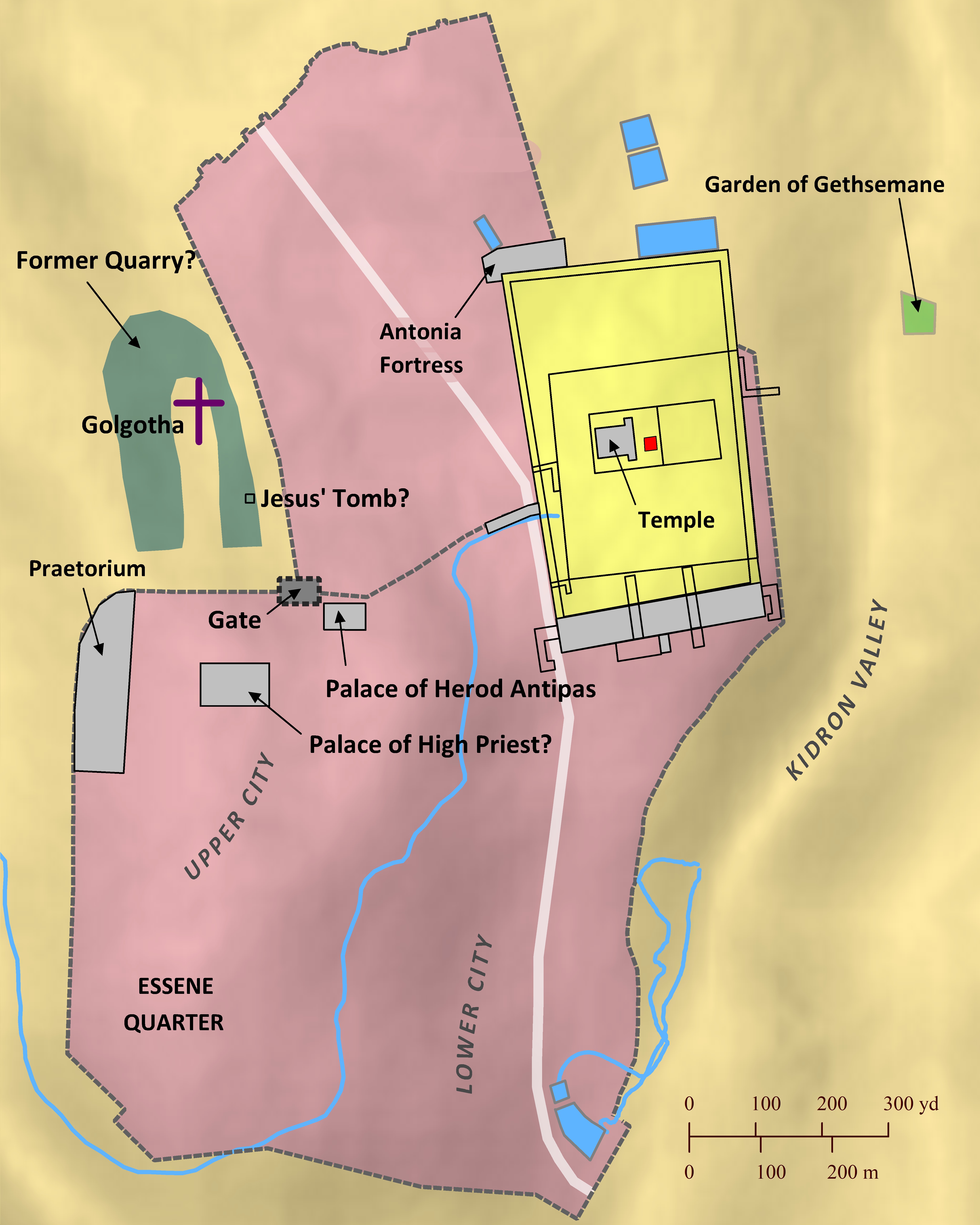
Matthew 26-27; Mark 14-15; Luke 22-23; John 13-19
On the Thursday before he was crucified, Jesus had arranged to share the Passover meal with his disciples in an upper room, traditionally thought to be located in the Essene Quarter of Jerusalem. After they finished the meal, they went to the Garden of Gethsemane, where Jesus often met with his disciples. There Judas Iscariot, one of Jesus’ own disciples, betrayed him to soldiers sent from the High Priest, and they took Jesus to the High Priest’s residence. In the morning the leading priests and teachers of the law put Jesus on trial and found him guilty of blasphemy. The council sent Jesus to stand trial for treason before the Roman governor Pontius Pilate, who resided at the Praetorium while in Jerusalem. The Praetorium was likely located at the former residence of Herod the Great, who had died over 30 years earlier. When Pilate learned that Jesus was from Galilee, he sent him to Herod Antipas, who had jurisdiction over Galilee. But when Jesus gave no answer to Herod’s many questions, Herod and his soldiers sent him back to Pilate, who conceded to the people’s demands that Jesus be crucified. Jesus was forced to carry his cross out of the city gate to Golgotha, meaning Skull Hill, referring to what may have been a small unquarried hill in the middle of an old quarry just outside the gate. After Jesus was unable to carry his cross any further, a man named Simon from Cyrene was forced to carry it for him. There at Golgotha they crucified Jesus. After Jesus died, his body was hurriedly taken down before nightfall and placed in a newly cut, rock tomb owned by Joseph of Arimathea, a member of the Jewish high council. This tomb was likely located at the perimeter of the old quarry.
Open Bible Data site copyright © 2023–2026 Freely-Given.org.
Python source code for creating these static pages is available on GitHub under an open licence.
For Bible data copyrights, see the details for each displayed Bible version.
The Open English Translation (OET) main site is at OpenEnglishTranslation.Bible or OET.Bible.