
OET OET-RV OET-LV GHT ULT UST BSB MSB BLB AICNT OEB WEBBE WMBB NET LSV FBV TCNT T4T LEB BBE Moff JPS Wymth ASV DRA YLT Drby RV SLT Wbstr KJB-1769 KJB-1611 Bshps Gnva Cvdl TNT Wycl SR-GNT UHB BrLXX BrTr Related Parallel Simple Interlinear Topics Reference Dictionary Search
ParallelVerse GEN EXO LEV NUM DEU JOB JOS JDG RUTH 1 SAM 2 SAM PSA AMOS HOS 1 KI 2 KI 1 CHR 2 CHR PROV ECC SNG JOEL MIC ISA ZEP HAB JER LAM YNA (JNA) NAH OBA DAN EZE EZRA EST NEH HAG ZEC MAL LAO GES LES ESG DNG 2 PS TOB JDT WIS SIR BAR LJE PAZ SUS BEL MAN 1 MAC 2 MAC 3 MAC 4 MAC YHN (JHN) MARK MAT LUKE ACTs YAC (JAM) GAL 1 TH 2 TH 1 COR 2 COR ROM COL PHM EPH PHP 1 TIM TIT 1 PET 2 PET 2 TIM HEB YUD (JUD) 1 YHN (1 JHN) 2 YHN (2 JHN) 3 YHN (3 JHN) REV
2 Chr Intro C1 C2 C3 C4 C5 C6 C7 C8 C9 C10 C11 C12 C13 C14 C15 C16 C17 C18 C19 C20 C21 C22 C23 C24 C25 C26 C27 C28 C29 C30 C31 C32 C33 C34 C36
2 Chr 35 V1 V2 V3 V4 V5 V6 V7 V8 V9 V10 V11 V12 V13 V14 V15 V16 V17 V18 V19 V20 V21 V22 V24 V25 V26 V27
Note: This view shows ‘verses’ which are not necessarily natural language units and hence sometimes only part of a sentence will be visible—click on any Bible version abbreviation down the left-hand side to see the verse in more of its context. Normally the OET discourages the reading of individual ‘verses’, but this view is only designed as a tool for Bible-translators and others doing comparisons of different translations—the older translations are further down the page (so you can read up from the bottom to trace the English translation history). The OET segments on this page are still early looks into the drafted texts of the Open English Translation of the Bible—please double-check these texts in advance before using in public.
B I ◄ ← 2 Chr 35:23 ↓ → ► ≡ ═ ©
Text critical issues=none Clarity of original=clear Importance to us=normal Speaker(s)=Narrator (All still tentative.)
OET (OET-RV) King Yoshiyah was hit by the archers, and he told his servants, “Get me away from here, because I’m badly wounded.”
OET-LV And_they_shot_arrows the_archers to/for_the_king Yʼoshiyyāh/(Josiah) and_he/it_said the_king to_servants_of_his take_me_away if/because I_have_been_wounded exceedingly.
UHB וַיֹּרוּ֙ הַיֹּרִ֔ים לַמֶּ֖לֶךְ יֹאשִׁיָּ֑הוּ וַיֹּ֨אמֶר הַמֶּ֤לֶךְ לַעֲבָדָיו֙ הַעֲבִיר֔וּנִי כִּ֥י הָחֳלֵ֖יתִי מְאֹֽד׃ ‡
(vayyorū hayyorim lammelek yoʼshiyyāhū vayyoʼmer hammelek laˊₐⱱādāyv haˊₐⱱīrūnī kiy hāḩₒlēytī məʼod.)
Key: khaki:verbs.
Note: Automatic aligning of the OET-RV to the LV is done by some temporary software, hence the OET-RV alignments are incomplete (and may occasionally be wrong).
BrLXX Καὶ ἐτόξευσαν οἱ τοξόται ἐπὶ βασιλέα Ἰωσίαν· καὶ εἶπεν ὁ βασιλεὺς τοῖς παισὶν αὐτοῦ, ἐξαγάγετέ με, ὅτι ἐπόνεσα σφόδρα.
(Kai etoxeusan hoi toxotai epi basilea Yōsian; kai eipen ho basileus tois paisin autou, exagagete me, hoti eponesa sfodra.)
BrTr And the archers shot at king Josias; and the king said to his servants, Take me away, for I am severely wounded.
ULT And the archers shot King Josiah, and the king said to his servants, “Cause me to pass over for I am badly wounded.”
UST Some archers shot King Josiah. He told his officers, “Take me away from here because I am badly wounded.”
BSB & MSB There the archers shot King Josiah, who said to his servants, “Take me away, for I am badly wounded!”
OEB No OEB CH2 35:23 book available
WEBBE & WMBB The archers shot at King Josiah; and the king said to his servants, “Take me away, because I am seriously wounded!”
NET Archers shot King Josiah; the king ordered his servants, “Take me out of this chariot, for I am seriously wounded.”
LSV and the archers shoot at King Josiah, and the king says to his servants, “Remove me, for I have become very sick.”
FBV There archers shot King Josiah. He called out those beside him, “Get me out of the battle, because I'm badly wounded!”
T4T Some Egyptian archers shot King Josiah. He told his officers, “Take me away from here because I am badly wounded.”
LEB And the archers shot King Josiah, and the king said to his servants, “Take me away, for I am badly wounded.”
BBE And the bowmen sent their arrows at King Josiah, and the king said to his servants, Take me away, for I am badly wounded.
Moff The archers aimed at king Josiah, till Josiah cried to his men, “Take me away, I am badly wounded.”
JPS And the archers shot at king Josiah; and the king said to his servants: 'Have me away; for I am sore wounded.'
ASV And the archers shot at king Josiah; and the king said to his servants, Have me away; for I am sore wounded.
DRA And there he was wounded by the archers, and he said to his servants: Carry me out of the battle, for I am grievously wounded.
YLT and the archers shoot at king Josiah, and the king saith to his servants, 'Remove me, for I have become very sick.'
Drby And the archers shot at king Josiah; and the king said to his servants, Have me away, for I am sore wounded.
RV And the archers shot at king Josiah; and the king said to his servants, Have me away; for I am sore wounded.
SLT And the archers will shoot at king Josiah; and the king will say to his servants, Cause me to pass away; for I was made sick greatly.
Wbstr And the archers shot at king Josiah; and the king said to his servants, Have me away; for I am severely wounded.
KJB-1769 And the archers shot at king Josiah; and the king said to his servants, Have me away; for I am sore wounded.[fn]
35.23 wounded: Heb. made sick
KJB-1611 And the archers shot at king Iosiah: and the King saide to his seruants, Haue mee away, for I am [fn]sore wounded.
(Modernised spelling is same as from KJB-1769 above, apart from capitalisation and punctuation and footnotes)
35:23 Hebr. made sicke.
Bshps And the shooters shot dartes at king Iosia: And the king sayde to his seruauntes, Carie me away, for I am sore wounded.
(And the shooters shot darts at king Yosia: And the king said to his servants, Carry me away, for I am sore wounded.)
Gnva And the shooters shot at king Iosiah: then the King saide to his seruants, Cary me away, for I am very sicke.
(And the shooters shot at king Yosiah: then the King said to his servants, Carry me away, for I am very sick.)
Cvdl But the Archers shot at kynge Iosias. And the kynge sayde vnto his seruauntes: Cary me awaye, for I am sore wounded.
(But the Archers shot at king Yosias. And the king said unto his servants: Carry me away, for I am sore wounded.)
Wycl And there he was woundide of archeris, and seide to hise children, `Lede ye me out of the batel, for Y am woundid greetli.
(And there he was wounded of archers, and said to his children, Lead ye/you_all me out of the battle, for I am wounded greatly.)
Luth Aber die Schützen schossen den König Josia. Und der König sprach zu seinen Knechten: Führet mich hinüber, denn ich bin sehr wund.
(But the shooters shot the king Josiah. And the/of_the king spoke to/for his servants: Leads me over, because/than I am very sore/raw.)
ClVg Ibique vulneratus a sagittariis, dixit pueris suis: Educite me de prælio, quia oppido vulneratus sum.
(And_there wounded from archers, he/she_said children to_his_own: Bring_out me from/about battle, because town wounded I_am.)
2 Kings 22-23; 2 Chronicles
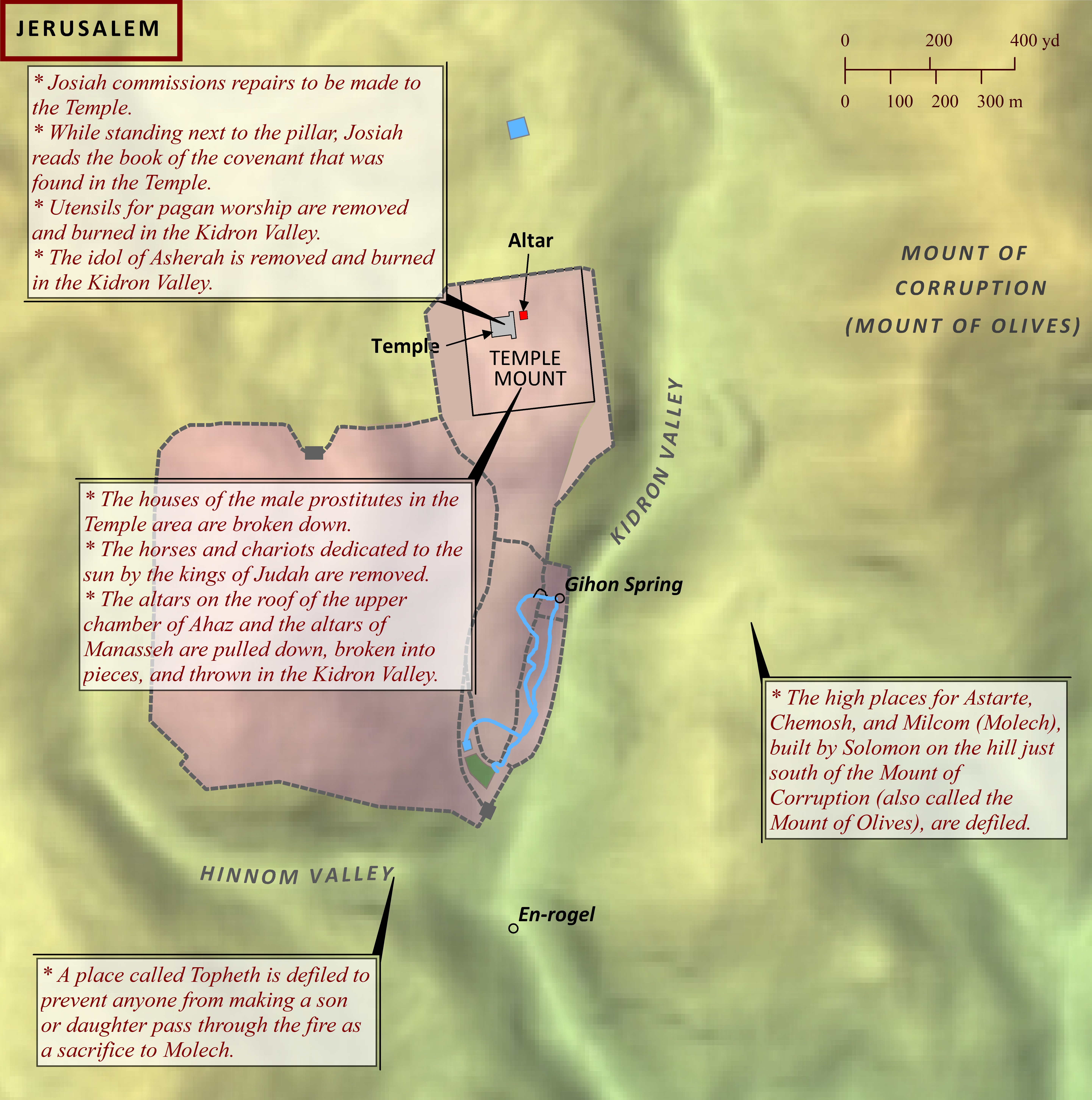
If ever there was a point in biblical history when the worship of Yahweh seemed all but extinguished, it was during the years leading up to King Josiah’s birth. Yet it was against this incredibly dark backdrop that the Lord raised up Josiah of Judah to bring about one of the greatest spiritual reforms his nation had ever seen. Josiah was the grandson of Manasseh, one of the most wicked and idolatrous kings of Judah (2 Kings 21:1-9; 2 Chronicles 33:1-9), though Manasseh later repented (2 Chronicles 33:12-19), and the son of Amon, another wicked, idolatrous king (2 Kings 21:18-22; 2 Chronicles 33:20-23). After his father’s death, Josiah became king at the young age of eight, so perhaps it was this lack of influence from his wicked father during some of his most formative years as a leader that enabled him to become such a force for spiritual renewal throughout Judah. Whatever the reason for his spiritual fervor, Josiah’s passion also coincided with a period of Assyrian decline, which allowed him to expand his renewal even to the lands once ruled by the northern kingdom of Israel. Josiah began his reforms by commissioning repairs to be made to the Temple of the Lord in Jerusalem. During these repairs, the book of the law, likely the book of Deuteronomy, was found in the Temple and brought to Josiah. When Josiah read the book, he tore his clothes in anguish over the punishment that surely awaited the nation for their disobedience to the laws of Moses. He called for all the elders of Judah and Jerusalem to gather by the pillar of the Temple, and he read the law to them as well and led them to establish a new covenant to follow the laws of Moses. Josiah then began a great purge of idolatry throughout Jerusalem, Judah, and even Israel. Utensils used for pagan worship were removed from the Temple in Jerusalem and burned in the Kidron Valley, and their ashes were carried to Bethel. The image of Asherah was also removed and burned in the Kidron Valley, and the remains were ground to dust and spread over graves of the common people. The houses of the male prostitutes in the Temple area were also broken down. The horses and chariots dedicated to the sun by the kings of Judah were removed, and the chariots were burned. The altars on the roof of the upper chamber of Ahaz and the altars that Manasseh had made in Temple courtyard were pulled down and broken in pieces, and the rubble was thrown into the Kidron Valley. A place called Topheth in the Hinnom Valley was defiled so that no one would make a son or daughter pass through fire as an offering to Molech. Just east of Jerusalem the high places built by King Solomon for his pagan wives on the Mount of Corruption (also called the Mount of Olives; 1 Kings 11:7-8) were defiled. Josiah’s reforms throughout Judah included putting away the mediums, wizards, teraphim, idols, and all the abominations that were seen in the land. At Bethel he tore down the altar and the high place erected by Jeroboam son of Nebat. He burned the high place, crushing it to dust, and burned the sacred pole. There he also saw tombs of people who must have been associated with the pagan rituals there, so he removed the bones and burned them on the altar, thus defiling it, as was prophesied years earlier (1 Kings 13:1-10). Josiah then extended his reforms to lands that formerly belonged to Israel but were now directly governed by Assyria. Throughout the towns of Samaria all the shrines of the high places were removed, the priests of the high places were slaughtered on the pagan altars, and their bones were burned on them. Throughout the rest of the land of Israel and Judah–in Manasseh, Ephraim, Simeon, and as far as Naphtali–Josiah also broke down the altars, ground the sacred poles and images into powder, and demolished all the incense altars. When Josiah returned to Jerusalem, he celebrated the Passover in a way that exceeded all the Passover celebrations since the time of the Judges.
Open Bible Data site copyright © 2023–2026 Freely-Given.org.
Python source code for creating these static pages is available on GitHub under an open licence.
For Bible data copyrights, see the details for each displayed Bible version.
The Open English Translation (OET) main site is at OpenEnglishTranslation.Bible or OET.Bible.