
OET OET-RV OET-LV GHT ULT UST BSB MSB BLB AICNT OEB WEBBE WMBB NET LSV FBV TCNT T4T LEB BBE Moff JPS Wymth ASV DRA YLT Drby RV SLT Wbstr KJB-1769 KJB-1611 Bshps Gnva Cvdl TNT Wycl SR-GNT UHB BrLXX BrTr Related Parallel Simple Interlinear Topics Reference Dictionary Search
ParallelVerse GEN EXO LEV NUM DEU JOB JOS JDG RUTH 1 SAM 2 SAM PSA AMOS HOS 1 KI 2 KI 1 CHR 2 CHR PROV ECC SNG JOEL MIC ISA ZEP HAB JER LAM YNA (JNA) NAH OBA DAN EZE EZRA EST NEH HAG ZEC MAL LAO GES LES ESG DNG 2 PS TOB JDT WIS SIR BAR LJE PAZ SUS BEL MAN 1 MAC 2 MAC 3 MAC 4 MAC YHN (JHN) MARK MAT LUKE ACTs YAC (JAM) GAL 1 TH 2 TH 1 COR 2 COR ROM COL PHM EPH PHP 1 TIM TIT 1 PET 2 PET 2 TIM HEB YUD (JUD) 1 YHN (1 JHN) 2 YHN (2 JHN) 3 YHN (3 JHN) REV
2 Chr Intro C1 C2 C3 C4 C5 C6 C7 C8 C9 C10 C11 C12 C13 C14 C15 C16 C17 C18 C19 C20 C21 C22 C23 C24 C25 C26 C27 C28 C29 C30 C31 C32 C33 C34 C36
2 Chr 35 V1 V2 V3 V4 V5 V6 V7 V8 V9 V10 V11 V12 V13 V14 V15 V16 V17 V18 V19 V20 V21 V22 V23 V24 V26 V27
Note: This view shows ‘verses’ which are not necessarily natural language units and hence sometimes only part of a sentence will be visible—click on any Bible version abbreviation down the left-hand side to see the verse in more of its context. Normally the OET discourages the reading of individual ‘verses’, but this view is only designed as a tool for Bible-translators and others doing comparisons of different translations—the older translations are further down the page (so you can read up from the bottom to trace the English translation history). The OET segments on this page are still early looks into the drafted texts of the Open English Translation of the Bible—please double-check these texts in advance before using in public.
B I ◄ ← 2 Chr 35:25 ↓ → ► ≡ ═ ©
Text critical issues=none Clarity of original=clear Importance to us=normal Speaker(s)=Narrator (All still tentative.)
OET (OET-RV) The prophet Yirmeyah (Jeremiah) wrote a funeral song for him, which the male and female singers still use at funerals to this day. That became a custom in Yisrael—the words of that song are written in a scroll of funeral songs.
OET-LV and_ Yirməyāh/(Jeremiah) _he_made_a_lament on Yʼoshiyyāh and_ all_of _they_said the_male_singers and_the_female_singers in_lamentations_of_their on Yʼoshiyyāh until the_day and_they_made_them into_a_decree on Yisrāʼēl/(Israel) and_THERE_they are_written on the_lamentations.
UHB וַיְקוֹנֵ֣ן יִרְמְיָהוּ֮ עַל־יֹאשִׁיָּהוּ֒ וַיֹּאמְר֣וּ כָֽל־הַשָּׁרִ֣ים ׀ וְ֠הַשָּׁרוֹת בְּקִינ֨וֹתֵיהֶ֤ם עַל־יֹאשִׁיָּ֨הוּ֙ עַד־הַיּ֔וֹם וַיִּתְּנ֥וּם לְחֹ֖ק עַל־יִשְׂרָאֵ֑ל וְהִנָּ֥ם כְּתוּבִ֖ים עַל־הַקִּינֽוֹת׃ ‡
(vayəqōnēn yirməyāhū ˊal-yoʼshiyyāhū vayyoʼmərū kāl-hashshārim vəhashshārōt bəqīnōtēyhem ˊal-yoʼshiyyāhū ˊad-hayyōm vayyittənūm ləḩoq ˊal-yisrāʼēl vəhinnām kətūⱱim ˊal-haqqīnōt.)
Key: khaki:verbs.
Note: Automatic aligning of the OET-RV to the LV is done by some temporary software, hence the OET-RV alignments are incomplete (and may occasionally be wrong).
BrLXX Καὶ ἐθρήνησεν Ἱερεμίας ἐπὶ Ἰωσίαν, καὶ εἶπαν πάντες οἱ ἄρχοντες καὶ αἱ ἄρχουσαι θρῆνον ἐπὶ Ἰωσίαν ἕως τῆς σήμερον· καὶ ἔδωκαν αὐτὸν εἰς πρόσταγμα ἐπὶ Ἰσραὴλ, καὶ ἰδοὺ γέγραπται ἐπὶ τῶν θρήνων.
(Kai ethraʸnaʸsen Hieremias epi Yōsian, kai eipan pantes hoi arⱪontes kai hai arⱪousai thraʸnon epi Yōsian heōs taʸs saʸmeron; kai edōkan auton eis prostagma epi Israaʸl, kai idou gegraptai epi tōn thraʸnōn.)
BrTr And Jeremias mourned over Josias, and all the chief men and chief women uttered a lamentation over Josias until this day: and they made it an ordinance for Israel, and, behold, it is written in the lamentations.
ULT And Jeremiah sang a dirge for Josiah, and all the male singers and the female singers said in their dirges about Josiah until today. And they placed for a statute over Israel; and behold, they are written in the Laments.
UST The prophet Jeremiah composed a song to lament for Josiah, and all the men and women singers in Israel still mourn for Josiah by singing that song. That became a custom in Israel; the words of that song are written in a scroll of funeral songs.
BSB & MSB Then Jeremiah lamented over Josiah, and to this day all the male and female singers recite laments over Josiah. They established them as a statute for Israel, and indeed they are written in the Book of Laments.
OEB No OEB CH2 35:25 book available
WEBBE & WMBB Jeremiah lamented for Josiah, and all the singing men and singing women spoke of Josiah in their lamentations to this day; and they made them an ordinance in Israel. Behold, they are written in the lamentations.
NET Jeremiah composed laments for Josiah which all the male and female singers use to mourn Josiah to this very day. It has become customary in Israel to sing these; they are recorded in the Book of Laments.
LSV and Jeremiah laments for Josiah, and all the male and female singers speak in their lamentations of Josiah to this day, and set them for a statute on Israel, and behold, they are written beside the Lamentations.
FBV Then Jeremiah wrote a lament over Josiah, and to this day male and female choirs sing sad songs about Josiah. They have become a part of what is regularly sung in Israel, and they are recorded in the Book of Laments.
T4T The prophet Jeremiah composed a song to mourn for Josiah, and all the men and women singers in Israel still mourn for Josiah by singing that song. That became a custom in Israel; the words of that song are written in a scroll of funeral songs.
LEB And Jeremiah uttered a lament for Josiah, and all the male and female singers have spoken in their laments about Josiah to this day. And they made them a requirement in Israel, and behold, they are written in the laments.
BBE And Jeremiah made a song of grief for Josiah; and to this day Josiah is named by all the makers of melody, men and women, in their songs of grief; they made it a rule in Israel; and the songs are recorded among the songs of grief.
Moff Jeremiah composed an elegy over Josiah, and the singers, both men and women, all uttered a lament over Josiah--as indeed they do to this day, for they made it a regular custom in Israel. The laments are written in the Book of Elegies.
JPS And Jeremiah lamented for Josiah; and all the singing men and singing women spoke of Josiah in their lamentations, unto this day; and they made them an ordinance in Israel; and, behold, they are written in the lamentations.
ASV And Jeremiah lamented for Josiah: and all the singing men and singing women spake of Josiah in their lamentations unto this day; and they made them an ordinance in Israel: and, behold, they are written in the lamentations.
DRA Particularly Jeremias: whose lamentations for Josias all the singing men and singing women repeat unto this day, and it became like a law in Israel: Behold it is found written in the Lamentations.
YLT and Jeremiah lamenteth for Josiah, and all the singers and the songstresses speak in their lamentations of Josiah unto this day, and set them for a statute on Israel, and lo, they are written beside the lamentations.
Drby And Jeremiah lamented for Josiah; and all the singing men and singing women spoke of Josiah in their lamentations to this day; and they made them an ordinance for Israel. And behold, they are written in the lamentations.
RV And Jeremiah lamented for Josiah: and all the singing men and singing women spake of Josiah in their lamentations, unto this day; and they made them an ordinance in Israel: and, behold, they are written in the lamentations.
SLT And Jeremiah will lament for Josiah: and all the singing men and singing women will speak concerning Josiah in their lamentations, even to this day, and they will give them for a law upon Israel: and behold them written upon the lamentations.
Wbstr And Jeremiah lamented for Josiah: and all the singing men and the singing women have spoken of Josiah in their lamentations to this day, and made them an ordinance in Israel: and behold, they are written in the lamentations.
KJB-1769 ¶ And Jeremiah lamented for Josiah: and all the singing men and the singing women spake of Josiah in their lamentations to this day, and made them an ordinance in Israel: and, behold, they are written in the lamentations.
KJB-1611 ¶ And Ieremiah lamented for Iosiah, and all the singing men and the singing women spake of Iosiah in their lamentations to this day, and made them an ordinance in Israel; and beholde, they are written in the Lamentations.
(Modernised spelling is same as from KJB-1769 above, apart from capitalisation and punctuation)
Bshps And Ieremia lamented Iosia, and all singing men and singing women mourned for Iosias in their lamentations to this day, and made the same lamentations an ordinaunce in Israel: and beholde they are written in the lamentations.
(And Yeremia lamented Yosia, and all singing men and singing women mourned for Yosias in their lamentations to this day, and made the same lamentations an ordinance in Israel: and behold they are written in the lamentations.)
Gnva And Ieremiah lamented Iosiah, and al singing men and singing women mourned for Iosiah in their lamentations to this day, and made the same for an ordinance vnto Israel: and beholde, they be written in the lamentations.
(And Yeremiah lamented Yosiah, and all singing men and singing women mourned for Yosiah in their lamentations to this day, and made the same for an ordinance unto Israel: and behold, they be written in the lamentations.)
Cvdl and Ieremy bewayled Iosias, and all the synginge men and wemen, spake their lametacions ouer Iosias vnto this daye, and made a custome therof vnto this daye. Beholde, it is wrytten also amonge the Lamentacions.
(and Yeremiah bewailed Yosias, and all the singing men and women, spake their lamentations over Yosias unto this day, and made a custom thereof unto this day. Behold, it is written also among the Lamentations.)
Wycl Jeremye moost, of whom alle syngeris and syngeressis `til in to present dai rehersen `lamentaciouns, ether weilyngis, on Josie; and it cam forth as a lawe in Israel, Lo! it is seid writun in Lamentaciouns. Forsothe the residue of wordis of Josie, and of hise mercies, that ben comaundid in the lawe of the Lord, and hise werkis, `the firste and the laste, ben wryten in the book of kyngis of Israel and of Juda.
(Yeremiah most, of whom all singers and female_singers till in to present day rehearse lamentations, either wailings, on Yosie; and it came forth as a law in Israel, Lo! it is said written in Lamentations. For_certain/Truly the residue of words of Yosie, and of his mercies, that been commanded in the law of the Lord, and his works, the first and the last, been written in the book of kings of Israel and of Yuda.)
Luth Und Jeremia klagte Josia; und alle Sänger und Sängerinnen redeten ihre Klagelieder über Josia bis auf diesen Tag und machten eine Gewohnheit draus in Israel. Siehe, es ist geschrieben unter den Klageliedern.
(And Yeremiah complained Josiah; and all singers and female_singers) talked their/her lamentations above Josiah until on/in/to this day and make a/one habit/practice out_of_it in Israel. See/Look, it is written under the lamentations.)
ClVg Jeremias maxime: cujus omnes cantores atque cantatrices, usque in præsentem diem, lamentationes super Josiam replicant, et quasi lex obtinuit in Israël: Ecce scriptum fertur in lamentationibus.
(Yeremiah especially/most: whose everyone singers and_yet singers, until in/into/on present(sg) day, lamentations over Yosiah they_turn, and as_if the_law got in/into/on Israel: Behold written is_carried in/into/on lamentations.)
(Occurrence 0) to this day
(Some words not found in UHB: and,he_made_a_lament Yirməyāh/(Jeremiah) on/upon/above/on_account_of//he/it_went_in Yʼoshiyyāh/(Josiah) and=they_said all the_male,singers and,the_female,singers in,lamentations_of,their on/upon/above/on_account_of//he/it_went_in Yʼoshiyyāh/(Josiah) until the=day and,they,made_them into,a_decree on/upon/above/on_account_of//he/it_went_in Yisrael and,there,they written on/upon/above/on_account_of//he/it_went_in the,lamentations )
This means the day on which the writer wrote. See how you translated this in [2 Chronicles 5:9](../05/09.md).
(Occurrence 0) behold, they
(Some words not found in UHB: and,he_made_a_lament Yirməyāh/(Jeremiah) on/upon/above/on_account_of//he/it_went_in Yʼoshiyyāh/(Josiah) and=they_said all the_male,singers and,the_female,singers in,lamentations_of,their on/upon/above/on_account_of//he/it_went_in Yʼoshiyyāh/(Josiah) until the=day and,they,made_them into,a_decree on/upon/above/on_account_of//he/it_went_in Yisrael and,there,they written on/upon/above/on_account_of//he/it_went_in the,lamentations )
This could mean: (1) “this is where they are: they” or (2) “they still exist: they.”
(Occurrence 0) the songs of lament
(Some words not found in UHB: and,he_made_a_lament Yirməyāh/(Jeremiah) on/upon/above/on_account_of//he/it_went_in Yʼoshiyyāh/(Josiah) and=they_said all the_male,singers and,the_female,singers in,lamentations_of,their on/upon/above/on_account_of//he/it_went_in Yʼoshiyyāh/(Josiah) until the=day and,they,made_them into,a_decree on/upon/above/on_account_of//he/it_went_in Yisrael and,there,they written on/upon/above/on_account_of//he/it_went_in the,lamentations )
This was an ancient scroll of funeral songs.
2 Kings 22-23; 2 Chronicles
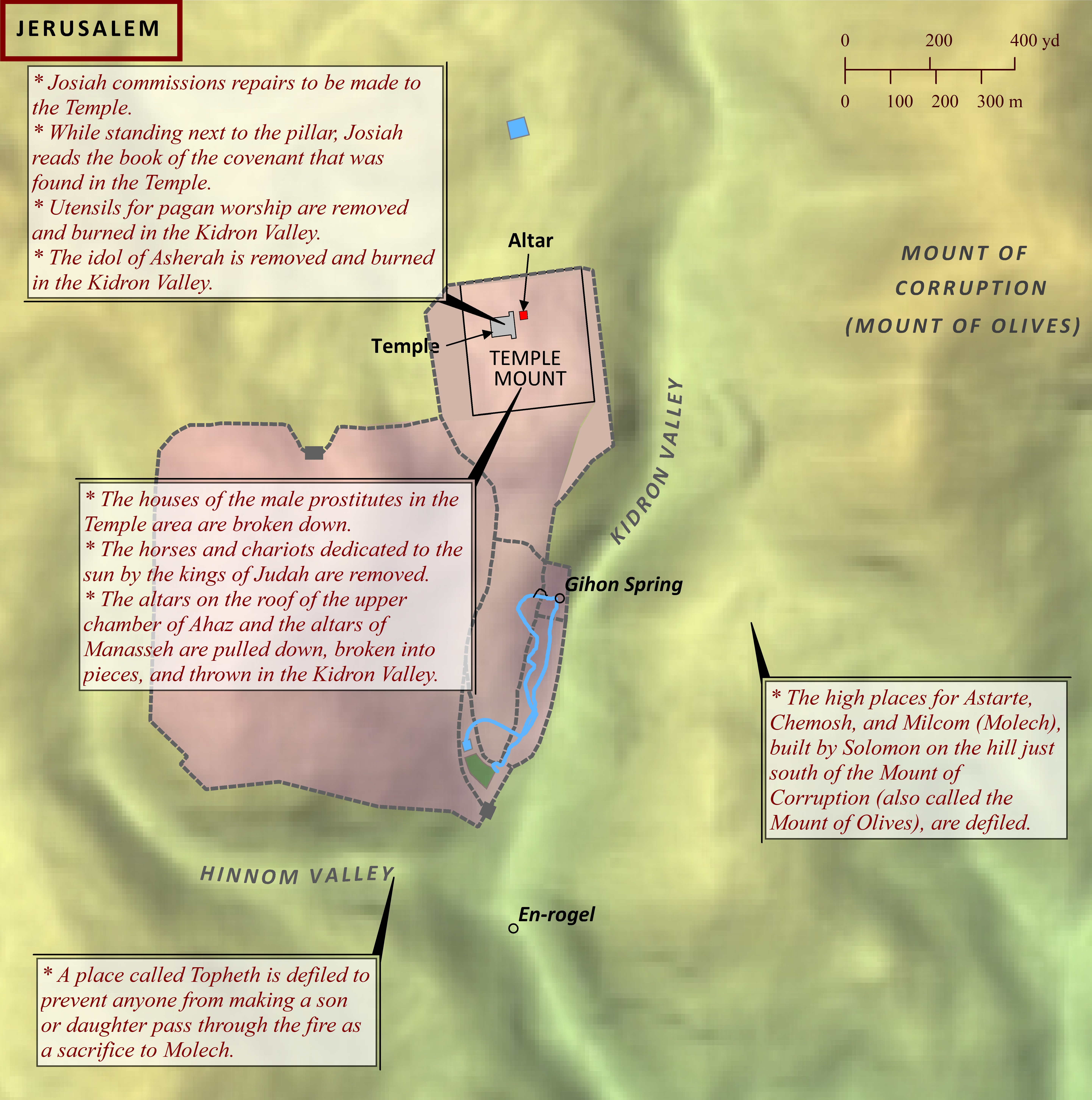
If ever there was a point in biblical history when the worship of Yahweh seemed all but extinguished, it was during the years leading up to King Josiah’s birth. Yet it was against this incredibly dark backdrop that the Lord raised up Josiah of Judah to bring about one of the greatest spiritual reforms his nation had ever seen. Josiah was the grandson of Manasseh, one of the most wicked and idolatrous kings of Judah (2 Kings 21:1-9; 2 Chronicles 33:1-9), though Manasseh later repented (2 Chronicles 33:12-19), and the son of Amon, another wicked, idolatrous king (2 Kings 21:18-22; 2 Chronicles 33:20-23). After his father’s death, Josiah became king at the young age of eight, so perhaps it was this lack of influence from his wicked father during some of his most formative years as a leader that enabled him to become such a force for spiritual renewal throughout Judah. Whatever the reason for his spiritual fervor, Josiah’s passion also coincided with a period of Assyrian decline, which allowed him to expand his renewal even to the lands once ruled by the northern kingdom of Israel. Josiah began his reforms by commissioning repairs to be made to the Temple of the Lord in Jerusalem. During these repairs, the book of the law, likely the book of Deuteronomy, was found in the Temple and brought to Josiah. When Josiah read the book, he tore his clothes in anguish over the punishment that surely awaited the nation for their disobedience to the laws of Moses. He called for all the elders of Judah and Jerusalem to gather by the pillar of the Temple, and he read the law to them as well and led them to establish a new covenant to follow the laws of Moses. Josiah then began a great purge of idolatry throughout Jerusalem, Judah, and even Israel. Utensils used for pagan worship were removed from the Temple in Jerusalem and burned in the Kidron Valley, and their ashes were carried to Bethel. The image of Asherah was also removed and burned in the Kidron Valley, and the remains were ground to dust and spread over graves of the common people. The houses of the male prostitutes in the Temple area were also broken down. The horses and chariots dedicated to the sun by the kings of Judah were removed, and the chariots were burned. The altars on the roof of the upper chamber of Ahaz and the altars that Manasseh had made in Temple courtyard were pulled down and broken in pieces, and the rubble was thrown into the Kidron Valley. A place called Topheth in the Hinnom Valley was defiled so that no one would make a son or daughter pass through fire as an offering to Molech. Just east of Jerusalem the high places built by King Solomon for his pagan wives on the Mount of Corruption (also called the Mount of Olives; 1 Kings 11:7-8) were defiled. Josiah’s reforms throughout Judah included putting away the mediums, wizards, teraphim, idols, and all the abominations that were seen in the land. At Bethel he tore down the altar and the high place erected by Jeroboam son of Nebat. He burned the high place, crushing it to dust, and burned the sacred pole. There he also saw tombs of people who must have been associated with the pagan rituals there, so he removed the bones and burned them on the altar, thus defiling it, as was prophesied years earlier (1 Kings 13:1-10). Josiah then extended his reforms to lands that formerly belonged to Israel but were now directly governed by Assyria. Throughout the towns of Samaria all the shrines of the high places were removed, the priests of the high places were slaughtered on the pagan altars, and their bones were burned on them. Throughout the rest of the land of Israel and Judah–in Manasseh, Ephraim, Simeon, and as far as Naphtali–Josiah also broke down the altars, ground the sacred poles and images into powder, and demolished all the incense altars. When Josiah returned to Jerusalem, he celebrated the Passover in a way that exceeded all the Passover celebrations since the time of the Judges.
Open Bible Data site copyright © 2023–2026 Freely-Given.org.
Python source code for creating these static pages is available on GitHub under an open licence.
For Bible data copyrights, see the details for each displayed Bible version.
The Open English Translation (OET) main site is at OpenEnglishTranslation.Bible or OET.Bible.