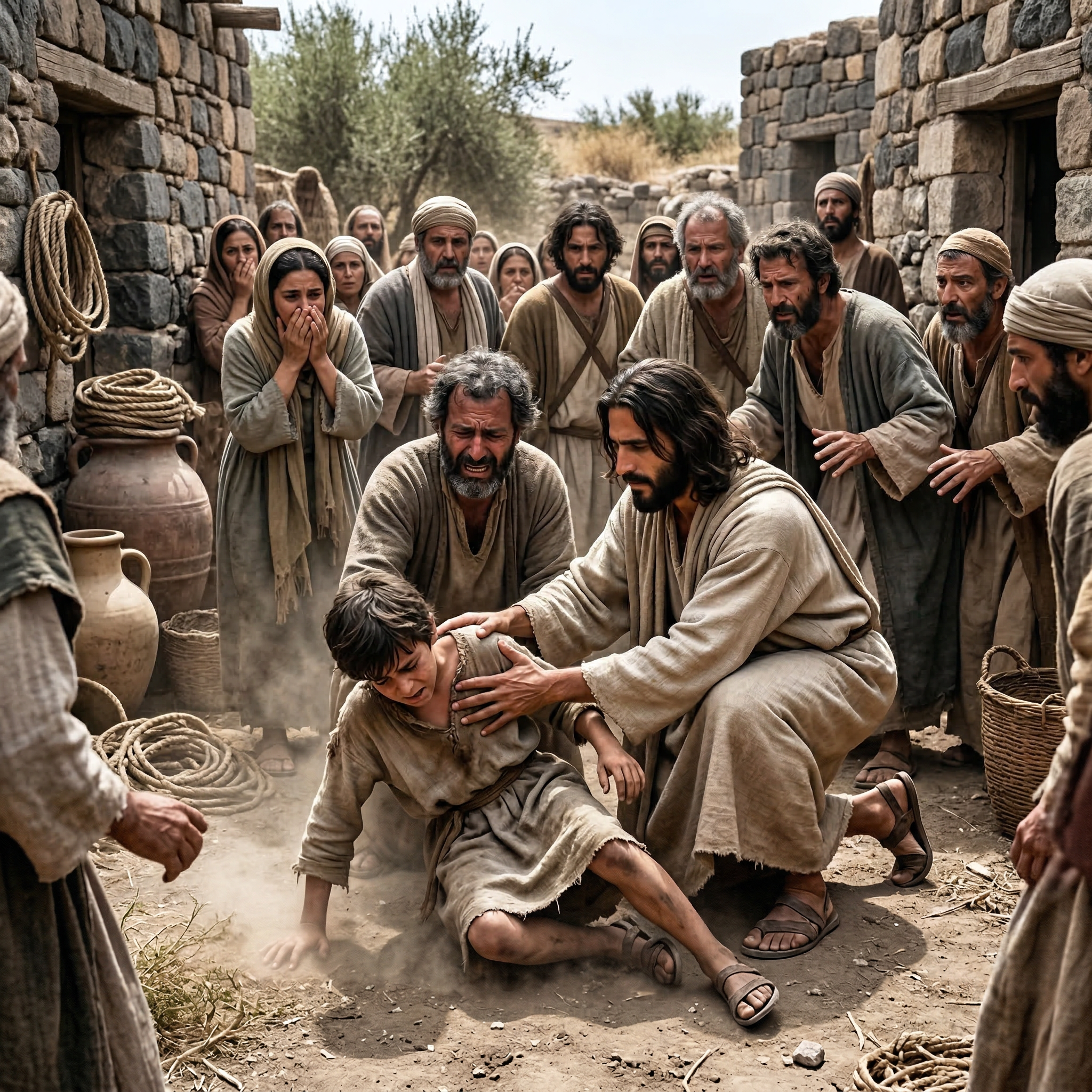
 “Oh you unbelieving and depraved generation,” Yeshua answered, “how much longer will I have to be with you people? How much longer can I tolerate you people? Bring your son here to me.”
OET OET-RV OET-LV GHT ULT UST BSB MSB BLB AICNT OEB WEBBE WMBB NET LSV FBV TCNT T4T LEB BBE Moff JPS Wymth ASV DRA YLT Drby RV SLT Wbstr KJB-1769 KJB-1611 Bshps Gnva Cvdl TNT Wycl SR-GNT UHB BrLXX BrTr Related Parallel Simple Interlinear Topics Reference Dictionary Search
ParallelVerse GEN EXO LEV NUM DEU JOB JOS JDG RUTH 1 SAM 2 SAM PSA AMOS HOS 1 KI 2 KI 1 CHR 2 CHR PROV ECC SNG JOEL MIC ISA ZEP HAB JER LAM YNA (JNA) NAH OBA DAN EZE EZRA EST NEH HAG ZEC MAL LAO GES LES ESG DNG 2 PS TOB JDT WIS SIR BAR LJE PAZ SUS BEL MAN 1 MAC 2 MAC 3 MAC 4 MAC YHN (JHN) MARK MAT LUKE ACTs YAC (JAM) GAL 1 TH 2 TH 1 COR 2 COR ROM COL PHM EPH PHP 1 TIM TIT 1 PET 2 PET 2 TIM HEB YUD (JUD) 1 YHN (1 JHN) 2 YHN (2 JHN) 3 YHN (3 JHN) REV
Mat Intro C1 C2 C3 C4 C5 C6 C7 C8 C9 C10 C11 C12 C13 C14 C15 C16 C18 C19 C20 C21 C22 C23 C24 C25 C26 C27 C28
Mat 17 V1 V2 V3 V4 V5 V6 V7 V8 V9 V10 V11 V12 V13 V14 V15 V16 V18 V19 V20 V21 V22 V23 V24 V25 V26 V27
Note: This view shows ‘verses’ which are not necessarily natural language units and hence sometimes only part of a sentence will be visible—click on any Bible version abbreviation down the left-hand side to see the verse in more of its context. Normally the OET discourages the reading of individual ‘verses’, but this view is only designed as a tool for Bible-translators and others doing comparisons of different translations—the older translations are further down the page (so you can read up from the bottom to trace the English translation history). The OET segments on this page are still early looks into the drafted texts of the Open English Translation of the Bible—please double-check these texts in advance before using in public.
Text critical issues=small word differences Clarity of original=clear Importance to us=normal Speaker(s)=Yeshua,Narrator,Yeshua (All still tentative.)
OET (OET-RV)
“Oh you unbelieving and depraved generation,” Yeshua answered, “how much longer will I have to be with you people? How much longer can I tolerate you people? Bring your son here to me.”
OET-LV And the Yaʸsous/(Yəhōshūˊa) answering said:
Oh unbelieving generation and having_been_perverted, until when will_ I _be with you_all?
Until when ˓will˒_I_be_tolerating of_you_all?
Be_bringing him here to_me.
SR-GNT Ἀποκριθεὶς δὲ ὁ ˚Ἰησοῦς εἶπεν, “Ὦ γενεὰ ἄπιστος καὶ διεστραμμένη, ἕως πότε μεθʼ ὑμῶν ἔσομαι; Ἕως πότε ἀνέξομαι ὑμῶν; Φέρετέ μοι αὐτὸν ὧδε.” ‡
(Apokritheis de ho ˚Yaʸsous eipen, “Ō genea apistos kai diestrammenaʸ, heōs pote methʼ humōn esomai; Heōs pote anexomai humōn; Ferete moi auton hōde.”)
Key: khaki:verbs, light-green:nominative/subject, orange:accusative/object, pink:genitive/possessor, cyan:dative/indirect object, magenta:vocative.
Note: Automatic aligning of the OET-RV to the LV is done by some temporary software, hence the RV alignments are incomplete (and may occasionally be wrong).
GHT Moreover, respond[ing], the Jesus says, "Oh generation, unbelieving[adjective] and having-been-through-turned/twisted/distorted. Until at-what-time[?] I-will-be alongside of {you}[?] Until at-what-time[?] I-will-hold/be-held-up/anew of {you}[?] Be-carrying same here to {me},"
ULT But answering, Jesus said, “O unbelieving and perverted generation, until when will I be with you? Until when will I bear with you? Bring him here to me.”
UST Jesus responded, “You people who are alive right now do not believe or think properly. It is hard for me to live here with you. It is difficult for me to be patient with you.” Then he said to them, “Bring the man’s son here to me!”
BSB & MSB “O unbelieving and perverse generation!” Jesus replied. “How long must I remain with you? How long must I put up with you? Bring [the boy] here to Me.”
BLB And Jesus answering said, "O unbelieving and perverted generation, how long will I be with you? How long will I bear with you? Bring him here to Me."
AICNT {Jesus}[fn] answered and said [[to them]],[fn] “O faithless and perverse generation, how long will I be with you? How long will I bear with you? Bring him here to me.”
OEB ‘Faithless and perverse generation!’ Jesus exclaimed, ‘how long must I be among you? How long must I have patience with you? Bring the boy here to me.’
WEBBE Jesus answered, “Faithless and perverse generation! How long will I be with you? How long will I bear with you? Bring him here to me.”
WMBB Yeshua answered, “Faithless and perverse generation! How long will I be with you? How long will I bear with you? Bring him here to me.”
NET Jesus answered, “You unbelieving and perverse generation! How much longer must I be with you? How much longer must I endure you? Bring him here to me.”
LSV And Jesus answering said, “O generation, unsteadfast and perverse, until when will I be with you? Until when will I bear you? Bring him to Me here”;
FBV “You people[fn] refuse to trust me, and are so corrupt!” Jesus responded. “How long do I have to remain here with you? How long do I have to put up with you? Bring him here to me!”
17:17 Literally, “generation.”
TCNT Jesus answered, “O faithless and perverse generation, how long shall I be with you? How long shall I bear with you? Bring him here to me.”
T4T Jesus responded by saying to everyone who had gathered there, “You who have seen how I help people do not believe that you can do anything! Your minds are distorted! How long do I have to be with you before you are able to do what I do [RHQ]? How long do I have to endure your not believing [RHQ]? Bring the boy here to me!”
LEB And Jesus answered and[fn] said, “O unbelieving and perverse generation! ⌊How long⌋[fn] will I be with you? ⌊How long⌋[fn] must I put up with you? Bring him here to me!”
17:17 *Here “and” is supplied because the previous participle (“answered”) has been translated as a finite verb
17:17 Literally “until when”
17:17 Literally “until when”
BBE And Jesus, answering, said, O false and foolish generation, how long will I be with you? how long will I put up with you? let him come here to me.
Moff Jesus answered, "O faithless and perverse generation, how long must I still be with you? How long have I to bear with you? Bring him here to me."
Wymth "O unbelieving and perverse generation!" replied Jesus; "how long shall I be with you? how long shall I endure you? Bring him to me."
ASV And Jesus answered and said, O faithless and perverse generation, how long shall I be with you? how long shall I bear with you? bring him hither to me.
DRA (MAT 17:16) Then Jesus answered and said: O unbelieving and perverse generation, how long shall I be with you? How long shall I suffer you? bring him hither to me.
YLT And Jesus answering said, 'O generation, unstedfast and perverse, till when shall I be with you? till when shall I bear you? bring him to me hither;'
Drby And Jesus answering said, O unbelieving and perverted generation, how long shall I be with you? how long shall I bear with you? Bring him here to me.
RV And Jesus answered and said, O faithless and perverse generation, how long shall I be with you? how long shall I bear with you? bring him hither to me.
(And Jesus answered and said, Oh faithless and perverse generation, how long shall I be with you? how long shall I bear with you? bring him hither/hereto me.)
SLT And Jesus, having answered, said, O faithless and perverted generation, how long shall I be with you how long shall I endure you? bring him here to me.
Wbstr Then Jesus answered and said, O faithless and perverse generation, how long shall I be with you? how long shall I suffer you? bring him hither to me.
KJB-1769 Then Jesus answered and said, O faithless and perverse generation, how long shall I be with you? how long shall I suffer you? bring him hither to me.
(Then Jesus answered and said, Oh faithless and perverse generation, how long shall I be with you? how long shall I suffer you? bring him hither/hereto me.)
KJB-1611 Then Iesus answered, and said, O faithlesse and peruerse generation, how long shall I bee with you? howe long shal I suffer you? bring him hither to me.
(Modernised spelling is same as from KJB-1769 above, apart from punctuation)
Bshps Iesus aunswered and sayde: O faythlesse and croked nation, howe long shall I be with you? howe long shal I suffer you? bryng hym hyther to me.
(Yesus/Yeshua answered and said: Oh faithless and crooked nation, how long shall I be with you? how long shall I suffer you? bring him hither/here to me.)
Gnva Then Iesus answered, and said, O generation faithlesse, and crooked, how long now shall I be with you! howe long nowe shall I suffer you! bring him hither to me.
(Then Yesus/Yeshua answered, and said, Oh generation faithless, and crooked, how long now shall I be with you! how long now shall I suffer you! bring him hither/hereto me.)
Cvdl Iesus answered, and sayde: O thou faithles and frowarde generacion, how longe shal I be with you? How longe shal I suffre you? Bringe him hither to me.
(Yesus/Yeshua answered, and said: Oh thou/you faithless and froward/ornery_or_disobedient generation, how long shall I be with you? How long shall I suffer you? Bring him hither/hereto me.)
TNT Iesus answered and sayde: O generacion faythles and croked: how longe shall I be with you? how longe shall I suffre you? bring him hidder to me.
(Yesus/Yeshua answered and said: Oh generation faithless and crooked: how long shall I be with you? how long shall I suffer you? bring him hither/here to me.)
Wycl (MAT 17:16) Jhesus answeride, and seide, A! thou generacion vnbileueful and weiward; hou long schal Y be with you? hou long schal Y suffre you? Brynge ye hym hider to me.
(Yesus/Yeshua answered, and said, A! thou/you generation unbelieving and wayward; how long shall I be with you? how long shall I suffer you? Bring ye/you_all him hither/here to me.)
Luth JEsus aber antwortete und sprach:O du ungläubige und verkehrte Art, wie lange soll ich bei euch sein? Wie lange soll ich euch dulden? Bringet mir ihn hieher!
(Yesus but replied and spoke: O you(sg) unbelieving and wrong Art, as/like long should I at/in you be? How long should I you tolerate/suffer? Bring to_me him/it here!)
ClVg (MAT 17:16) Respondens autem Jesus, ait: O generatio incredula, et perversa, quousque ero vobiscum? usquequo patiar vos? Afferte huc illum ad me.[fn]
(Responding however Yesus, he_said: O generation incredulous, and perverted, how_long I_will_be with_you(pl)? so_far I_will_suffer you(pl)? Bring_it here him to me.)
17.16 Respondens. Non tædio superatus, qui mitis est in verba erumpit, sed sicut medicus ægroto contra sua præcepta agenti.
17.16 Responding. Not/No boredom overcome, who/which gentle it_is in/into/on words breaks_out, but like doctor I_am_sick on_the_contrary his_own commands(n) acting.
UGNT ἀποκριθεὶς δὲ ὁ Ἰησοῦς εἶπεν, ὦ γενεὰ ἄπιστος καὶ διεστραμμένη, ἕως πότε μεθ’ ὑμῶν ἔσομαι? ἕως πότε ἀνέξομαι ὑμῶν? φέρετέ μοι αὐτὸν ὧδε.
(apokritheis de ho Yaʸsous eipen, ō genea apistos kai diestrammenaʸ, heōs pote meth’ humōn esomai? heōs pote anexomai humōn? ferete moi auton hōde.)
SBL-GNT ἀποκριθεὶς δὲ ὁ Ἰησοῦς εἶπεν· Ὦ γενεὰ ἄπιστος καὶ διεστραμμένη, ἕως πότε ⸂μεθʼ ὑμῶν ἔσομαι⸃; ἕως πότε ἀνέξομαι ὑμῶν; φέρετέ μοι αὐτὸν ὧδε.
(apokritheis de ho Yaʸsous eipen; Ō genea apistos kai diestrammenaʸ, heōs pote ⸂methʼ humōn esomai⸃; heōs pote anexomai humōn; ferete moi auton hōde.)
RP-GNT Ἀποκριθεὶς δὲ ὁ Ἰησοῦς εἶπεν, Ὦ γενεὰ ἄπιστος καὶ διεστραμμένη, ἕως πότε ἔσομαι μεθ' ὑμῶν; Ἕως πότε ἀνέξομαι ὑμῶν; Φέρετέ μοι αὐτὸν ὧδε.
(Apokritheis de ho Yaʸsous eipen, Ō genea apistos kai diestrammenaʸ, heōs pote esomai meth' humōn; Heōs pote anexomai humōn; Ferete moi auton hōde.)
TC-GNT ἀποκριθεὶς δὲ ὁ Ἰησοῦς εἶπεν, Ὦ γενεὰ ἄπιστος καὶ διεστραμμένη, ἕως πότε [fn]ἔσομαι μεθ᾽ ὑμῶν; ἕως πότε ἀνέξομαι ὑμῶν; φέρετέ μοι αὐτὸν ὧδε.
(apokritheis de ho Yaʸsous eipen, Ō genea apistos kai diestrammenaʸ, heōs pote esomai meth humōn; heōs pote anexomai humōn; ferete moi auton hōde.)
17:17 εσομαι μεθ υμων ¦ μεθ υμων εσομαι ᴄᴛ
Key for above GNTs: yellow:punctuation differs, red:words differ (from our SR-GNT base).
In 10:1 Jesus had given power to his twelve disciples to cast out demons and heal sick people. Then the disciples went out in groups of two and did those things (Mark 6:7–13). But in this section, they could not cast out a demon that caused a boy to have severe physical problems. Only Jesus was able to force the demon to leave the boy. This story shows that the disciples’ faith was not yet strong.
Here are some other possible headings for this section:
Jesus Cures A Demon-Possessed Boy (GW)
The Healing of a Boy With a Demon (NIV)
There are parallel passages for this section in Mark 9:14–29 and at Luke 9:37–43.
“O unbelieving and perverse generation!” Jesus replied.
Jesus replied, “You(plur) are an unbelieving and corrupt/evil generation!
Jesus said, “You people lack faith. You do what is not right.
O: The Greek word that the BSB translates as O was used when someone addressed another person or group and was feeling strong emotion at the time. Some English translations substitute a pronoun for this word to achieve a similar effect. For example:
You unbelieving and perverted generation (NASB)
unbelieving: The Greek word that the BSB translates as unbelieving can also be translated as “faithless.” It refers to a lack of trust in God.
Here are some other ways to translate this word:
faithless (ESV)
You people have no faith (NCV)
perverse: The Greek word that the BSB translates as perverse describes a person whose thinking and behavior are against God’s desires. He has strayed from doing what is right.
Here are some other ways to translate this word:
corrupt (NLT)
you have strayed off the right path
you don’t know what is right
generation: The Greek word that the BSB translates as generation refers to all the members of a particular group (like a tribe or a country) alive at the same time. Here Jesus apparently included the disciples who could not heal the boy in that group.
Here is another way to translate this word:
people (GNT)
Jesus replied: Here Jesus did not answer a question. He responded to the man’s statement and plea for help. So here are some other ways to begin this verse:
Jesus answered (ESV)
Jesus said (CEV)
“How long must I remain with you?
How long must I stay with you? (GNT)
Must I stay with you longer?
I am frustrated that I may have to stay with you longer because you still do not believe/trust me.
How long must I remain with you?: This is a rhetorical question. Jesus used this rhetorical question to rebuke the people he was talking to, especially his disciples. He also used it to express his frustration with them. They should have had faith, but they did not.
Here are some other ways to translate this rebuke:
As a rhetorical question. For example:
How much longer must I be with you? (NET)
How long must I stay with you? (GNT)
As a statement. For example:
I am frustrated that I may have to stay with you longer than necessary because you still do not believe/trust me.
Translate this rebuke and frustration in a way that is natural in your language.
How long: The Greek phrase that the BSB translates as How long could also be translated as “until when.” Jesus used this phrase to indicate his frustration with the people’s lack of progress.
Here is another way to translate this phrase:
How much longer (NET)
must I remain with you: This phrase means “to live among you.” Jesus’ question could imply that their unbelief would force him to stay longer than necessary. Some English translations try to communicate this idea. For example:
how long must I stay with you (GNT)
How long must I put up with you?
How much longer must I endure you?
I’m so frustrated that I may have to endure you longer.”
How long must I put up with you?: This is a rhetorical question. It is similar to the previous rhetorical question. Jesus used this rhetorical question to rebuke the people he was talking to, especially his disciples. He also used it to express his frustration with them. They should have had faith, but they did not.
Here are some other ways to translate this rebuke:
As a rhetorical question. For example:
How much longer must I endure you? (NET)
As a statement. For example:
I am frustrated that I may have to endure you longer than necessary because you still do not believe/trust me.
Translate this rebuke and frustration in a way that is natural in your language.
must I put up with you: The Greek word that the BSB translates as put up with means “to endure/tolerate.” Jesus had to endure the people’s unbelief. As with the previous rhetorical question, Jesus implies that their unbelief would force him to endure them longer than necessary
Bring the boy here to Me.”
Bring(plur) the boy to me here.”
Then Jesus said, “Come(plur) with the boy here to me.” They came with him.
In 17:17d Jesus suddenly switched from rebuking people to giving them a command. In some languages, it may be more natural to introduce this command. For example:
Then Jesus said to them
Then Jesus told them
Bring the boy here to Me: In Greek, the word Bring is plural. This means that Jesus commanded several people to bring the boy to him. Jesus was not just speaking to the boy’s father.
Here are some other ways to translate this command:
Take him here to me.
Come with the boy to me.
The next verse shows that the people did what Jesus commanded and brought the boy to him. If that would not be clear from the context in your language, you may need to make it more explicit. For example:
So they brought the boy to him.
Note 1 topic: grammar-connect-words-phrases
δὲ
(Some words not found in SR-GNT: ἀποκριθείς Δέ ὁ Ἰησοῦς εἶπεν Ὦ γενεά ἄπιστος καί διεστραμμένη ἕως πότε μεθʼ ὑμῶν ἔσομαι Ἕως πότε ἀνέξομαι ὑμῶν Φέρετε μοί αὐτόν ὧδε)
Here, the word But introduces the next thing that happened. If it would be helpful in your language, you could use a word or phrase that introduces the next event, or you could leave But untranslated. Alternate translation: [Then]
Note 2 topic: figures-of-speech / apostrophe
ὦ γενεὰ ἄπιστος καὶ διεστραμμένη, ἕως πότε μεθ’ ὑμῶν ἔσομαι? ἕως πότε ἀνέξομαι ὑμῶν
(Some words not found in SR-GNT: ἀποκριθείς Δέ ὁ Ἰησοῦς εἶπεν Ὦ γενεά ἄπιστος καί διεστραμμένη ἕως πότε μεθʼ ὑμῶν ἔσομαι Ἕως πότε ἀνέξομαι ὑμῶν Φέρετε μοί αὐτόν ὧδε)
Jesus is speaking to something that he knows cannot hear him. He is addressing the entire generation of people who were living at that time, and they are not all present to hear him. He is doing this to show in a very strong way how he feels about this generation. He is actually speaking to the people who can hear him, the crowd that has gathered there. If it would be helpful in your language, you could translate Jesus’ words as if he were speaking directly to the disciples and the crowd, since they are included in the generation that Jesus is addressing. Alternate translation: [You who are part of this unbelieving and perverse generation, how long will I be with you? How long will I bear with you?]
Note 3 topic: figures-of-speech / metonymy
ὦ γενεὰ ἄπιστος καὶ διεστραμμένη
(Some words not found in SR-GNT: ἀποκριθείς Δέ ὁ Ἰησοῦς εἶπεν Ὦ γενεά ἄπιστος καί διεστραμμένη ἕως πότε μεθʼ ὑμῶν ἔσομαι Ἕως πότε ἀνέξομαι ὑμῶν Φέρετε μοί αὐτόν ὧδε)
Here, generation represents the people who are part of the generation, which means that they are adults who are currently alive. If it would be helpful in your language, you could use an equivalent expression from your language or state the meaning plainly. See how you translated the similar expression in [11:16](../11/16.md). Alternate translation: [O today’s people who are unbelieving and perverted] or [O unbelieving and perverted people of this generation]
Note 4 topic: figures-of-speech / rquestion
ἕως πότε μεθ’ ὑμῶν ἔσομαι? ἕως πότε ἀνέξομαι ὑμῶν
until when with you_all ˱I˲_will_be (Some words not found in SR-GNT: ἀποκριθείς Δέ ὁ Ἰησοῦς εἶπεν Ὦ γενεά ἄπιστος καί διεστραμμένη ἕως πότε μεθʼ ὑμῶν ἔσομαι Ἕως πότε ἀνέξομαι ὑμῶν Φέρετε μοί αὐτόν ὧδε)
Jesus is using the question form to rebuke the disciples and the crowds and to show how frustrated he is by them. If you would not use the question form for this purpose in your language, you could translate these as statements or exclamations. Alternate translation: [I do not want to be with you for long. I do not want to bear with you for long.] or [I want to leave you! I want to stop bearing with you!]
(Occurrence -1) ἕως πότε
(Some words not found in SR-GNT: ἀποκριθείς Δέ ὁ Ἰησοῦς εἶπεν Ὦ γενεά ἄπιστος καί διεστραμμένη ἕως πότε μεθʼ ὑμῶν ἔσομαι Ἕως πότε ἀνέξομαι ὑμῶν Φέρετε μοί αὐτόν ὧδε)
Alternate translation: [how long … How long]
Note 5 topic: figures-of-speech / idiom
ἀνέξομαι ὑμῶν
˱I˲_˓will_be˒_tolerating ˱of˲_you_all
Here, the phrase bear with refers to being charitable or kind to someone. If it would be helpful in your language, you could use a comparable phrase. Alternate translation: [will I be charitable to you] or [will I act kindly with you]
Note 6 topic: writing-pronouns
αὐτὸν
(Some words not found in SR-GNT: ἀποκριθείς Δέ ὁ Ἰησοῦς εἶπεν Ὦ γενεά ἄπιστος καί διεστραμμένη ἕως πότε μεθʼ ὑμῶν ἔσομαι Ἕως πότε ἀνέξομαι ὑμῶν Φέρετε μοί αὐτόν ὧδε)
The pronoun him refers to the boy who was epileptic. If this is not clear for your readers, you could refer to him more directly. Alternate translation: [the boy] or [the epileptic]
Open Bible Data site copyright © 2023–2026 Freely-Given.org.
Python source code for creating these static pages is available on GitHub under an open licence.
For Bible data copyrights, see the details for each displayed Bible version.
The Open English Translation (OET) main site is at OpenEnglishTranslation.Bible or OET.Bible.