
ParallelVerse GEN EXO LEV NUM DEUT JOB YEHO (JOS) HERO (JDG) RUTH 1 SAM 2 SAM PSA AMOS HOS 1 KI 2 KI 1 CHR 2 CHR PROV ECC SNG YOEL (JOEL) MIC ISA ZEP HAB YIR (JER) LAM YNA (JNA) NAH OBAD DAN EZEK EZRA EST NEH HAG ZEC MAL 2 PS WIS TOB MAN BAR L JER G DAN SUS PR AZ BEL G ESD L ESD ESG JDT 3 MAC SIR 1 MAC 2 MAC 4 MAC YHN (JHN) MARK MAT LUKE ACTs YAC (JAM) GAL 1 TH 2 TH 1 COR 2 COR ROM COL LAOD PHM EPH PHP 1 TIM TIT 1 PET 2 PET 2 TIM HEB YUD (JUD) 1 YHN (1 JHN) 2 YHN (2 JHN) 3 YHN (3 JHN) REV
ParallelVerse Acts Intro C1 C2 C3 C4 C5 C6 C7 C8 C9 C10 C11 C12 C13 C14 C16 C17 C18 C19 C20 C21 C22 C23 C24 C25 C26 C27 C28
Acts 15 V0 V1 V3 V5 V7 V9 V11 V13 V15 V17 V19 V21 V23 V25 V27 V29 V31 V33 V35 V37 V39 V41
Note: This view shows ‘verses’ which are not necessarily natural language units and hence sometimes only part of a sentence will be visible—click on any Bible version abbreviation down the left-hand side to see the verse in more of its context. Normally the OET discourages the reading of individual ‘verses’, but this view is only designed as a tool for Bible-translators and others doing comparisons of different translations—the older translations are further down the page (so you can read up from the bottom to trace the English translation history). The OET segments on this page are still early looks into the drafted texts of the Open English Translation of the Bible—please double-check these texts in advance before using in public.
Text critical issues=minor/spelling Clarity of original=clear Importance to us=normal Speaker(s)=Narrator (All still tentative.)
OET (OET-RV) So the missionaries and the elders met separately in order to consider the matter further.
OET-LV And the ambassadors and the elders were_gathered_together, to_see about the this matter.
SR-GNT Συνήχθησάν δὲ οἱ ἀπόστολοι καὶ οἱ πρεσβύτεροι, ἰδεῖν περὶ τοῦ λόγου τούτου. ‡
(Sunaʸⱪthaʸsan de hoi apostoloi kai hoi presbuteroi, idein peri tou logou toutou.)
Key: khaki:verbs, light-green:nominative/subject, pink:genitive/possessor.
Note: Automatic aligning of the OET-RV to the LV is done by some temporary software, hence the RV alignments are incomplete (and may occasionally be wrong).
GHT Moreover, the sent-off[one]s and the elders are-gathered to-behold about of {the word, the-same}.
ULT So the apostles and the elders were gathered together to see about this word.
UST Then the apostles and the elders met together in order to talk about this issue.
BSB [So] the apostles and elders met to look into this matter.
BLB And both the apostles and the elders were gathered together to see about this matter.
AICNT The apostles and the elders were gathered together to consider this matter.
OEB The apostles and the church elders held a meeting to consider this question.
WEBBE The apostles and the elders were gathered together to see about this matter.
WMBB The emissaries and the elders were gathered together to see about this matter.
NET Both the apostles and the elders met together to deliberate about this matter.
LSV And there were gathered together the apostles and the elders, to see about this matter,
FBV The apostles and elders met together to discuss the issue.
TCNT So the apostles and the elders gathered together to consider this matter.
T4T Then the apostles and the other elders met together in order to talk about this matter.
LEB Both the apostles and the elders assembled to deliberate concerning this matter.
BBE And the Apostles and the rulers of the church came together and gave thought to the question.
Moff The apostles and the presbyters met to investigate this question,
Wymth Then the Apostles and Elders met to consider the matter;
ASV And the apostles and the elders were gathered together to consider of this matter.
DRA And the apostles and ancients assembled to consider of this matter.
YLT And there were gathered together the apostles and the elders, to see about this matter,
Drby And the apostles and the elders were gathered together to see about this matter.
RV And the apostles and the elders were gathered together to consider of this matter.
SLT And the sent and elders were gathered together to see about this word.
Wbstr And the apostles and elders came together to consider of this matter.
KJB-1769 ¶ And the apostles and elders came together for to consider of this matter.
KJB-1611 ¶ And the Apostles & Elders came together for to consider of this matter.
(Modernised spelling is same as from KJB-1769 above, apart from capitalisation)
Bshps And the Apostles and elders came together, for to consider of this matter.
(Same as from KJB-1769 above, apart from capitalisation and punctuation)
Gnva Then the Apostles and Elders came together to looke to this matter.
(Then the Apostles and Elders came together to look to this matter.)
Cvdl But the Apostles and Elders came together, to reason vpon this matter.
(But the Apostles and Elders came together, to reason upon this matter.)
TNT And the Apostles and elders came to geder to reason of this matter.
(And the Apostles and elders came together to reason of this matter.)
Wycl And the apostlis and eldre men camen togidre, to se of `this word.
(And the apostles and elder men came together, to see of this word.)
Luth Aber die Apostel und die Ältesten kamen zusammen, diese Rede zu besehen.
(But the apostles and the elders came together, this/these speech to/for view(v).)
ClVg Conveneruntque Apostoli et seniores videre de verbo hoc.[fn]
(And_they_met Apostles and elders to_see from/about word hoc.)
15.6 Conveneruntque apostoli. ID. Hic datur exemplum faciendi conventus, ad discernenda ea quæ fidei sunt necessaria.
15.6 And_they_met apostles. ID. Here/This given example of_doing met, to to_be_distinguished them which of_faith are necessary.
UGNT συνήχθησάν δὲ οἱ ἀπόστολοι καὶ οἱ πρεσβύτεροι, ἰδεῖν περὶ τοῦ λόγου τούτου.
(sunaʸⱪthaʸsan de hoi apostoloi kai hoi presbuteroi, idein peri tou logou toutou.)
SBL-GNT Συνήχθησάν ⸀τε οἱ ἀπόστολοι καὶ οἱ πρεσβύτεροι ἰδεῖν περὶ τοῦ λόγου τούτου.
(Sunaʸⱪthaʸsan ⸀te hoi apostoloi kai hoi presbuteroi idein peri tou logou toutou.)
RP-GNT Συνήχθησαν δὲ οἱ ἀπόστολοι καὶ οἱ πρεσβύτεροι ἰδεῖν περὶ τοῦ λόγου τούτου.
(Sunaʸⱪthaʸsan de hoi apostoloi kai hoi presbuteroi idein peri tou logou toutou.)
TC-GNT Συνήχθησαν [fn]δὲ οἱ ἀπόστολοι καὶ οἱ πρεσβύτεροι ἰδεῖν περὶ τοῦ λόγου τούτου.
(Sunaʸⱪthaʸsan de hoi apostoloi kai hoi presbuteroi idein peri tou logou toutou.)
15:6 δε ¦ τε ɴᴀ ꜱʙʟ ᴡʜ
Key for above GNTs: yellow:punctuation differs, orange:accents differ, red:words differ (from our SR-GNT base).
Note 1 topic: figures-of-speech / activepassive
συνήχθησάν
(Some words not found in SR-GNT: συνήχθησαν Δέ οἱ ἀπόστολοι καί οἱ πρεσβύτεροι ἰδεῖν περί τοῦ λόγου τούτου)
If your language does not use this passive form, you could express the idea in active form or in another way that is natural in your language. Alternate translation: [gathered together]
Note 2 topic: figures-of-speech / idiom
ἰδεῖν περὶ
˓to˒_see (Some words not found in SR-GNT: συνήχθησαν Δέ οἱ ἀπόστολοι καί οἱ πρεσβύτεροι ἰδεῖν περί τοῦ λόγου τούτου)
Here the phrase to see about is an idiom that means “to consider.” If it would be helpful in your language, you could state the meaning plainly. Alternate translation: [to consider]
Note 3 topic: figures-of-speech / metonymy
τοῦ λόγου τούτου
¬the matter this
Luke is using the term word to mean the claim that the Jewish believers who were Pharisees had made by using words. If it would be helpful in your language, you could state the meaning plainly. Alternate translation: [the claim that the Jewish believers who were Pharisees had made]
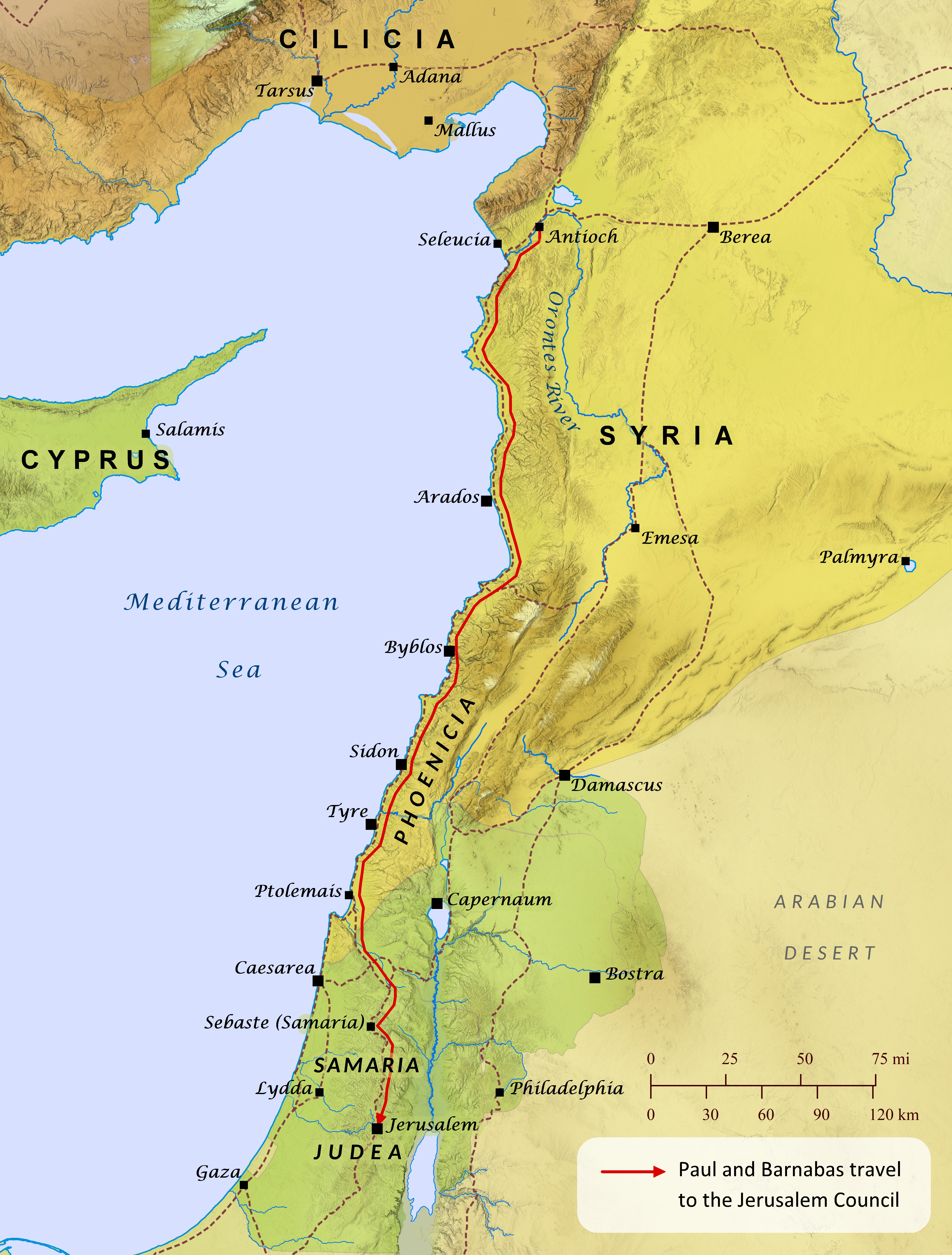
Acts 15
Paul’s first three missionary journeys originated from Antioch, one of the largest cities in the Roman Empire by Paul’s time. Founded by Seleucus I Nicator, it first served as the capital of the Seleucid Empire, and by the time of Paul it boasted a significant Jewish population. Decades earlier King Herod the Great of Judea had funded the building of a marble colonnaded street there that was nearly two miles (3.2 km) long. As persecuted followers of Jesus fled Judea, some of them traveled as far as Antioch. There they led many Jews and even Gentiles to become believers, and it was in Antioch that the followers of Jesus were first called “Christians” (Acts 11:19-26). Antioch was also the starting point for Paul’s first three missionary journeys (Acts 13:1-3; 15:36-41; 18:22-23). After Paul’s first missionary journey, some people came to Antioch from Judea and began to teach that all believers–Jews and Gentiles–must be circumcised and follow the laws of Moses (Acts 15:1). But Paul and Barnabas argued against them. So the church in Antioch sent Paul and Barnabas and other leaders to Jerusalem to discuss this issue with the apostles and elders there. As they passed through Phoenicia and Samaria on their way to Jerusalem, they told others (presumably Jewish believers) about the conversion of many Gentiles to the faith, and all the believers rejoiced with them. After Paul and the other leaders arrived in Jerusalem and were warmly received by the church there, their reports about the conversion of Gentiles led some believers from the sect of the Pharisees to insist that these new believers be circumcised and follow the laws of Moses. After much debate about the matter, the apostles and elders in Jerusalem decided that Gentile believers did not need to follow the laws of Moses except for a few critical requirements: that they abstain from sacrifices made to idols, from blood, from what has been strangled, and from sexual immorality. Then the Jerusalem church sent Paul and the other leaders back to Antioch with a letter stating this decision. After Paul and the others arrived in Antioch and delivered the letter, the church in Antioch rejoiced. Paul and Barnabas remained in Antioch and continued to teach the believers there. Sometime after this Paul and a believer named Silas embarked on a second missionary journey to visit the churches that Paul had helped to found during his first missionary journey, and Barnabas took his relative John Mark to minister in his home region of Cyprus.
Open Bible Data site copyright © 2023–2026 Freely-Given.org.
Python source code for creating these static pages is available on GitHub under an open licence.
For Bible data copyrights, see the details for each displayed Bible version.
The Open English Translation (OET) main site is at OpenEnglishTranslation.Bible or OET.Bible.