
OET OET-RV OET-LV GHT ULT UST BSB MSB BLB AICNT OEB WEBBE WMBB NET LSV FBV TCNT T4T LEB BBE Moff JPS Wymth ASV DRA YLT Drby RV SLT Wbstr KJB-1769 KJB-1611 Bshps Gnva Cvdl TNT Wycl SR-GNT UHB BrLXX BrTr Related Parallel Simple Interlinear Topics Reference Dictionary Search
ParallelVerse GEN EXO LEV NUM DEU JOB JOS JDG RUTH 1 SAM 2 SAM PSA AMOS HOS 1 KI 2 KI 1 CHR 2 CHR PROV ECC SNG JOEL MIC ISA ZEP HAB JER LAM YNA (JNA) NAH OBA DAN EZE EZRA EST NEH HAG ZEC MAL LAO GES LES ESG DNG 2 PS TOB JDT WIS SIR BAR LJE PAZ SUS BEL MAN 1 MAC 2 MAC 3 MAC 4 MAC YHN (JHN) MARK MAT LUKE ACTs YAC (JAM) GAL 1 TH 2 TH 1 COR 2 COR ROM COL PHM EPH PHP 1 TIM TIT 1 PET 2 PET 2 TIM HEB YUD (JUD) 1 YHN (1 JHN) 2 YHN (2 JHN) 3 YHN (3 JHN) REV
Gen Intro C1 C2 C3 C4 C5 C6 C7 C8 C9 C10 C11 C12 C13 C14 C15 C16 C17 C18 C19 C20 C21 C22 C23 C24 C25 C26 C27 C28 C29 C30 C31 C32 C33 C34 C35 C36 C37 C39 C40 C41 C42 C43 C44 C45 C46 C47 C48 C49 C50
Gen 38 V1 V2 V4 V5 V6 V7 V8 V9 V10 V11 V12 V13 V14 V15 V16 V17 V18 V19 V20 V21 V22 V23 V24 V25 V26 V27 V28 V29 V30
Note: This view shows ‘verses’ which are not necessarily natural language units and hence sometimes only part of a sentence will be visible—click on any Bible version abbreviation down the left-hand side to see the verse in more of its context. Normally the OET discourages the reading of individual ‘verses’, but this view is only designed as a tool for Bible-translators and others doing comparisons of different translations—the older translations are further down the page (so you can read up from the bottom to trace the English translation history). The OET segments on this page are still early looks into the drafted texts of the Open English Translation of the Bible—please double-check these texts in advance before using in public.
Text critical issues=small word differences Clarity of original=clear Importance to us=normal Speaker(s)=Narrator (All still tentative.)
OET (OET-RV) and she got pregnant and in due course, gave birth to a son who Yehudah named Er.
OET-LV And_she/it_conceived/became_pregnant and_she/it_gave_birth a_son and_he/it_called DOM his/its_name ˊĒr.
UHB וַתַּ֖הַר וַתֵּ֣לֶד בֵּ֑ן וַיִּקְרָ֥א אֶת־שְׁמ֖וֹ עֵֽר׃ ‡
(vattahar vattēled bēn vayyiqrāʼ ʼet-shəmō ˊēr.)
Key: khaki:verbs.
Note: Automatic aligning of the OET-RV to the LV is done by some temporary software, hence the OET-RV alignments are incomplete (and may occasionally be wrong).
BrLXX Καὶ συλλαβοῦσα ἔτεκεν υἱὸν, καὶ ἐκάλεσε τὸ ὄνομα αὐτοῦ, Ἤρ.
(Kai sullabousa eteken huion, kai ekalese to onoma autou, Aʸr.)
BrTr And she conceived and bore a son, and called his name, Er.
ULT and she conceived and bore a son, and he called his name Er.
UST and she became pregnant. When she gave birth, she had a son, whom Judah named Er.
BSB & MSB So she conceived and gave birth to a son, and [Judah] named him Er.
OEB and she conceived, and bore a son, and he named him Er.
WEBBE & WMBB She conceived, and bore a son; and he named him Er.
NET She became pregnant and had a son. Judah named him Er.
LSV And she conceives, and bears a son, and he calls his name Er;
FBV and she became pregnant and had a son he named Er.
T4T and she became pregnant and later gave birth to a son, whom he named Er.
LEB And she conceived and bore a son, and he called his name Er.
BBE And she gave birth to a son, and he gave him the name Er.
Moff No Moff GEN 38:3 book available
JPS And she conceived, and bore a son; and he called his name Er.
ASV And she conceived, and bare a son; and he called his name Er.
DRA And she conceived, and bore a son, and called his name Her.
YLT And she conceiveth, and beareth a son, and he calleth his name Er;
Drby And she conceived and bore a son; and he called his name Er.
RV And she conceived, and bare a son; and he called his name Er.
SLT And she will conceive and bring forth a son, and he will call his name Er.
Wbstr And she conceived, and bore a son; and he called his name Er.
KJB-1769 And she conceived, and bare a son; and he called his name Er.
KJB-1611 And she conceiued & bare a sonne, and he called his name Er.
(Modernised spelling is same as from KJB-1769 above, apart from punctuation)
Bshps And she conceaued, and bare a sonne, and called his name Er.
(And she conceived, and bare a son, and called his name Er.)
Gnva So she conceiued and bare a sonne, and he called his name Er.
(So she conceived and bare a son, and he called his name Er.)
Cvdl she conceaued and bare a sonne, whom she called Er.
(she conceived and bare a son, whom she called Er.)
Wycl he entride to hir, and sche conseyuede, and childide a sone, and clepide his name Her.
(he entered to her, and she conceived, and gave_birth_to a son, and called his name Her.)
Luth ward sie schwanger und gebar einen Sohn, den hieß er Ger.
(what/which they/she/them pregnant and gave_birth a son, the was_called he Er.)
ClVg Quæ concepit, et peperit filium, et vocavit nomen ejus Her.[fn]
(Which conceived, and gave_birth son, and he_called name his/her Her.)
38.3 Quæ concepit, etc. Genuit Synagoga principes, qui ei tanquam mariti præfuerunt: quorum alii fuerunt nocentes, quos significat Her, qui interpretatur pelliceus pellis enim mortem significat, quia primi parentes pellibus induti addicti sunt morti; alii inutiles, quos significat Onan, qui interpretatur mœror eorum, quibus scilicet non prosunt.
38.3 Which conceived, etc. He_gave_birth Synagogue leaders, who/which to_him as_if nuptial they_were_in_charge: whose others they_were harm, which means Her, who/which interprets leather you_drive_out because death means, because first parents skins dressed/put_on devoted are death; others useless, which means Onan, who/which interprets sadness their, to_whom namely not/no they_are_useful.
וַתֵּ֣לֶד בֵּ֑ן
(Some words not found in UHB: and=she/it_conceived/became_pregnant and=she/it_gave_birth son and=he/it_called DOM his/its=name ˊĒr )
Alternate translation: [and gave birth to a son]
Note 1 topic: translate-names
וַיִּקְרָ֥א אֶת־שְׁמ֖וֹ עֵֽר
(Some words not found in UHB: and=she/it_conceived/became_pregnant and=she/it_gave_birth son and=he/it_called DOM his/its=name ˊĒr )
Throughout Genesis, sometimes the father, sometimes the mother, and sometimes both are said to give their child his name. Alternate translation: [whom he named Er]
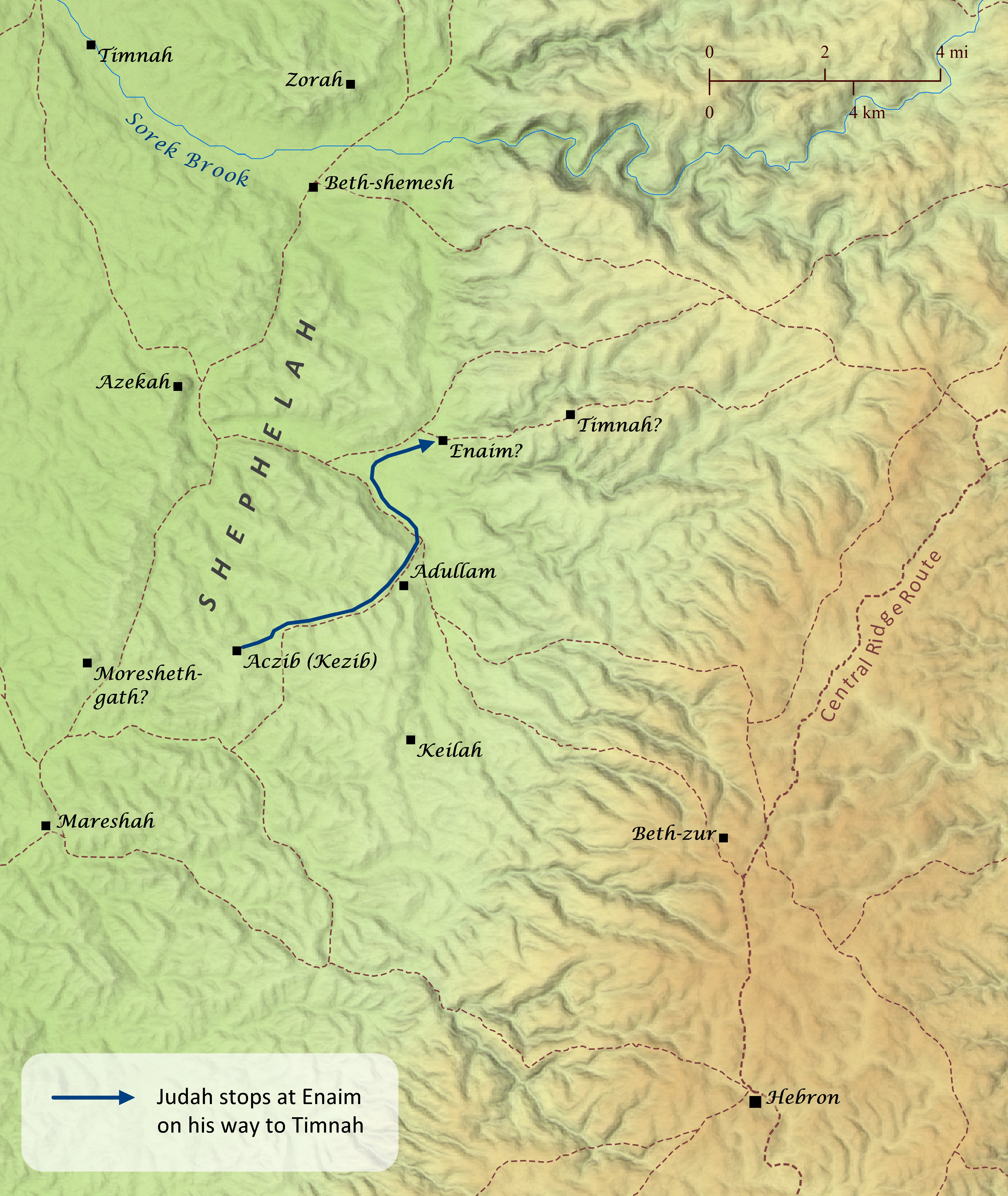
Genesis 38
The story of Yehudah/Judah and Tamar is likely set in the foothills (often called the Shephelah) of Judah around the general area of Adullam. The story opens by noting that Judah went “down” from his brothers, though it does not mention where his brothers were living. The last mention of their location, however, is in Genesis 35:27, where it notes that they were in Mamre in the vicinity of Hebron, appropriately situated at significantly higher elevation than Adullam. After settling in this area, Judah married a Canaanite woman, who bore him three sons. The passage also notes that Judah’s wife was living in Kezib when she bore their third son, so presumably Judah was living there as well. This is likely the same location called Aczib elsewhere in Scripture (Josh 15:44; Micah 1:14). Judah then took a wife, Tamar, for his oldest son, but his son soon died. So Judah instructed his second son to fulfill the common custom of marrying his brother’s widow and raising children in his brother’s name. Though this son married Tamar, he refused to have children by her, so the Lord put him to death. Then Judah instructed Tamar to remain in her father’s house as a widow until his third son was old enough to marry her, but secretly he feared that his third son might die like his brothers if he married her. Sometime after this Judah’s wife died, and Judah made plans to go “up” to Timnah, where his sheep were being sheared. Several other passages of Scripture (Joshua 15:10; Joshua 19:43; Judges 14; 2 Chronicles 28:18) mention a place called Timnah, which was located at Tall Batashi along the Sorek Brook, but it is unlikely that this is the same Timnah mentioned in this story, because Tall Batashi is at a very low elevation, so it could hardly be said that Judah went “up” to that Timnah from Aczib or Adullam. Instead the Timnah of Genesis 38 may have been located at Khirbet et Tabbaneh northeast of Adullam (likely also mentioned in Joshua 15:57) and higher in elevation. If Timnah is indeed located there, Enaim may have been located at Khirbet Beth Ikka, though this identification is less certain (see also Joshua 15:34, which mentions a town called Enam). Returning to the story, the passage notes that, upon hearing of Judah’s plans to go up to Timnah, Tamar disguised herself as a prostitute, went up to Enaim, and seduced Judah on his way to Timnah as part of a plan to bring shame upon him for not providing his third son, who was now an adult, to her as a husband. It is interesting to note that the word Enaim, which means “the place of two springs,” can also mean “the place of two eyes,” and some commentators have speculated that the writer was making a play on words with the name of the village, because it was at Enaim that Judah failed to recognize Tamar, and later he failed to recognize his own hypocrisy in denouncing Tamar for her sexual immorality.
Open Bible Data site copyright © 2023–2026 Freely-Given.org.
Python source code for creating these static pages is available on GitHub under an open licence.
For Bible data copyrights, see the details for each displayed Bible version.
The Open English Translation (OET) main site is at OpenEnglishTranslation.Bible or OET.Bible.