
ParallelVerse GEN EXO LEV CEN (NUM) DEUT IYOV (JOB) YEHO (JOSH) H&G (JDG) RUTH 1 SHM (1 SAM) 2 SHM (2 SAM) SONGS (PSA) AMOS HOS 1 KI 2 KI 1 CHR 2 CHR PROV REFL (ECC) SNG YOEL (JOEL) MIK (MIC) YESH (ISA) TSEF (ZEP) HAV (HAB) YIR (JER) SOR (LAM) YONAH (JNA) NAH OVAD (OBAD) DAN YEHEZ (EZEK) EZRA EST NEH HAG ZEK (ZEC) MAL 2 PS WIS TOVI (TOB) MAN BAR L YIR (L JER) DAG (G DAN) SUS PR AZ BEL 1 ES (G ESD) 2 ES (L ESD) ESG (ESG) YDT (JDT) 3 MAC SIR 1 MAC 2 MAC 4 MAC YHN (JOHN) MARK MAT LUKE ACTs YAK (JAM) GAL 1 TH 2 TH 1 KOR (1 COR) 2 KOR (2 COR) ROM KOL (COL) LAOD FILEM (PHM) EFE (EPH) FILI (PHP) 1 TIM TIT 1 KEF (1 PET) 2 KEF (2 PET) 2 TIM IVR (HEB) YEHU (JUDE) 1 YN (1 JHN) 2 YN (2 JHN) 3 YN (3 JHN) REV
ParallelVerse Yir Intro C1 C2 C3 C4 C5 C6 C7 C8 C9 C10 C11 C12 C13 C14 C15 C16 C17 C18 C19 C20 C21 C22 C23 C24 C25 C26 C27 C28 C29 C30 C31 C32 C33 C34 C35 C36 C37 C38 C39 C40 C41 C42 C43 C44 C45 C46 C47 C48 C49 C50 C51
Yir 52 V0 V1 V2 V3 V4 V5 V6 V7 V8 V9 V10 V11 V12 V13 V14 V15 V16 V17 V18 V19 V20 V21 V22 V23 V24 V25 V26 V27 V28 V29 V30 V31 V32 V34
Note: This view shows ‘verses’ which are not necessarily natural language units and hence sometimes only part of a sentence will be visible—click on any Bible version abbreviation down the left-hand side to see the verse in more of its context. Normally the OET discourages the reading of individual ‘verses’, but this view is only designed as a tool for Bible-translators and others doing comparisons of different translations—the older translations are further down the page (so you can read up from the bottom to trace the English translation history). The OET segments on this page are still early looks into the drafted texts of the Open English Translation of the Bible—please double-check these texts in advance before using in public.
Text critical issues=none Clarity of original=clear Importance to us=normal Speaker(s)=Narrator (All still tentative.)
OET (OET-RV) Evil-Merodak supplied new clothes for Yehoyakin to wear, and he ate regularly at the king’s table for the rest of his life.
OET-LV And_he_changed DOM the_clothes_of his_imprisonment_of_his and_he/it_will_eat bread before_him continually all_of the_days_of his_life_of_his.
UHB וְשִׁנָּ֕ה אֵ֖ת בִּגְדֵ֣י כִלְא֑וֹ וְאָכַ֨ל לֶ֧חֶם לְפָנָ֛יו תָּמִ֖יד כָּל־יְמֵ֥י חַיָּֽו׃ ‡
(vəshinnāh ʼēt bigdēy kilʼō vəʼākal leḩem ləfānāyv tāmid kāl-yəmēy ḩayyāv.)
Key: khaki:verbs.
Note: Automatic aligning of the OET-RV to the LV is done by some temporary software, hence the OET-RV alignments are incomplete (and may occasionally be wrong).
UBS handbooks: Prison, dungeon (realia) · Clothing (generic) (realia) · Bread (realia)
UBS parallel passages: 2 KI 25:29
BrLXX καὶ ἤλλαξε τὴν στολὴν τῆς φυλακῆς αὐτοῦ, καὶ ἤσθιεν ἄρτον διαπαντὸς κατὰ πρόσωπον αὐτοῦ πάσας τὰς ἡμέρας ἃς ἔζησε.
(kai aʸllaxe taʸn stolaʸn taʸs fulakaʸs autou, kai aʸsthien arton diapantos kata prosōpon autou pasas tas haʸmeras has ezaʸse.)
BrTr and changed his prison garments: and he ate bread continually before him all the days that he lived.
ULT And he changed the clothes of his imprisonment, and he ate bread regularly to his face all of the days of his life.
UST He gave Jehoiachin new clothes to replace the clothes that he had been wearing in prison, and he allowed Jehoiachin to eat meals with him every day for the rest of his life.
BSB So Jehoiachin changed out of his prison clothes, and he dined regularly at the king’s table for the rest of his life.
OEB No OEB JER 52:33 book available
WEBBE and changed his prison garments. Jehoiachin ate bread before him continually all the days of his life.
NET Jehoiachin took off his prison clothes and ate daily in the king’s presence for the rest of his life.
LSV and he has changed his prison garments, and he has continually eaten bread before him, all the days of his life.
FBV So Jehoiachin was able to remove his prison clothes, and he ate frequently at the king's table for the rest of his life.
T4T He supplied new clothes for Jehoiachin, to replace the clothes that he had been wearing in prison. He also allowed Jehoiachin to eat with him every day, all during the rest of his life.
LEB So he changed the garments of his imprisonment and he ate food ⌊before him⌋[fn] continually all the days of his life.
52:33 Literally “to the face of him”
BBE And his prison clothing was changed, and he was a guest at the king's table every day for the rest of his life.
Moff No Moff JER 52:33 book available
JPS And he changed his prison garments, and did eat bread before him continually all the days of his life.
ASV and changed his prison garments. And Jehoiachin did eat bread before him continually all the days of his life:
DRA And he changed his prison garments, and he ate bread before him always all the days of his life.
YLT and he hath changed his prison garments, and he hath eaten bread before him continually, all the days of his life.
Drby And he changed his prison garments; and he ate bread before him continually all the days of his life;
RV and he changed his prison garments, and did eat bread before him continually all the days of his life.
SLT And he changed the garment of his shutting up: and he ate bread before him continually all the days of his life.
Wbstr And changed his prison garments: and he continually ate bread before him all the days of his life.
KJB-1769 And changed his prison garments: and he did continually eat bread before him all the days of his life.
KJB-1611 And changed his prison garments: and hee did continually eate bread before him all the dayes of his life.
(Modernised spelling is same as from KJB-1769 above)
Bshps He chaunged also the clothes of his prison, yea and did eate with hym all his life long.
(He changed also the clothes of his prison, yea and did eat with him all his life long.)
Gnva And changed his pryson garmentes, and he did continually eate bread before him all the dayes of his life.
(Modernised spelling is same as from KJB-1769 above, apart from punctuation)
Cvdl He chaunged also the clothes of his preson, yee and he ate with him all his life longe.
(He changed also the clothes of his prison, ye/you_all and he ate with him all his life long.)
Wycl and chaungide the clothis of his prisoun. And Joachym eet breed bifore hym euere, in alle the daies of his lijf;
(and changed the clothes of his prison. And Yehoiakim eat bread before him ever, in all the days of his life;)
Luth Und wandelte ihm seines Gefängnisses Kleider, daß er vor ihm aß stets sein Leben lang.
(And walked him his prison/jail clothes, that he before/in_front_of him ate always be life long.)
ClVg Et mutavit vestimenta carceris ejus, et comedebat panem coram eo semper cunctis diebus vitæ suæ.
(And changed clothes prison his/her, and was_eating bread/food before by_him always to_all days of_life his/her_own(pl).)
Note 1 topic: writing-pronouns
וְשִׁנָּ֕ה אֵ֖ת בִּגְדֵ֣י כִלְא֑וֹ
and,he_changed DOM clothes_of his_imprisonment_of,his
The pronoun he refers to Evil Merodach/Merodak, while the pronoun his refers to Jehoiachin/Yehoyakin. It may be helpful to clarify this for your readers. Alternate translation: [And Evil Merodach changed the clothes of Jehoiachin’s imprisonment] or [And Evil Merodach allowed Jehoiachin to wear the clothes of a courtier rather than those of a prisoner]
Note 2 topic: translate-symaction
וְשִׁנָּ֕ה אֵ֖ת בִּגְדֵ֣י כִלְא֑וֹ
and,he_changed DOM clothes_of his_imprisonment_of,his
Giving Jehoiachin/Yehoyakin different clothes to wear was a symbolic action by which Evil Merodach/Merodak showed that Jehoiachin’s status had changed from prisoner to honored guest. If it would be helpful to your readers, you could explain the significance of this action in the text of your translation or in a footnote. Alternate translation: [And he changed the clothes of his imprisonment to show that he was no longer a prisoner]
Note 3 topic: writing-pronouns
וְאָכַ֨ל לֶ֧חֶם לְפָנָ֛יו תָּמִ֖יד
and=he/it_will_eat food/grain/bread before,,him regularly
The pronoun he refers to Jehoiachin/Yehoyakin, while the pronoun his refers to Evil Merodach/Merodak. It may be helpful to clarify this for your readers. Alternate translation: [and Jehoiachin ate bread regularly to the face of Evil Merodach]
Note 4 topic: figures-of-speech / synecdoche
לֶ֧חֶם
food/grain/bread
See how you translated the similar expression in 52:6. Alternate translation: [meals]
Note 5 topic: figures-of-speech / metonymy
לְפָנָ֛יו
before,,him
Here, the face of Evil Merodach/Merodak represents his “presence.” If it would be helpful in your language, you could use an equivalent expression or plain language. Alternate translation: [in his presence]
Note 6 topic: figures-of-speech / metonymy
כָּל־יְמֵ֥י חַיָּֽו
all/each/any/every days_of his_life_of,his
The author is using the term days to refer to a specific time, the lifetime of Jehoiachin/Yehoyakin. If it would be helpful in your language, you could state the meaning plainly. Alternate translation: [throughout his lifetime]
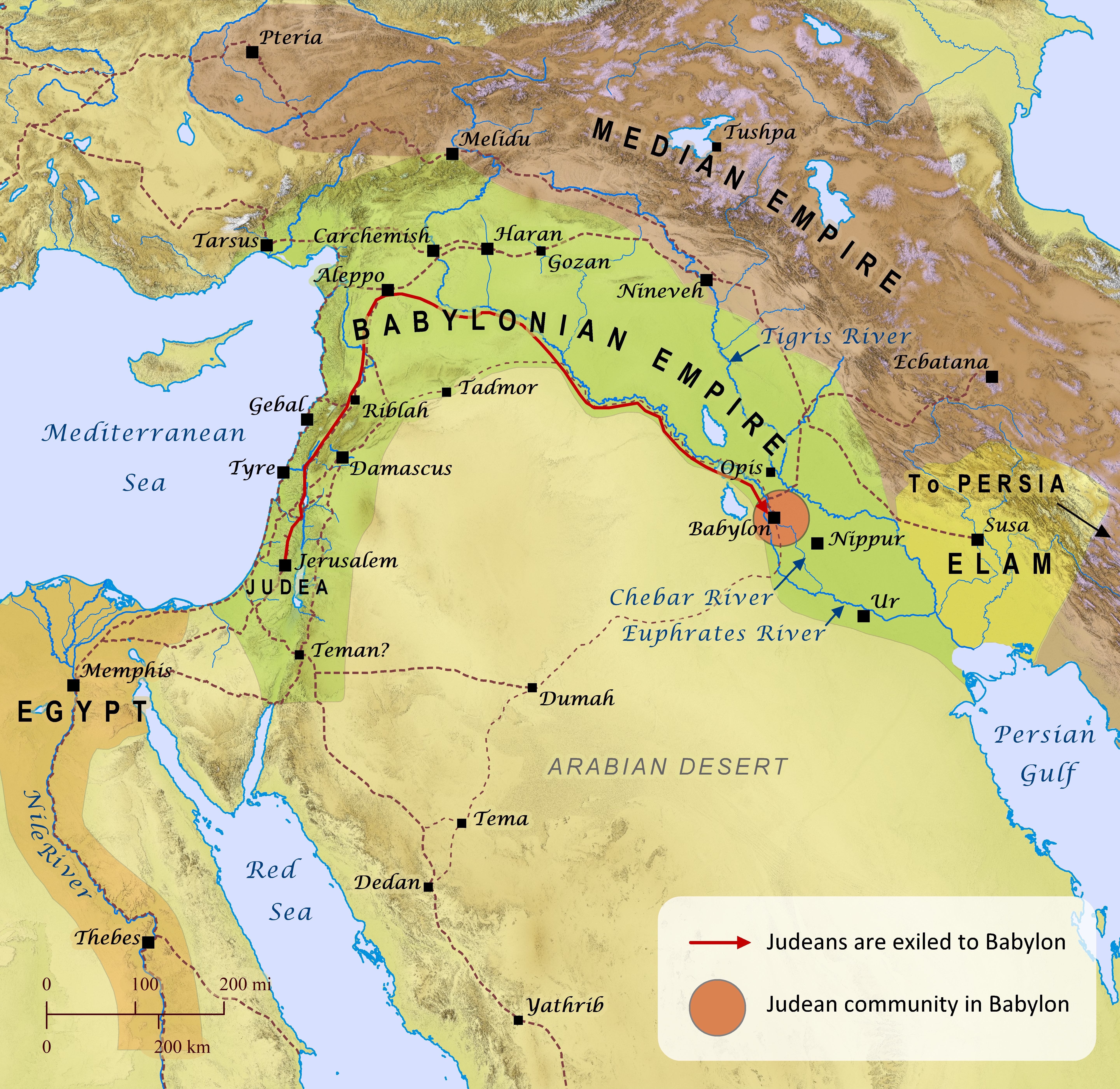
Daniel 1; 2 Kings 24-25; 2 Chronicles 36; Jeremiah 39; 52
One of the most significant events in the story of the Old Testament is the exile of Judah to Babylon in 586 B.C. This event–actually the third in a series of exiles to Babylon (the others occurring in 605 B.C. and 597 B.C.)–precipitated several crises in the nation and in Judaism. The northern kingdom of Israel had already been exiled to Assyria over a century earlier in 722 B.C. (2 Kings 15:29; 17:1-6; 1 Chronicles 5:26; see also “Israelites Are Exiled to Assyria” map), and in some ways that exile was even more devastating. Nevertheless, the Temple of the Lord remained intact in Jerusalem as a place where the faithful could continue to offer their sacrifices. With the destruction of Jerusalem and the Temple of the Lord at the hands of the Babylonians, however, sacrifices could no longer be offered at the Tabernacle or Temple of the Lord (Leviticus 17:2-4; Deuteronomy 12:5-7), and the Lord’s promise to provide a land for his people and a descendant on the throne of David no doubt seemed abandoned. At the same time, however, the Judean exiles were allowed to maintain their religious traditions in Babylon, and many even began to thrive there, including Daniel and his friends, who served at the royal court (Daniel 1; see also “The Land of Exile” map). One of the last kings of Babylon expanded Babylonia further by capturing the desert oases of Dumah, Tema, Dedan, and Yathrib (see “Oases of the Arabian Desert” map), but eventually the Median Empire to the north merged with the Persian Empire to the southeast and conquered the Babylonian Empire. King Cyrus of Persia then decreed that the exiled Judeans, now called “Jews,” could return to their homeland if they desired (2 Chronicles 36:22-23; Ezra 1-2; see also “Jews Return from Exile” map).
Open Bible Data site copyright © 2023–2026 Freely-Given.org.
Python source code for creating these static pages is available on GitHub under an open licence.
For Bible data copyrights, see the details for each displayed Bible version.
Visit the Open English Translation (OET) main site.