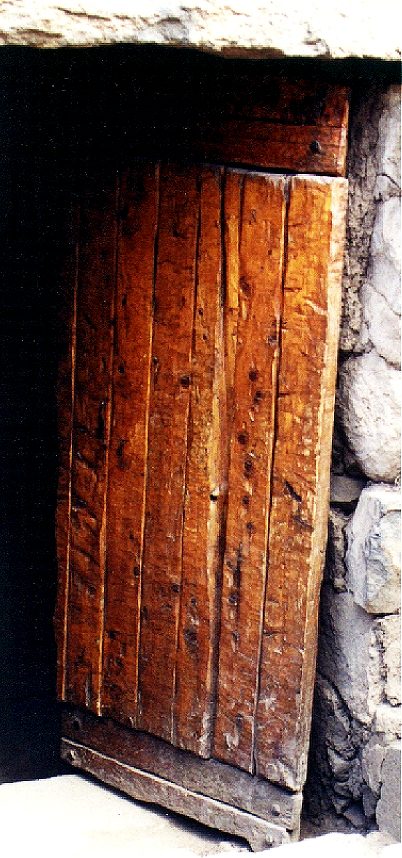
Wooden outside door to a house (© Ray Pritz by United Bible Societies)
References
- Hebrew דַּל, דֶּלֶת dal, dalah, deleth: GEN 19:6, GEN 19:9, GEN 19:10, EXO 21:6
- Hebrew סַף saf: 2 KI 12:9, 2 KI 22:4, 2 KI 23:4, 2 KI 25:18, 1 CHR 9:19, 1 CHR 9:22, 2 CHR 23:4, 2 CHR 34:9
- Hebrew ספף safaf (verb): PSA 84:10
- Hebrew פֶּתַח pethach: GEN 4:7, GEN 6:16, GEN 18:1, GEN 18:2, GEN 18:10, GEN 19:6, GEN 19:11, GEN 43:19
111 more references
EXO 12:22, EXO 12:23, EXO 26:36, EXO 29:4, EXO 29:11, EXO 29:32, EXO 29:42, EXO 33:8, EXO 33:9, EXO 33:10, EXO 35:15, EXO 36:37, EXO 38:8, EXO 38:30, EXO 39:38, EXO 40:5, EXO 40:6, EXO 40:12, EXO 40:28, EXO 40:29, LEV 1:3, LEV 1:5, LEV 3:2, LEV 4:4, LEV 4:7, LEV 4:18, LEV 8:3, LEV 8:4, LEV 8:31, LEV 8:33, LEV 8:35, LEV 10:7, LEV 12:6, LEV 14:11, LEV 14:23, LEV 14:38, LEV 15:14, LEV 15:29, LEV 16:7, LEV 17:4, LEV 17:5, LEV 17:6, LEV 17:9, LEV 19:21, NUM 3:25, NUM 3:26, NUM 4:25, NUM 6:10, NUM 6:13, NUM 6:18, NUM 10:3, NUM 11:10, NUM 12:5, NUM 16:18, NUM 16:19, NUM 16:27, NUM 16:50, NUM 20:6, NUM 25:6, NUM 27:2, DEUT 22:21, DEUT 31:15, YEHO 19:51, HERO 4:20, HERO 9:52, HERO 19:26, HERO 19:27, 1 SAM 2:22, 2 SAM 11:9, 1 KI 6:8, 1 KI 6:31, 1 KI 6:33, 1 KI 7:5, 1 KI 14:6, 1 KI 14:27, 1 KI 19:13, 2 KI 4:15, 2 KI 5:9, 1 CHR 9:21, 2 CHR 4:22, 2 CHR 12:10, NEH 3:20, NEH 3:21, EST 5:1, JOB 31:9, JOB 31:34, PSA 24:7, PSA 24:9, PROV 5:8, PROV 8:3, PROV 8:34, PROV 9:14, PROV 17:19, SNG 7:13, YIR 43:9, EZEK 8:7, EZEK 8:8, EZEK 8:16, EZEK 33:30, EZEK 40:38, EZEK 41:2, EZEK 41:3, EZEK 41:11, EZEK 41:17, EZEK 41:20, EZEK 42:2, EZEK 42:4, EZEK 42:11, EZEK 42:12, EZEK 47:1, HOS 2:15 - Aramaic תְּרַע tra‘: DAN 3:26
- Greek θύρα thura: MAT 6:6, MAT 24:33, MAT 25:10, MARK 1:33, MARK 2:2, MARK 11:4, MARK 13:29, LUKE 11:7
25 more references
LUKE 13:24, LUKE 13:25, YHN 10:1, YHN 10:2, YHN 10:7, YHN 10:9, YHN 18:16, YHN 20:19, YHN 20:26, ACTs 5:9, ACTs 5:19, ACTs 5:23, ACTs 12:6, ACTs 12:13, ACTs 14:27, ACTs 16:26, ACTs 16:27, ACTs 21:30, 1 COR 16:9, 2 COR 2:12, COL 4:3, YAC 5:9, REV 3:8, REV 3:20, REV 4:1 - Greek θύρωμα thurōma: SIR 14:23, L JER 1:17, 2 MAC 14:43
- Greek θυρωρός thurōros: MARK 13:34, YHN 18:16, YHN 18:17
- Greek θυρόω thuroō (verb): 1 MAC 4:57
Description and usage
The door was the entranceway into a building or structure or the panel that covered that entranceway. Doors were normally made of wood. To one edge along the length of the door was attached a wooden pole which extended slightly past the top and bottom edge of the door. The protruding ends of this pole were sharpened or rounded and set into sockets or holes cut into the stone lintel and threshold, thus allowing the door to swing open and shut. Sometimes the door panel was hung on hinges made usually of leather, sometimes of metal.
———
Translation
In some passages “door” means simply “opening” or “doorway” without reference to the physical object (see JOB 3:10, JOB 41:14, PSA 78:23). This is especially true of the Hebrew word pethach.
Occasionally “door” is used as a figure for shutting out; for example, CEV says “boundaries” in JOB 38:8, where God speaks of limiting the extent of the sea. Similarly, in PSA 141:3 the psalmist literally asks Yahweh to “keep watch over the door of my lips” (RSV). In some languages it may be better to render this line without the image, for example, NCV says “help me be careful about what I say.” CEV provides a helpful model for the whole verse, saying “Help me to guard my words whenever I say something.”
There seems to be a textual problem in 1 KI 6:34, where the Hebrew text speaks of the two doors to the sanctuary being made of two “curtains.” A minor emendation changes “curtains” to “sections,” which is the reading preferred by most translations. However, the meaning of the text still remains unclear even after the emendation. The rendering of GNT shows the way a number of translations solve the difficulty: “There were two folding doors made of pine.” Somewhat more literal is NIV, which says “He also made two pine doors, each having two leaves that turned in sockets.”
The Aramaic word tra‘ in DAN 3:26 means “gate” or “door.” Some translations have “door” (RSV, GNT, NASB), while others have “opening” (NIV, NCV). The opening may have been in the top of the furnace, but it was more likely in the side as a kind of “doorway.”
In YHN 10:7, YHN 10:9 the Greek word thura is used figuratively to refer to Yeshua (Jesus; Grk. Yesus) as the means of access to salvation. The emphasis in these verses is on the “door” as a passageway and not as an object closing off an entrance. The literal translation “I am the door of the sheep” (RSV) may often lead to misinterpretation, since the term used for “door” is likely to refer to the door panel rather than to the doorway or entranceway, thus suggesting that Yeshua Christ functions primarily to prevent passage rather than to make entrance possible. The translator should use an expression such as “I am the gateway/doorway/entranceway where the sheep enter.”
 Open English Translation (OET)