
Open Bible Data Home About News OET Key
OET OET-RV OET-LV ULT UST BSB MSB BLB AICNT OEB WEBBE WMBB NET LSV FBV TCNT T4T LEB BBE Moff JPS Wymth ASV DRA YLT Drby RV SLT Wbstr KJB-1769 KJB-1611 Bshps Gnva Cvdl TNT Wycl SR-GNT UHB BrLXX BrTr Related Topics Parallel Interlinear Reference Dictionary Search
ParallelVerse GEN EXO LEV NUM DEU JOB JOS JDG RUTH 1 SAM 2 SAM PSA AMOS HOS 1 KI 2 KI 1 CHR 2 CHR PROV ECC SNG JOEL MIC ISA ZEP HAB JER LAM YNA (JNA) NAH OBA DAN EZE EZRA EST NEH HAG ZEC MAL LAO GES LES ESG DNG 2 PS TOB JDT WIS SIR BAR LJE PAZ SUS BEL MAN 1 MAC 2 MAC 3 MAC 4 MAC YHN (JHN) MARK MAT LUKE ACTs YAC (JAM) GAL 1 TH 2 TH 1 COR 2 COR ROM COL PHM EPH PHP 1 TIM TIT 1 PET 2 PET 2 TIM HEB YUD (JUD) 1 YHN (1 JHN) 2 YHN (2 JHN) 3 YHN (3 JHN) REV
Mark Intro C1 C2 C3 C4 C5 C6 C7 C8 C9 C10 C11 C12 C13 C14 C15 C16
Mark 13 V1 V3 V4 V5 V6 V7 V8 V9 V10 V11 V12 V13 V14 V15 V16 V17 V18 V19 V20 V21 V22 V23 V24 V25 V26 V27 V28 V29 V30 V31 V32 V33 V34 V35 V36 V37
Note: This view shows ‘verses’ which are not natural language units and hence sometimes only part of a sentence will be visible—click on any Bible version abbreviation down the left-hand side to see the verse in more of its context. Normally the OET discourages the reading of individual ‘verses’, but this view is only designed as a tool for doing comparisons of different translations—the older translations are further down the page (so you can read up from the bottom to trace the English translation history). The OET segments on this page are still very early looks into the unfinished texts of the Open English Translation of the Bible—please double-check these texts in advance before using in public.
Text critical issues=small word differences Clarity of original=clear Importance to us=normal (All still tentative.)
OET (OET-RV) But Yeshua responded, “Yes, incredible buildings, but the time will come when they’re torn down—not a single piece of stone will be left sitting in its place.”
OET-LV And the Yaʸsous/(Yəhōshūˊa) said to_him:
Are_you_seeing these the great buildings?
Stone on stone by_no_means may_ not _be_left here, which by_no_means may_ not _be_torn_down.
SR-GNT Καὶ ὁ ˚Ἰησοῦς εἶπεν αὐτῷ, “Βλέπεις ταύτας τὰς μεγάλας οἰκοδομάς; Οὐ μὴ ἀφεθῇ ὧδε λίθος ἐπὶ λίθον, ὃς οὐ μὴ καταλυθῇ.” ‡
(Kai ho ˚Yaʸsous eipen autōi, “Blepeis tautas tas megalas oikodomas; Ou maʸ afethaʸ hōde lithos epi lithon, hos ou maʸ kataluthaʸ.”)
Key: khaki:verbs, light-green:nominative/subject, orange:accusative/object, cyan:dative/indirect object, red:negative.
Note: Automatic aligning of the OET-RV to the LV is done by some temporary software, hence the RV alignments are incomplete (and may occasionally be wrong).
ULT And Jesus said to him, “Do you see these great buildings? A stone upon a stone will certainly not be left here, which will certainly not be torn down.”
UST Jesus replied, “Look at these impressive structures! Enemies will completely destroy them. They will not leave anything standing.”
BSB “Do you see [all] these great buildings?” Jesus replied. “Not [one] stone here will be left on [another]; [every one] will be thrown down.”
MSB “Do you see [all] these great buildings?” Jesus replied. “Not [one] stone[fn] will be left on [another]; [every one] will be thrown down.”
13:2 CT Not one stone here
BLB And Jesus said to him, "Do you see these great buildings? Not one stone shall be left here upon a stone, which shall not be thrown down."
AICNT And Jesus said to him, “Do you see these great buildings? There will not be left here a stone upon a stone that will not be torn down.”
OEB ‘Do you see these great buildings?’ asked Jesus. ‘Not a single stone will be left here on another, which will not be thrown down.’
WEBBE Jesus said to him, “Do you see these great buildings? There will not be left here one stone on another, which will not be thrown down.”
WMBB Yeshua said to him, “Do you see these great buildings? There will not be left here one stone on another, which will not be thrown down.”
NET Jesus said to him, “Do you see these great buildings? Not one stone will be left on another. All will be torn down!”
LSV And Jesus answering said to him, “See these great buildings? There may not be left a stone on a stone that may not be thrown down.”
FBV “You see all these great buildings?” Jesus replied. “Not one stone will be left on top of another. Everything will be torn down.”
TCNT Jesus [fn]answered him, “Do yoʋ see these great buildings? Not one stone will be [fn]left upon another; all of them will be torn down.”
T4T Jesus said to him, “Yes, these buildings that you are looking at [RHQ] are wonderful, but I want to tell you something about them. They will soon be destroyed {Foreign invaders will destroy them} completely, with the result that no stone here in this Temple area will be left on top of another stone.”
LEB And Jesus said to him, “Do you see these great buildings? Not one stone will be left here on another stone that will not be thrown down!”
BBE And Jesus said to him, Do you see these great buildings? there is not one stone here resting on another which will not be overturned.
Moff Jesus said to him, "You see these great buildings? Not a stone shall be left on another, without being torn down."
Wymth "You see all these great buildings?" Jesus replied; "not one stone will be left here upon another—not thrown down."
ASV And Jesus said unto him, Seest thou these great buildings? there shall not be left here one stone upon another, which shall not be thrown down.
DRA And Jesus answering, said to him: Seest thou all these great buildings? There shall not be left a stone upon a stone, that shall not be thrown down.
YLT and Jesus answering said to him, 'Seest thou these great buildings? there may not be left a stone upon a stone, that may not be thrown down.'
Drby And Jesus answering said to him, Seest thou these great buildings? not a stone shall be left upon a stone, which shall not be thrown down.
RV And Jesus said unto him, Seest thou these great buildings? there shall not be left here one stone upon another, which shall not be thrown down.
(And Jesus said unto him, Seest thou/you these great buildings? there shall not be left here one stone upon another, which shall not be thrown down. )
SLT And Jesus having answered, said to him, Seest thou these great buildings? stone upon stone shall not be left which shall not be loosed.
Wbstr And Jesus answering said to him, Seest thou these great buildings? there shall not be left one stone upon another, that shall not be thrown down.
KJB-1769 And Jesus answering said unto him, Seest thou these great buildings? there shall not be left one stone upon another, that shall not be thrown down.
(And Jesus answering said unto him, Seest thou/you these great buildings? there shall not be left one stone upon another, that shall not be thrown down. )
KJB-1611 And Iesus answering, said vnto him, Seest thou these great buildings? there shall not be left one stone vpon an other, that shal not be throwen downe.
(Modernised spelling is same as from KJB-1769 above, apart from punctuation)
Bshps And Iesus aunswered, & sayde vnto hym: Seest thou these great buildynges? There shall not be left one stone vpon another, that shall not be throwen downe.
(And Yesus/Yeshua answered, and said unto him: Seest thou/you these great buildings? There shall not be left one stone upon another, that shall not be thrown down.)
Gnva Then Iesus answered and saide vnto him, Seest thou these great buildings? there shall not be left one stone vpon a stone, that shall not be throwen downe.
(Then Yesus/Yeshua answered and said unto him, Seest thou/you these great buildings? there shall not be left one stone upon a stone, that shall not be thrown down. )
Cvdl And Iesus answered and sayde vnto him: Seist thou all this greate buyldinge? There shal not one stone be left vpo another, yt shal not be broken downe.
(And Yesus/Yeshua answered and said unto him: Seist thou/you all this great building? There shall not one stone be left upon another, it shall not be broken down.)
TNT And Iesus answered and sayde vnto him: Seist thou these greate byldinges? There shall not be leefte one stone vpon a another that shall not be throwen doune.
(And Yesus/Yeshua answered and said unto him: Seist thou/you these great byldinges? There shall not be left one stone upon a another that shall not be thrown doune. )
Wycl And Jhesu answeride, and seide to hym, Seest thou alle these grete bildingis? ther schal not be left a stoon on a stoon, which schal not be distried.
(And Yhesu answered, and said to him, Seest thou/you all these great bildingis? there shall not be left a stone on a stone, which shall not be destroyed.)
Luth Und JEsus antwortete und sprach zu ihm: Siehest du wohl allen diesen großen Bau? Nicht ein Stein wird auf dem andern bleiben, der nicht zerbrochen werde.
(And Yesus replied and spoke to/for him: See you(sg) probably/well all/everyone this large building(n)? Not a stone becomes on/in/to to_him change remain/stay, the/of_the not broken become.)
ClVg Et respondens Jesus, ait illi: Vides has omnes magnas ædificationes? Non relinquetur lapis super lapidem, qui non destruatur.
(And responding Yesus, he_said them: Sees has everyone big buildsiones? Not/No will_be_left stone over a_stone, who/which not/no be_destroyed. )
UGNT καὶ ὁ Ἰησοῦς εἶπεν αὐτῷ, βλέπεις ταύτας τὰς μεγάλας οἰκοδομάς? οὐ μὴ ἀφεθῇ ὧδε λίθος ἐπὶ λίθον, ὃς οὐ μὴ καταλυθῇ.
(kai ho Yaʸsous eipen autōi, blepeis tautas tas megalas oikodomas? ou maʸ afethaʸ hōde lithos epi lithon, hos ou maʸ kataluthaʸ.)
SBL-GNT καὶ ὁ ⸀Ἰησοῦς εἶπεν αὐτῷ· Βλέπεις ταύτας τὰς μεγάλας οἰκοδομάς; οὐ μὴ ἀφεθῇ ⸀ὧδε λίθος ἐπὶ ⸀λίθον ὃς οὐ μὴ καταλυθῇ.
(kai ho ⸀Yaʸsous eipen autōi; Blepeis tautas tas megalas oikodomas; ou maʸ afethaʸ ⸀hōde lithos epi ⸀lithon hos ou maʸ kataluthaʸ.)
RP-GNT Καὶ ὁ Ἰησοῦς ἀποκριθεὶς εἶπεν αὐτῷ, Βλέπεις ταύτας τὰς μεγάλας οἰκοδομάς; Οὐ μὴ ἀφεθῇ λίθος ἐπὶ λίθῳ, ὃς οὐ μὴ καταλυθῇ.
(Kai ho Yaʸsous apokritheis eipen autōi, Blepeis tautas tas megalas oikodomas; Ou maʸ afethaʸ lithos epi lithōi, hos ou maʸ kataluthaʸ.)
TC-GNT Καὶ [fn]ὁ Ἰησοῦς ἀποκριθεὶς εἶπεν αὐτῷ, Βλέπεις ταύτας τὰς μεγάλας οἰκοδομάς; Οὐ μὴ [fn]ἀφεθῇ λίθος ἐπὶ [fn]λίθῳ, ὃς οὐ μὴ καταλυθῇ.
(Kai ho Yaʸsous apokritheis eipen autōi, Blepeis tautas tas megalas oikodomas; Ou maʸ afethaʸ lithos epi lithōi, hos ou maʸ kataluthaʸ. )
13:2 ο ιησους αποκριθεις ¦ αποκριθεις ο ιησους PCK ¦ ο ιησους CT
13:2 αφεθη 78.4% ¦ αφεθη ωδε ANT CT PCK 21.4%
13:2 λιθω ¦ λιθον ANT CT
Key for above GNTs: yellow:punctuation differs, red:words differ (from our SR-GNT base).
13:2 Jesus’ reply to the disciples was shocking. This glorious and massive Temple complex, a symbol of strength and permanence and God’s favor for the Jews, would be totally, irrevocably destroyed.
• Not one stone will be left on top of another! Jesus’ prediction emphasized the total devastation that would result from the Roman army’s systematic attack on the entire Temple complex (Josephus, Antiquities 6.9.1; 7.1.1.). To say that Jesus’ prediction was not fulfilled because some of the foundation stones still stand is to misunderstand the language of prophecy. One does not expect a prophet to say that 97.9% of these stones will be removed! Anyone in the first century who visited Jerusalem after AD 70 would have acknowledged that Jesus’ prediction had been fulfilled.
The Day Is Coming
Jesus predicted three future events in the synoptic Gospels. One was his own death and resurrection (Mark 8:31; 9:31; 10:33-34); this was a past event when the Gospels were written.
The second event that Jesus predicted was the destruction of Jerusalem in AD 70 (Matt 24:1-28; 13:1-23; Luke 19:41-44; 21:5-24). This event was probably about to happen when Mark wrote his Gospel (see Mark Book Introduction, “Date”). It would not signify the very end, so the Christian community must continue to live in faithful watchfulness after this event for the Son of God’s return in glory, which might be soon (Mark 13:34-37).
The third event that Jesus predicted was his own future return (Matt 23:39; 24:3, 29-31, 24:36–25:46; Mark 8:38; 13:24-27, 32-37; Luke 21:25-36; John 14:1-3). References to Jesus’ return can be found throughout the New Testament (see, e.g., 1 Cor 1:7-8; 3:13; 5:5; 2 Cor 1:14; Phil 1:6, 10; 2:16; 1 Thes 5:1-11; 2 Thes 2:2; 2 Tim 1:12, 18; 4:1, 8).
When Jesus returns, the promises about God’s Kingdom will be completely fulfilled. Jesus will bring judgment and destruction for Satan and his angels (Rom 16:20; 2 Thes 2:3-12). Unbelievers will also experience eternal judgment (Matt 13:40-42; 25:31-46; Luke 6:24-26; 16:19-31; Acts 10:42; Eph 5:6; Col 3:6; Heb 10:25; 2 Pet 3:7; Jude 1:6; Rev 1:7; 6:14, 17). Meanwhile, the faithful will be resurrected to experience the joy of eternal life (1 Thes 4:13-18). God will gather his chosen people for salvation (Mark 13:27; Heb 1:14; 9:27-28), grace (1 Pet 1:13), and glory (1 Thes 2:12; 2 Thes 2:14; 1 Pet 1:7; 5:1, 4). He will give his people a priceless inheritance (1 Pet 1:4) and new eternal bodies (1 Cor 15:35-57; Phil 3:21; 1 Thes 4:13-18). All of creation will also be rescued from its curse (Gen 3:17-18) and be transformed (Rom 8:20-23; 2 Pet 3:12-13; Rev 21:1–22:5). Sorrow, tears, mourning, and death will no longer exist (Rev 21:4). Those who have had faith during this life will see God (Matt 5:8; Rev 22:3).
In light of these promises, believers in Jesus are to prayerfully await his return (Matt 6:10; Rev 22:20). We should not speculate on dates for his coming (Mark 13:32; Acts 1:7), but should live in a way that is honorable (1 Jn 2:28) and be prepared (Matt 24:36–25:30; 1 Thes 5:1-11).
Passages for Further Study
Matt 5:8; 6:10; 13:41-42; 23:39; 24:3–25:46; Mark 8:38; 13:1-37; 14:25; Luke 6:24-26; 16:19-31; 19:41-44; 21:5-36; John 14:1-3; Acts 1:6-7; 10:42; Rom 8:20-23; 16:20; 1 Cor 1:7-8; 15:35-58; 2 Cor 1:14; Phil 1:6, 10; 2:16; 3:21; 1 Thes 4:13-18; 2 Thes 2:2-14; 2 Tim 4:1-8; Titus 2:11-13; Heb 9:28; 10:25, 37; 1 Pet 1:7, 13; 5:1-4; 2 Pet 3:7-13; 1 Jn 2:28; Rev 1:7; 6:15-17; 21:1–22:7; 22:12, 20
In 11:27 Jesus entered the temple courts, and he and his disciples probably remained there through chapter 12. Then they left the temple (13:1), and one of the disciples exclaimed about how beautiful the temple was. Jesus told him that the Jews’ enemies would one day destroy the temple. The other disciples overheard this conversation. Some of them came to Jesus with some questions about what he had said. Jesus told them to be prepared for times of trouble in the future.
It is good to translate this section before you decide on a heading for it.
Here are some other possible headings for this section:
The Jerusalem temple would soon be destroyed
The destruction of the temple and the coming times of trouble
There are parallel passages for this section in Matthew 24:1–8 and Luke 21:5–11.
“Do you see all these great buildings?” Jesus replied.
Jesus replied, “You(sing) see these great buildings?
Jesus said to him, “Yes indeed, look(sing) at these great buildings.
Jesus said, “As for these great buildings that you(sing) see,
Do you see all these great buildings?: This is a rhetorical question. Jesus used it to introduce a new fact. This fact is in 13:2b: the temple and its buildings will be completely destroyed. The rhetorical question focuses attention on the fact as surprising and dreadful. There are at least three ways to translate it:
As a rhetorical question. For example, the BSB and the NIV say:
Do you see all these great buildings?
As a repetition of what the disciple said in 13:1. For example, the NLT says:
Yes, look at these great buildings.
As a clause that introduces a new thought about a subject. For example:
As for these big buildings which you are looking at now…
Use a form that is natural in your language.
you: The word you refers to the disciple who exclaimed about the beauty of the temple. The form in Greek is singular.
Jesus replied: The BSB places the expression Jesus replied at the end of the sentence:
“Do you see all these great buildings?” Jesus replied.
In Greek, this expression occurs at the beginning of 13:2a, before Jesus’ words. Place it where it is natural in your language.
“Not one stone here will be left on another;
I tell you,(sing) not one stone of these buildings will remain in its present place.
But, I tell you,(sing) enemies will not leave one stone in its present place.
not one of its stones will remain on top of another.
In some languages, it may be clearer to put 13:2b after 13:2c. See the General Comment on 13:2b–c below.
Not one stone here will be left on another: The phrase Not one stone here will be left on another means that all the stones in the temple would be knocked to the ground. No stone would remain on top of another stone. This indicates that the temple would be completely demolished.
Here is another way to translate this phrase:
Not one stone will remain in its present place.
In some languages it may be necessary to say who would not leave one stone on another. Jesus did not say who it was, but it is clear from the context that it would be the enemies of the Jews.
Here are some other ways to translate this:
Enemies/soldiers will not leave one stone in its present place.
Enemies will knock down all the stones.
every one will be thrown down.”
They will all be destroyed.”
They will cause them all to fall down.”
Every stone will be thrown/pushed down on the ground.”
Jesus restated here what he had just said in 13:2b in order to emphasize it.
every one will be thrown down: The Greek phrase that the BSB translates as every one will be thrown down here means “every stone will be torn from its place.” It indicates that soldiers would push to the ground every stone that was on top of another. For example, the NET says:
All will be torn down!
In some languages it may be necessary to say explicitly who would tear the stones down. For example:
They will cause them all to fall down.
Your enemies will knock them all down.
In some languages, it may be more natural to change the order of 13:2b and 13:2c. For example:
2cEvery stone will be thrown/pushed down. 2bNot one stone will remain on another!
Note 1 topic: figures-of-speech / rquestion
βλέπεις ταύτας τὰς μεγάλας οἰκοδομάς?
(Some words not found in SR-GNT: Καί ὁ Ἰησοῦς εἶπεν αὐτῷ Βλέπεις ταύτας τάς μεγάλας οἰκοδομάς οὒ μή ἀφεθῇ ὧδε Λίθος ἐπί λίθον ὅς οὒ μή καταλυθῇ)
Jesus is using the question form to draw the attention of the disciples to the buildings. If you would not use the question form for this purpose in your language, you could translate this as a statement or an exclamation. Alternate translation: [Consider these great buildings.] or [See these great buildings!]
Note 2 topic: figures-of-speech / yousingular
βλέπεις
(Some words not found in SR-GNT: Καί ὁ Ἰησοῦς εἶπεν αὐτῷ Βλέπεις ταύτας τάς μεγάλας οἰκοδομάς οὒ μή ἀφεθῇ ὧδε Λίθος ἐπί λίθον ὅς οὒ μή καταλυθῇ)
Because Jesus is speaking to one of his disciples, the word you here is singular.
Note 3 topic: figures-of-speech / hyperbole
οὐ μὴ ἀφεθῇ ὧδε λίθος ἐπὶ λίθον, ὃς οὐ μὴ καταλυθῇ
(Some words not found in SR-GNT: Καί ὁ Ἰησοῦς εἶπεν αὐτῷ Βλέπεις ταύτας τάς μεγάλας οἰκοδομάς οὒ μή ἀφεθῇ ὧδε Λίθος ἐπί λίθον ὅς οὒ μή καταλυθῇ)
Jesus says that every stone will be torn down as an overstatement for emphasis. If it would be helpful in your language, you could use a different way to express the emphasis. Alternate translation: [Almost every stone upon a stone will not be left here, and almost none of them will not be torn down]
Note 4 topic: figures-of-speech / activepassive
οὐ μὴ ἀφεθῇ ὧδε λίθος ἐπὶ λίθον, ὃς οὐ μὴ καταλυθῇ
(Some words not found in SR-GNT: Καί ὁ Ἰησοῦς εἶπεν αὐτῷ Βλέπεις ταύτας τάς μεγάλας οἰκοδομάς οὒ μή ἀφεθῇ ὧδε Λίθος ἐπί λίθον ὅς οὒ μή καταλυθῇ)
If your language does not use this passive form, you could express the idea in active form or in another way that is natural in your language. If you need to say who will do the action, it is clear from the context that it will be invading enemies. Alternate translation: [An invading army will certainly not leave a stone upon a stone here, which they will not tear down]
οὐ μὴ ἀφεθῇ ὧδε λίθος ἐπὶ λίθον, ὃς οὐ μὴ καταλυθῇ
(Some words not found in SR-GNT: Καί ὁ Ἰησοῦς εἶπεν αὐτῷ Βλέπεις ταύτας τάς μεγάλας οἰκοδομάς οὒ μή ἀφεθῇ ὧδε Λίθος ἐπί λίθον ὅς οὒ μή καταλυθῇ)
If it would be helpful in your language, you could express the ideas in positive form. Alternate translation: [Every stone will be toppled off the stone it is on, and each one will be torn down]
Note 5 topic: figures-of-speech / doublenegatives
(Occurrence -1) οὐ μὴ
(Some words not found in SR-GNT: Καί ὁ Ἰησοῦς εἶπεν αὐτῷ Βλέπεις ταύτας τάς μεγάλας οἰκοδομάς οὒ μή ἀφεθῇ ὧδε Λίθος ἐπί λίθον ὅς οὒ μή καταλυθῇ)
The words translated certainly not are two negative words. In this construction, the second negative does not cancel the first to create a positive meaning. Instead, it gives greater emphasis to the negative. If your language can use two negatives that do not cancel one another to create a positive meaning, you could use a double negative here. If your language does not use two negatives in that way, you could translate with one strong negative, as the ULT does. Alternate translation: [by no means … by no means]
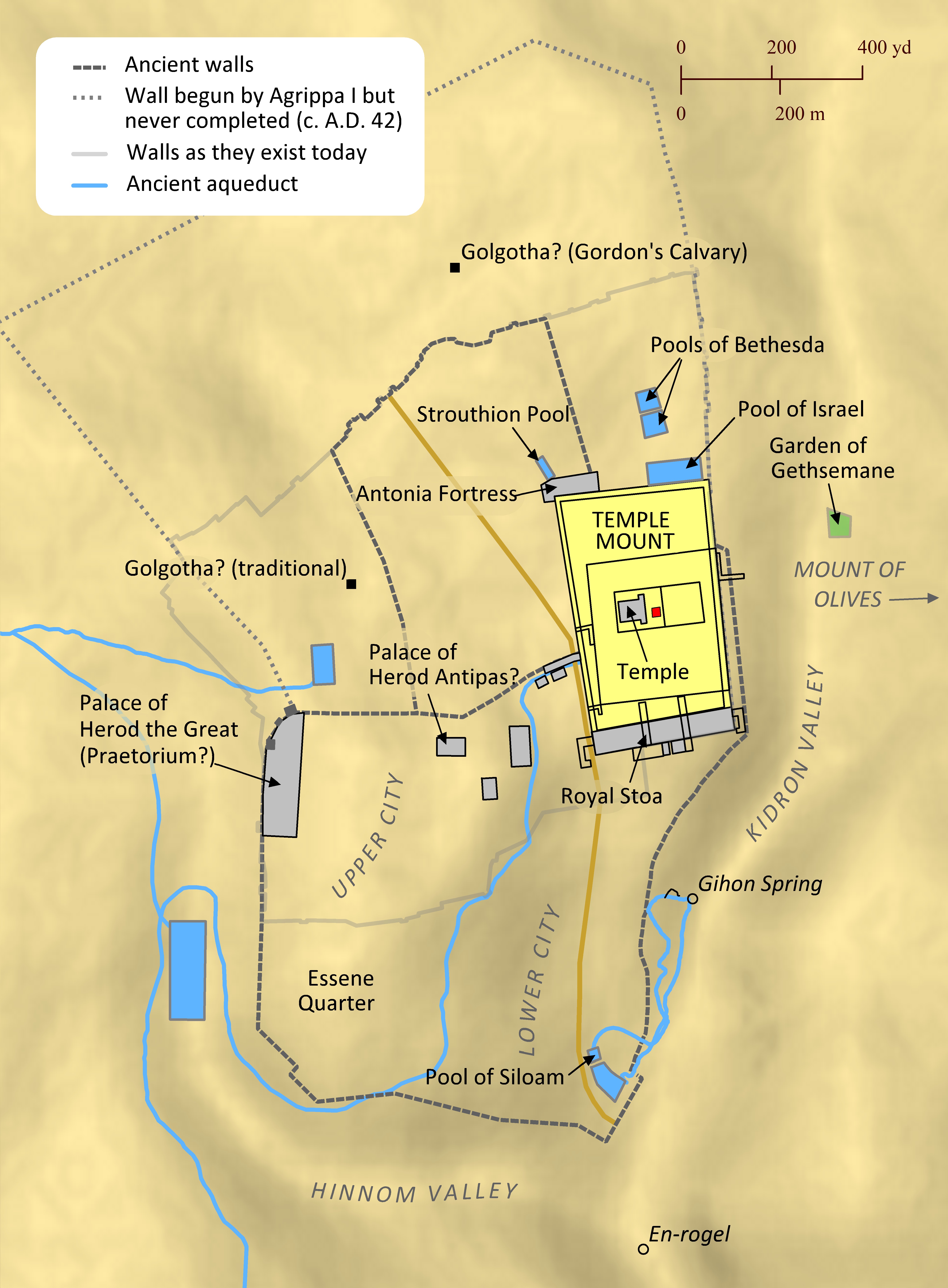
By the time of the New Testament, the ancient city of Jerusalem had been transformed from the relatively small fortress of David’s day (2 Samuel 5:6-10; 1 Chronicles 11:4-9) into a major city with a Temple that rivaled the greatest temples in the Roman world. Just prior to Jesus’ birth, Herod the Great completely renovated and expanded the Temple of the Lord, and he also built a lavish palace for himself, various pools (where Jesus occasionally performed healings), public buildings, and military citadels, including the Antonia Fortress, which overlooked the Temple. Wealthy residents, including the high priest, occupied extravagant houses in the Upper City, while the poorer residents were relegated to less desirable areas like the Lower City. The Essene Quarter was so named because many of its residents belonged to the Essenes, a strict religious sect that was known for its careful attention to the law of Moses. Across the Kidron Valley lay the Garden of Gethsemane, where Jesus often met with his disciples (Matthew 26:36-46; Mark 14:32-53; John 18:1-14). Further east was the Mount of Olives, where Jesus began his triumphal entry one week before his crucifixion (Matthew 21:1-11; Mark 11:1-11; Luke 19:28-40; John 12:12-19), taught his disciples about the last days (Matthew 24-25; Mark 13), and eventually ascended to heaven after his resurrection (Luke 24:50-53; Acts 1:1-11).
Open Bible Data site copyright © 2023–2026 Freely-Given.org.
Python source code for creating these static pages is available on GitHub under an open licence.
For Bible data copyrights, see the details for each displayed Bible version.
The Open English Translation (OET) main site is at OpenEnglishTranslation.Bible or OET.Bible.