
OET OET-RV OET-LV GHT ULT UST BSB MSB BLB AICNT OEB WEBBE WMBB NET LSV FBV TCNT T4T LEB BBE Moff JPS Wymth ASV DRA YLT Drby RV SLT Wbstr KJB-1769 KJB-1611 Bshps Gnva Cvdl TNT Wycl SR-GNT UHB BrLXX BrTr Related Parallel Simple Interlinear Topics Reference Dictionary Search
ParallelVerse GEN EXO LEV NUM DEU JOB JOS JDG RUTH 1 SAM 2 SAM PSA AMOS HOS 1 KI 2 KI 1 CHR 2 CHR PROV ECC SNG JOEL MIC ISA ZEP HAB JER LAM YNA (JNA) NAH OBA DAN EZE EZRA EST NEH HAG ZEC MAL LAO GES LES ESG DNG 2 PS TOB JDT WIS SIR BAR LJE PAZ SUS BEL MAN 1 MAC 2 MAC 3 MAC 4 MAC YHN (JHN) MARK MAT LUKE ACTs YAC (JAM) GAL 1 TH 2 TH 1 COR 2 COR ROM COL PHM EPH PHP 1 TIM TIT 1 PET 2 PET 2 TIM HEB YUD (JUD) 1 YHN (1 JHN) 2 YHN (2 JHN) 3 YHN (3 JHN) REV
Mark Intro C1 C2 C3 C4 C5 C6 C7 C8 C9 C10 C11 C12 C14 C15 C16
Mark 13 V1 V2 V3 V4 V5 V6 V7 V9 V10 V11 V12 V13 V14 V15 V16 V17 V18 V19 V20 V21 V22 V23 V24 V25 V26 V27 V28 V29 V30 V31 V32 V33 V34 V35 V36 V37
Note: This view shows ‘verses’ which are not necessarily natural language units and hence sometimes only part of a sentence will be visible—click on any Bible version abbreviation down the left-hand side to see the verse in more of its context. Normally the OET discourages the reading of individual ‘verses’, but this view is only designed as a tool for Bible-translators and others doing comparisons of different translations—the older translations are further down the page (so you can read up from the bottom to trace the English translation history). The OET segments on this page are still early looks into the drafted texts of the Open English Translation of the Bible—please double-check these texts in advance before using in public.
Text critical issues=small word differences Clarity of original=clear Importance to us=normal Speaker(s)=Yeshua,Narrator (All still tentative.)
OET (OET-RV) Countries will take up arms against other countries, and kingdoms against other kingdoms. There’ll be earthquakes in many places and there’ll be famines, but those will be just like the beginning of birth pains.
OET-LV For/Because nation will_be_being_raised against nation, and kingdom against kingdom.
There_will_be earthquakes in places, there_will_be famines, these are the_beginning of_birth_pains.
SR-GNT Ἐγερθήσεται γὰρ ἔθνος ἐπὶ ἔθνος, καὶ βασιλεία ἐπὶ βασιλείαν. Ἔσονται σεισμοὶ κατὰ τόπους, ἔσονται λιμοί· ἀρχὴ ὠδίνων ταῦτα. ‡
(Egerthaʸsetai gar ethnos epi ethnos, kai basileia epi basileian. Esontai seismoi kata topous, esontai limoi; arⱪaʸ ōdinōn tauta.)
Key: khaki:verbs, light-green:nominative/subject, orange:accusative/object, pink:genitive/possessor.
Note: Automatic aligning of the OET-RV to the LV is done by some temporary software, hence the RV alignments are incomplete (and may occasionally be wrong).
GHT for nation will-be-roused upon nation and kingdom upon kingdom and will-be shakes/quakes down/against places, and will-be famines and disturbances, origin of {travails/anguishes[e.g. childbirth]}, the-same.
ULT For nation will rise against nation, and kingdom against kingdom. There will be earthquakes in various places; there will be famines.[fn] These things, are the beginning of birth pains.
Instead of famines, some manuscripts read famines and troubles.
UST Further, groups of people will attack each other. Earthquakes will happen in many places. Many people will not have enough food to eat. Those events are like the first pains a pregnant woman feels when she is going to have a child. They are bad, but many more bad things will still happen after them.
BSB Nation will rise against nation, and kingdom against kingdom. There will be earthquakes in various places, [as well as] famines. These [are] [the] beginning of birth pains.
MSB Nation will rise against nation, and kingdom against kingdom. There will be earthquakes in various places, [as well as] famines and riots.[fn] These [are] [the] beginning of birth pains.
13:8 CT does not include and riots.
BLB For nation will rise up against nation, and kingdom against kingdom. There will be earthquakes in various places; there will be famines. These are the beginning of birth pains.
AICNT “[For][fn] Nation will rise against nation, and kingdom [against kingdom];[fn] [[and]][fn] there will be earthquakes in various places [[and]][fn] [[there will be]][fn] [famines][fn] [[and disturbances]].[fn] [These are but the beginning of birth pains.][fn]
13:8, For: Absent from W(032).
13:8, against kingdom: Absent from ℵ(01).
13:8, and: Included in A(02) Latin(a b ff2 i k) BYZ TR.
13:8, and: Included in A(02) BYZ TR.
13:8, there will be: Absent from ℵ(01) D(05) W(032) Latin(a b ff2 i k).
13:8, famines: Absent from ℵ(01).
13:8, and disturbances: Included in A(02) W(032) BYZ TR.
13:8, These are but the beginning of birth pains: Absent from W(032).
OEB For nation will rise against nation, and kingdom against kingdom; there will be earthquakes in various places; there will be famines. This will be but the beginning of the birth-pangs.
WEBBE & WMBB For nation will rise against nation, and kingdom against kingdom. There will be earthquakes in various places. There will be famines and troubles. These things are the beginning of birth pains.
NET For nation will rise up in arms against nation, and kingdom against kingdom. There will be earthquakes in various places, and there will be famines. These are but the beginning of birth pains.
LSV for nation will rise against nation, and kingdom against kingdom, and there will be earthquakes in various places, and there will be famines and troubles; these [are the] beginning of travails.
FBV Nation will fight against nation, and kingdom against kingdom. There will be earthquakes in various places, and famines too. These are the beginnings of the world's birth pains.
TCNT For nation will rise up against nation, and kingdom against kingdom. There will be earthquakes in various places, along with famines [fn]and riots. These are the [fn]beginnings of the labor pains.
T4T Groups who live in various countries will fight each other, and various governments will fight each other. There will also be big earthquakes in various places; and there will be famines. Yet, when these things happen, people will have only just begun to suffer. The first things that they suffer will be like the first pains a woman suffers who is about to bear a child. They will suffer much more after that.
LEB For nation will rise up against nation and kingdom against kingdom. There will be earthquakes in various places. There will be famines. These things are the beginning of birth pains.
BBE Nation will go to war with nation, and kingdom with kingdom: there will be earth-shocks in different places; there will be times when there is no food; these things are the first of the troubles.
Moff For nation will rise against nation, and realm against realm; there will be earthquakes here and there, and famines too. All that is but the beginning of the trouble.
Wymth For nation will rise in arms against nation, and kingdom against kingdom. There will be earthquakes in various places; there will be famines. These miseries are but like the early pains of childbirth.
ASV For nation shall rise against nation, and kingdom against kingdom; there shall be earthquakes in divers places; there shall be famines: these things are the beginning of travail.
DRA For nation shall rise against nation and kingdom against kingdom, and there shall be earthquakes in divers places, and famines. These things are the beginning of sorrows.
YLT for nation shall rise against nation, and kingdom against kingdom, and there shall be earthquakes in divers places, and there shall be famines and troubles; beginnings of sorrows [are] these.
Drby For nation shall rise up against nation, and kingdom against kingdom; and there shall be earthquakes in [different] places, and there shall be famines and troubles: these things [are the] beginnings of throes.
RV For nation shall rise against nation, and kingdom against kingdom: there shall be earthquakes in divers places; there shall be famines: these things are the beginning of travail.
(For nation shall rise against nation, and kingdom against kingdom: there shall be earthquakes in diverse/various places; there shall be famines: these things are the beginning of travail.)
SLT For nation shall be raised against nation, and kingdom against kingdom, and there shall be earthquakes in places, and there shall be famines, and commotions: these the beginnings of anguish.
Wbstr For nation will rise against nation, and kingdom against kingdom: and there will be earthquakes in divers places, and there will be famines, and troubles: these are the beginnings of sorrows.
KJB-1769 For nation shall rise against nation, and kingdom against kingdom: and there shall be earthquakes in divers places, and there shall be famines and troubles: these are the beginnings of sorrows.
( For nation shall rise against nation, and kingdom against kingdom: and there shall be earthquakes in diverse/various places, and there shall be famines and troubles: these are the beginnings of sorrows.)
KJB-1611 For nation shall rise against nation, and kingdome against kingdome: and there shalbe earthquakes in diuers places, and there shall be famines, and troubles: these are the beginnings of [fn]sorrowes.
(Modernised spelling is same as from KJB-1769 above, apart from punctuation and footnotes)
13:8 The word in the originall, importeth, the paines of a woman in trauaile.
Bshps For there shall nation aryse agaynst nation, and kyngdome agaynst kyngdome: And there shalbe earthquakes in diuers places, and famine shall there be, and troubles. These are the begynnyng of sorowes.
(For there shall nation arise against nation, and kingdom against kingdom: And there shall be earthquakes in diverse/various places, and famine shall there be, and troubles. These are the beginning of sorrows.)
Gnva For nation shall rise against nation, and kingdome against kingdome, and there shalbe earthquakes in diuers quarters, and there shalbe famine and troubles: these are the beginnings of sorowes.
(For nation shall rise against nation, and kingdom against kingdom, and there shall be earthquakes in diverse/various quarters, and there shall be famine and troubles: these are the beginnings of sorrows.)
Cvdl One people shal ryse ageynst another, and one realme ageynst another, and there shal be earth quakes here and there, and derth shal there be and troubles. These are the begynnynge of sorowes.
(One people shall rise against another, and one realm against another, and there shall be earth quakes here and there, and death shall there be and troubles. These are the beginning of sorrows.)
TNT For ther shall nacion aryse agaynste nacion and kyngdome agaynst kyngdome. And ther shalbe erth quakes in all quarters and famyshment and troubles. These are the begynnynge of sorowes.
(For there shall nation arise against nation and kingdom against kingdom. And there shall be earth quakes in all quarters and famishment and troubles. These are the beginning of sorrows.)
Wycl For folk schal rise on folk, and rewme on rewme, and erthe mouyngis and hungur schulen be bi placis; these thingis schulen be bigynnyngis of sorewis.
(For folk/people shall rise on folk/people, and realm on realm, and earth movements and hunger should be by places; these things should be beginnings of sorrows.)
Luth Es wird sich ein Volk über das andere empören und ein Königreich über das andere. Und es werden geschehen Erdbeben hin und wieder, und wird sein teure Zeit und Schrecken. Das ist der Not Anfang.
(It becomes itself/yourself/themselves a people above the other/different outrage/disgust and a kingdom above the other/different. And it become happen earthquake there/therefore and again, and becomes be expensive time/period and horror. The is the/of_the emergency beginning.)
ClVg Exsurget enim gens contra gentem, et regnum super regnum, et erunt terræmotus per loca, et fames. Initium dolorum hæc.[fn]
(It_will_rise because nation on_the_contrary nation, and kingdom over kingdom, and they_will_be earthquake through places, and hungers. The_beginning of_pain these_things.)
13.8 Exsurget enim. BEDA. Hæc omnia ante ultimos et acerbissimos dolores, etc., usque ad qui contra se invicem dimicantes, Ecclesiæ victoriam faciunt.
13.8 It_will_rise because. BEDA. These everything before the_last_(ones) and most_bitter pains, etc., until to who/which on_the_contrary himself each_other fighting, Assemblies/Churches victory they_do.
UGNT ἐγερθήσεται γὰρ ἔθνος ἐπ’ ἔθνος, καὶ βασιλεία ἐπὶ βασιλείαν. ἔσονται σεισμοὶ κατὰ τόπους, ἔσονται λιμοί; ἀρχὴ ὠδίνων ταῦτα.
(egerthaʸsetai gar ethnos ep’ ethnos, kai basileia epi basileian. esontai seismoi kata topous, esontai limoi; arⱪaʸ ōdinōn tauta.)
SBL-GNT ἐγερθήσεται γὰρ ἔθνος ἐπʼ ἔθνος καὶ βασιλεία ἐπὶ βασιλείαν, ⸀ἔσονται σεισμοὶ κατὰ τόπους, ⸁ἔσονται ⸀λιμοί· ⸀ἀρχὴ ὠδίνων ταῦτα.
(egerthaʸsetai gar ethnos epʼ ethnos kai basileia epi basileian, ⸀esontai seismoi kata topous, ⸁esontai ⸀limoi; ⸀arⱪaʸ ōdinōn tauta.)
RP-GNT Ἐγερθήσεται γὰρ ἔθνος ἐπὶ ἔθνος, καὶ βασιλεία ἐπὶ βασιλείαν· καὶ ἔσονται σεισμοὶ κατὰ τόπους, καὶ ἔσονται λιμοὶ καὶ ταραχαί· ἀρχαὶ ὠδίνων ταῦτα.
(Egerthaʸsetai gar ethnos epi ethnos, kai basileia epi basileian; kai esontai seismoi kata topous, kai esontai limoi kai taraⱪai; arⱪai ōdinōn tauta.)
TC-GNT ἐγερθήσεται γὰρ ἔθνος [fn]ἐπὶ ἔθνος καὶ βασιλεία ἐπὶ βασιλείαν, [fn]καὶ ἔσονται σεισμοὶ κατὰ τόπους, [fn]καὶ ἔσονται λιμοὶ [fn]καὶ ταραχαί· [fn]ἀρχαὶ ὠδίνων ταῦτα.
(egerthaʸsetai gar ethnos epi ethnos kai basileia epi basileian, kai esontai seismoi kata topous, kai esontai limoi kai taraⱪai; arⱪai ōdinōn tauta.)
13:8 επι ¦ επ ᴄᴛ
13:8 και ¦ — ᴄᴛ
13:8 και ¦ — ᴄᴛ
13:8 και ταραχαι 96% ¦ — ᴄᴛ 0.5%
13:8 αρχαι ¦ αρχη ᴄᴛ
Key for above GNTs: red:words differ (from our SR-GNT base).
In 11:27 Jesus entered the temple courts, and he and his disciples probably remained there through chapter 12. Then they left the temple (13:1), and one of the disciples exclaimed about how beautiful the temple was. Jesus told him that the Jews’ enemies would one day destroy the temple. The other disciples overheard this conversation. Some of them came to Jesus with some questions about what he had said. Jesus told them to be prepared for times of trouble in the future.
It is good to translate this section before you decide on a heading for it.
Here are some other possible headings for this section:
The Jerusalem temple would soon be destroyed
The destruction of the temple and the coming times of trouble
There are parallel passages for this section in Matthew 24:1–8 and Luke 21:5–11.
In this paragraph, Jesus warned his disciples that terrible events would occur sometime after he died and before he returned to earth. He told them to be careful not to let anyone deceive them, because false messiahs would come. There would also be wars, famines, and earthquakes.
Nation will rise against nation,
Countries will fight each other; (GNT)
People in one country will fight against people in another country,
People from one ethnic group are going to attack people from another ethnic group,
Nation will rise against nation: The Greek word that the BSB translates as Nation means “the people of one country.” In this context it is also possible to translate nation as “tribe” or “ethnic group.”
rise against: The expression rise against means “start to make war against” or “attack.”
Here are some other ways to translate this expression:
Countries will fight each other (GNT)
People from one tribe will attack people from another tribe.
and kingdom against kingdom.
kingdoms will attack one another. (GNT)
and the people from one kingdom/region will fight against the people of another kingdom/region.
and people who are under one ruler/chief will fight against people who are under another ruler/chief.
and kingdom against kingdom: The phrase and kingdom against kingdom implies the verb that the BSB translates as “will rise” in 13:8a. In many languages it is necessary to supply this verb or another verb with the same meaning here in 13:8b, as well. For example:
kingdoms will attack one another (GNT)
and the people of one kingdom will march against those of another
kingdom: A kingdom is the territory that a king rules. Here it refers to the people who live in the kingdom.
Here is another way to translate this phrase:
and people who are under one ruler/chief will fight against people who are under another ruler/chief
The statements in 13:8a and 13:8b are very similar. In some languages it may be natural to combine these statements. For example, the CEV says:
Nations and kingdoms will go to war against each other.
There will be earthquakes in various places,
The earth will shake violently in various places.
In many parts of the world earthquakes will happen,
There will be earthquakes in various places: The Greek word that the BSB translates as earthquakes refers to sudden and violent movements of the ground. When the ground shakes like this, it often destroys buildings. Jesus said that the earth would shake at different times and in different places. He implied that this would cause much damage and suffering.
Here are some other ways to translate this clause:
The earth will shake violently in various places.
In various places earthquakes will happen.
in various places: This phrase means “in different places” or “in many parts of the world.”
as well as famines.
There will also be famines.
and there will be long times when there is no food for people to eat.
as well as famines: The Greek word that the BSB translates as famines refers to prolonged periods when people do not have enough food to eat. They become very hungry and many die of hunger.
The word famines should be distinguished from annual periods when food is usually in short supply. It should also be distinguished from the daily experience of hunger which shows someone that it is time to eat again.
Here is another way to translate this:
…and some people will die of hunger.
These are the beginning of birth pains.
These sufferings are like the first pains of childbirth.
These events are like the first pains of a woman before she gives birth. They show that greater sufferings are coming.
These are the beginning of birth pains: The clause These are the beginning of birth pains is a metaphor. The word These refers to the terrible events that Jesus predicted in 13:6–8. They would be like the pains that a woman first feels when her child is about to be born. These pains increase until the moment when the child is born. In the same way, these terrible events would be a sign that there would be even more severe suffering in the future. See 13:14–22.
Here are some other ways to translate this clause:
These sufferings are like the first pains of childbirth.
These events are like the first pains of a woman before she gives birth. They show that greater suffering is coming.
Note 1 topic: grammar-connect-words-phrases
γὰρ
(Some words not found in SR-GNT: ἐγερθήσεται Γάρ ἔθνος ἐπί ἔθνος καί βασιλεία ἐπί βασιλείαν Ἔσονται σεισμοί κατά τόπους ἔσονται λιμοί ἀρχή ὠδίνων ταῦτα)
Here, the word For introduces a further explanation of what is going to happen. If it would be helpful in your language, you could use a word or phrase that introduces a further explanation, or you could leave For untranslated. Alternate translation: [Even more,]
Note 2 topic: figures-of-speech / parallelism
ἐγερθήσεται & ἔθνος ἐπ’ ἔθνος, καὶ βασιλεία ἐπὶ βασιλείαν
˓will_be_being˒_raised & nation (Some words not found in SR-GNT: ἐγερθήσεται Γάρ ἔθνος ἐπί ἔθνος καί βασιλεία ἐπί βασιλείαν Ἔσονται σεισμοί κατά τόπους ἔσονται λιμοί ἀρχή ὠδίνων ταῦτα)
These two phrases mean basically the same thing. The second emphasizes the meaning of the first by repeating the same idea with different words. If it would be helpful to your readers, you could connect the phrases with a word other than and in order to show that the second phrase is repeating the first one, not saying something additional. Alternatively, you could combine the two phrases. Alternate translation: [nation will rise against nation, yes, kingdom against kingdom] or [nation and kingdom rise against nation and kingdom]
Note 3 topic: figures-of-speech / genericnoun
ἐγερθήσεται & ἔθνος ἐπ’ ἔθνος, καὶ βασιλεία ἐπὶ βασιλείαν
˓will_be_being˒_raised & nation (Some words not found in SR-GNT: ἐγερθήσεται Γάρ ἔθνος ἐπί ἔθνος καί βασιλεία ἐπί βασιλείαν Ἔσονται σεισμοί κατά τόπους ἔσονται λιμοί ἀρχή ὠδίνων ταῦτα)
The words nation and kingdom represents nations and kingdoms in general, not one particular kingdom and nation. If it would be helpful in your language, you could express the idea in another way. Alternate translation: [some nations will rise against other nations, and some kingdoms against other kingdoms]
Note 4 topic: figures-of-speech / metonymy
ἐγερθήσεται & ἔθνος ἐπ’ ἔθνος, καὶ βασιλεία ἐπὶ βασιλείαν
˓will_be_being˒_raised & nation (Some words not found in SR-GNT: ἐγερθήσεται Γάρ ἔθνος ἐπί ἔθνος καί βασιλεία ἐπί βασιλείαν Ἔσονται σεισμοί κατά τόπους ἔσονται λιμοί ἀρχή ὠδίνων ταῦτα)
Here, the words nation and kingdom represent the people who live in them. If it would be helpful to your readers, you could state the meaning plainly. Alternate translation: [the people of a nation will rise up against the people of another nation, and the people of a kingdom against the people of another kingdom]
Note 5 topic: figures-of-speech / idiom
ἐγερθήσεται & ἐπ’
˓will_be_being˒_raised & (Some words not found in SR-GNT: ἐγερθήσεται Γάρ ἔθνος ἐπί ἔθνος καί βασιλεία ἐπί βασιλείαν Ἔσονται σεισμοί κατά τόπους ἔσονται λιμοί ἀρχή ὠδίνων ταῦτα)
The phrase rise against referring to attacking someone or something. If it would be helpful in your language, you could use an equivalent phrase or state the meaning plainly. Alternate translation: [will fight against]
Note 6 topic: figures-of-speech / ellipsis
βασιλεία ἐπὶ βασιλείαν
kingdom (Some words not found in SR-GNT: ἐγερθήσεται Γάρ ἔθνος ἐπί ἔθνος καί βασιλεία ἐπί βασιλείαν Ἔσονται σεισμοί κατά τόπους ἔσονται λιμοί ἀρχή ὠδίνων ταῦτα)
Jesus is leaving out some of the words that in many languages a sentence would need in order to be complete. You can supply these words from earlier in the sentence if it would be clearer in your language. Alternate translation: [kingdom will rise against kingdom]
Note 7 topic: translate-textvariants
λιμοί
famines
Many ancient manuscripts read famines. The ULT follows that reading. Other ancient manuscripts read “famines and troubles.” If a translation of the Bible exists in your region, you may wish to use the reading that it uses. If a translation of the Bible does not exist in your region, you may wish to use the reading of the ULT.
Note 8 topic: figures-of-speech / explicit
ταῦτα
these_‹are›
Here, These things refers to the things that Jesus has said will happen. If it would be helpful in your language, you could make that idea more explicit. Alternate translation: [The things that I have just described are]
Note 9 topic: figures-of-speech / metaphor
ἀρχὴ ὠδίνων
(Some words not found in SR-GNT: ἐγερθήσεται Γάρ ἔθνος ἐπί ἔθνος καί βασιλεία ἐπί βασιλείαν Ἔσονται σεισμοί κατά τόπους ἔσονται λιμοί ἀρχή ὠδίνων ταῦτα)
Here Jesus speaks of the events that he has described as if they were the beginning of birth pains. He means that, just like birth pains, they are difficult and painful things that eventually lead to a happy and wonderful result. If possible, you should maintain the figure of speech or express the idea in simile form. Alternate translation: [like the beginning of birth pains]
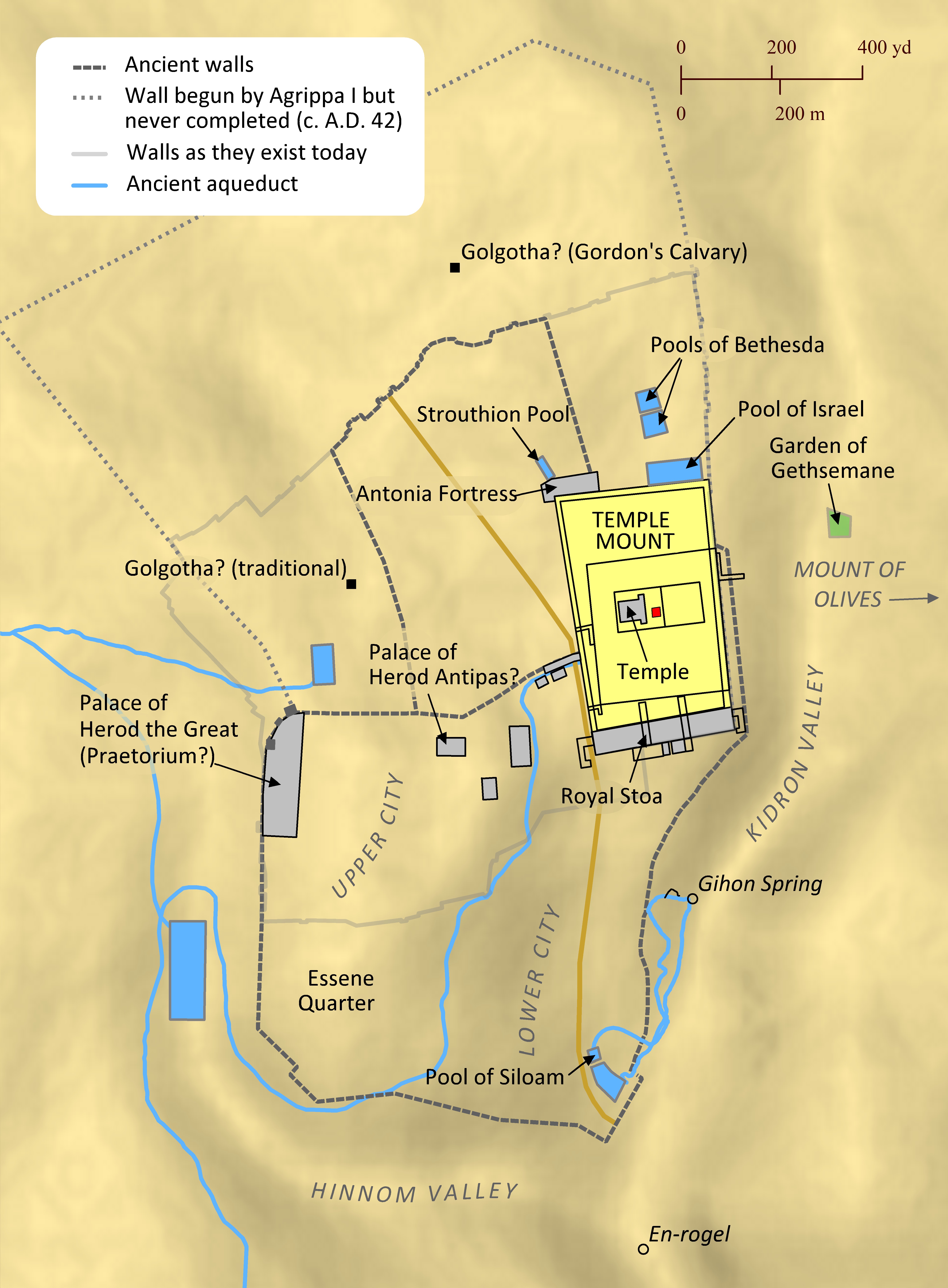
By the time of the New Testament, the ancient city of Jerusalem had been transformed from the relatively small fortress of David’s day (2 Samuel 5:6-10; 1 Chronicles 11:4-9) into a major city with a Temple that rivaled the greatest temples in the Roman world. Just prior to Jesus’ birth, Herod the Great completely renovated and expanded the Temple of the Lord, and he also built a lavish palace for himself, various pools (where Jesus occasionally performed healings), public buildings, and military citadels, including the Antonia Fortress, which overlooked the Temple. Wealthy residents, including the high priest, occupied extravagant houses in the Upper City, while the poorer residents were relegated to less desirable areas like the Lower City. The Essene Quarter was so named because many of its residents belonged to the Essenes, a strict religious sect that was known for its careful attention to the law of Moses. Across the Kidron Valley lay the Garden of Gethsemane, where Jesus often met with his disciples (Matthew 26:36-46; Mark 14:32-53; John 18:1-14). Further east was the Mount of Olives, where Jesus began his triumphal entry one week before his crucifixion (Matthew 21:1-11; Mark 11:1-11; Luke 19:28-40; John 12:12-19), taught his disciples about the last days (Matthew 24-25; Mark 13), and eventually ascended to heaven after his resurrection (Luke 24:50-53; Acts 1:1-11).
Open Bible Data site copyright © 2023–2026 Freely-Given.org.
Python source code for creating these static pages is available on GitHub under an open licence.
For Bible data copyrights, see the details for each displayed Bible version.
The Open English Translation (OET) main site is at OpenEnglishTranslation.Bible or OET.Bible.