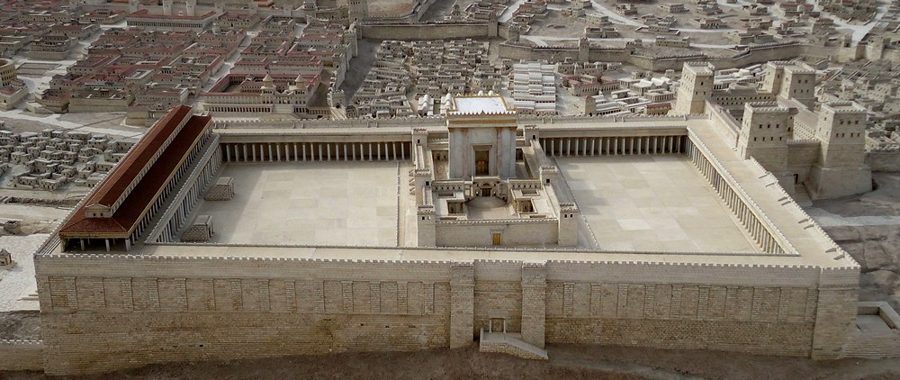
A model of the temple mount in Herodes’s time (© Ray Pritz by United Bible Societies)
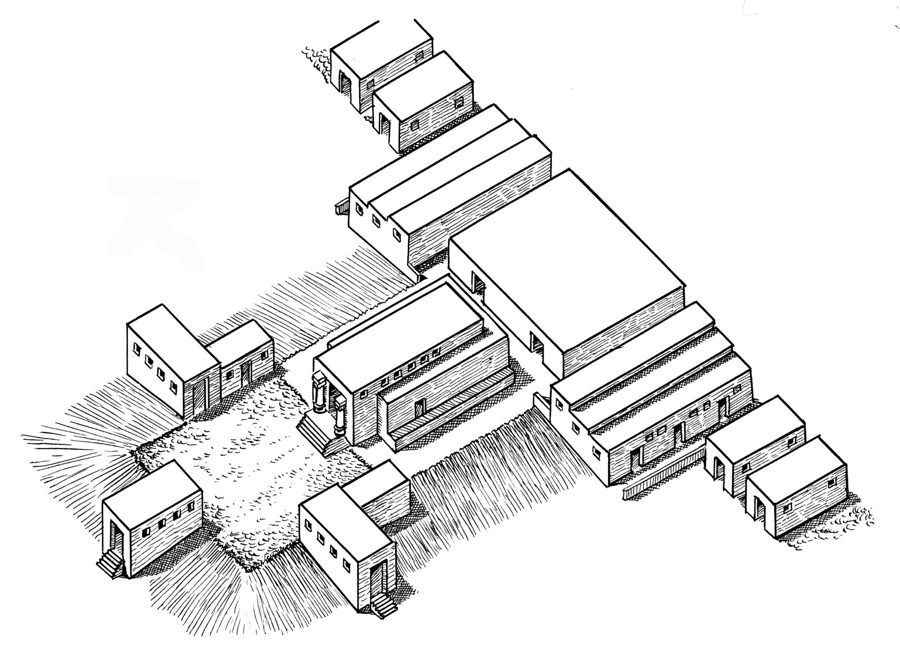
An artist's conception of Yehezkel’s (Ezekiel’s) Temple (© Deutsche Bibelgesellschaft, Stuttgart by United Bible Societies)
- 3.14.1.1 Entrance room, entrance hall
- 3.14.1.2 Colonnade, porch, covered walkway, stoa, portico
- 3.14.1.3 Rooms for boiling meat from sacrifices, kitchens
- 3.14.1.4 Treasury, strongroom
- 3.14.1.5 Pinnacle
- 3.14.1.6 Curtain, veil, drape
- 3.14.1.7 Additional Temple features
- 3.14.1.8 Other features of the Temple treated elsewhere in this chapter
References
- Hebrew בַּיִת bayith: 2 SAM 7:5, 2 SAM 7:6, 2 SAM 7:7, 1 KI 3:1, 1 KI 3:2, 1 KI 5:3, 1 KI 5:5, 1 KI 5:17
1 more references
1 KI 5:18 - Hebrew הֵיכָל heykal: 2 SAM 22:7, 1 KI 6:3, 1 KI 6:5, 1 KI 7:21, 2 KI 18:16, 2 KI 23:4, 2 KI 24:13, 2 CHR 3:17
- Aramaic הֵיכַל heykal: EZRA 5:14, EZRA 5:15, EZRA 6:5, DAN 5:2, DAN 5:3
- Hebrew מוֹעֵד mo‘ed: PSA 74:4, LAM 2:6
- Hebrew מִקְדָּשׁ miqdash: 1 CHR 22:19, 1 CHR 28:10, 2 CHR 20:8, 2 CHR 26:18, 2 CHR 29:21, 2 CHR 30:8, 2 CHR 36:17, NEH 10:39
39 more references
PSA 68:35, PSA 73:17, PSA 74:7, PSA 78:69, PSA 96:6, ISA 60:13, ISA 63:18, YIR 17:12, YIR 51:51, LAM 1:10, LAM 2:7, LAM 2:20, EZEK 5:11, EZEK 8:6, EZEK 9:6, EZEK 23:38, EZEK 23:39, EZEK 24:21, EZEK 25:3, EZEK 37:26, EZEK 37:28, EZEK 43:21, EZEK 44:1, EZEK 44:5, EZEK 44:7, EZEK 44:8, EZEK 44:9, EZEK 44:11, EZEK 44:15, EZEK 44:16, EZEK 45:4, EZEK 45:18, EZEK 47:12, EZEK 48:8, EZEK 48:10, EZEK 48:21, DAN 8:11, DAN 9:17, DAN 11:31 - Hebrew קָדוֹשׁ qadosh: ECC 8:10
- Hebrew קֹדֶשׁ qodesh: 1 CHR 23:32, 1 CHR 24:5, 2 CHR 29:5, 2 CHR 29:7, 2 CHR 30:19, PSA 20:2, PSA 24:3, PSA 63:2
- Hebrew שֹׂךְ sok: LAM 2:6
- Greek ἅγιος hagios: JDT 4:12, JDT 4:13, JDT 8:21, JDT 8:24, JDT 9:8, JDT 16:20, 1 MAC 2:12, 1 MAC 3:43
25 more references
1 MAC 3:51, 1 MAC 3:58, 1 MAC 3:59, 1 MAC 4:36, 1 MAC 4:41, 1 MAC 4:43, 1 MAC 4:48, 1 MAC 6:18, 1 MAC 6:54, 1 MAC 7:33, 1 MAC 7:42, 1 MAC 9:54, 1 MAC 10:42, 1 MAC 10:39, 1 MAC 10:44, 1 MAC 13:3, 1 MAC 13:6, 1 MAC 14:15, 1 MAC 14:29, 1 MAC 14:31, 1 MAC 14:36, 1 MAC 14:42, 1 MAC 14:48, 1 MAC 15:7, 2 MAC 15:17 - Greek ἁγίασμα hagiasma: JDT 5:19, SIR 47:10, SIR 47:13, SIR 50:11, 1 MAC 1:21, 1 MAC 1:36, 1 MAC 1:37, 1 MAC 1:39
9 more references
1 MAC 1:45, 1 MAC 1:46, 1 MAC 2:7, 1 MAC 3:45, 1 MAC 4:38, 1 MAC 5:1, 1 MAC 6:7, 1 MAC 6:26, 1 MAC 6:51 - Greek ἁγιασμός hagiasmos: 3 MAC 2:18
- Greek ἱερός hieros: MAT 4:5, MAT 12:5, MAT 12:6, MAT 21:12, MAT 21:14, MAT 21:15, MAT 21:23, MAT 24:1
59 more references
MAT 26:55, MARK 11:11, MARK 11:15, MARK 11:16, MARK 11:27, MARK 12:35, MARK 13:1, MARK 13:3, MARK 14:49, LUKE 2:27, LUKE 2:37, LUKE 2:46, LUKE 4:9, LUKE 18:10, LUKE 19:45, LUKE 19:47, LUKE 20:1, LUKE 21:5, LUKE 21:37, LUKE 21:38, LUKE 22:52, LUKE 22:53, LUKE 24:53, YHN 2:14, YHN 2:15, YHN 5:14, YHN 7:14, YHN 7:28, YHN 8:2, YHN 8:20, YHN 8:59, YHN 10:23, YHN 11:56, YHN 18:20, ACTs 2:46, ACTs 3:1, ACTs 3:2, ACTs 3:3, ACTs 3:8, ACTs 3:10, ACTs 4:1, ACTs 5:20, ACTs 5:21, ACTs 5:24, ACTs 5:25, ACTs 5:42, ACTs 19:27, ACTs 21:26, ACTs 21:27, ACTs 21:28, ACTs 21:29, ACTs 21:30, ACTs 22:17, ACTs 24:6, ACTs 24:12, ACTs 24:18, ACTs 25:8, ACTs 26:21, 1 COR 9:13 - Greek ναός naos: MAT 23:16, MAT 23:17, MAT 23:21, MAT 23:35, MAT 26:61, MAT 27:5, MAT 27:40, MAT 27:51
25 more references
MARK 14:58, MARK 15:29, MARK 15:38, LUKE 1:9, LUKE 1:21, LUKE 1:22, LUKE 23:45, YHN 2:19, YHN 2:20, 1 COR 3:17, 2 COR 6:16, EPH 2:21, 2 TH 2:4, REV 3:12, REV 7:15, REV 11:1, REV 11:2, REV 11:19, REV 14:15, REV 14:17, REV 15:5, REV 15:6, REV 15:8, REV 16:1, REV 16:17 - Greek νεώς neōs: 2 MAC 4:14, 2 MAC 6:2, 2 MAC 9:16, 2 MAC 10:3, 2 MAC 10:5, 2 MAC 13:23, 2 MAC 14:33
- Greek οἰκία, οἶκος oikia, oikos: MAT 12:4, MAT 21:13, MARK 2:26, MARK 11:17, LUKE 6:4, LUKE 11:51, LUKE 19:46, YHN 2:16
- Greek σκήνωμα skēnōma: JDT 9:8
- Greek τόπος, ἅγιος, ἁγίασμα topos, hagios topos, topos hagios, topos tou hagiasmatos: MAT 24:15, YHN 11:48, ACTs 6:13, ACTs 21:28, 2 MAC 2:18, 2 MAC 3:18, 2 MAC 5:17, 2 MAC 5:19
9 more references
2 MAC 8:17, 2 MAC 10:7, 2 MAC 13:23, 3 MAC 1:9, 3 MAC 1:23, 3 MAC 2:14, 4 MAC 4:9, 4 MAC 4:12, G ESD 8:75 - Latin sanctificatio: L ESD 7:108, L ESD 10:21, L ESD 12:48, L ESD 15:25
- Latin templum: L ESD 10:21
Description and usage
The Temple was the building in Yerushalem (Jerusalem) in which God was regarded as dwelling and where he was worshiped. From the time it was first built by Shelomoh (Solomon), it was the center of worship for the Jewish people. In Jewish history three temples were constructed, all of them quite different from the others. The first Temple, built by Shelomoh, was destroyed in 587/586 B.C. A new, more modest Temple was built about seventy years later by Zerubavel (Zerubbabel) and lasted until almost the time of the New Testament, when it was rebuilt by Herodes (Herod) the Great. This third structure was only completed about 63 A.D. and was destroyed by the Roman army seven years later.
———
Translation
There are, in fact, four different Jewish temples in the Bible: those built by Shelomoh, Zerubavel, and Herodes the Great, and the vision of an ideal Temple in the last chapters of Yehezkel (Ezekiel). While the same word should be used for all of them, it will be helpful for the reader to have a note or glossary entry explaining the differences between them. It will not normally be necessary—or even advisable—to reflect those differences in translation.
“Temple” may be rendered “house of God,” “place where God dwells,” or “God’s building.” Some languages often say “holy house” or “holy place.” Other renderings are “God’s great singing house” and “God’s big prayer house.”
The Hebrew word mo‘ed means literally an appointed time or place of meeting. In the references given above it refers to the Temple as the place where people came for the sacred festivals.
In some languages there is a technical term for “temple,” and this is often carefully distinguished from an expression designating a central sanctuary in which the deity is thought to dwell. In the New Testament the Greek word naos refers to a single building, while the word hieron points to the entire Temple precinct with its buildings, courts, and storerooms. Even though in a number of contexts it is not necessary to distinguish between hieron and naos, in MAT 21:12 (and the parallel passages MARK 11:15, LUKE 19:45, YHN 2:14), it is important to indicate this distinction in order not to leave the impression that sacrificial animals were actually being sold inside the central sanctuary. When translating “temple,” translators should avoid using the same term used to translate “synagogue” in the New Testament.
 Open English Translation (OET)